0 ITEMS

8 Use of Funds Examples for Startups
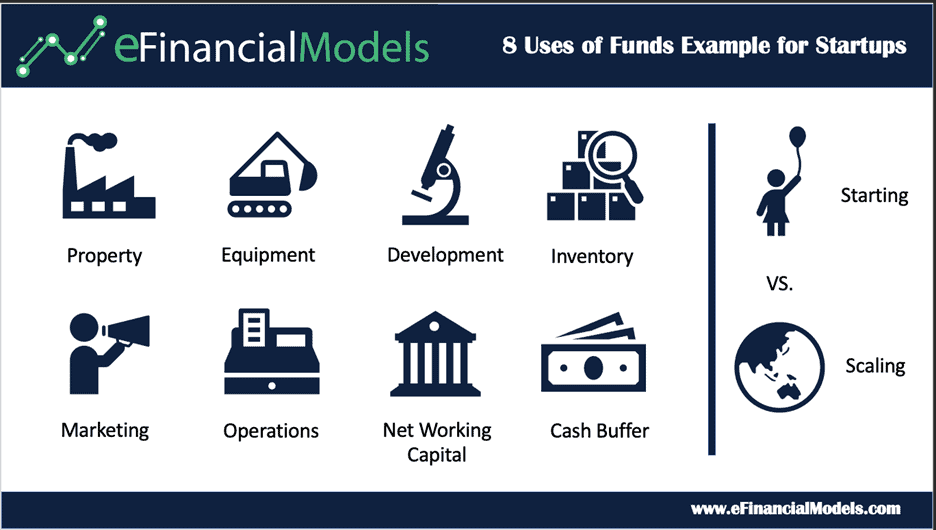
One important topic to think about when trying to figure out how to get funding for a startup is how a startup is going to use the funds.
Raising equity capital is expensive as investors will ask for a company’s share when raising funds for a startup. Therefore, startups should only raise funding if needed, and there is no other way to get started.
Furthermore, investors in a startup usually do not like to see overfunded startups. They prefer when the funds are invested on an “as needed “basis to reduce their risk exposure. During the funding round, the uses of funds can be brought up and lead to discussions.
Therefore, this article will review the eight main areas with a list of use of funds examples where a startup needs funding.
Property – Land and Buildings
One area where startups may require funding is to buy property, lands, or buildings. Funding to purchase properties will only be required when a property is essential to the success of a startup, and the property cannot be rented and needs to be purchased.
Typical startup businesses that require funding to purchase properties are found in Real Estate, Parking Operators, Hotels, Hospitals, Manufacturing Sites, and similar use of funds examples for startups that require custom adaptations.
The alternative to buying a property would be renting. Renting a property that usually reduces the funding need significantly. The main problem with renting is its limitations as a tenant has to adhere to the house rules of the landlord. Furthermore, the lease will expire one day, or the landlord might wish to build a different building on the property or use it for his purposes. Especially for a startup, these limitations can pose significant obstacles, especially when complicated manufacturing processes are involved.
Apart from these reasons, many entrepreneurs might prefer owning their real estate to not depend on landlords. Another option worth considering might also be to enter a rental contract with a purchase option at a later point in time.
Startups will buy real estate if the property is an essential core asset over which control is required. Buying real estate is expensive and can significantly increase the use of funds for a startup. Buying Real Estate also increases the risk for investors, as more money will be at stake. If a startup fails and has made many custom adjustments to a property, it might be challenging to transform a building back to everyday use.
There are different ways to mitigate risks:
- Building a property in a way that allows for multi-purpose use (in case something goes wrong)
- Secure an off-take agreement (e.g., a solar park project that negotiates the off-take of the produced electricity at a specified price from an electricity distributor).
Purchasing a property can be a must-have or nice-to-have, depending on the business and industry a startup operates. Purchasing property can be expensive and increase the funding amount significantly. In many cases, leasing might be a more attractive option and lowers the required funding amount, enhancing investor returns. So, startup businesses might think twice about whether to ask for funding to purchase real estate or not.
Equipment
Businesses in the manufacturing industry will usually require machinery and equipment to start their operations. For a beverage manufacturing startup business, tanks, storage, bottling, and laboratory equipment will need to be purchased. A photovoltaic solar energy project will require to purchase of solar panels. Businesses in agriculture typically require the purchase of vehicles, irrigation, and harvesting equipment.
Starting as an Automotive supplier which produces small plastic parts for passenger cars might require the purchase of injection molding machines. Starting a supermarket will require the purchase of shelves and storage equipment. Starting a Bitcoin mining operation will require the purchase of special IT hardware to mine the cryptocurrency efficiently.
Purchasing equipment to start a business is quite common, and there are many more examples of businesses that will require the purchase of equipment to start operations.
Development
Many startups will need to develop a new product before even launching. Examples of startups requiring significant development costs before they can start operations:
- Pharma/Biotech company which develops a new drug or vaccine
- Automotive supplier producing plastic or metal car parts
- Software as a Service (SaaS) company which needs to develop a complex web platform before it can start operations
- Mobile Apps that require the development of an iOS or Android version
Development costs can quickly mount up to a significant cost position that needs financing before being launched. Mounting up a significant cost position means the costs will need to be managed to minimize the initial capital outlay. Modern startups will be working towards a product prototype that is a minimal viable product (MVP) following the lean startup methodology.
Developing a new product is risky. It can be a hit or a miss, and in the worst case leading to a total loss of the invested capital. Therefore, a careful analysis will be needed to justify developments costs in the use of funds table presented by a startup. Funds for developing a new product and costs should only be spent when pre-agreed milestones are achieved to mitigate the risk.
Inventory
Many supermarkets and grocery stores, gasoline stations, retail stores, trading businesses will require significant inventory to start their operations. Those types of companies can only sell products available in their inventories. Building up inventory requires capital investment and can add up to a significant funding amount in funds calculation for a startup.
The business model will define how much inventory will be required. Foreseeable inventory levels are typically forecasted by estimating the number of days the business will hold a product’s goods in inventory. The more efficient a company operates, the less inventory is required. Companies operating with less efficiency will require more inventory concerning their sales. Startups that need to build up inventory will have to estimate how many days of inventory are required for the first months. Please note, some businesses require zero inventory, such as online businesses, digital product marketplaces.
Marketing
A startup with little to no customers will first need to acquire customers. For Startups selling a large ticket item to business clients, where just one customer can generate large incomes, marketing costs might not apply if word-of-mouth referrals can generate customers. A different situation is a startup selling small-ticket items to end consumers. Attracting new customers will typically require spending some effort on marketing.
Marketing can be very costly, depending on which activities need to be performed. There is a range of marketing tactics available to a Startup, and each tactic will require either time or money to be invested. Below, standard marketing techniques are listed and whose cost consequences need to be considered when calculating the funding required for a startup:
- Paid ads – such as, e.g., an online advertisement with Google Adword, Facebook Ads, Youtube Ads but also offline marketing campaigns by showing ads on Billboard or in traditional newspapers
- Direct Marketing – Marketing initiatives such as cold calling or email outreach reach out to potentially interested customers. Direct marketing initiatives require contracting a specialized call center or hiring a dedicated marketing and sales team.
- Trade fairs and Roadshows – Attending trade fairs and roadshows can offer opportunities to easier meet interested customers in an industry. They offer networking opportunities and identify leads potentially interested customers. Participating in trade fairs comes at a cost and will also require the purchase of marketing materials.
- Conferences – Attending conferences as participants or speakers allows exposure and can help to raise brand awareness.
- Creation of Marketing Materials –Brochures, whitepapers, and other documentation will need to be written to explain how a product or service works. The marketing materials are especially relevant to Startups introducing new products that require even more explanation and education of customers.
- Public Relations (PR) – PR work includes writing and distributing press releases and establishing relations with interested journalists. Costs will result in the form of time and expenses spent.
- Article writing – The writing and publishing of articles, whitepapers, and online content are essential. and other promotions
- Search Engine Optimization – Search engine optimization is also a widely used marketing technique in online marketing. However, this is usually a long-term play and requires steady work until businesses obtain the first results. The major plus is that the customer acquisition costs can be pretty low.
- Social Media Marketing – Today, marketing via social media channels can become a must for a Startup. There are plenty of social media channels to choose from, and the only limitation is that preparing content and participating will require time. A dedicated team will need to be hired or use an outside agency.
- Email Marketing – This would be setting up a regular newsletter subscription list and email automation.
All these activities are time-consuming and can be pretty costly. Nevertheless, it’s a must and a prerequisite to attracting clients. Marketing is an important activity for most Startups to get the word out. In many cases, significant effort and funding will need to be reserved at the product launch and ongoing. Marketing budgets need to be added when calculating the funding needs of startups.
Operations
It is pretty common to see operational losses during the early phases of a startup business. At a startup, normally, expenses exceed the revenues, and it can take a while until the business can reach break-even. If a Startup plans to generate losses for a specified period, the funding raised will also need to cover those. Here is a list of operational costs which may require funding in the early months/years of a Startup.
- Rent (wherever office or property is rented)
- Utilities
- General and Administrative Costs
- Fuel and Supplies
- Travel expenses
- Employee expenses for direct and indirect labor
- Packaging and Shipping expenses
- Training costs for new employees
- Repairs and Maintenance
- Compliance and Regulatory Costs
- Licenses and Fees
- Other operating costs
Operating costs like these can quickly add up, especially when going on many months without getting to break even. Therefore, startups will need careful budgeting to manage the required funding amount.
Net Working Capital
Net Working Capital (NWC) is the capital needed to operate by paying its suppliers and collecting receivables from customers and partners. Net Working Capital typically consists of Inventory plus Receivables less Payables but may also include other current assets such as rent or customer deposits. Depending on the business model, a smaller or larger Net Working Capital position might be required.
It is essential to keep an eye on the overall net working capital required to operate a business. While we have already looked at inventory, it is essential also to forecast how long a business has to wait until its receivables are paid and how fast suppliers will need to be paid. Forecasting can influence and add to the required funding to startup operations. Net Working Capital is also an item that is often forgotten in a uses of funds table for a startup. Proper planning will help here to avoid any unpleasant surprises later on.
Cash Buffer
Another item we might want to think about when calculating the required funding amount for a Startup is simply a cash buffer. A cash buffer acts as a reserve for unforeseen events. Remember, Startups are inherently risky, and many things can go wrong. Startups might think about what can go wrong in the worst place. Any delay or obstacle can easily lead to months of operating losses and put the business in a dire situation. A cash buffer offers flexibility and the option to adjust to the events.
Starting vs. Scaling of a Startup Business
Above, we have listed why and how Startups use require funding. Now the term “Startup” does not necessarily refer to a freshly founded company but, in practice, is used to young companies which are in the process of establishing themselves in the market, which can last for years. We, therefore, can differentiate another dimension of why startups require funding.
- Starting
- Scaling
While starting a business refers to starting from a Greenfield, scaling a business refers to scaling a skeleton business from the proof of concept to a larger scale where funding can stabilize a business. Scaling requires validating an initial proof of concept to assure that the business model will work. Starting a business from scratch naturally comes with a lot more risks.
Conclusion: Startups need to specify the intended Use of Funds properly
This article covered some Use of Funds examples to illustrate how funds raised from investors might be used for a Startup. When calculating the uses of funds, it is essential to thoroughly identify all relevant cost and cash flow positions to start the business to avoid negative surprises later on. These positions may include property, equipment, inventory, development, marketing, operations, net working capital, and cash buffer. While startups might require initial funding to start a business, additional funding might be needed to scale.