
0 ITEMS

Solar Project Finance Model (Excel Financial Model) | DSCR Sculpting · LLCR/PLCR · DSRA · Covenant Testing · LP/GP Waterfall · P90 Yield
22-tab lender-grade solar project finance model: DSCR-sculpted debt with a gearing cap, LLCR/PLCR, construction IDC, funded DSRA, covenant lock-up and default testing, LP/GP waterfall, P50-P99 yield, real and nominal LCOE. No circular references.

Most solar models tell you the deal works. This one tells you when it breaks — the
exact period the DSCR dips toward the covenant, whether the lock-up traps your
distributions, and how much reserve it takes to hold the line.
Of the 53 solar-titled models on this platform, not one names DSCR sculpting,
LLCR, PLCR, DSRA, P90 or LCOE in its title (measured on the live catalogue,
2026-08-02; counting rule: title text only). Those are the six things a credit
committee actually asks about. This model is built around them.
The Solar Project Finance Model is a self-contained, single-asset project finance
model for lenders’ credit teams, investment committees, developers and
infrastructure funds underwriting a contracted utility-scale solar project. Enter
the plant, the offtake, the financing terms and the tax profile, and the model
sizes the senior debt by sculpting it to a target DSCR, caps it at your maximum
gearing, builds the full generation-to-equity-cash-flow waterfall, and reports the
coverage, returns and covenant outcomes a credit committee asks for.
The differentiator is verifiability, not feature count. Most models in this
category ask you to trust the number. Every headline figure in this one is
recomputed two independent ways — every formula re-derived in an independent
engine, and each headline rebuilt from raw inputs in a separate model that shares
no formulas with the workbook — and the release passes a five-stage verification
chain before it ships.
**THE PROBLEM**
A solar deal lives or dies on the debt number, and the debt number depends on a
chain most templates skip: sculpt the debt to a target DSCR, cap it at maximum
gearing, fund construction interest without creating a circular reference, hold a
reserve, then test the covenant every period. Get one link wrong and the model
still balances — it is just wrong in the sponsor’s favour. And the whole equity
margin can sit inside a resource assumption that never gets stress-tested.
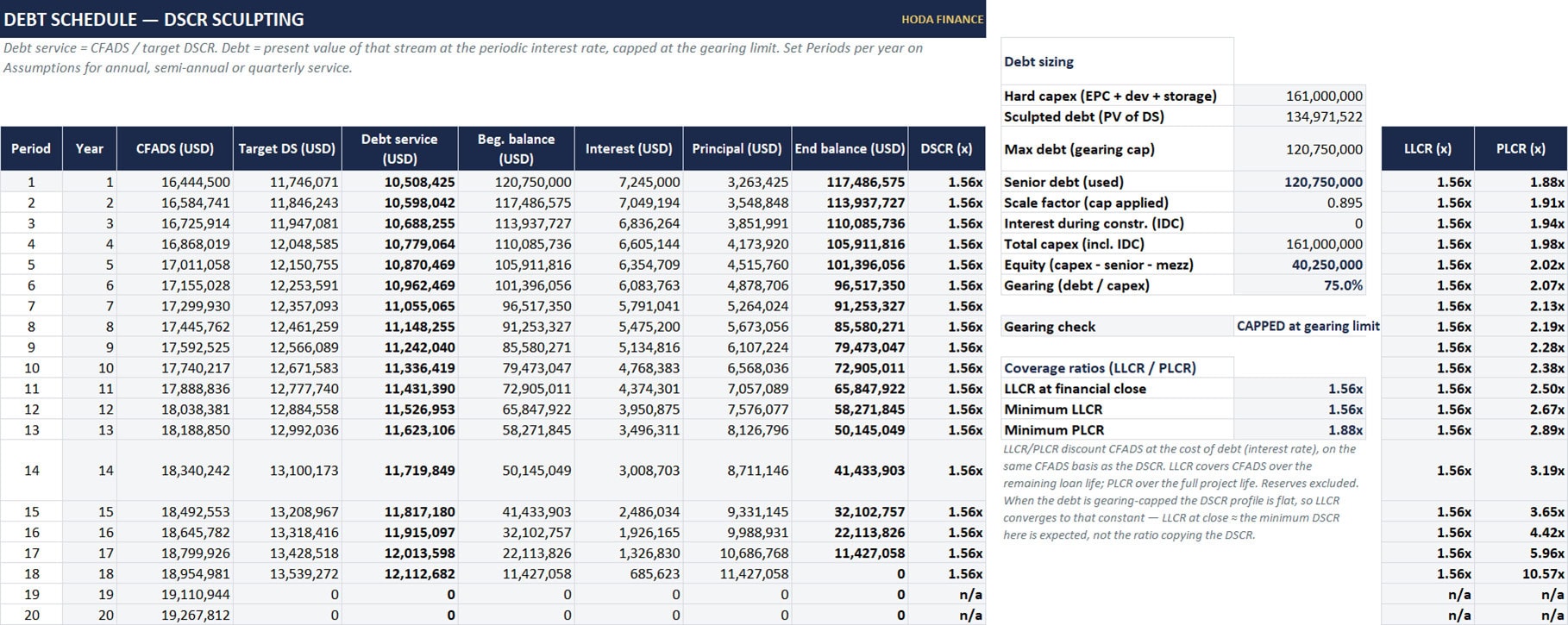
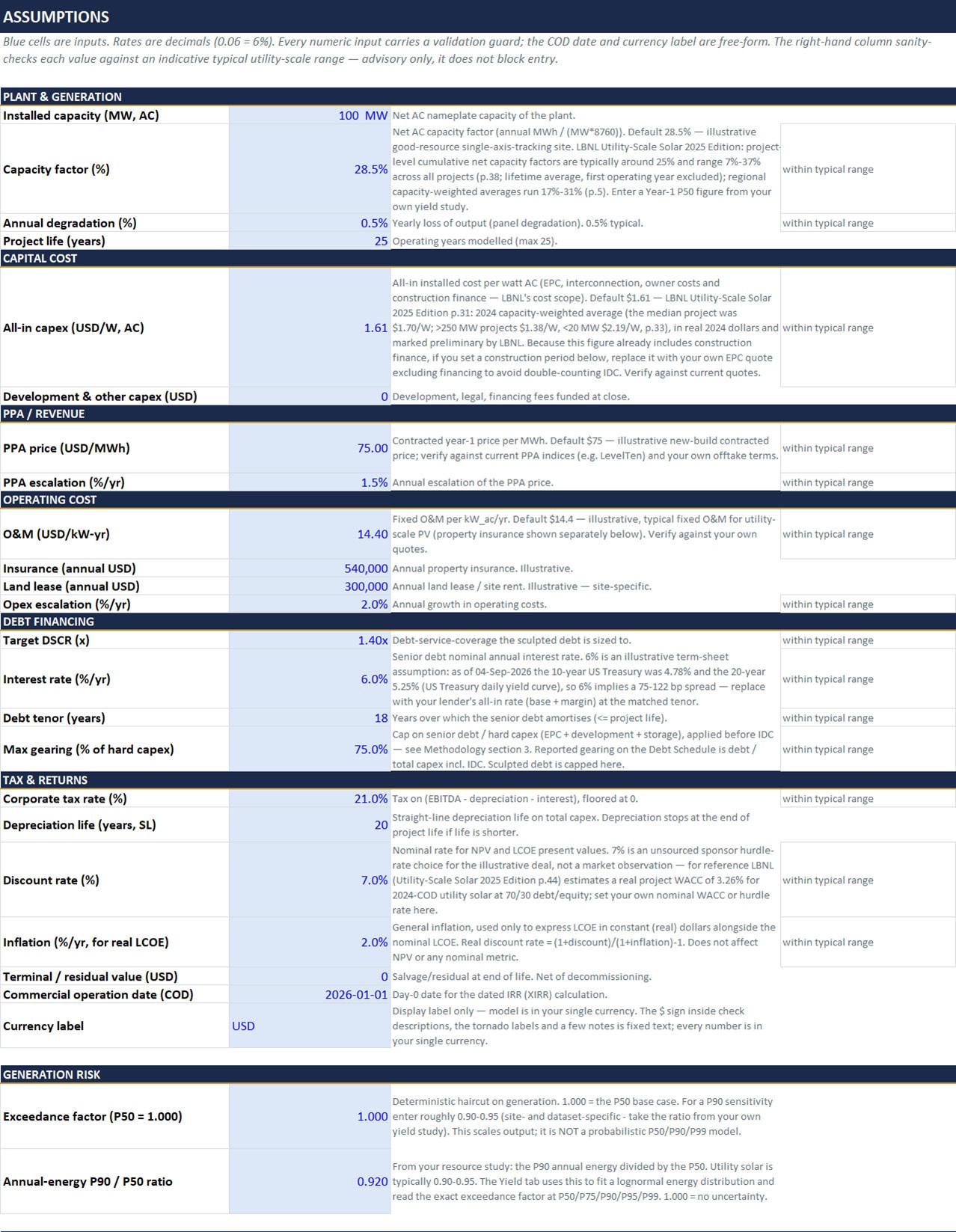
On the shipped deal that is not an abstraction: sculpting to a 1.40x DSCR wants
$134.97M of debt, the 75% gearing cap binds first at $120.75M, and at a 0.92
P90/P50 resource ratio the P90 LCOE rises to $75.18/MWh — ABOVE the $75.00/MWh PPA
the deal is priced on. The entire equity margin lives inside the yield assumption,
and the model shows you the exact period it disappears.
**WHY NOT JUST USE A CHEAPER ONE?**
Solar models run from $30 to $169.95 across a 3,100-listing template catalogue
(the handful priced below $30 are country market studies, not models), and NREL’s
SAM is free and very good at energy yield. Use either if it gives you the right
answer. What you are paying for here is arithmetic that has been adversarially
checked rather than assumed — and every claim below is one you can check yourself:
– Every one of the 13,955 formulas is re-derived in an independent engine, and every
headline is rebuilt a second time from raw inputs by a separate model that shares
no formulas with the workbook.
– The release passes a five-stage verification chain — including a golden case with a
closed-form answer — before it ships.
– The method has been through an adversarial cross-lab review: a model from a
different AI lab, instructed to break the model rather than agree with it, ran
against the certified computation build (sha256 434fd80c) from which this release
is re-cut. Since that review seven text-label formulas changed (Tax!T6 and
Sensitivity!B34:B37 on 2026-08-27, Assumptions!E7’s typical-range flag on
2026-08-30 and again on 2026-09-10,
Deal Dossier!C62’s depreciation label on 2026-09-10) and every stored numeric value is byte-identical,
each cut proven cell by cell in the RECUT_*_PROOF.txt files — it rebuilt the
model blind from the raw
inputs in its own code, matched the capital structure, coverage ratios and both
LCOE figures to the cent, matched the return metrics within the documented
solver tolerance, and exercised all five optional modules, including forcing a
covenant breach and locating the tax-equity flip from the file’s own forward test.
– The debt number is bounded by construction:
debt = MAX(0, MIN(sculpted debt, maximum gearing x hard capex)). That bound
is not automatic in DSCR sizing: NREL’s SAM carried an unbounded debt
fraction that could return debt above 100% of installed cost and negative
equity — raised as NREL/SAM issue #534 in February 2021 and fixed that
November. Set the PPA price to zero here and the debt floors at zero rather
than turning negative; the same bound is reproduced independently by the
Layer-B rebuild.
– Defaults are calibrated to published data (LBNL capex, Lazard LCOE), not invented.
– Of the 53 solar-titled models in a 3,100-listing marketplace catalogue pulled
2026-08-02, not one names DSCR sculpting, LLCR, PLCR, DSRA, P90 or LCOE in its
title. (Counting rule: title text only — a model can implement a mechanic
without naming it in the title.)
If a cheaper model gets those things right, it will agree with this one. That is
the point — you can check.
**Model Structure — 22 tabs**
1. **START HERE** — what the model does, input order, the method in plain English, sourced defaults, disclaimer
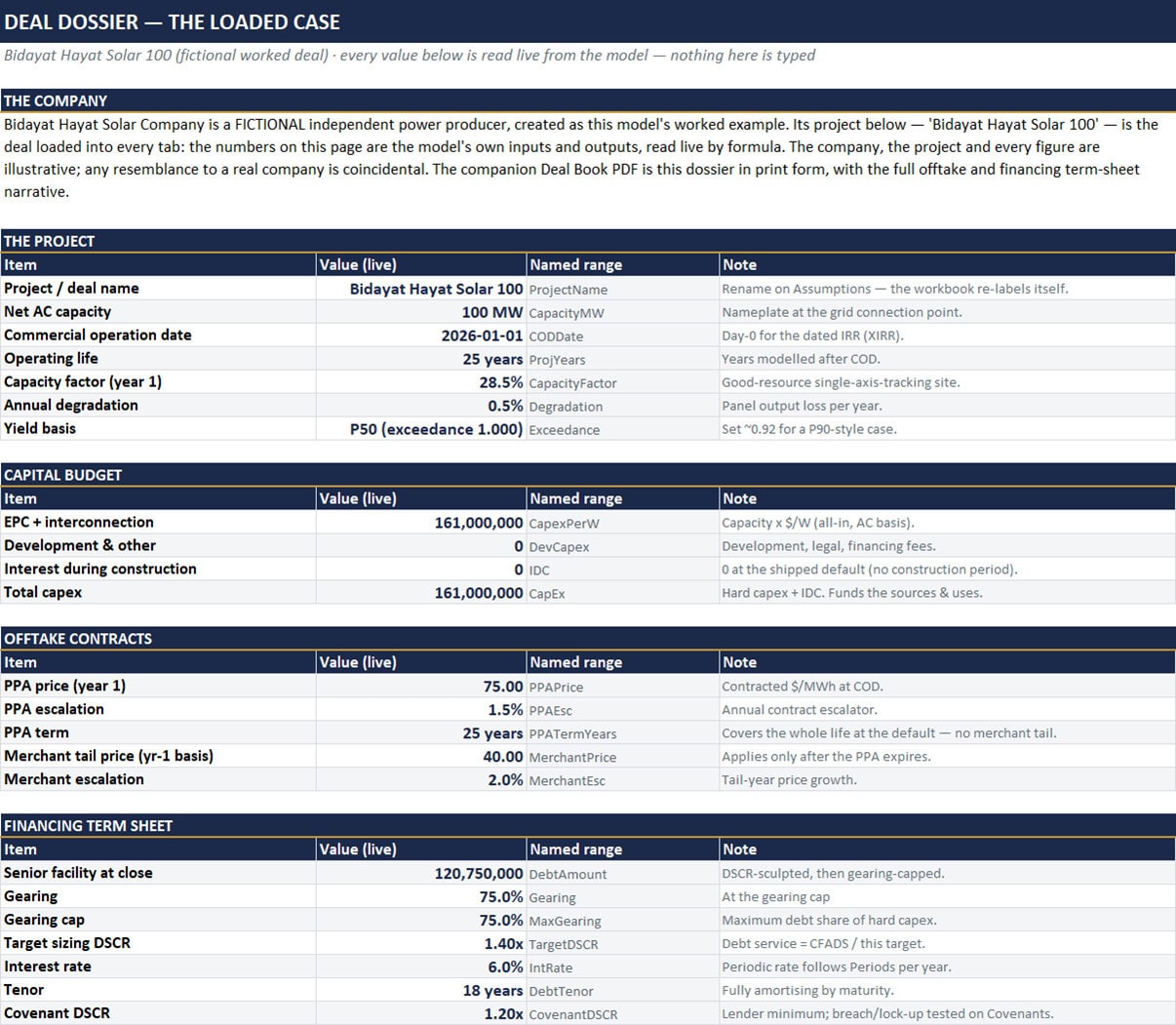
2. **Deal Dossier** — the loaded deal’s company profile, capital budget, offtake and term sheet, read live from the model
3. **Assumptions** — every input in one place, each with a validation bound, a hover note and a typical-range sanity flag
4. **Scenarios** — one switch drives Custom / Downside / Upside / Lender cases
5. **Debt Schedule** — DSCR sculpting, the gearing cap, amortisation, LLCR and PLCR
6. **Construction** — monthly drawdown with interest during construction capitalised into capex
7. **Mezzanine** *(optional)* — subordinated debt serviced behind the senior tranche, with an optional senior refinancing at a new rate from a chosen year
8. **Storage** *(optional)* — PV + BESS: throughput, discharge revenue, charging cost grossed up by round-trip efficiency, and opex; battery capex joins hard capex, so it genuinely re-sizes the senior debt
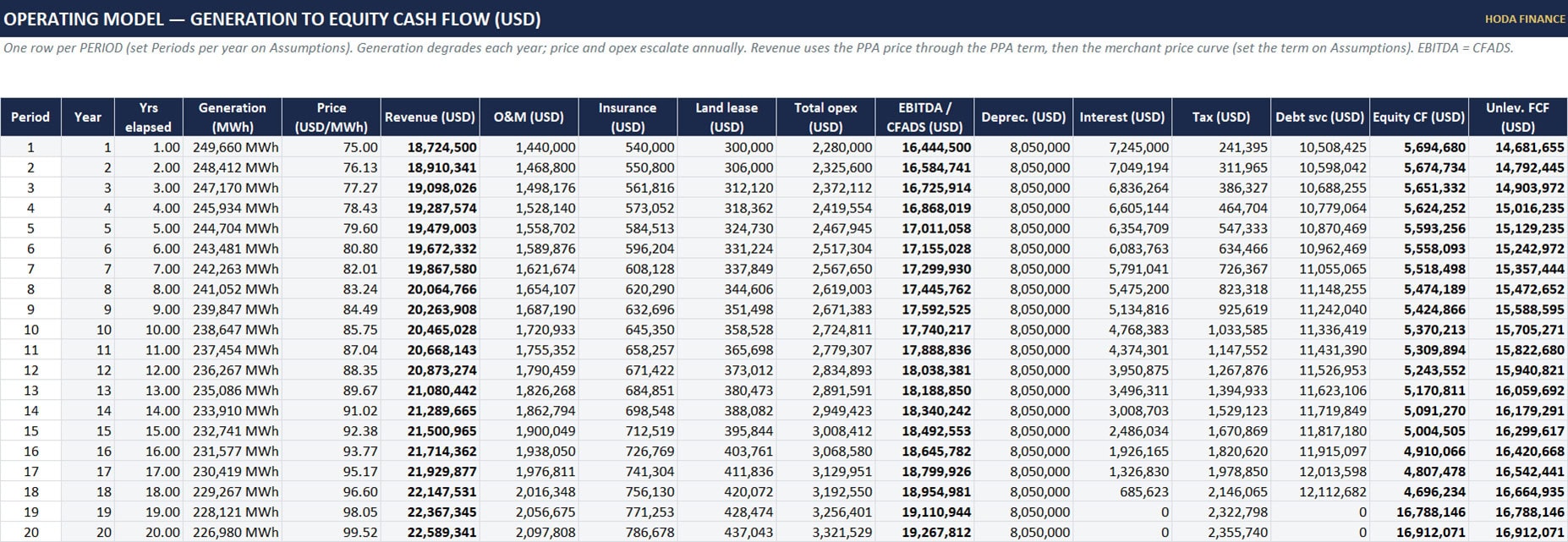
9. **Operating Model** — generation, degradation, PPA and merchant revenue, opex escalation, CFADS
10. **Tax** — straight-line / declining-balance / custom / MACRS depreciation with an optional NOL carryforward, plus the optional investment tax credit
11. **Covenants** — per-period DSCR test, distribution lock-up, cure periods, event of default
12. **DSRA** — a funded debt service reserve that re-times equity and revolves to zero at maturity
13. **Returns** — nominal and real LCOE, project NPV, dated project and equity IRR, equity multiple, DSCR summary
14. **Waterfall** — LP/GP preferred return, return of LP capital, GP catch-up, promote, with LP and GP IRR and MoIC
15. **Tax Equity** *(optional)* — partnership flip: differential cash and taxable-income sharing before and after the flip, a target-return flip point, per-partner capital accounts, and loss allocations limited by the capital account plus any deficit restoration obligation
16. **Yield** — analytic P50 / P75 / P90 / P95 / P99 exceedance factors and the LCOE at each, plus the P50-P99 energy fan chart
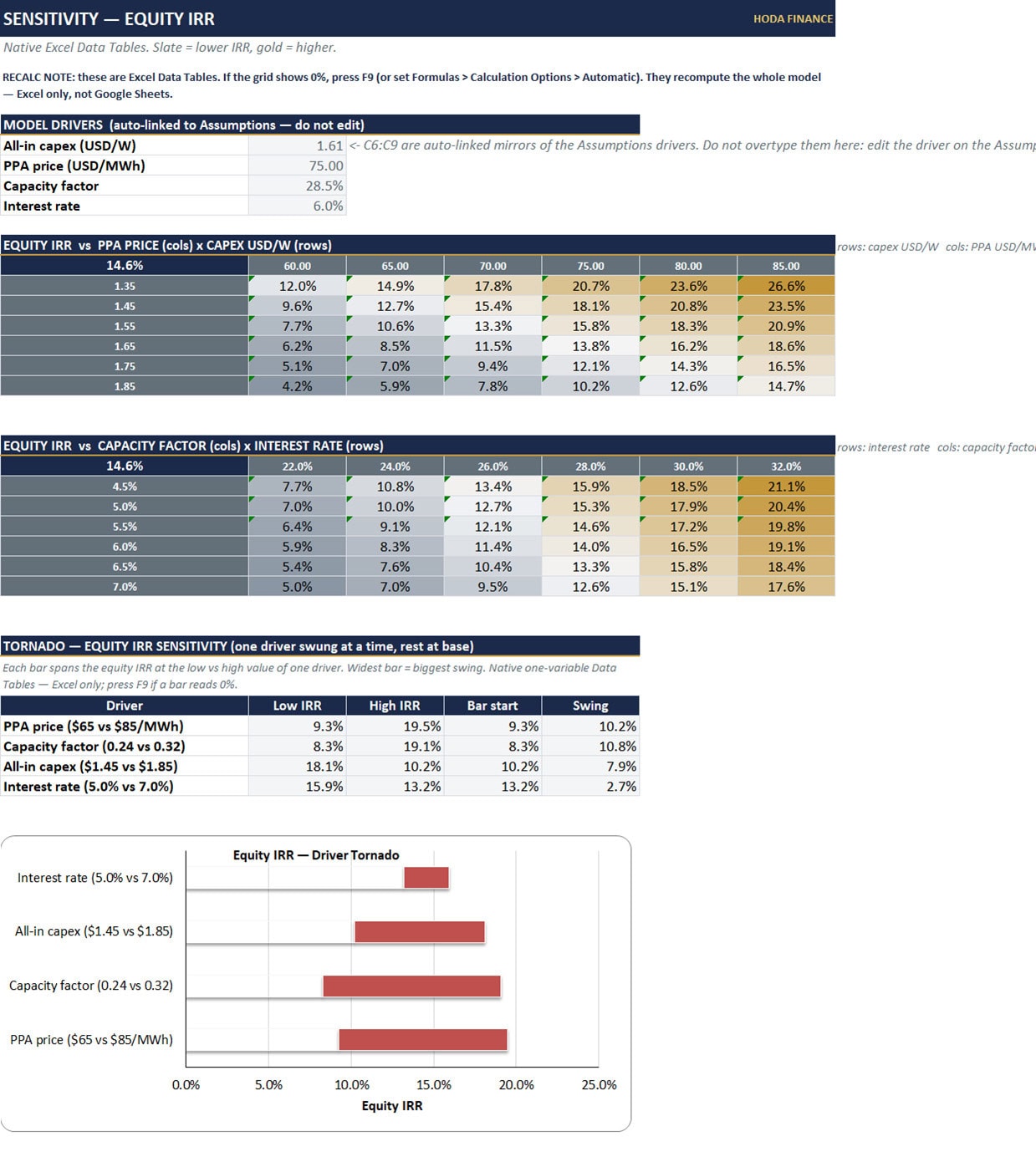
17. **Sensitivity** — two native two-variable Data Tables plus a driver tornado
18. **Checks** — every reconciliation, including no error values in the headline metrics, rolled into one master PASS / REVIEW flag
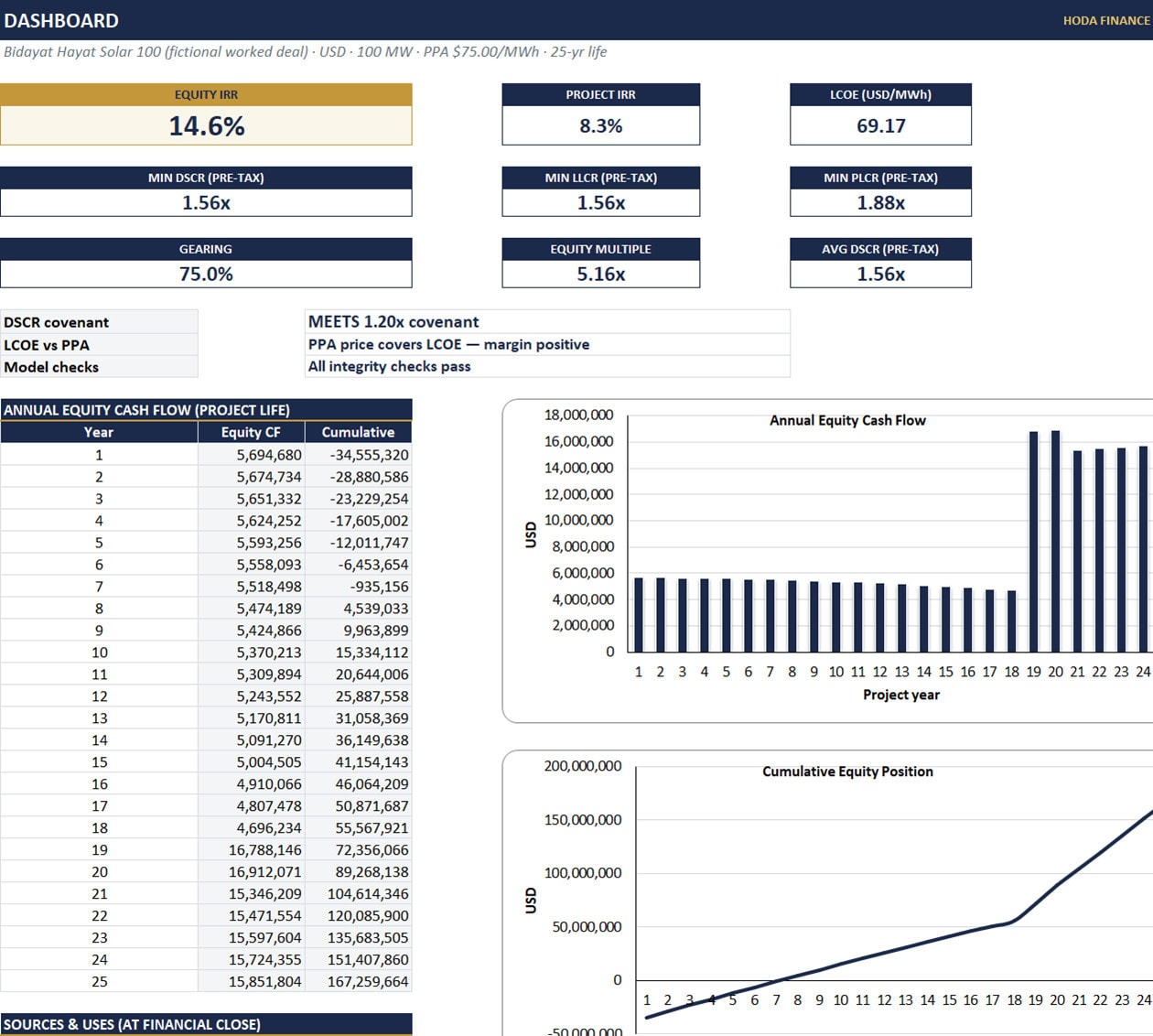
19. **Dashboard** — KPI tiles, annual and cumulative equity cash flow, DSCR-path vs covenant, sources & uses, cash-flow bridge
20. **Glossary** — plain-English definitions (CFADS, LLCR, sculpting, DSRA, promote, exceedance)
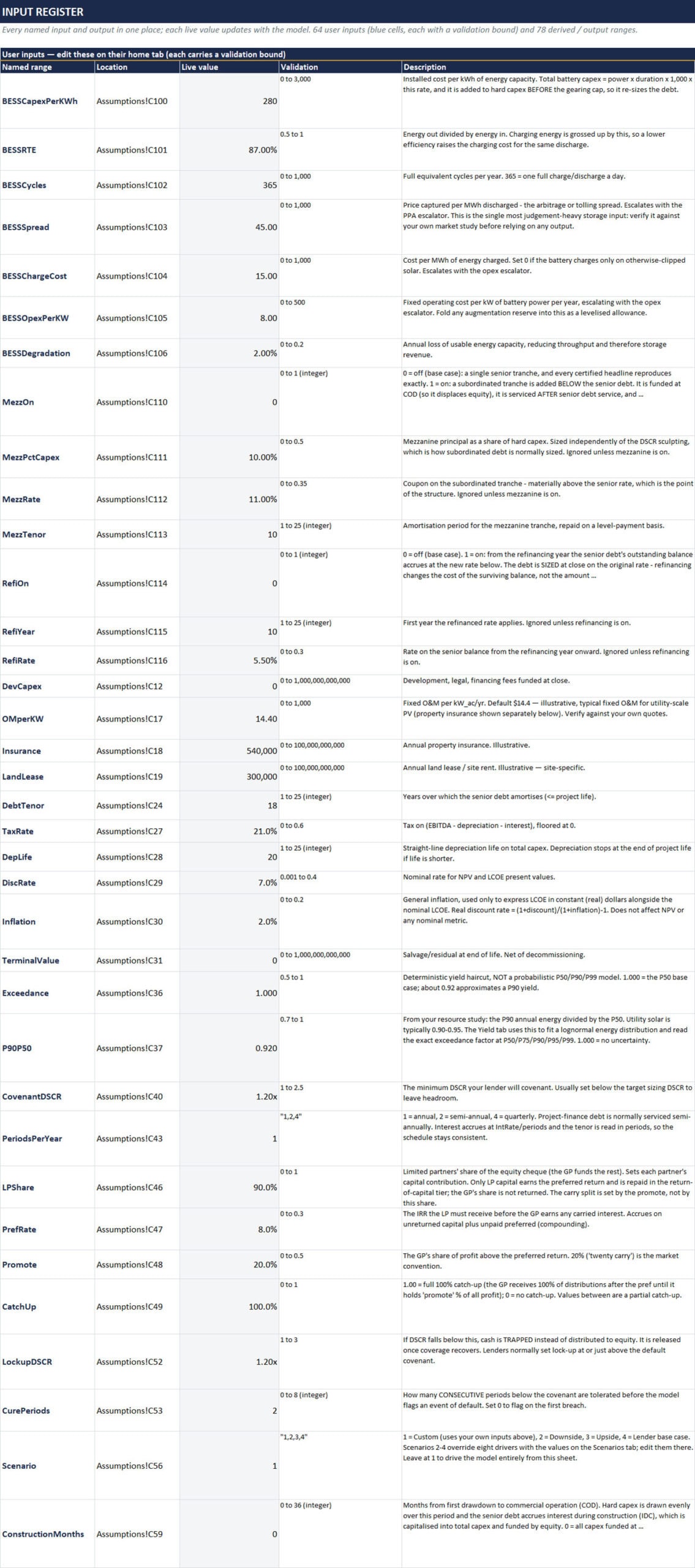
21. **Input Register** — every named input and output with its location, live value and validation bound
22. **Change Log** — the released-version stamp, mirrored in the workbook’s File > Info properties
**Key Methodological Features**
– Senior debt sized by sculpting to a target DSCR — target debt service = CFADS / target DSCR, debt = the present value of that stream at the cost of debt — then capped at maximum gearing on HARD capex
– The gearing cap keys off hard capex, not total capex: that is the deliberate break that keeps construction interest from creating a debt -> IDC -> capex -> debt circular reference
– LLCR and PLCR computed as the present value of CFADS over the remaining loan or project life, discounted at the cost of debt, over debt outstanding
– Construction interest accrues only in active construction months and is funded by equity, so the facility at COD equals the sculpted amount exactly
– The DSRA holds N months of forward debt service, is funded at COD from equity, and releases as the debt amortises — changing equity timing only, leaving project IRR, NPV and LCOE untouched
– Covenant testing produces per-period breach flags, a distribution lock-up that traps cash, a configurable cure period and an event-of-default flag
– The LP/GP waterfall accrues the preferred return on unreturned capital plus unpaid preference, then a full GP catch-up, then the promote split — and conserves cash exactly every period
– Analytic lognormal yield quantiles fitted to the one number a resource study reports, the P90/P50 energy ratio — exact quantiles, no simulation noise
– Nominal and real LCOE, real via the Fisher relation on the discount rate: lifetime cost is discounted at the nominal rate and only the energy stream at the real rate, so the quoted real price, escalated at inflation, recovers exactly the same lifetime cost as the nominal one
– Sub-annual periodicity: annual, semi-annual or quarterly debt service from one input
– MACRS uses the IRS Publication 946 Table A-1 half-year-convention percentages, printed in full on the Tax tab, for all six recovery classes — each class sums to 100% and fully recovers the depreciable basis
– The investment tax credit reduces the depreciable basis by the share you set (the US rule is 50% of the credit), and is either used against the project’s own tax with a carryforward or transferred for cash at a price you set
– The tax-equity flip point is a FORWARD test — the first period in which the investor’s cumulative after-tax flows, discounted at its target return, turn positive — so the flip introduces no circular reference; loss allocations stop at the capital account unless a deficit restoration obligation is entered
– Battery capex joins hard capex rather than sitting alongside it, so switching storage on re-sizes the senior debt; charging energy is grossed up by round-trip efficiency
– Mezzanine debt is serviced strictly behind the senior tranche and its senior service is capped at the outstanding payoff amount, so a refinancing at a different rate cannot manufacture phantom debt service
**Calibration**
The pre-loaded deal is calibrated to published market data rather than invented:
the all-in capex default of $1.61/W AC is the capacity-weighted average for
utility-scale PV that came online in 2024, per Lawrence Berkeley National
Laboratory’s *Utility-Scale Solar, 2025 Edition* (p.31); the 28.5% capacity factor sits
inside LBNL’s 17-31% band of regional averages (p.5; individual projects run 7-37%,
typically ~25%, p.38); and the $75/MWh PPA sits inside the $40-98/MWh
unsubsidized utility-scale range in Lazard’s *LCOE+* v19.0 (2026), p.26. Both sources
are cited on the START HERE tab and in the Methodology PDF, with a note to verify
the current editions. Not affiliated with, sponsored by or endorsed by LBNL or Lazard.
**Worked Example — pre-filled and tied out**
The workbook opens on a complete fictional deal, “Bidayat Hayat Solar 100”: a
100 MW AC plant at $1.61/W ($161.0M capex), a 28.5% capacity factor, a $75/MWh
PPA escalating at 1.5%, 18-year senior debt at 6.0% sculpted to a 1.40x target
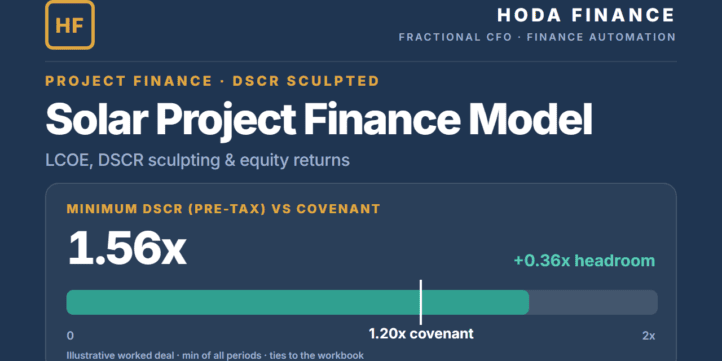
DSCR against a 1.20x covenant, over a 25-year life. It produces senior debt of
$120.75M against equity of $40.25M — 75% gearing, the cap binding, the sculpted
amount before the cap being $134.97M. LCOE $69.17/MWh nominal, $56.89/MWh real
against that $75 PPA. Project NPV $19.93M; project IRR 8.31%
and equity IRR 14.59%; equity multiple 5.16x; minimum DSCR 1.5649x against the
1.20x covenant; minimum LLCR 1.5649x and minimum PLCR 1.8815x (coverage ratios are pre-tax); year-1 cash-on-cash
14.15%. Split between partners, the LP earns 14.90% IRR at 4.78x and the GP 13.14%
at 8.51x. The GP’s higher multiple comes from its 20% promote on a 10% stake; its
lower IRR comes from the model returning LP capital only — the GP’s $4.025M
co-investment is not returned as capital — and the model says so on the tab. At a 0.92 P90/P50
resource ratio the P90 LCOE rises to $75.18/MWh — above the PPA price, which is
the point: the entire margin lives inside the yield assumption, and the model
shows you exactly where. Replace the inputs with your own and every output re-prices.
**DOES THIS FIT YOUR DEAL? — read before you buy**
COVERED: a single contracted utility-scale solar asset · DSCR-sculpted senior debt
with a gearing cap · LLCR and PLCR · construction period with capitalised IDC ·
funded DSRA · per-period covenant testing with lock-up, cure and event of default ·
LP/GP promote waterfall · SL / declining-balance / custom / MACRS depreciation with
optional NOL · post-PPA merchant tail · analytic P50-P99 yield · nominal and real
LCOE · annual, semi-annual or quarterly periodicity. Five optional modules ship
switched OFF so the certified base case is unchanged until you turn one on: MACRS
(all six IRS recovery classes), the investment tax credit, a tax-equity partnership
flip, battery storage (PV + BESS), and mezzanine debt with senior refinancing.
NOT COVERED, by design: the US PTC and a dedicated bonus-depreciation switch ·
multi-currency / FX · portfolio or fund-level roll-up across SPVs · a full Monte
Carlo simulation inside the workbook (yield uses exact analytic lognormal quantiles
instead, cross-checked against simulation before release) · a separate
inverter-replacement reserve line — fold periodic replacement capex into the fixed
O&M per kW input as a levelised allowance · Google Sheets (see the FAQ; this is a
hard incompatibility, not a limitation being worked around) · return of the GP’s own
co-investment: the waterfall returns LP capital only, so the GP is paid through the
catch-up and promote alone and the LP and GP figures reflect that (Methodology,
section 6).
**Suitable For**
– Lenders’ credit teams sizing and testing senior debt on a contracted solar asset
– Investment committees reviewing a sponsor’s case with an independent model
– Renewable-energy developers preparing a financing request or an IC paper
– Infrastructure and energy-transition funds underwriting single-asset acquisitions
– Advisors and consultants producing client-facing project finance analysis
**Technical Specifications**
– Format: .xlsx, single Excel edition, plus five PDF companions
– Compatibility: Microsoft Excel 2019, 2021, 365 (Windows and Mac).
**NOT Google Sheets** — the sensitivity grids are native two-variable Data Tables, which Sheets cannot compute
– No macros, no VBA, no add-ins
– No circular references, no iterative calculation
– 22 tabs · 13,955 live formulas · 142 named ranges · 7 charts
– Pre-filled worked deal; replace with your
Similar ProductsOther customers were also interested in...



 eFinancialModels
Electric Vehicle (EV) Charging Station Financial M...
With this comprehensive 5- or 10-year monthly tool, investors can assess the viability of setting up... Read more

Financial Model for Mobile App | Mobile App Busine...
The Mobile App Financial Plan Template in Excel allows you to develop financial projections when lau... Read more

 HenrySheykin
Food Truck Financial Model Excel Template
The Food Truck Financial Model helps entrepreneurs, founders, business owners, consultants, and anal... Read more

Green Hydrogen Production from Wind Energy Financi...
The Green Hydrogen from Wind Financial Model aims to comprehensively forecast a horizon of 40 years ... Read more

Simple Mutual Non-Disclosure Agreement Template
Protect your business secrets with ease using our Simple Mutual Non-Disclosure Agreement Template. S... Read more

Solar Energy Financial Model
The Solar Energy Financial Model Spreadsheet Template in Excel assists you in preparing a sophistica... Read more

 Peter Graf
The Customer-Centric Financial Model for Restauran...
Starting a restaurant without a financial plan is like driving a car blindfolded. You wouldn´t do i... Read more
You must log in to submit a review.