
0 ITEMS

Metal Mining Business Financial Model Excel Template
The Metal Mining Financial Model Financial Model Template helps users turn a mining project concept into a structured financial forecast built around the realities of mineral extraction. Instead of relying on a generic spreadsheet, the template is designed for ore production, commodity pricing, recovery assumptions, operating costs, capital expenditures, payroll, cash flow, and profitability. It gives entrepreneurs, mining business owners, consultants, analysts, and project sponsors a practical way to evaluate whether a metal mining operation can generate enough revenue to justify the startup investment and ongoing operating risk. This model is especially useful for preparing business plans, feasibility discussions, investor materials, lender submissions, and internal decision-making documents. Users can adjust revenue assumptions for different metallic products, enter expected production volumes, modify pricing, estimate startup costs, forecast operating expenses, and review how the project may perform over a five-year period. Because metal mining projects often require large upfront capital commitments, the template helps organize major launch expenses such as land rights, mine infrastructure, processing plant development, heavy equipment, permits, and working capital needs. The template also supports detailed financial planning by connecting revenue drivers with cost of goods sold, staffing requirements, fixed overhead, variable costs, and financing assumptions. Users can evaluate payroll, royalty costs, shipping, energy, consumables, lease costs, and other operating expenses to understand their impact on margins, EBITDA, cash flow, and net profit. This makes it easier to test whether production targets, metal prices, and cost structures are realistic before approaching investors or committing capital. With built-in forecasting logic, dashboards, charts, KPI summaries, profitability analysis, break-even analysis, and financial statements, the Metal Mining Financial Model helps users move from assumptions to actionable insights. It is fully editable, compatible with Microsoft Excel and Google Sheets, and suitable for both new mining ventures and established operators planning expansion. By using a ready-made model tailored to metal mining, buyers can save time, improve financial clarity, and make more informed decisions about funding, operations, growth, and project viability.
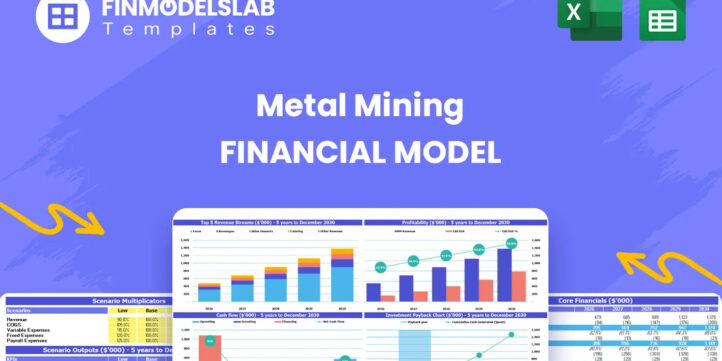


Financial Model Overview
The Metal Mining Financial Model Financial Model Template gives mining entrepreneurs, project developers, consultants, analysts, and business owners a structured way to evaluate a metal mining project before launch, expansion, financing, or investor presentation. Metal mining requires a very different financial planning approach from many other businesses because revenue depends on production volumes, metal prices, recovery assumptions, processing capacity, grade quality, and commodity demand, while costs are shaped by capital expenditure, heavy equipment, labor, royalties, energy, logistics, consumables, leases, compliance, and ongoing site operations.
This template brings those assumptions into one editable model so users can forecast revenue, operating expenses, startup costs, cash flow, profitability, and funding needs over a multi-year period. It is designed to help replace guesswork with a clear planning framework that can support business plans, feasibility reviews, funding discussions, lender submissions, and internal decision-making.
All-in-One Dashboard
The all-in-one dashboard brings the most important inputs and outputs of the Metal Mining Financial Model into a single, easy-to-review area. It helps users see the connection between production assumptions, commodity prices, operating costs, capital investment, financing needs, revenue, EBITDA, profitability, and cash position without having to search across multiple sections of the workbook. Typical inputs may include production start date, metal categories, annual units produced, selling prices, cost assumptions, payroll, fixed expenses, variable expenses, and funding structure.
The dashboard then summarizes key outputs such as projected revenue, gross margin, EBITDA, net profit, cash balance, payback period, and return metrics. This component is useful because mining projects involve many moving parts, and decision-makers need a concise view of whether the assumptions produce a financially viable project. For founders and executives, it supports faster strategy reviews. For consultants and analysts, it provides a clean summary for client discussions. For investors and lenders, it creates a professional starting point for understanding the project economics before moving into detailed schedules and financial statements.
Low/Base/High Scenario Analysis
The low, base, and high scenario analysis section helps users test how the metal mining project may perform under different market and operating conditions. A mining project can be highly sensitive to commodity prices, production ramp-up timing, ore recovery rates, cost inflation, capital expenditure overruns, and financing terms, so a single forecast is rarely enough for serious planning. This component allows users to compare conservative, expected, and optimistic cases by adjusting the assumptions that drive revenue, expenses, margins, and cash flow.
Inputs may include different metal selling prices, annual production volumes, recovery rates, operating cost levels, staffing plans, capital deployment schedules, and financing assumptions. Outputs may show how each scenario affects revenue, EBITDA, net income, cash flow, break-even timing, payback period, internal rate of return, and funding requirements. This is especially valuable for business planning and investor preparation because it demonstrates that the project has been tested beyond one set of assumptions. It also helps management identify the biggest risks and opportunities, such as whether the project remains viable if metal prices fall, if production is delayed, or if operating costs rise faster than expected.
Professional Charts
The professional charts component turns the financial forecast into clear visual reports that can be used for presentations, management reviews, investor meetings, and lender discussions. Mining financial models often contain large amounts of numerical detail, and charts make it easier to communicate trends, risks, and performance drivers quickly. This section may visualize annual revenue growth, EBITDA trends, net profit, operating cash flow, cash balance, capital expenditure timing, expense categories, revenue by metal type, margin development, debt levels, and return metrics. Inputs are drawn from the underlying forecast sections, while outputs are automatically presented as presentation-ready graphs and visual summaries.
This is useful because stakeholders often need to understand the financial story without reviewing every formula or schedule in the model. For example, a chart showing the initial cash outflow followed by operating cash generation can help explain the capital intensity and payback profile of the project. A revenue chart by metal can highlight which commodities drive the investment case. A profitability trend can show whether scaling production improves margins over time. These visual outputs make the financial model more practical for decision-making and more polished for external communication.
ROE Components and DuPont Analysis
The ROE components and DuPont analysis section helps users understand the drivers behind return on equity rather than looking at one headline return figure in isolation. In a capital-intensive metal mining project, equity returns can be affected by operating profitability, asset efficiency, leverage, debt structure, and the amount of shareholder capital invested. This component breaks return on equity into underlying factors so users can see whether the project’s return profile is being driven by strong margins, efficient use of assets, or financial leverage.
Inputs may include net income, revenue, total assets, equity, debt, interest expense, and profit margins from the core financial statements. Outputs may include return on equity, net profit margin, asset turnover, equity multiplier, and related profitability and leverage indicators. This is useful for investors, founders, and analysts because it provides a more complete view of financial performance and risk. A high ROE may look attractive, but DuPont analysis helps reveal whether that return is supported by operational strength or amplified by leverage. For mining project finance, this distinction matters because lenders and equity investors will want to understand both the upside potential and the financial risk behind the forecast.
Revenue Inputs
The revenue inputs section is where users define the commercial assumptions that drive the Metal Mining Financial Model. Because revenue in a mining project is heavily dependent on the type and quantity of metals produced, this component allows users to enter production volumes, selling prices, timing assumptions, and product-level revenue drivers. It can be used for metals such as lithium carbonate, cobalt sulfate, gallium metal, neodymium oxide, dysprosium oxide, or other metallic products relevant to the project.
Inputs may include annual units produced, ramp-up assumptions, price per ton or unit, expected production start date, price escalation, sales mix, and any project-specific adjustments. The model then calculates revenue by multiplying production volume by projected selling price, producing a forecast that flows into the profit and loss statement, cash flow forecast, dashboards, and investor metrics. This section is important because revenue assumptions are often the foundation of a mining investment case. If production volumes are overstated or pricing is unrealistic, the entire forecast can become unreliable. By organizing revenue inputs clearly, the template helps users document assumptions, test price and volume changes, and build a more transparent forecast for business planning, funding, and strategic decision-making.
Bank-Ready Reports
The bank-ready reports component provides lender-friendly financial outputs that can support loan applications, project finance discussions, credit reviews, and stakeholder due diligence. Mining projects often require substantial upfront funding for land rights, mine development, infrastructure, equipment fleets, processing facilities, working capital, and permitting. Banks and financing partners need to see more than revenue potential; they need to review whether the business can generate sufficient cash flow to service debt, maintain liquidity, and manage operating risk. This component may include summarized financial statements, cash flow projections, profitability analysis, debt service indicators, funding needs, capital expenditure schedules, and key ratios.
Inputs flow from the model’s operating assumptions, financing structure, loan terms, interest rates, repayment schedule, and capital requirements. Outputs can help users present annual and monthly financial projections in a professional format that is easier for lenders to assess. This is useful because organized reports reduce the time needed to prepare funding documentation and help users communicate the project’s financial case more clearly. For mining sponsors, consultants, and analysts, bank-ready reporting also creates a disciplined framework for explaining how the project will move from capital deployment to production, revenue generation, cash flow stability, and debt repayment capacity.
Revenue Breakdown
The revenue breakdown component provides a detailed view of revenue streams by metal, product category, or production line. Instead of showing only total revenue, this section helps users understand which metals contribute the most to the overall forecast and how the sales mix changes over time. For a diversified metal mining operation, revenue may come from multiple high-value products, each with its own production volume, price assumption, market outlook, and cost profile.
Inputs may include product-level production units, price per unit, annual growth or ramp-up rates, and timing of each revenue stream. Outputs may show revenue by product, percentage contribution to total revenue, year-over-year growth, and the impact of each commodity on total sales. This is useful because it allows decision-makers to see whether the project depends heavily on one metal or benefits from diversified revenue sources. It can also help identify which products deserve operational focus, marketing priority, or long-term offtake agreements. For funding documents, a detailed revenue breakdown improves transparency and makes it easier for investors or lenders to evaluate the assumptions behind the top-line forecast. For management, it supports better planning around production capacity, processing priorities, sales contracts, and commodity price exposure.
KPI Dashboard
The KPI dashboard helps users monitor the financial and operational performance metrics that matter most in a metal mining business. While the all-in-one dashboard provides a broad summary of the model, the KPI dashboard focuses more specifically on measurable indicators that can be tracked against targets, industry benchmarks, and investor expectations. Inputs are drawn from the revenue forecast, cost schedules, payroll assumptions, capital expenditure plan, financing structure, and financial statements. Outputs may include EBITDA margin, gross margin, net profit margin, cash balance, revenue growth, operating cash flow, return on equity, internal rate of return, payback period, debt-to-equity ratio, and other performance metrics.
This component is valuable because mining projects need ongoing performance monitoring, not just a one-time forecast. A KPI view helps users quickly identify whether revenue growth is strong enough, whether costs are eroding margins, whether cash reserves are adequate, and whether returns meet stakeholder expectations. It can also support board updates, investor presentations, monthly management reporting, and operational reviews. By translating detailed forecast data into clear performance indicators, the KPI dashboard makes the model more actionable for founders, operators, analysts, and finance teams.
Startup and Capital Expenditure Planning
The startup and capital expenditure planning component helps users estimate the initial investment required to bring a metal mining project into operation. Mining ventures typically require significant upfront spending before revenue begins, and this section provides a structured way to organize those costs. Inputs may include land acquisition and mineral rights, geological studies, permitting, environmental compliance, mine development, roads and utilities, processing plant construction, heavy mining equipment, vehicles, site infrastructure, safety systems, technology, pre-opening payroll, consulting fees, and initial working capital. Outputs may include a total startup cost estimate, timing of capital outflows, funding requirement, depreciation basis, and links to cash flow and balance sheet projections.
This component is useful because underestimating capital expenditure can create serious funding shortfalls and delay the path to production. By itemizing startup costs, users can better understand how much capital must be secured before launch, how spending should be phased, and which cost categories have the greatest impact on project viability. It also supports investor and lender discussions by showing that the funding request is based on a detailed capital plan rather than a rough estimate. For established operators, this section can also be adapted for expansion projects, new processing capacity, or additional mining sites.
Cash Flow Forecast and Break-Even Analysis
The cash flow forecast and break-even analysis component helps users evaluate liquidity, funding gaps, and the point at which the metal mining project becomes financially sustainable. A mining project may show strong profitability on paper while still facing cash pressure due to large upfront capital expenditures, payment timing, debt service, working capital needs, or delayed production ramp-up. Inputs may include revenue collection timing, operating expenses, payroll, capital expenditures, loan proceeds, equity funding, interest expense, principal repayments, taxes, and opening cash balance. Outputs may include monthly and annual cash flow, ending cash balance, minimum cash requirement, cash shortfall periods, cumulative cash flow, break-even date, payback period, and the amount of funding needed to avoid liquidity problems.
This component is especially useful for planning because it shows when money leaves the business, when revenue begins to recover the initial investment, and whether the project has enough cash to operate through early development and production stages. Break-even analysis helps users understand how much revenue or production volume is needed to cover fixed and variable costs. For investors and lenders, it provides a clear view of risk, funding timing, and capital recovery.
Similar ProductsOther customers were also interested in...


 HenrySheykin
Coal Mining Financial Model Excel Template
The Coal Mining Financial Model helps users turn a mining project concept, expansion plan, or invest... Read more
Gold Mining Business Financial Model Excel Templat...
The Gold Mining Financial Model Financial Model Template helps users turn a gold mining project into... Read more
 Finmodelhub
Comprehensive 3 – Statement Financial Model ...
This is a 6,000bpd financial model for refinery producing Diesel and Jet Fuel. The Model is flexible... Read more
Solar Panel Manufacturing Plant Business Plan Fina...
The Solar Panel Manufacturing Financial Model helps users turn a solar factory concept into a struct... Read more
Food Production Financial Model Excel Template
The Food Manufacturing Financial Model helps entrepreneurs, founders, consultants, analysts, and bus... Read more
Clothing Line Business Financial Model Excel Templ...
The Clothing Line Financial Model helps founders, apparel entrepreneurs, consultants, analysts, and ... Read more
T-Shirt Printing Business Financial Model Excel Te...
The T-Shirt Printing Financial Model helps entrepreneurs, founders, business owners, consultants, an... Read more
Biodiesel Manufacturing Business Financial Model E...
The Biodiesel Manufacturing Financial Model helps entrepreneurs, founders, business owners, consulta... Read more
Organic Fertilizer Production Financial Model Exce...
The Organic Fertilizer Production Financial Model helps users turn a fertilizer plant concept into a... Read more
Reviews
 Template very professional
had the opportunity to review and work with this business plan template and I must say it stands out for its clarity and structure. The monthly financial breakdown, including EBITDA, net income, and operating cash flow, is both thorough and well-organized. I particularly appreciated the inclusion of operational KPIs, which provides a deeper insight into the company’s day-to-day performance.
Thank you for your feedback.
247 of 583 people found this review helpful.
Top File
Ho scaricato questo file ed ho riscontrato che fosse professionale e adatto per sviluppare un buon business plan
367 of 825 people found this review helpful.
Help other customers find the most helpful reviews
Did you find this review helpful?
You must log in to submit a review.