
0 ITEMS

Cryotherapy & Recovery Studio Financial Model — Whole-Body Cryo | 5-Year 3-Statement Forecast, Nitrogen vs Electric Comparison, DSCR & Valuation
A financial model built specifically for whole-body cryotherapy and recovery studios, and structured around the decision that actually determines your cost base: nitrogen versus electric. A nitrogen cryosauna is cheap to buy but burns 3-7 kg of liquid nitrogen every single session, so your running cost scales directly with volume. An electric chamber costs far more upfront and then runs on electricity alone. Flip one cell to switch between them — purchase price and per-session running cost move together — and the Dashboard tells you how many years it takes the electric chamber to earn back its higher price at your own session volumes. Because cryo sessions last only 1-3 minutes, chamber capacity is rarely what limits a studio — demand is. So revenue is built from demand (members with churn, session packages, walk-ins) and then checked against physical chamber capacity, with a flag showing the first month you would need a second chamber. Includes 60 monthly periods plus 5 annual years, full three-statement output with a balance sheet that ties in every period, capex and depreciation schedules, monthly loan amortisation, DSCR by year for lenders, break-even and cash payback analysis, and a valuation section with exit value, NPV and equity IRR. Every default assumption is sourced from published industry data and cited on a dedicated Benchmarks tab.
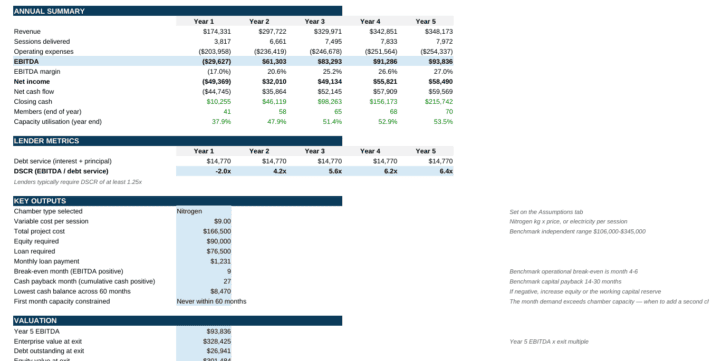


A financial model built specifically for whole-body cryotherapy studios — structured around the decision that actually sets your cost base.
Nitrogen or electric? The model answers it with your numbers.
This is the choice every cryo operator faces and most templates ignore entirely. A nitrogen cryosauna costs around $25,500–$29,450 but consumes 3–7 kg of liquid nitrogen every session, so your cost of delivery scales with every client who walks in. An electric chamber costs $54,900–$97,998+ and then runs on electricity alone, roughly $0.50–$3.00 per session, with no gas contract at all.
One toggle switches the entire model between the two — purchase price, capital requirement and per-session running cost all move together. A dedicated Dashboard section then shows your annual saving from going electric, the extra upfront cost, and how many years it takes to recover it at your own projected volumes. On the default assumptions that payback lands under a year, which is exactly the kind of finding that changes a purchase decision.
Demand-led, capacity-checked
Whole-body cryo sessions last 1–3 minutes, so a single chamber can physically serve far more people than most studios ever attract. Modelling this as a capacity-constrained business, the way you would a gym or a treatment room, produces nonsense. So revenue here is built from demand — members tracked as a cohort with joins and churn, session packages, and walk-ins — and then tested against physical chamber capacity. A flag tells you the first month demand would exceed one chamber, which is when a second one becomes a real decision rather than a guess.
What is included
- 60 monthly periods plus 5 annual years
- Full three-statement output: P&L, cash flow, and a balance sheet that ties to zero every month
- Capital expenditure and depreciation schedules, split between equipment and build-out
- Monthly loan amortisation with interest and principal split
- DSCR by year — the metric lenders underwrite against
- Break-even month, cash payback month, lowest cash balance and peak funding requirement
- Valuation: exit enterprise value, equity value, NPV and equity IRR
- Membership share of revenue tracked monthly, so you can steer toward the 60–75% industry target
- Franchise toggle: royalty, brand fund and the one-time franchise fee, on or off in one cell
- A dedicated Benchmarks tab citing published sources for every default
Built for
Founders opening a cryotherapy or recovery studio, franchisees evaluating a cryo franchise, and lenders or investors underwriting one.
Every input sits on a single colour-coded Assumptions tab with the benchmark range shown beside it. Edit the blue cells; everything else updates automatically. No hidden hardcoded numbers, no locked sheets, no macros.
This is a planning tool, not financial advice. Default values are published industry benchmarks, not a forecast of your specific studio.
Similar ProductsOther customers were also interested in...



 eFinancialModels
Electric Vehicle (EV) Charging Station Financial M...
With this comprehensive 5- or 10-year monthly tool, investors can assess the viability of setting up... Read more

Financial Model for Mobile App | Mobile App Busine...
The Mobile App Financial Plan Template in Excel allows you to develop financial projections when lau... Read more

 HenrySheykin
Food Truck Financial Model Excel Template
The Food Truck Financial Model helps entrepreneurs, founders, business owners, consultants, and anal... Read more

Green Hydrogen Production from Wind Energy Financi...
The Green Hydrogen from Wind Financial Model aims to comprehensively forecast a horizon of 40 years ... Read more

Simple Mutual Non-Disclosure Agreement Template
Protect your business secrets with ease using our Simple Mutual Non-Disclosure Agreement Template. S... Read more

Solar Energy Financial Model
The Solar Energy Financial Model Spreadsheet Template in Excel assists you in preparing a sophistica... Read more

 Peter Graf
The Customer-Centric Financial Model for Restauran...
Starting a restaurant without a financial plan is like driving a car blindfolded. You wouldn´t do i... Read more
You must log in to submit a review.