0 ITEMS

Freelancers vs Boutique Firms: Choosing Financial Modeling Help

A first-time founder with a standard fundraising model and a small budget is usually best served by a vetted freelancer plus an independent review, while a boutique firm fits investor diligence, several stakeholders or a model the business will depend on for years. Either route works only when the buyer tests Excel skills before paying.
Key Takeaways
- Marketplaces such as Upwork and Fiverr offer the lowest entry cost, but the buyer carries the vetting work and the quality risk.
- Boutique firms cost more per project but bring review, documentation and continuity; specialist hubs still depend on one seller and need the same checks.
- Run a paid test task, request a sample model and check formulas, inputs and a check cell before a full build.
- Field audits found errors in about a quarter of audited spreadsheets, so budget for an independent review whichever route you choose.
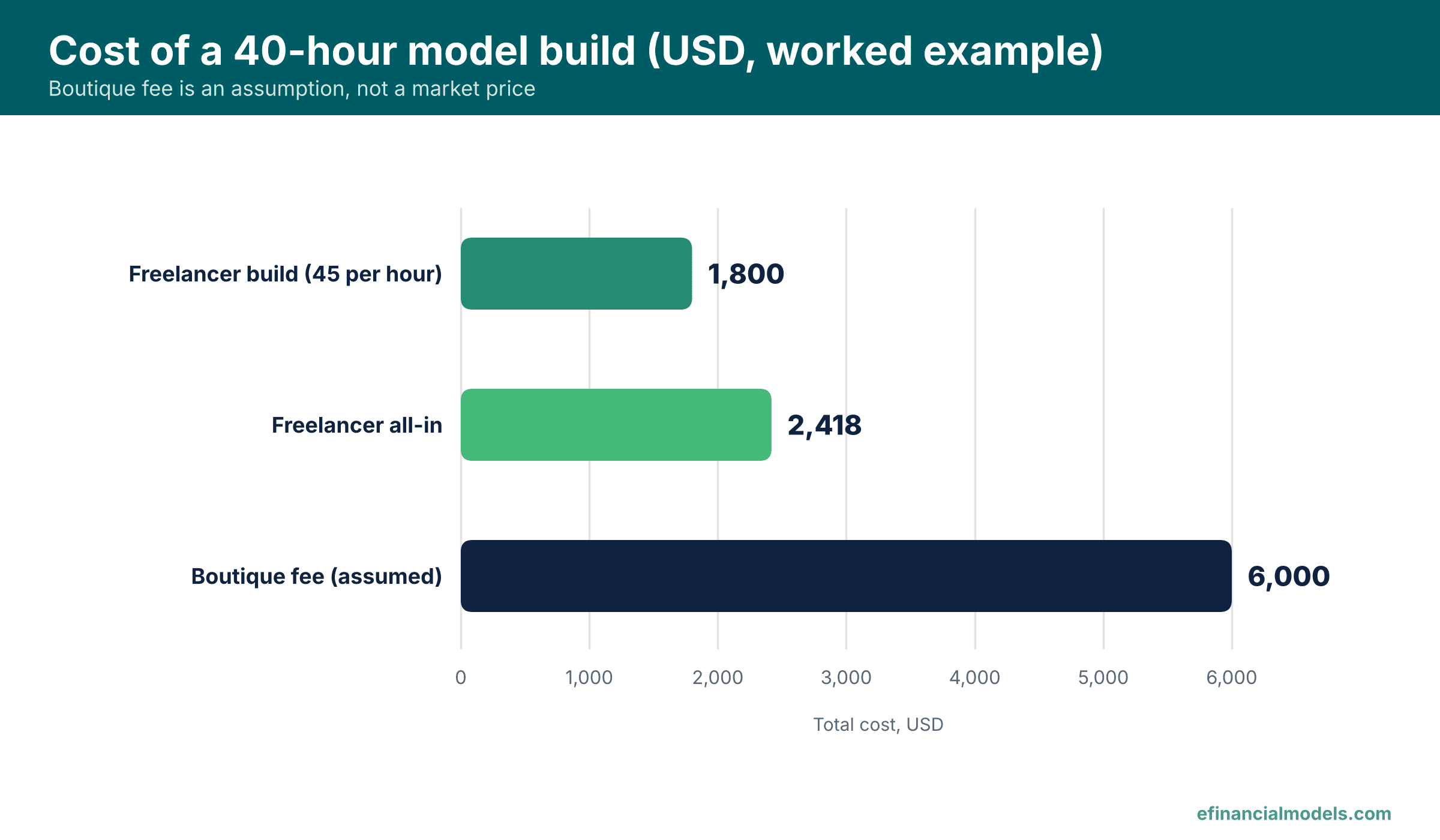
- A 40-hour freelancer build with review, a test task and fees totals USD 2,418 in the worked example, against an assumed USD 6,000 boutique fee.
When Should a First-Time Founder Hire a Financial Modeling Consultant?
Hire a consultant when the model supports a decision such as a fundraising round, a loan application or a hiring plan, because lenders and investors usually want to see financial projections they can trace.
A founder who only needs a rough budget can start from a startup financial model template and skip the consultant. Hire help once a lender, investor or co-founder will question how every number is built.
Where Do You Find a Financial Modeling Consultant?
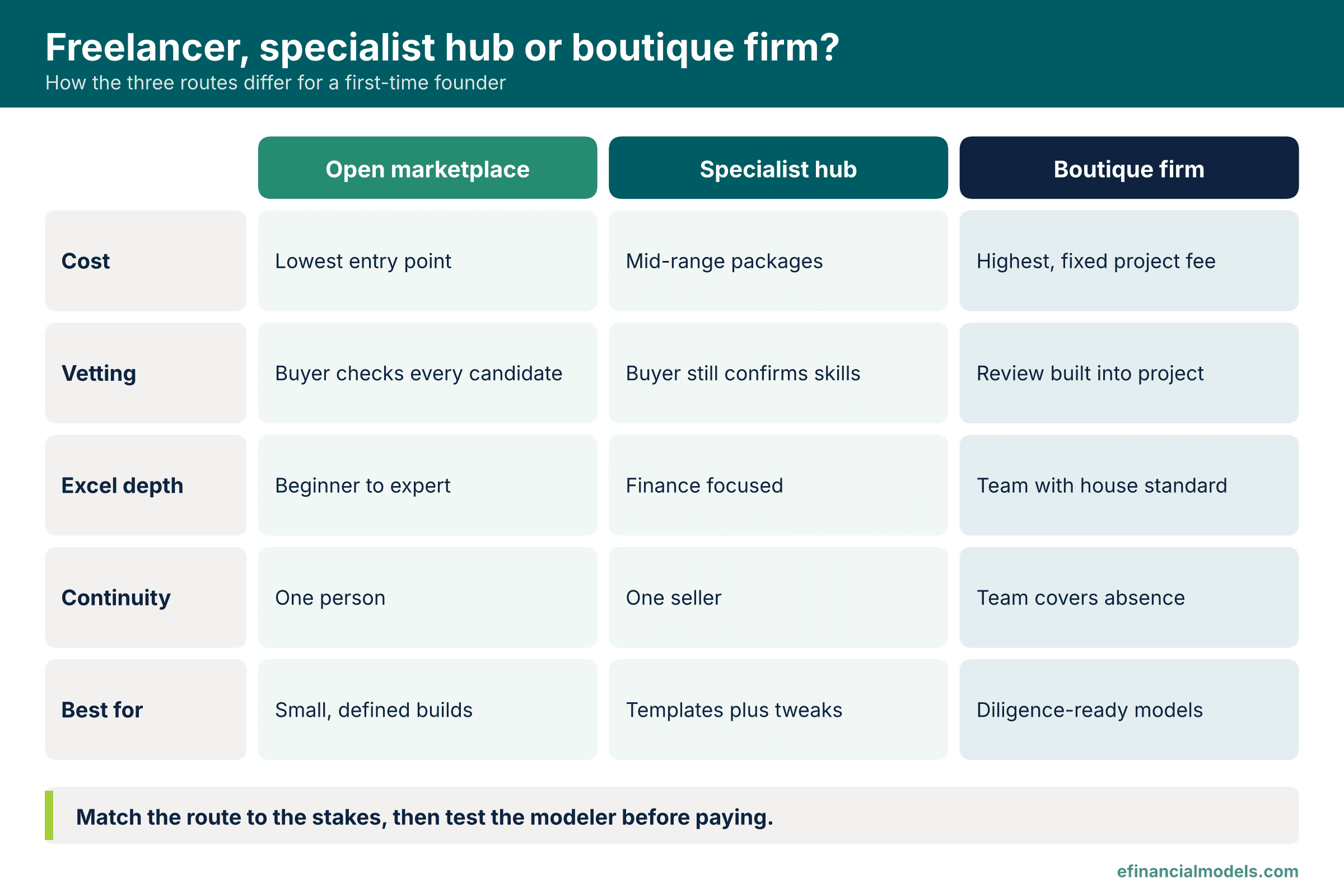
Founders find consultants through three routes: open marketplaces, specialist hubs that list modelers by service, and boutique firms that sell a managed project. To find a boutique firm, ask an accountant, an investor or an incubator for referrals, then ask for a sample model and the name of the person who will lead the work. The comparison below sets the tradeoffs side by side.
| Factor | Open marketplace (Upwork, Fiverr) | Specialist hub | Boutique firm |
|---|---|---|---|
| Cost | Lowest hourly entry point | Mid-range, often package priced | Highest, usually a fixed project fee |
| Quality control | Buyer vets every candidate | Varies by seller, so the buyer still checks | Internal review built into the project |
| Excel expertise | Ranges from beginner to expert | Usually finance focused | Dedicated modelers working to a house standard |
| Continuity | Depends on one person | Depends on one seller | A team covers absence and handover |
| Best fit | Small, well-defined builds | Templates plus light customisation | Diligence-ready or multi-year models |
How Do Marketplaces Such as Upwork and Fiverr Compare on Cost?
Marketplaces win on entry price, and the fees are published. Upwork states that its service fees on standard contracts range from 0% to 15% depending on the type of contract, which the freelancer pays (Upwork, 2026).
Fiverr charges buyers a separate fee at checkout, on top of the freelancer’s price. The standard service fee is 5.5% of the purchase amount, and a $3.50 fee is added to orders under $200 (Fiverr help center, 2026).
Published rates for Upwork modelers are modest. Upwork’s own hiring guide says freelance financial modeling consultants on Upwork typically charge $25 to $65 per hour (Upwork financial modelers guide, 2026).
Do Marketplaces Check a Freelancer’s Excel Expertise?
Marketplaces rank profiles, but the buyer still decides whether a modeler can build a clean model. Upwork reserves its Expert-Vetted tier for a small group: only the top 1% of freelancers on Upwork qualify for Expert-Vetted talent status (Upwork support, 2026).
Most candidates sit outside that tier, so buyers rely on a paid test task, described below.
What Do Specialist Hubs and Boutique Firms Add?
A specialist hub lists finance-focused modelers, so a buyer can compare specialists and packages directly, although each seller still works alone. On eFinancialModels, independent sellers list their offers on the custom financial modeling services tag page, and the page asks buyers to confirm a modeler’s availability before ordering.
A boutique firm sells a managed engagement: a project lead scopes the work, a second person reviews the workbook and the firm hands over documentation. That structure costs more, yet it lowers the risk that one person’s illness or mistake stalls a fundraising timeline.
Worked Example: Cost of a 40-Hour Model Build
In this worked example, assume a startup needs a 40-hour build of a three-year operating model. The freelancer rates come from the Upwork range above, the example assumes a mid-range rate of USD 45 per hour, a 3-hour paid test task and a 4% marketplace client fee that stands in for whatever fee the chosen plan charges, and the boutique fee is an illustrative figure chosen for the example, not a market price. Hub packages are priced seller by seller, so the example leaves them out.
| Input or result | Calculation | USD |
|---|---|---|
| Freelancer at the low end of the range | 40 hours × 25 | 1,000 |
| Freelancer at an assumed mid-range rate of 45 per hour | 40 hours × 45 | 1,800 |
| Freelancer at the high end of the range | 40 hours × 65 | 2,600 |
| Independent review of that build (assumed 6 hours at 65 per hour) | 6 hours × 65 | 390 |
| Paid test task (assumed 3 hours at 45 per hour) | 3 hours × 45 | 135 |
| Subtotal before fees | 1,800 + 390 + 135 | 2,325 |
| Marketplace client fee (assumed 4%) | 2,325 × 0.04 | 93 |
| Freelancer route, all-in | 2,325 + 93 | 2,418 |
| Boutique fixed fee (assumed, review included) | Assumption | 6,000 |
| Extra cost of the boutique route | 6,000 − 2,418 | 3,582 |
The table totals the freelancer route at USD 2,418: the build (USD 1,800), the review (USD 390) and the test task (USD 135) give a subtotal of USD 2,325, and the 4% fee adds USD 93. The assumed boutique fee exceeds that total by USD 3,582, a gap that buys continuity and a house standard.
Three Hypothetical Scenarios
These scenarios are illustrative composites, not client stories.
Scenario 1: pre-seed founder, one-time model. A founder needs a three-year forecast for a small angel round. A marketplace freelancer builds it after a paid test task, and a second modeler reviews the file. The founder spends little and owns the workbook.
Scenario 2: institutional round with investor diligence. A company expects an investor’s analyst to audit its model. A boutique firm builds the workbook to a documented standard and attends the diligence call, so the higher fee buys a defensible file.
Scenario 3: hybrid. A founder starts from a template, hires a hub modeler to customise it and pays a separate reviewer for a final check, so each person has a narrow job.
How Do You Vet a Consultant Before Paying?
Vet every candidate with the same short checklist, whichever route you choose:
- Paid test task. Pay for two to three hours on a small piece of your own model and judge the structure, not the speed.
- Sample workbook. Ask for an anonymised model and check that inputs, calculations and outputs sit on separate sheets with no hard-coded numbers inside formulas.
- Check cell. A good modeler adds a cell that confirms the totals reconcile, for example that assets equal liabilities plus equity, and shows pass or fail.
- Scenario test. Ask the candidate to show how a sensitivity analysis, which tests how results change when one input moves, will work in your model.
- Handover. Agree that you receive the unlocked workbook, a short guide and every assumption in writing.
A standard gives the checklist weight. The Financial Modelling Code from the Institute of Chartered Accountants in England and Wales (ICAEW) says that following good practice should result in a model that is robust, understandable and less likely to contain errors (ICAEW Financial Modelling Code, 2024).
Errors are common enough to justify a second pair of eyes. A 2000 review by Raymond Panko of the University of Hawaii reported that field audits found errors in 24% of the 367 spreadsheets audited; the figure is more than 25 years old, so it illustrates the risk rather than measuring today’s models (Panko, 2000).
Frequently Asked Questions
How much should a first-time founder budget for a financial model?
Set the budget by the decision the model supports, not by the model’s size. In the worked example above, a 40-hour build at the Upwork range costs USD 1,000 to 2,600 before review, a useful illustrative starting range. A model that an investor will audit needs extra hours for documentation. Ask each candidate for a fixed scope and a written estimate, and keep a contingency of, say, 4 to 6 hours for one round of changes.
Is a freelancer or a boutique firm better for a startup?
Neither wins in every case. A freelancer suits a tightly scoped build when the founder can review the work or pays a second person to do so. A boutique firm suits a model that several people will use over years, or one facing professional scrutiny. The deciding question is who answers an investor’s detailed questions about assumptions once the project has ended.
What should a financial modeling contract include?
A contract should list the deliverables, revision rounds, delivery dates, payment milestones and who owns the finished workbook, and it should require an unlocked file, written assumptions and a short user guide. Confidentiality terms matter because a model holds pricing, hiring plans and cash needs that a competitor would value, so the clause should also say how the modeler stores and deletes your files.
How long does it take to hire a modeler and receive a model?
As a typical assumption, not a measured norm, searching, interviewing and running a paid test task takes one to two weeks, and the build itself depends on scope. A narrow operating forecast can arrive within a couple of weeks, while a multi-scenario model with documentation takes longer. Founders who need a model for a deadline should start the search well before it, agree interim review dates and leave a buffer for the questions that surface once the first draft is read.
Can a founder use a template instead of hiring anyone?
Yes, when the business is simple and the founder understands every formula. A template gives a proven layout, and a consultant can then customise it, which usually costs less than a build from a blank sheet. Test the template with your own numbers, trace a few results by hand and hire help only for the parts that do not fit, such as unusual revenue streams or a funding structure the template never anticipated.
Conclusion
Founders choose well when they match the route to the stakes: a vetted freelancer with an independent review for a simple, one-off model, and a boutique firm when diligence or complexity raises the cost of a mistake. Founders who want a free baseline to compare any consultant’s work against can start from the eFinancialModels General Financial Model Bundle, a collection of free Excel templates that includes a capitalization table (cap table), a debt amortization table and a budget planner.