0 ITEMS

How to Choose a Financial Model Template by Industry and Stage

Choose a financial model template by matching it to three facts, the industry’s revenue logic, the company’s growth stage and the decision the model must support, then score each candidate on build quality before paying. A weighted scorecard and a short decision flow turn a crowded template catalogue into a shortlist of two or three that can be inspected side by side in one sitting.
Key Takeaways
- Industry fit comes first, because revenue drivers differ: subscriptions need churn rates, retail needs orders and stock, restaurants need covers and labor.
- Stage sets depth: a cash runway model suits pre-seed, a linked three-statement model suits seed and later raises.
- The use case, fundraising or budgeting, decides which outputs matter, so check the output sheets before the inputs.
- Separated inputs, built-in checks and plain formulas matter more than a long feature list, as modelling standards stress.
- A weighted scorecard makes the choice repeatable: in the illustrative example below, the best industry fit did not win.
Start with the Industry, Because It Sets the Revenue Drivers
A template fits an industry when its revenue block is built from the same drivers the business actually earns from. A software as a service (SaaS) company, meaning a business that sells software by subscription, needs plans, customer additions and the churn rate, which is the share of customers who cancel in a period. An eCommerce shop needs traffic, conversion, average order value and inventory. A restaurant needs seats, meals served and average check (spend per meal), plus labor as a share of sales. A solar plant or a farm needs capacity, yield, capital spending and a long timeline.
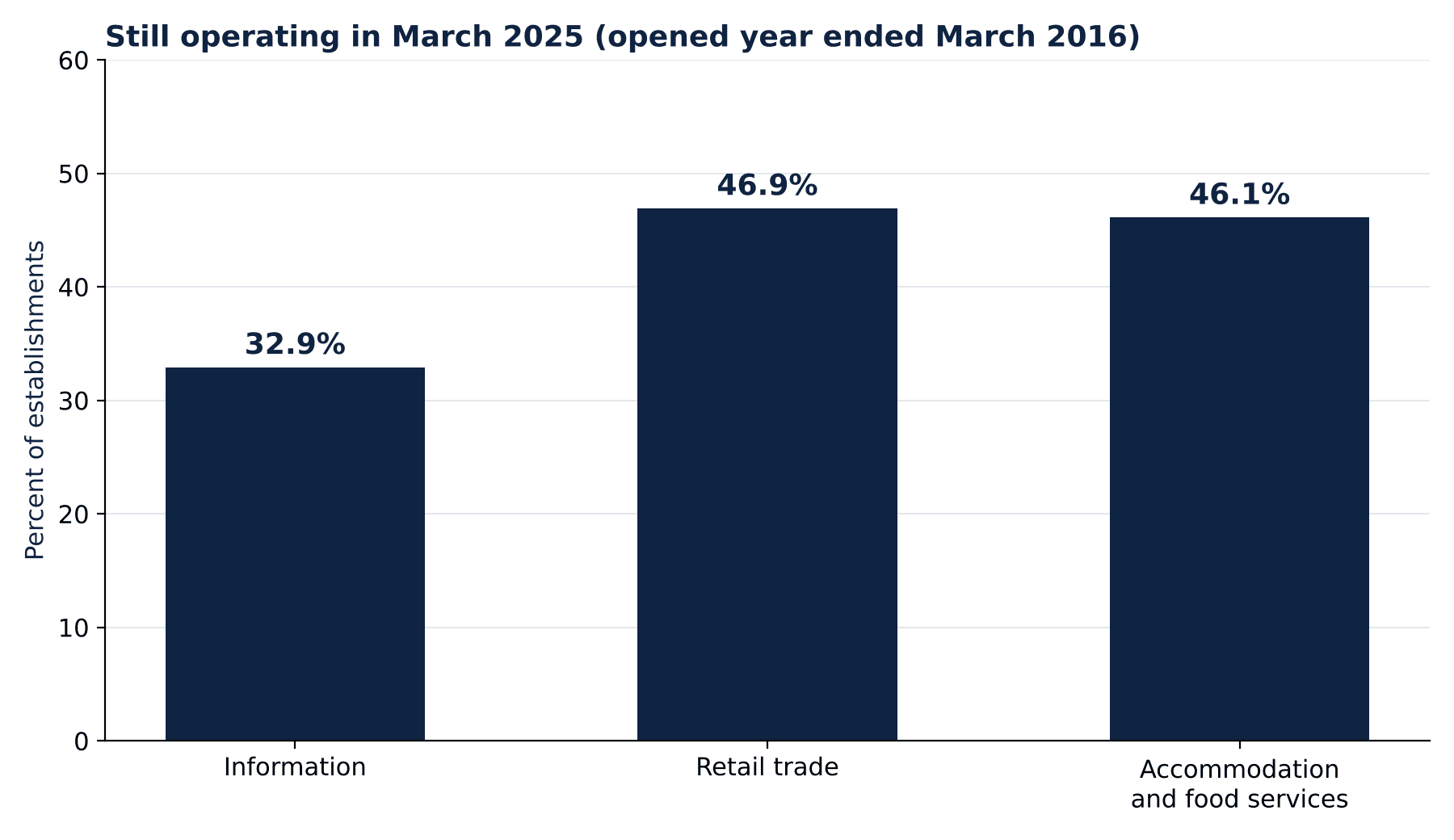
Sector survival data gives useful context. The U.S. Bureau of Labor Statistics (BLS) tracks how many private-sector establishments opened in the year ended March 2016 were still operating in March 2025. The information sector shows 32.9 percent, retail trade shows 46.9 percent and accommodation and food services shows 46.1 percent. These figures count establishments, not firms, and they describe the United States only, and the information sector is broader than SaaS, so the figures give context rather than a template rule. They do show that sectors face different risks, which is a reason to prefer a template built around the sector’s own drivers.
Match the Stage, Because Depth Should Follow the Funding Question
The stage decides how much detail a model needs. A pre-seed founder has few facts and needs a monthly cash view that shows how long the money lasts. A seed company needs revenue drivers linked to a profit and loss statement, a balance sheet and a cash flow statement.
The U.S. Small Business Administration (SBA) guide to writing a business plan tells owners to supplement a funding request with financial projections, to provide a prospective financial outlook for the next five years, and to include forecasted income statements, balance sheets, cash flow statements and capital expenditure budgets. A template that cannot produce those statements is too thin to support a funding request, and one that demands dozens of inputs from a pre-seed founder is too heavy. A pre-seed founder can start with the cash plan and add the three statements before a lender or seed investor asks for them.
The table below sets out the depth to look for at each stage, as editorial guidance rather than a sourced standard.
| Stage | Main question | Depth to look for |
|---|---|---|
| Pre-seed | How many months does the cash last? | Monthly cash plan, few inputs |
| Seed | What must be true to reach the next raise? | Linked three statements, driver-based revenue |
| Growth | How do rounds, hiring and margins interact? | Scenarios, funding rounds, customer-group or per-unit views |
| Mature or listed | Can the numbers be audited and consolidated? | Multi-entity consolidation, full disclosure schedules |
Match the Use Case, Because Outputs Differ for Fundraising and Budgeting
A fundraising model must show a funding need, a sources and uses table, which matches where the money comes from to how it will be spent, and investor returns that can be tested. A budgeting model must compare plan with actuals each month and flag variances. Cash pressure is common among small firms in general. In the Federal Reserve Banks’ 2025 Report on Employer Firms, based on a survey fielded in 2024, 56 percent of U.S. small employer firms cited paying operating expenses and 51 percent cited uneven cash flows as financial challenges.
Access to outside money is also uneven for new firms in the United States. In the Federal Reserve Banks’ 2024 Report on Startup Firms, built on 2023 survey data, 43 percent of startup employer applicants were fully approved for the financing they sought, and the report found that rate below the rate for older employers.
Use a Four-Step Decision Flow to Reach a Shortlist
A decision flow removes most of the catalogue in minutes.
- Filter a catalogue such as the startup financial models at eFinancialModels by industry until the revenue block names the business’s own drivers.
- Filter by stage, rejecting templates that are far deeper or far thinner than the funding question needs.
- Filter by use case, then open the output sheets and confirm that they answer the decision, whether a funding ask or a monthly variance report.
- Keep two or three survivors and score them on build quality, as the next section describes.
A template is not enough for project-financed assets, regulated businesses or pre-revenue research ventures, and a founder in those cases should ask an accountant or a custom modelling service.
A visible sign-off, for example from a CFO (chief financial officer) or an accountant, shows that someone other than the author checked the logic, and customization notes show how much editing the template will need.
Check Build Quality Before Buying
Build quality is easy to inspect and expensive to ignore. In a 2015 paper that summarised inspection studies from 1995 to 2001, Raymond Panko reported errors in 94 percent of the 85 operational spreadsheets examined, so any workbook can hide mistakes until it is checked. The Institute of Chartered Accountants in England and Wales (ICAEW) publishes Twenty Principles for spreadsheets. They say to separate and clearly identify inputs, workings and outputs, to include an About or Welcome sheet that documents the workbook, and to build in checks, controls and alerts from the start.
The Flexible, Appropriate, Structured and Transparent (FAST) Standard is a published set of modelling rules that adds two more tests. It states that rigorous consistency in layout and organisation is essential to a model’s logical integrity over time, and that effective models rest on simple, clear formulas that modellers and non-modellers can both understand. A buyer can apply all five tests in one sitting: inputs separated, an About sheet present, a visible check cell, consistent layout and plain formulas.
Worked Example: Score Three Candidates with a Weighted Matrix
This illustrative example assumes a seed-stage SaaS founder who is comparing Templates A, B and C for a fundraising use case. The founder weights five criteria so that the weights add to 100 percent, then scores each template from 1 (poor) to 5 (excellent), where for ease of customization 5 means the least editing.
| Criterion | Weight | Template A | Template B | Template C |
|---|---|---|---|---|
| Industry fit | 30 percent | 5 | 4 | 3 |
| Build quality and checks | 25 percent | 3 | 5 | 4 |
| Fundraising outputs | 20 percent | 4 | 3 | 5 |
| Ease of customization | 15 percent | 2 | 4 | 3 |
| Reviewer evidence | 10 percent | 3 | 4 | 2 |
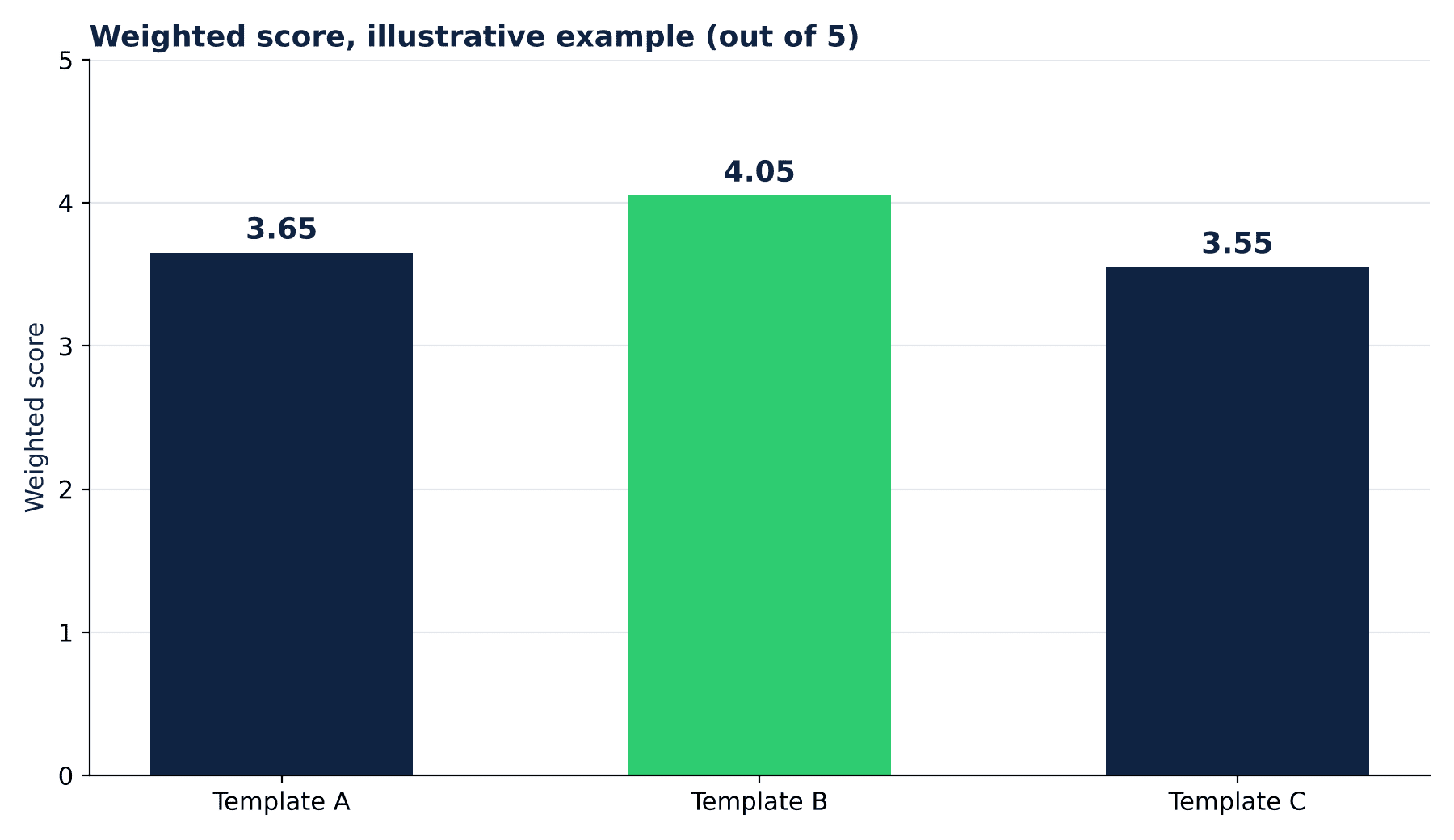
| Weighted score | 100 percent | 3.65 | 4.05 | 3.55 |
For Template B the calculation is 0.30 x 4 + 0.25 x 5 + 0.20 x 3 + 0.15 x 4 + 0.10 x 4 = 1.20 + 1.25 + 0.60 + 0.60 + 0.40 = 4.05. Template A has the best industry fit at 5, yet its middling checks and low ease of customization pull it to 3.65, below Template B. Template C scores 3.55 because its strong fundraising outputs cannot offset the weakest industry fit and reviewer evidence of the three.
Conclusion
The right template is the one whose revenue drivers, depth and outputs match the business and that passes the build-quality tests. A seed-stage SaaS founder, like the one in the worked example, can start with the SaaS Business Financial Model at eFinancialModels, which lists a debt schedule and the option, in some versions, to plan multiple funding rounds, and then run it through the five tests and the weighted scorecard before paying.
Frequently Asked Questions
Can one template serve both fundraising and budgeting?
Sometimes, but the two jobs pull in different directions. A raise needs a long horizon, a funding schedule and clean summary pages for outsiders, while a budget needs monthly granularity and a place to type actuals. A founder who buys one workbook for both should confirm that the monthly sheets can roll up into annual summaries without manual copying. If they cannot, two linked workbooks usually cost less in errors than one overloaded file.
How much customization is reasonable for a first-time founder?
Plan to change inputs, labels and a handful of revenue lines, but avoid rebuilding formulas. Each edited formula is a place where a hidden mistake can enter, and a founder without a modelling background will struggle to trace it. A good test is whether the seller documents which cells are meant to change. If most of the calculation sheets need rewriting, the template is the wrong one, and the search should resume with a closer industry match.
What should a buyer ask a seller before purchasing?
Ask for a sample or screenshots of the output sheets, the list of inputs, the software version required and whether updates are included. Ask who reviewed the logic and when, and how the model handles tax, financing and negative cash. A reply that is specific and quick suggests a maintained product, while vague answers about flexibility usually mean the author has not documented the structure.
Is a free template safe to use for a real raise?
A free template can work for learning, budgeting or a first draft, but it deserves the same inspection as a paid one. Run the five build-quality tests, change one input and watch every dependent output move, and break a check on purpose to see that the warning appears. If the template fails any of these, use it only as a sketch and rebuild the figures before they reach an investor.
How often should a chosen model be updated?
Refresh actuals monthly and review assumptions at every funding event, price change or new product line. A stale model misleads more than no model, because decision makers trust it. Keep a version log on the About sheet with the date, the change and the person who made it, so that a lender or investor can see which numbers belong to which version and why they moved.