
0 ITEMS

Producing Oil & Gas Well (PDP) Acquisition Model | Arps Decline, Realized Pricing & RBL
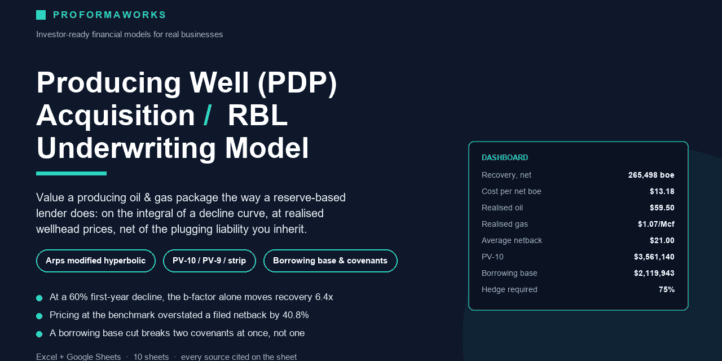
Underwrite a producing oil and gas package the way a reserve-based lender does: on the integral of an Arps decline curve, at realised wellhead prices, and net of the plugging liability a working interest owner inherits. Ten sheets covering the decline engine, realised pricing built from benchmark, basis, BTU, shrinkage and midstream deducts, state severance and ad valorem, PV-10 against the bank’s PV-9 and the strip, borrowing base sizing with published regulatory advance rates, and the redetermination that breaks two covenants at once. Every sourced value cites its source on the same row, and a dedicated sheet lists what the model does not claim to know.
| Financial Model, Manufacturing, Mining Industry, Oil & Gas |
| Break-Even, Business Valuation, Cash Flow Projections, DCF Model, Debt Service Coverage, Financial Due Diligence, Financial Model, Pro-Forma |


Underwrite a producing oil and gas package the way a reserve-based lender does.
This is an acquisition model for interests in wells that are already producing: non-operated working interests, mineral interests and royalty interests. It is not a drilling model, not an LNG or refinery project model, and not a reserve report.
A laundromat is worth a multiple of its earnings. A producing oil and gas package is worth the integral of a decline curve: production falls on its own, every year, and most of the value sits in a tail you cannot verify at closing. Four modelling errors move more money than any negotiation over price, and this workbook intercepts each one in dollars, on the face of a sheet.
1. The b-factor. Holding the observed first-year decline at 60 percent, the Arps b-factor alone moves estimated recovery from 39,835 to 256,418 barrels, a factor of 6.4, and at a b-factor of 1 or more the integral does not converge at all. Five years of production history cannot separate those curves. There is a live table, plus the modified hyperbolic terminal switch the industry uses. The model also shows the three published terminal declines side by side: the official convention of 10 percent a year against the 16.7 and 17.0 percent measured on more than 16,000 wells.
2. Pricing at the benchmark. There is deliberately no cell called gas price. Benchmark, basis differential, BTU factor, shrinkage and midstream deducts, with the realised price calculated. A Permian operator’s filed 2025 figures: oil 62.95 dollars a barrel, gas minus 0.28 dollars per Mcf, NGL minus 1.27 dollars a barrel, against SEC benchmarks of 65.34 and 3.39. Pricing at the benchmark overstates revenue per boe by 28.8 percent and the operating netback by 40.8 percent. The model alerts you when a realised price turns negative, and keeps working when it does.
3. Working interest against net revenue interest. Revenues run on NRI, costs run on the working interest, in separate columns, and NRI is calculated rather than typed.
4. Plugging and the redetermination. A working interest owner inherits the plugging obligation even without operating and even after electing non-consent, while a royalty owner does not. And when a borrowing base is cut it hits twice: the deficiency opens, and because the contractual definition of current assets includes unused availability, the current ratio falls in the same quarter.
Ten sheets: START HERE, Setup, Decline Engine, Realized Pricing, Opex & Taxes, Cash Flow, Valuation, RBL & Covenants, Dashboard, and Sources & Limits. The last one lists every sourced value with its source and, separately, the thirteen things this model does not claim to know, including the fact that it cannot auto-update a forward curve because no free reliable feed for one exists.
Included: the Excel workbook with more than 1,000 formulas, an 11-page PDF user guide with sector benchmarks and the free public data sources for your own due diligence, and a README. Works in Excel and Google Sheets. No macros, no external links. 64 automated quality checks across four independent engines.
Educational and planning tool. Not financial, tax, legal or petroleum engineering advice, and not a reserve report or a reserve estimate under SEC Regulation S-X or SPE-PRMS.
Similar ProductsOther customers were also interested in...



 eFinancialModels
Electric Vehicle (EV) Charging Station Financial M...
With this comprehensive 5- or 10-year monthly tool, investors can assess the viability of setting up... Read more

Financial Model for Mobile App | Mobile App Busine...
The Mobile App Financial Plan Template in Excel allows you to develop financial projections when lau... Read more

 HenrySheykin
Food Truck Financial Model Excel Template
The Food Truck Financial Model helps entrepreneurs, founders, business owners, consultants, and anal... Read more

Green Hydrogen Production from Wind Energy Financi...
The Green Hydrogen from Wind Financial Model aims to comprehensively forecast a horizon of 40 years ... Read more

Simple Mutual Non-Disclosure Agreement Template
Protect your business secrets with ease using our Simple Mutual Non-Disclosure Agreement Template. S... Read more

Solar Energy Financial Model
The Solar Energy Financial Model Spreadsheet Template in Excel assists you in preparing a sophistica... Read more

 Peter Graf
The Customer-Centric Financial Model for Restauran...
Starting a restaurant without a financial plan is like driving a car blindfolded. You wouldn´t do i... Read more
You must log in to submit a review.