0 ITEMS

Mexico Tequila & Mezcal: 879M Litres by 2031
Mexico’s tequila and mezcal industry is on course to produce 879 million liters of combined output by 2031, up from 608.5 million liters in 2025, under the Base Case of the Mexico Distilleries Market Study 2026-2031. Getting there depends on three forces the market is currently mispricing: a 500-million-liter inventory overhang known as the Tequila Lake, a 90 percent collapse in blue Weber agave prices since 2022, and a 26 percent year-on-year fall in US tequila imports through the first nine months of 2025. Together they have compressed valuations to multi-year lows while handing surviving producers a historic input-cost tailwind — exactly the conditions that reward disciplined acquirers. This analysis sets out the supply, demand, pricing, and regulatory picture behind that 879-million-liter Base Case and where the risk-adjusted entry points sit between 2026 and 2031.
Key Takeaways
- Combined tequila + mezcal output reaches 879 million liters by 2031 under the Base Case in the Mexico Distilleries Market Study 2026-2031, up from 608.5 million liters in 2025.
- Blue Weber agave farm-gate prices collapsed 90 percent from a 2022 peak of MXN 35/kg to approximately MXN 8/kg by late 2025, cutting producer input costs by up to 60 percentage points.
- The so-called Tequila Lake — an estimated 500 million liters of unsold finished spirit — is the single largest supply-side drag on 2026 valuations and the primary reason entry prices are compressed.
- US tequila imports fell 26 percent year-on-year in the first nine months of 2025, but the USMCA preferential-origin carve-out (effective 7 March 2025) keeps the effective tariff rate at zero for compliant product.
- RTD canned tequila cocktails hit $4.8 billion in global retail value in 2025 and are the fastest-growing sub-segment in the category.
- Probability-weighted EBITDA per liter for a representative operator in 2031 is approximately USD 3.40 (Bear USD 1.80 / Base USD 3.40 / Bull USD 4.90).
The Industry Today: Structure, Scale, and Concentration
Mexico’s distilled-agave-spirits industry is one of the most geographically concentrated in global beverages. The Consejo Regulador del Tequila (CRT) — the official body that certifies compliance with NOM-006-SCFI-2012, the Mexican Official Standard governing tequila production — registers 3,294 tequila brands, 220 producers, and 43,398 agave producers as of 2025 in its CRT statistical information portal. Mezcal, governed by NOM-070-SCFI-2016 and certified by the Consejo Regulador del Mezcal (CRM/COMERCAM), recorded 11.36 million liters of certified production in 2024 across approximately 200 certified producers.
The top six tequila operators together account for roughly 60 percent of Mexican tequila distillation capacity, according to the Mexico Distilleries Market Study 2026-2031. Becle (Jose Cuervo, 1800, Maestro Dobel) dominates with approximately 150 million liters per year of installed capacity. Diageo (Don Julio, Casamigos), Bacardi (Patrón, El Tesoro), and Pernod Ricard (Olmeca, Altos, Avión, Del Maguey) cluster between 50 and 80 million liters per year each. Behind the top six sits a long tail of approximately 215 smaller producers, most operating under bulk-supply arrangements.
Mezcal’s structure is the mirror image: no single operator holds above 10 percent share, and the most actionable M&A pipeline sits in mid-market independents such as Mezcal Vago (estimated USD 10-15 million revenue), Madre Mezcal, and Casa Azul.
Supply-Side Analysis: The Agave Cycle and the Tequila Lake
The supply side is the leading indicator for every 2026-2031 investment decision in this category. Blue Weber agave (Agave tequilana Weber, blue variety) — the only species permitted under NOM-006 — matures in 6 to 8 years from planting to harvestable piña (the harvested agave heart used in distillation). Espadín agave, dominant in mezcal, matures in 7 to 9 years; wild artisanal species take 12 to 25 years. Planting decisions made in 2018-2020 at the peak of the global tequila boom therefore determined 2024-2027 harvest availability.
Between 2014 and 2023, the planted area of tequila agave expanded 167 percent to approximately 134,000 hectares across Jalisco and adjacent agave-region states, according to Consejo Regulador del Tequila agave and production statistics. The resulting harvest wave that began in 2024 is the proximate cause of two simultaneous supply shocks.
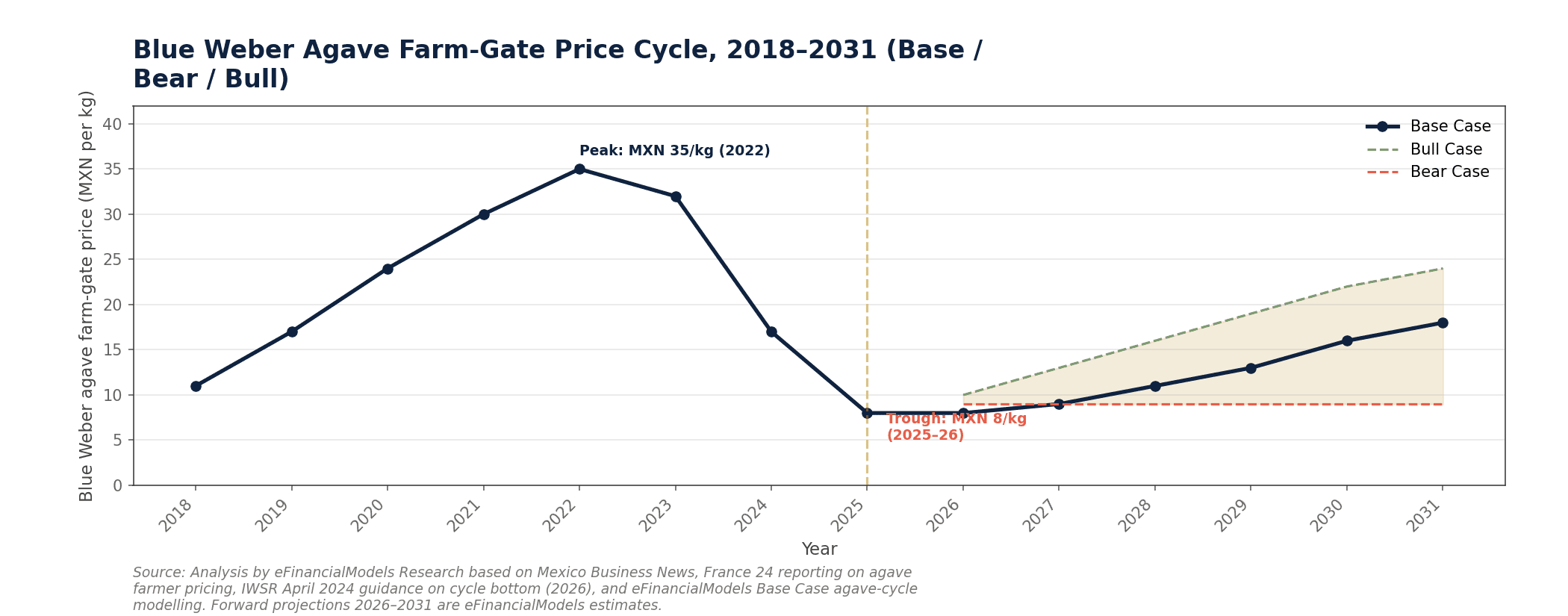
Agave price collapse. Blue Weber farm-gate prices peaked in 2022 at approximately MXN 35 per kilogram. By Q1 2025 they had collapsed to a consensus mid-point of approximately MXN 8 per kilogram — a 90 percent peak-to-trough decline. At 100 percent agave grades, agave is the largest variable cost input, typically 35 to 45 percent of cost of goods sold at peak prices and 10 to 15 percent at trough prices. For a mid-market 100 percent agave tequila with a wholesale price of MXN 280 per liter, the shift from MXN 35/kg to MXN 8/kg (assuming approximately 7 kg of agave per finished liter) reduces per-liter input cost by approximately MXN 175 — a 60-plus percentage-point cost-of-goods benefit that flows through producer P&Ls over the next 18 to 30 months.
The Tequila Lake. By early 2025 the Mexican tequila industry held an estimated 500 million liters of unsold finished spirit and bulk inventory — the stockpile that Mexico News Daily named the Tequila Lake in March 2025. The Base Case treats this overhang as a slow drag on new production through 2026-2027, normalising to 9-12 months of forward demand by 2030.
Production Pipeline: Base Case 2025-2031
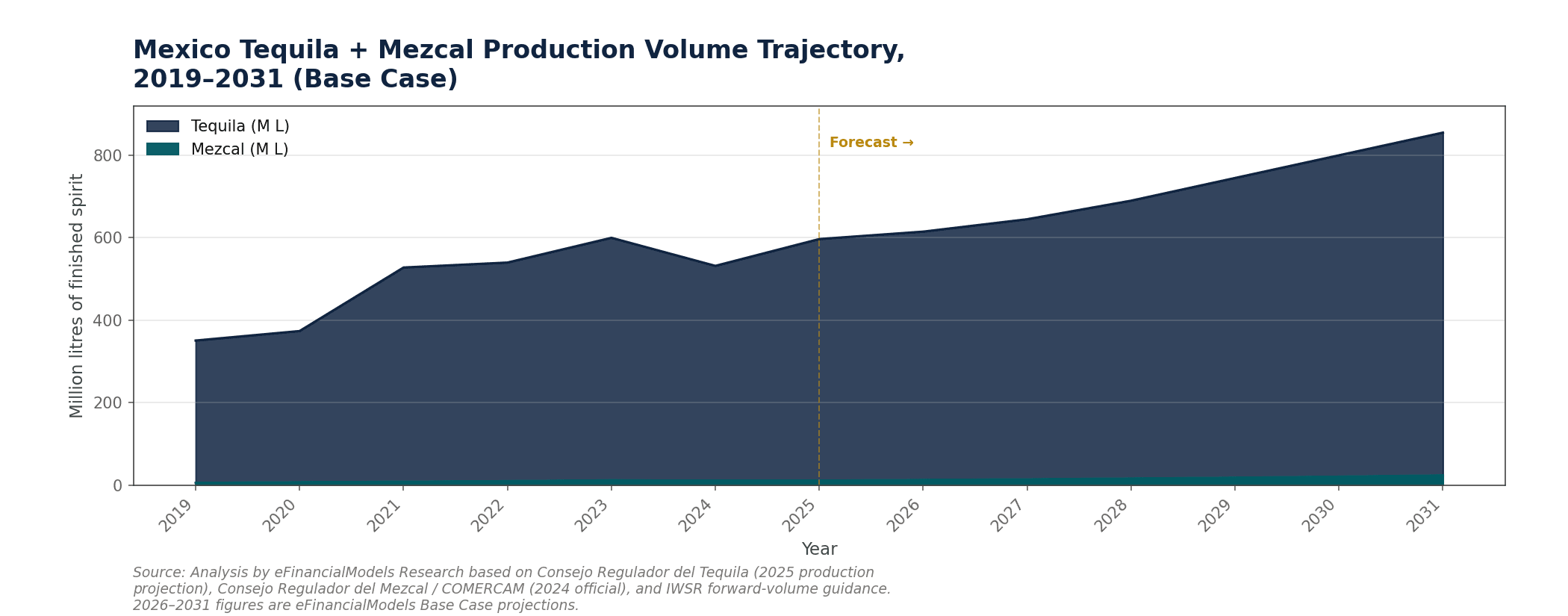
The table below shows the Base Case production trajectory from the eFinancialModels Research model, which is built on the CRT 2025 projection, the CRM/COMERCAM 2024 actual, and IWSR forward-volume guidance. Mezcal compounds faster on a percentage basis, but tequila remains the dominant absolute contributor.
| Year | Tequila (M L) | Mezcal (M L) | Combined (M L) |
|---|---|---|---|
| 2025 | 597 | 11.5 | 608.5 |
| 2026 | 615 | 13.0 | 628.0 |
| 2027 | 645 | 14.5 | 659.5 |
| 2028 | 690 | 16.5 | 706.5 |
| 2029 | 745 | 18.5 | 763.5 |
| 2030 | 800 | 21.0 | 821.0 |
| 2031 | 855 | 24.0 | 879.0 |
Demand-Side Analysis: US Recalibration and the RTD Opportunity
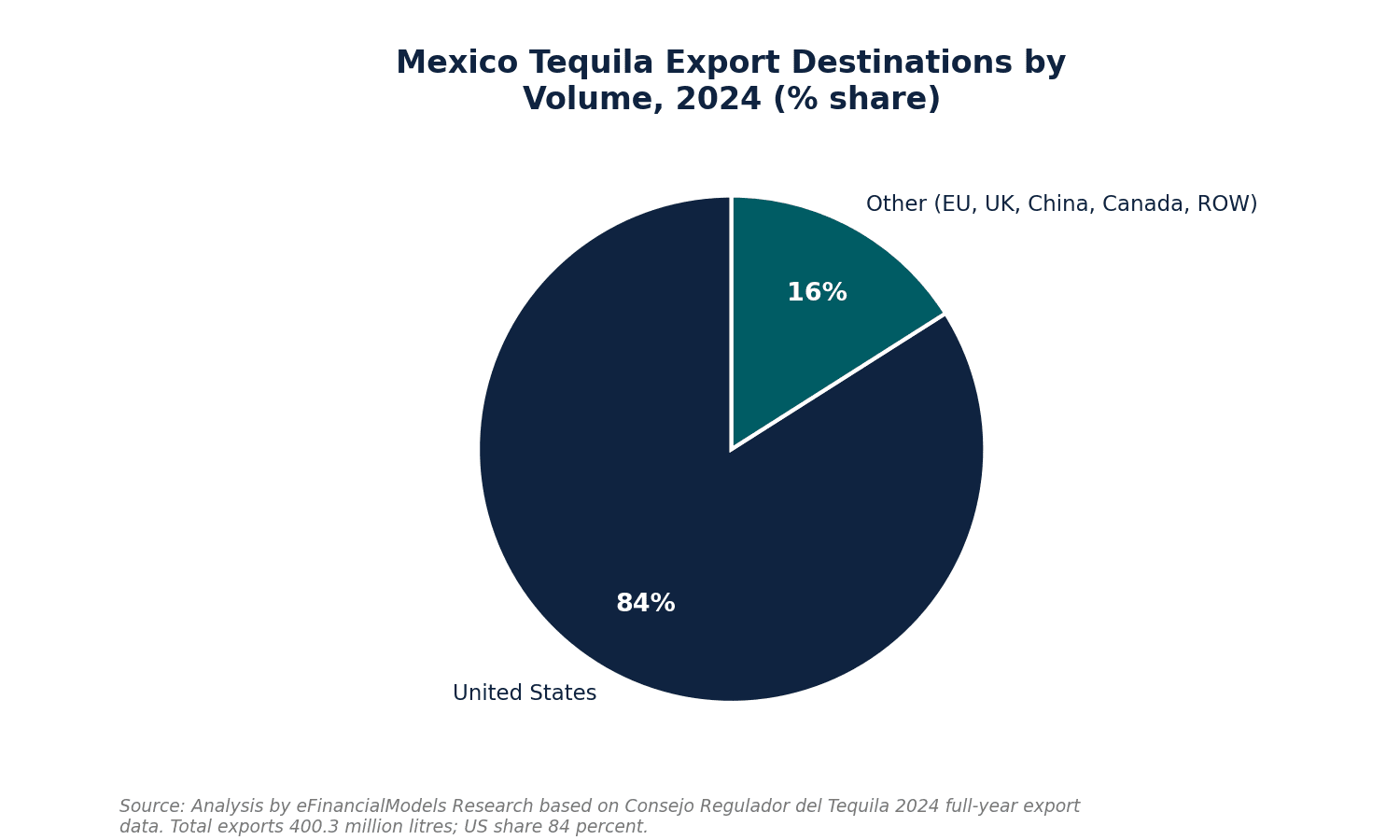
Demand for Mexican tequila and mezcal is heavily concentrated in the United States, which absorbs 84 percent of tequila exports by volume and approximately 68 percent of mezcal exports. The 2024-2025 recalibration in this channel is the most important single demand variable shaping 2026 forecasts.
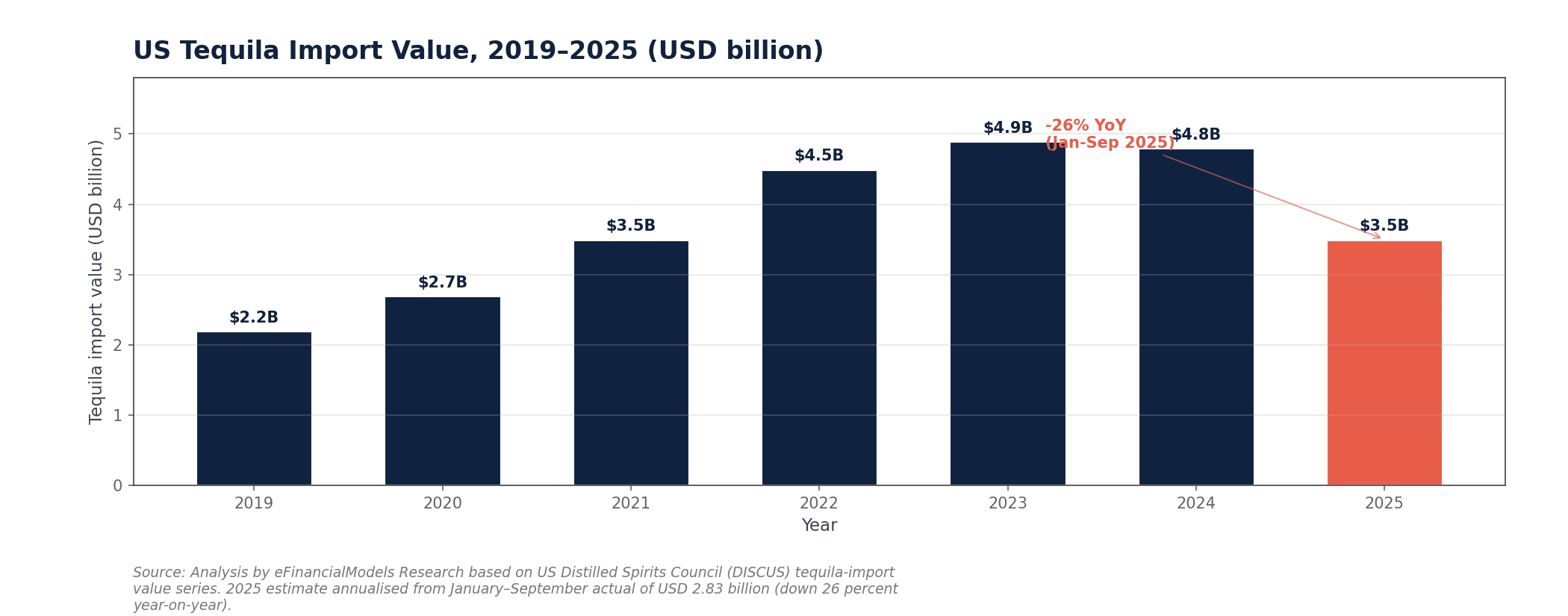
Total US tequila imports by value reached approximately USD 2.83 billion in the first nine months of 2025 — a 26 percent year-on-year decline against the same nine-month window in 2024, according to Distilled Spirits Council of the United States import data. The decline concentrated in the higher tiers: the USD 50-99.99 ultra-premium segment fell 8.8 percent in volume and 9.6 percent in value year-over-year, and the USD 100-plus prestige segment fell 9.3 percent in volume. The USD 20-30 premium segment and sub-USD 20 entry tier proved more resilient. The same Distilled Spirits Council data put total US distilled spirits supplier revenues at approximately USD 37.3 billion in 2024, underscoring the scale of the market into which tequila’s recalibration is occurring.
The driver mix is well understood: post-pandemic consumer-spending normalisation, GLP-1 weight-loss drug adoption (which trims alcohol consumption at the margin), generalised depremiumisation across spirits, and category-specific fatigue after several years of double-digit tequila growth. IWSR projects tequila category growth slowing to 1 percent by mid-2026 before re-accelerating; the Base Case models recovery to 3-4 percent annual category growth by 2028-2031.
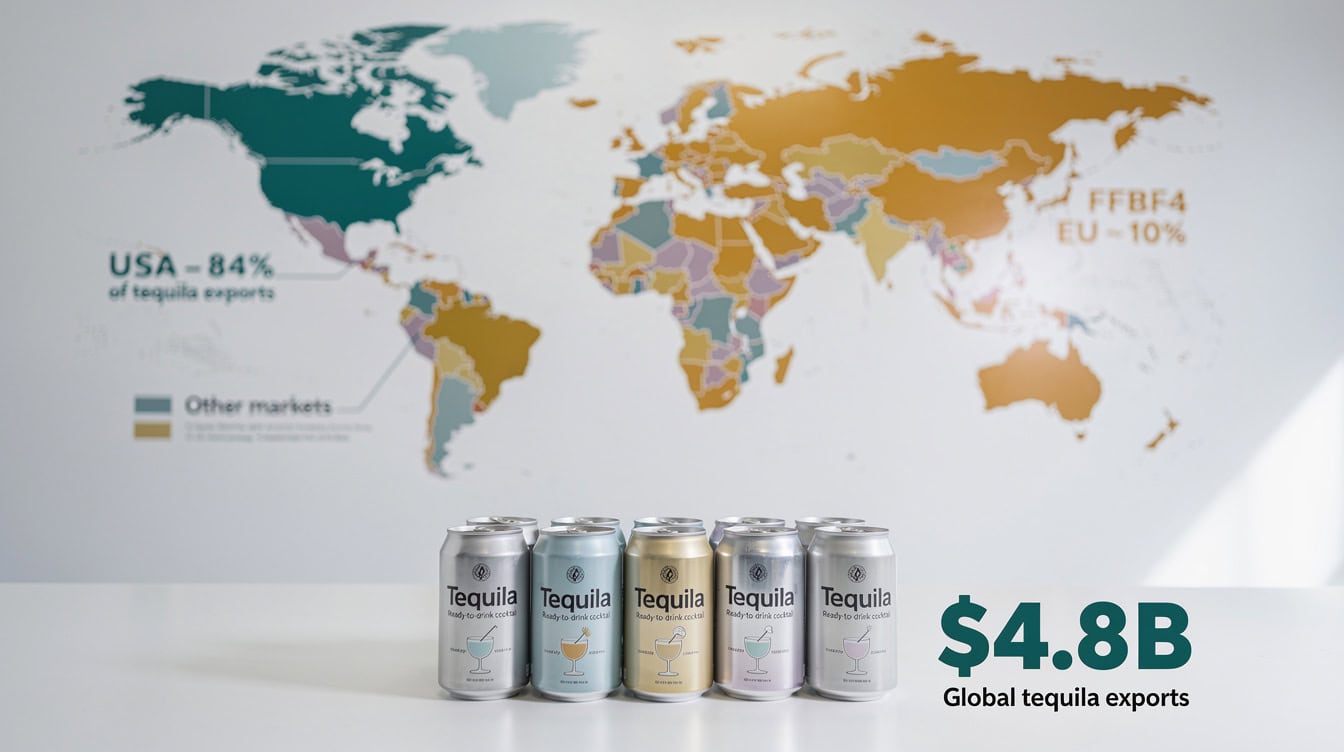
RTD canned tequila cocktails (ready-to-drink sealed single-serve containers, typically 5-9 percent ABV) are the standout growth pocket. The global tequila-RTD market reached USD 4.8 billion in global retail value in 2025, with brands including Onda, Volley, High Noon Tequila, Cazadores Spritz, and Casa Azul leading the wellness-RTD positioning. The Base Case projects global RTD tequila retail value reaching USD 8.7 billion by 2031.
Rest-of-world export markets — the EU (anchored by Spain, Germany, France, Italy), the UK, China, Japan, Australia, and Canada — absorb approximately 16 percent of tequila exports by volume. China and East Asia are now the fastest-growing tequila export destinations on percentage terms, though from under 2 percent of exports in 2024.
Pricing, Margins, and the Worked EBITDA Example
Producer economics in 2026 are shaped by three simultaneous forces: depressed agave input costs, a compressed wholesale price environment from the inventory overhang, and a premiumisation thesis that survives the cyclical wobble at the USD 20-50 tier.
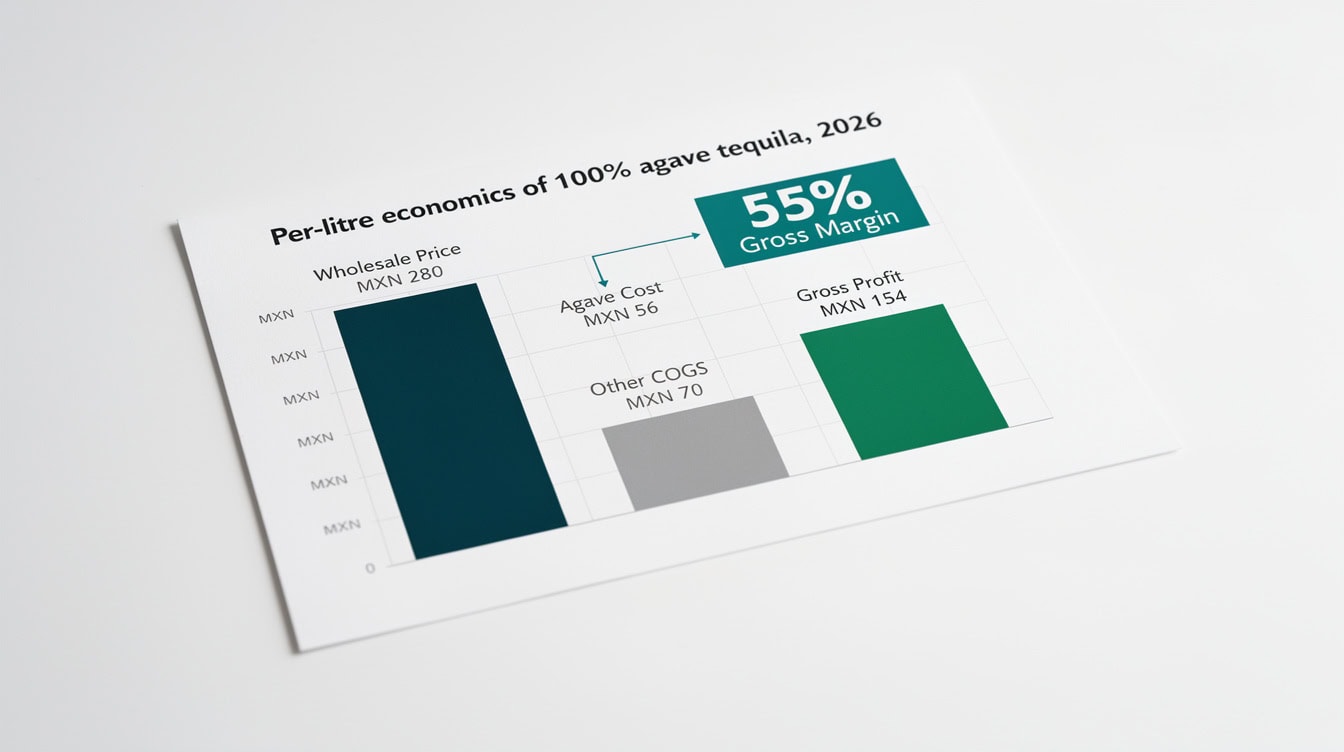
Here’s the math for a representative mid-market 100 percent agave tequila producer in the Base Case:
- Wholesale price per liter: MXN 280 (approximately USD 15.10 at MXN 18.5/USD)
- Agave cost at MXN 8/kg, 7 kg/liter: MXN 56 per liter
- Other COGS (production, packaging, aging): MXN 70 per liter
- Total COGS: MXN 126 per liter
- Gross margin: (MXN 280 – MXN 126) / MXN 280 = 55 percent
- EBITDA per liter (after SG&A and distribution, Base Case 2031): approximately USD 3.40
For comparison, the same producer paying MXN 35/kg in 2022 carried agave cost of MXN 245 per liter — nearly the entire wholesale price — leaving gross margin below 15 percent. The 2025-2026 agave trough is therefore a structural margin tailwind of historic proportions for operators who locked in supply at current prices.
The three-scenario EBITDA range for 2031: Bear approximately USD 1.80 per liter (probability 25 percent), Base approximately USD 3.40 per liter (probability 50 percent), Bull approximately USD 4.90 per liter (probability 25 percent). Probability-weighted expectation: approximately USD 3.40 per liter.
Three Scenarios: Bear, Base, and Bull Through 2031
The 2031 outlook depends primarily on three variables: the pace of US demand recovery, the USMCA tariff carve-out status, and the speed of the Tequila Lake drawdown.
| Scenario | Probability | 2031 Combined Output | Key Driver | EBITDA/Liter |
|---|---|---|---|---|
| Bear | 25% | ~720 M L | USMCA partial reversal + prolonged US softness | USD 1.80 |
| Base | 50% | 879 M L | US recovery by 2028, RTD growth, agave normalisation | USD 3.40 |
| Bull | 25% | ~980 M L | Fast RTD demand pull, emerging-market acceleration | USD 4.90 |
The Bear Case trigger is a partial reversal of the USMCA tequila carve-out at the 1 July 2026 mid-term review — assessed at approximately 20 percent likelihood. A 25 percent tariff on non-USMCA-compliant product would add approximately USD 3.75 per liter to landed cost in the US, effectively eliminating margin for bulk-export operators and compressing branded-product margins by 8-12 percentage points.
The Bull Case requires RTD bulk demand to absorb the Tequila Lake faster than the Base Case (by 2028 rather than 2030) and emerging-market exports to accelerate from under 2 percent to 5-6 percent of total volume.
Regulatory and Policy Context

Mexico’s distilled-agave-spirits industry operates under two anchor standards plus a layered set of federal and bilateral trade frameworks.
NOM-006-SCFI-2012 (Tequila) defines the Denomination of Origin (DO) scope across five states and approximately 180 municipalities, two production classifications (100 percent agave vs mixto, with mixto requiring a minimum 51 percent blue Weber agave), five age categories (Blanco/Plata, Joven/Oro, Reposado at minimum 2 months, Añejo at minimum 12 months, Extra Añejo at minimum 3 years), and permitted additives. Notably, the Reposado category requires a minimum aging period of 2 months in oak containers under the Consejo Regulador del Tequila maturation rules, while Extra Añejo must rest for a minimum of 3 years, making barrel-inventory working capital a critical planning variable for producers in these premium age categories.
NOM-070-SCFI-2016 (Mezcal) defines the DO scope across eleven states, three classifications (Mezcal Ancestral, Mezcal Artesanal, Mezcal), and requires 100 percent agave with no permitted additives.
US tariff regime. On 4 March 2025 the United States imposed a 25 percent tariff on goods from Mexico under IEEPA authority. On 7 March 2025, the administration carved out USMCA-qualifying goods — including tequila and mezcal under HTS subheading 2208.90 — from the additional tariff. The effective rate on USMCA-compliant product therefore remains zero. The 1 July 2026 USMCA mid-term review is the key regulatory watch item for the next 18 months.
Mexican IEPS (Impuesto Especial sobre Producción y Servicios, the federal excise tax on spirits) remains at 53 percent of production value for spirits above 20 percent ABV, unchanged through 2025.
Tequila has held EU Geographical Indication (GI) protection since the 1997 Mexico-EU agreement; mezcal received EU GI protection in 2019. Both protections remain in force and were reaffirmed in the 2024 EU-Mexico Global Agreement update.
Common Mistakes Investors Make in This Category
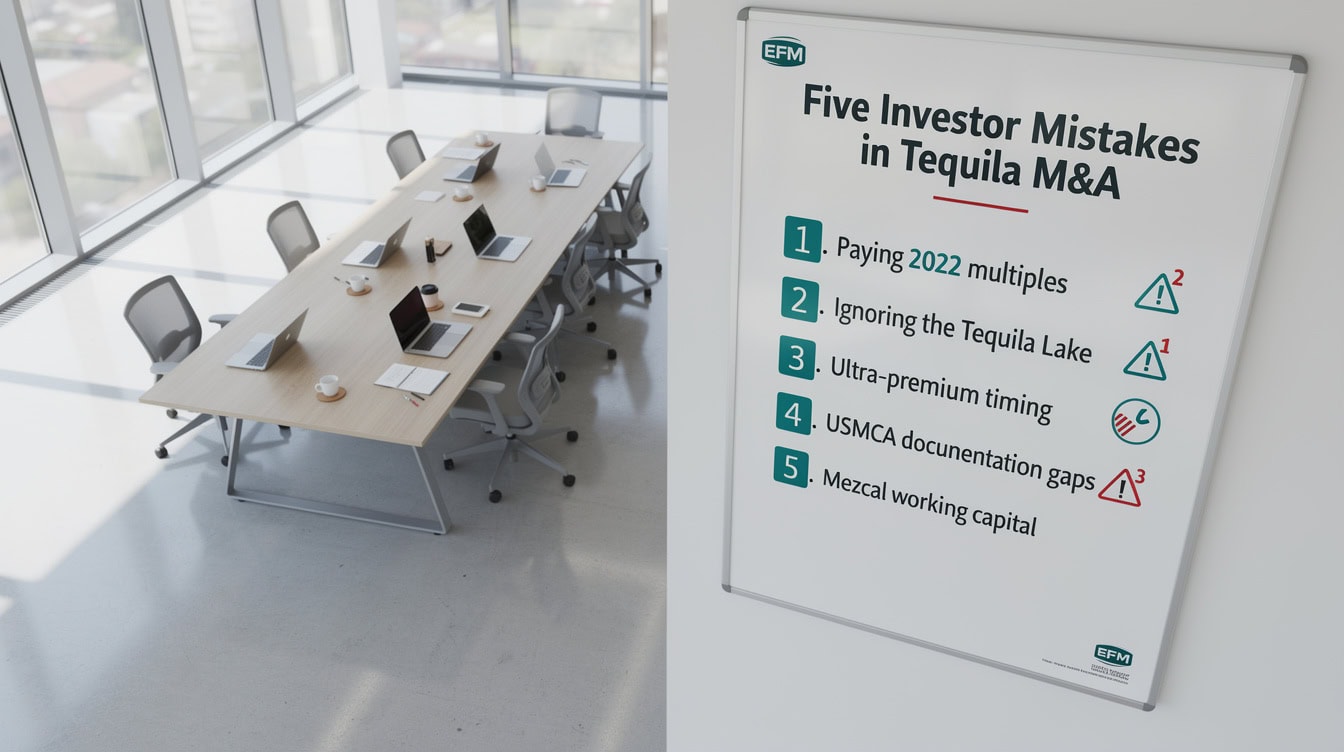
Five specific errors have destroyed value in tequila and mezcal M&A over the past five years.
1. Paying 2022-era multiples in 2026. Brand valuations compressed materially from 2022 peaks as US demand recalibrated. Acquirers who anchor to 2022 transaction comparables will overpay by 30-50 percent on EV/EBITDA multiples. Use 2025-2026 trailing EBITDA at current agave costs as the base, not peak-cycle revenue.
2. Ignoring the Tequila Lake in working-capital models. The 500-million-liter inventory overhang suppresses bulk-export prices and delays new-production revenue recognition. Any DCF (discounted cash flow) model that ignores the drawdown timeline will overstate near-term cash generation by 2-3 years.
3. Buying ultra-premium exposure at the wrong point in the cycle. The USD 50-99.99 and USD 100-plus tiers fell 8.8 percent and 9.3 percent in US volume in 2025. Acquirers targeting prestige brands should model a 2-3 year volume trough before premiumisation resumes, not a straight-line recovery.
4. Skipping USMCA-compliance documentation. Any acquisition of a Mexican tequila or mezcal producer must include pre-close verification of USMCA preferential-origin compliance. A single documentation gap converts a zero-tariff product into a 25 percent tariff product overnight.
5. Underestimating aged-inventory working capital in mezcal. A single-village ultra-premium mezcal brand needs 3 to 5 years of aging stock before reaching reported-margin steady state, locking up multiples of annual revenue in unsold inventory. Models that treat mezcal working capital like tequila will understate funding requirements by 40-60 percent.
Frequently Asked Questions
What is the Tequila Lake and why does it matter for investors?
The Tequila Lake is the industry shorthand for the approximately 500 million liters of unsold finished spirit and bulk inventory that accumulated in the Mexican tequila industry through 2024-2025. It formed because producers expanded distilling capacity in 2021-2023 to meet rising forward demand expectations, then faced a sudden demand-and-export downshift in 2024. For investors, the Tequila Lake matters because it suppresses bulk-export prices, delays the recovery of new-production economics, and creates a 2-3 year drag on EBITDA per liter. The Base Case projects the overhang normalising to 9-12 months of forward demand by 2030. Acquirers should model this drawdown explicitly in any DCF analysis and not assume a straight-line return to 2022-era margins.
How does the USMCA carve-out protect tequila exports from US tariffs?
On 7 March 2025, the US administration carved out goods qualifying for preferential origin under the United States-Mexico-Canada Agreement (USMCA) from the 25 percent tariff imposed on Mexican goods on 4 March 2025. Tequila and mezcal qualify under HTS subheading 2208.90, so the effective tariff rate on USMCA-compliant product remains zero. The critical watch item is the 1 July 2026 USMCA mid-term review: a partial reversal of the carve-out is the Bear Case scenario, assessed at approximately 20 percent likelihood. Operators and acquirers should maintain USMCA-compliance documentation pre-close and budget for a partial-tariff scenario in sensitivity analysis.
What is the difference between 100 percent agave tequila and mixto?
Under NOM-006-SCFI-2012, tequila falls into two production classifications. 100 percent agave tequila uses only fermentable sugars derived from blue Weber agave (Agave tequilana Weber, blue variety). Mixto tequila uses a minimum 51 percent blue Weber agave sugars, with the remaining up to 49 percent coming from other sugar sources (typically cane sugar). The distinction matters commercially because 100 percent agave commands a significant price premium and dominates the USD 20-plus retail tiers. At the USD 50-plus ultra-premium and prestige tiers, virtually all product is 100 percent agave. Agave is the largest variable cost input at 100 percent agave grades, typically 35-45 percent of COGS at peak agave prices.
Why is RTD canned tequila the standout growth sub-segment?
Ready-to-drink (RTD) canned tequila cocktails are sealed single-serve containers, typically 5-9 percent ABV, that combine tequila with juice, soda, or other mixers. The global tequila-RTD market reached USD 4.8 billion in retail value in 2025 and the Base Case projects it reaching USD 8.7 billion by 2031. RTD growth is driven by three structural forces: convenience and portability, wellness-oriented positioning (real-fruit-juice, clean-label brands like Onda and Volley), and the ability to reach consumers who do not purchase full-size spirit bottles. For operators, RTD also provides a channel to absorb bulk tequila inventory from the Tequila Lake, converting surplus Blanco spirit into finished RTD product at higher retail value per liter of alcohol.
What capex does a greenfield tequila distillery require in 2026?
A representative greenfield 100 percent agave tequila distillery sized at 5 million liters per year of finished-spirit capacity carries capex of approximately USD 18 to 24 million today. The breakdown: USD 6.0-8.0 million for hornos (autoclaves and traditional brick ovens used to cook the agave piña), USD 3.5-4.5 million for fermentation tanks and distillation columns, USD 2.5-3.5 million for aging-warehouse infrastructure, USD 2.0-3.0 million for bottling line, and USD 4.0-5.0 million for site, permits, regulatory certification, and contingency. A representative artisanal mezcal palenque (small-scale traditional distillery) sized at 50,000-150,000 liters per year sits at USD 0.5-1.5 million all-in, dominated by traditional pit-oven construction and master-mezcalero compensation.
Which tequila and mezcal sub-segments offer the best risk-adjusted returns through 2031?
The eFinancialModels Research ranking for 2031 under the Base Case places Jalisco Highlands premium tequila brands at sub-USD 50 million revenue in the top decile, Oaxaca Sierra Sur ultra-premium single-village mezcal in the top quintile, and wellness-RTD canned tequila pure-plays at sub-USD 200 million enterprise value also in the top quintile. Mid-tier positions go to Jalisco Lowlands bulk-supply operators with RTD customer concentration. The bottom quintile is ultra-premium and prestige tequila brands priced at 2022-era multiples. Acquirers should overweight the top-decile and top-quintile categories and avoid the bottom-quintile category entirely until premiumisation resumes in 2028.
How does mezcal regulation differ from tequila regulation?
Mezcal is governed by NOM-070-SCFI-2016 and certified by the CRM/COMERCAM, while tequila is governed by NOM-006-SCFI-2012 and certified by the CRT. The key differences: mezcal must be 100 percent agave with no permitted additives (tequila allows up to 1 percent additives in non-Blanco grades and permits mixto production); mezcal’s Denomination of Origin spans eleven states (tequila covers five states); and mezcal has three production classifications (Ancestral, Artesanal, Mezcal) that reflect the degree of traditional versus industrial production method. Mezcal Ancestral requires pre-Columbian production methods only, commanding the highest price premiums. The proposed Oaxaca state-level Ley de Desarrollo Sustentable de Maguey-Mezcal, not yet enacted as of 2025, would add sustainability and species-registry requirements that could further lift the floor for certified artisanal product.
Conclusion: 2026 Is the Entry Window — Act With Selectivity
Mexico’s tequila and mezcal industry offers a rare combination of compressed valuations, a structural cost tailwind from the agave price trough, and a credible growth path to 879 million liters by 2031. The Tequila Lake and the US demand recalibration are real headwinds, but they are time-bounded: the Base Case resolves both by 2028-2030. The USMCA carve-out protects the zero-tariff status of compliant product through at least mid-2026, and the RTD canned cocktail sub-segment provides a structural demand pull that did not exist in prior cycles.
Selectivity is the discipline that separates value creation from value destruction in this window. Target Jalisco Highlands premium brands and Oaxaca artisanal mezcal at current valuations. Avoid 2022-era ultra-premium multiples. Lock in forward agave contracts at 2025-2026 prices. Build USMCA-compliance documentation before close.
I recommend starting your investment analysis with the Mexico Distilleries Market Study 2026-2031, which provides the full demand-supply model, three-scenario EBITDA projections, competitive landscape, and the Base Case pricing assumptions that feed directly into project-level financial modeling. For comparable market studies in adjacent spirits markets, the UK Distilleries Market Study 2026-2031, Ireland Distilleries Market Study 2026-2031, and France Distilleries Market Study 2026-2031 provide the cross-market benchmarking context that serious acquirers need.