0 ITEMS

France Distilleries 2026-2031: Cognac Down 15%, What’s Next

French distilleries enter the 2026-2031 window in their deepest cyclical reset since the 2008-09 financial crisis, with Cognac shipments collapsing and new tariff regimes reshaping every export route.
Key Takeaways
- Cognac shipped only 141 million bottles globally in 2025, a 15.1% single-year decline — the steepest drop since 2008-09, with VS down 16.2%, VSOP down 11.5%, and XO-and-above down 23.2% (BNIC).
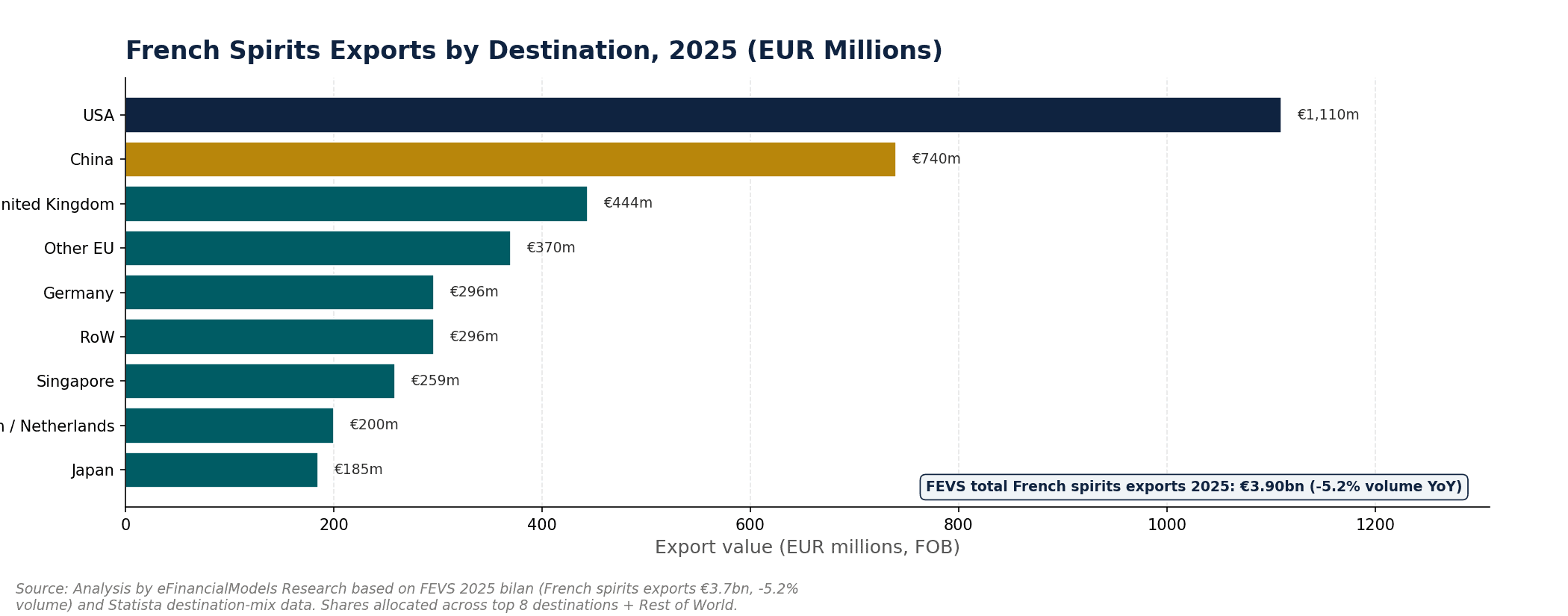
- French spirits total export value fell to EUR 3.7 billion in 2025, the third consecutive annual decline, with volume down 5.2% to 43.95 million 9-liter cases (FEVS Bilan 2025).
- China’s MOFCOM imposed a 34.9% anti-dumping duty on EU brandy from 5 July 2025, exempting 34 named companies including LVMH-Hennessy, Pernod-Martell, and Rémy Martin on minimum-price commitments.
- The US 15% baseline tariff on EU spirits is the single largest 2026-2031 demand-side variable; a threatened 200% rate would compress representative Cognac négociant EBIT by an estimated 45-60%.
- French whisky distillery count grew from roughly 10 in the early 2010s to approximately 145 by 2025, with category turnover on a trajectory to exceed EUR 2.9 billion within a few years.
- The base case (55% probability) projects French spirits export value recovering to approximately EUR 4.5 billion by 2031, driven by partial Cognac shipment recovery from 2027 onward.
- 2026-2027 represents the best distressed-entry window since 2009, with Cognac négociants, Armagnac estates, and Calvados producers all available at materially discounted multiples versus the 2022-2023 peak.
The State of French Distilleries in 2025
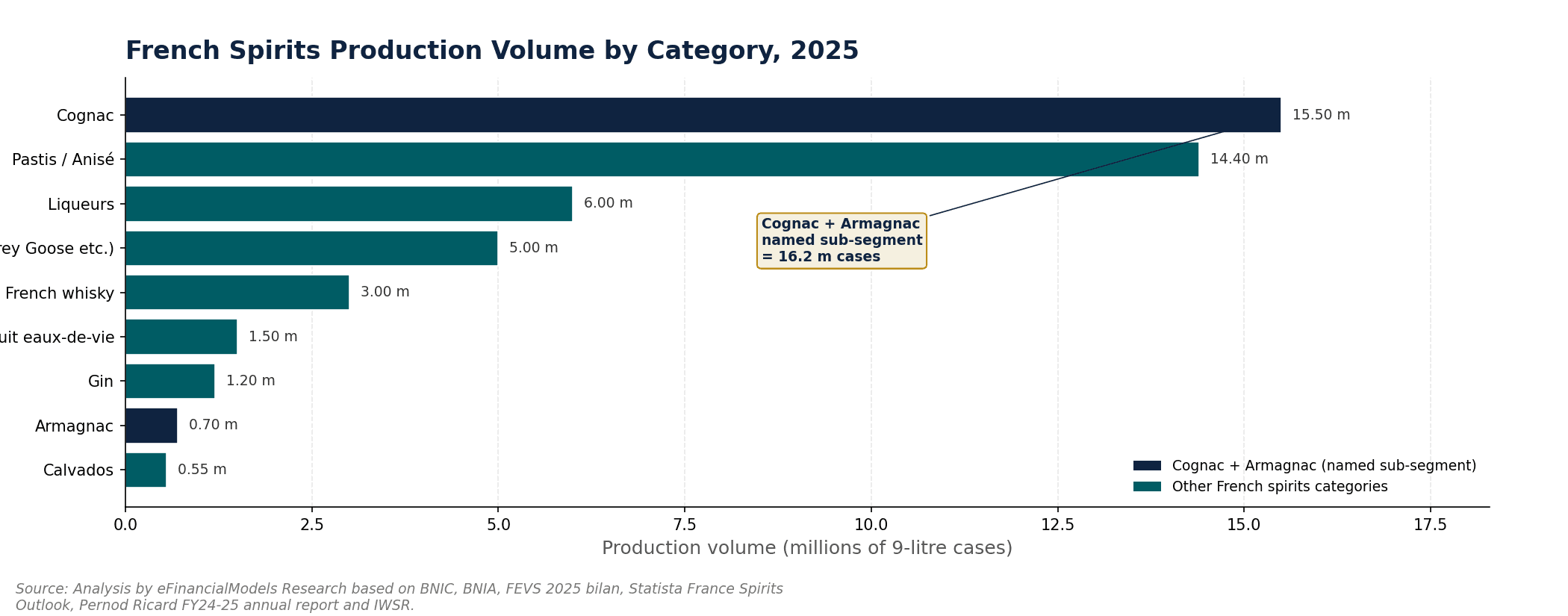
France’s distilleries landscape is more diverse than any other national distilling cluster in Europe, spanning Cognac, Armagnac, Calvados, pastis, French whisky, gin, premium vodka, fruit eaux-de-vie, and liqueurs. The 2025 snapshot, however, is dominated by one story: Cognac’s historic demand collapse.
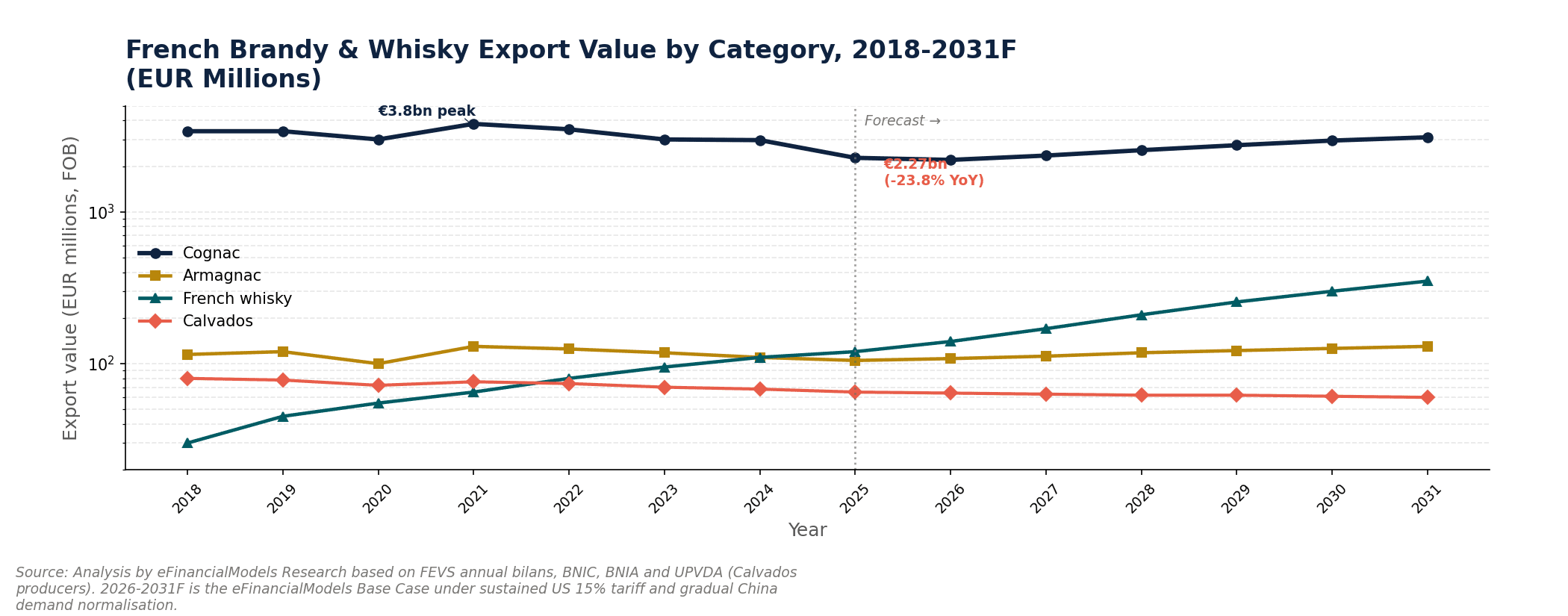
Cognac — an AOC (Appellation d’Origine Contrôlée, meaning a French regulated origin designation administered by INAO) brandy produced exclusively in the Charente region — shipped roughly 141 million bottles globally in 2025, a 15.1% decline on 2024 according to BNIC (Bureau National Interprofessionnel du Cognac). French export value for Cognac fell 23.8% to EUR 2.27 billion (FEVS), with BNIC data implying a 25.3% global value decline. The broader French spirits export envelope contracted to EUR 3.7 billion in 2025, the third consecutive year of decline, with volume down 5.2% to 43.95 million 9-liter cases (FEVS Bilan 2025).
Beyond Cognac, the picture is one of divergent trajectories. Armagnac — France’s other AOC brandy, produced in Gascony — holds at 6-7 million bottles per year across approximately 800 vineyards, 300 distillers, and 40-50 négociants (merchant-blenders who buy bulk eau-de-vie from growers and produce branded products), with 70% of volume consumed domestically and 30% exported (BNIA). Calvados, Normandy’s apple and pear AOC brandy, ships roughly 5 million bottles per year from about 300 producers and is structurally declining outside a super-premium pocket. Pastis remains the volume anchor of the domestic French market, with Pernod Ricard’s Ricard brand alone accounting for roughly 130 million liters of consumption per year in France. France is home to more than 500 active distilleries across all categories (Spirits Business), reflecting the breadth of the national distilling cluster beyond the headline Cognac figures.
The Two Tariff Shocks Reshaping Export Economics
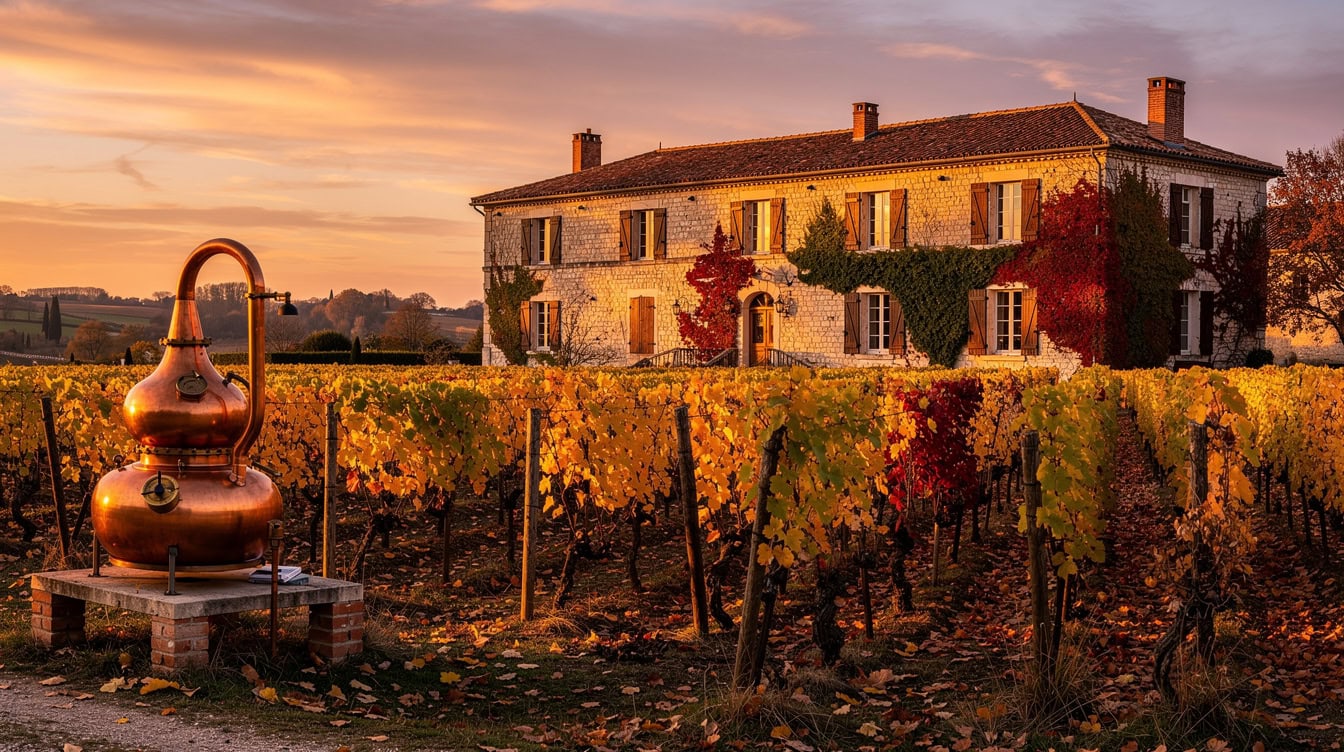
Two simultaneous tariff events in 2025 created the most hostile export environment for French spirits in a generation. Understanding both is essential for any financial model covering this sector.
China’s anti-dumping duty: China’s MOFCOM issued its final ruling on 4 July 2025, imposing a 34.9% anti-dumping duty on EU brandy effective 5 July 2025 for five years. The ruling exempted 34 named companies — including LVMH-Hennessy, Pernod-Martell, and Rémy Martin — on minimum-price commitments ranging from CNY 46 per liter for VS-grade Cognac up to CNY 613 per liter for XXO. This creates a two-tier landscape: the Big-4 négociants operate under price floors that constrain volume growth but avoid the full duty, while all other EU brandy exporters face the 34.9% rate in full.
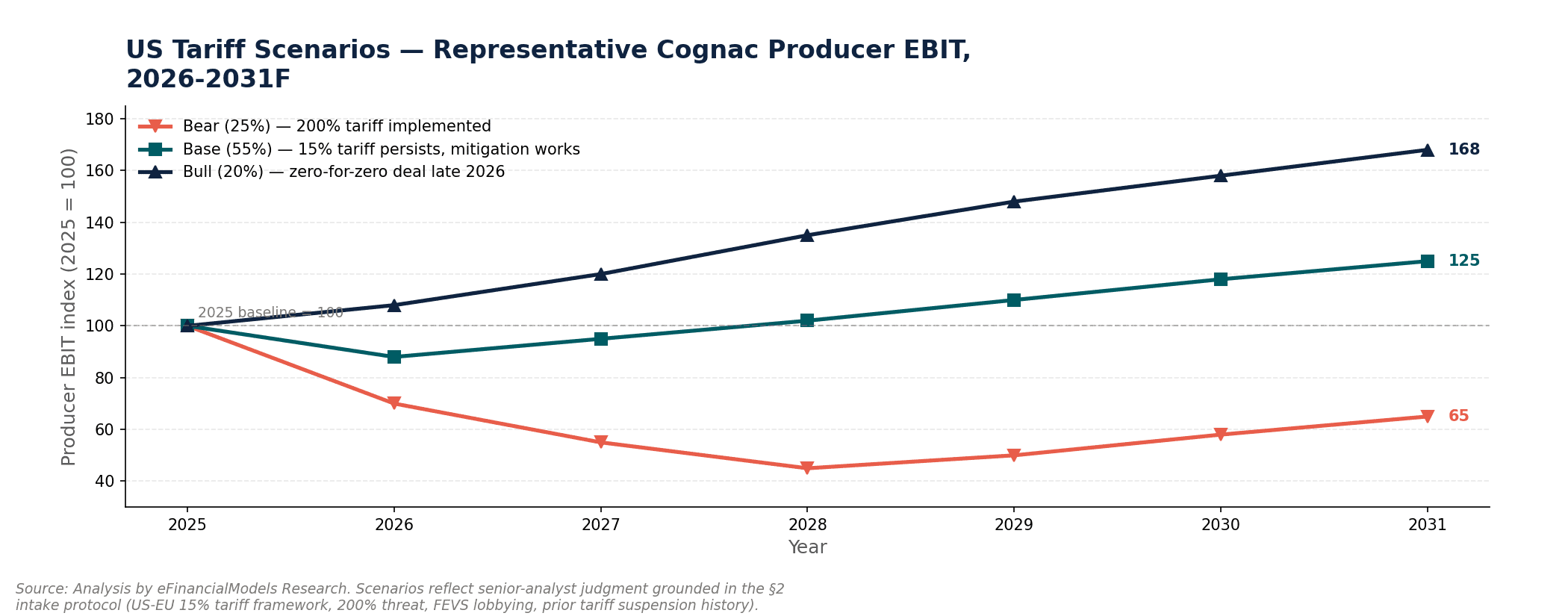
US baseline tariff: The United States moved EU spirits from MFN-zero to a 15% baseline tariff in summer 2025. On 20 January 2026, the Trump administration threatened a 200% tariff on French wine, Champagne, and spirits. For a representative export-heavy French Cognac négociant with EUR 200 million in revenue and approximately 50% US export exposure, the net EBIT impact of the 15% US tariff alone is estimated at roughly -12 to -18% in the first 12-18 months. The 200% threat scenario, if implemented, would compress representative EBIT by an estimated -45 to -60% and trigger category-wide consolidation.
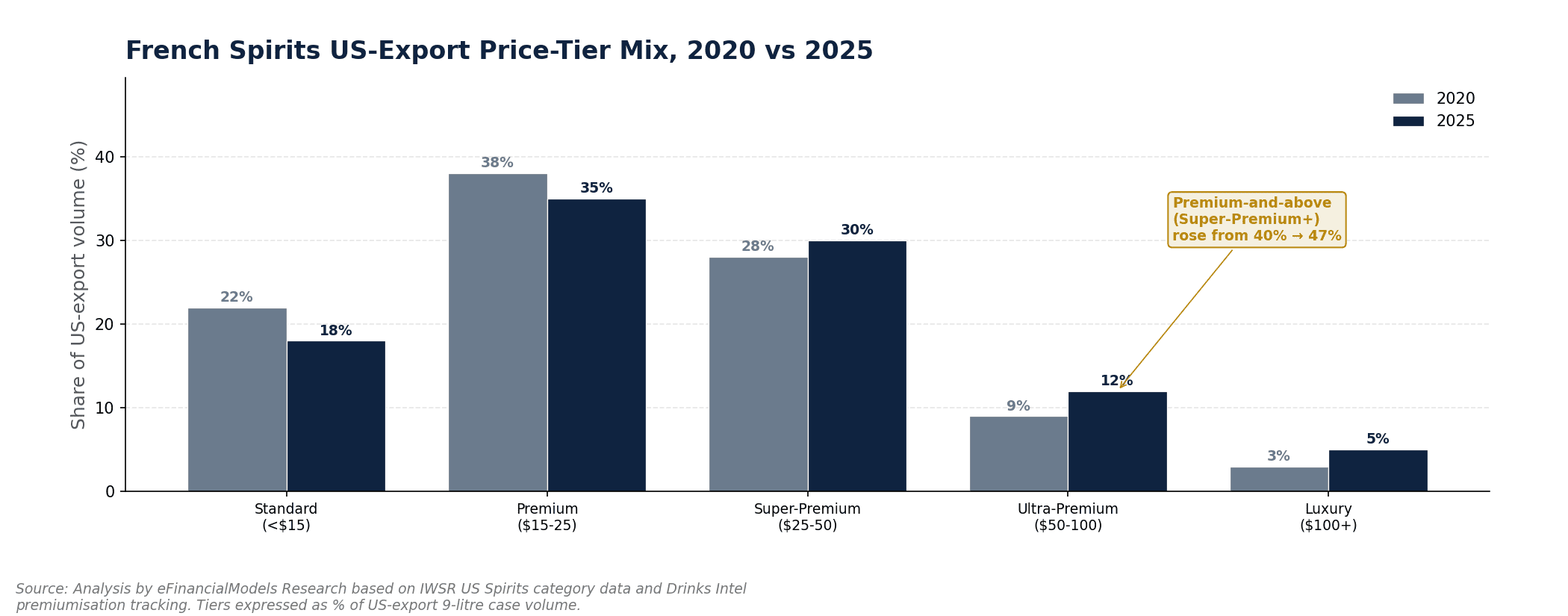
Tariff pass-through is asymmetric across price tiers. At the VS standard tier (spirits priced below approximately $15 per 750ml), demand is more price-elastic and the producer absorbs roughly 50-60% of the tariff through a reduced shipper-gate price. At the XO and prestige tiers ($50-100+ per 750ml), consumer pull is stronger and only 10-20% of the tariff falls on the producer, with the balance passing through distributor margin and shelf-price uplift.
Supply-Side Reset: The BNIC Yield Cut and Vineyard Uprooting
The supply-side response to Cognac’s demand collapse is the most consequential structural intervention in Charente vineyard economics in two decades. The BNIC set the 2025-26 marketing-year AOC yield at 7.65 hl AP/ha (hectolitres of pure alcohol per hectare) — the lowest level since 2004-05 and approximately 45% below boom-year yield levels. Combined with the BNIC and FranceAgriMer vineyard uprooting program, which pays EUR 10,000 per hectare (EUR 6,000 BNIC CVO supplement plus EUR 4,000 FranceAgriMer national premium), the AOC mechanism is permanently rebalancing Charente supply at a lower equilibrium. The Cognac AOC delimited area covers approximately 79,000 hectares of vineyards in the Charente and Charente-Maritime departments (BNIC), of which roughly 75,000 hectares are currently planted, making the scale of the uprooting program financially significant even at a 5-10% reduction target.
The eFinancialModels research team treats this uprooting as permanent supply destruction, not a temporary adjustment. The long-run Cognac vineyard area is projected to decline approximately 5-10% from the 2024 base, with an associated long-run shipment ceiling below the 2022 peak. For financial modellers, this reshapes terminal-value cash flows in any 2031+ DCF model for Cognac producers.
Bulk eau-de-vie pricing (the per-hectolitre price négociants pay growers for unaged spirit) softened materially through 2024-2025 as the demand shock met an inventory overhang. The eFinancialModels base case projects bulk pricing rebuilding gradually from 2026 onward, more pronounced in the mature compte 4-10 cohorts (spirits aged 4-10 years) where the supply pipeline is structurally thinner.
Worked Example: Cognac Négociant EBIT Under Three Scenarios
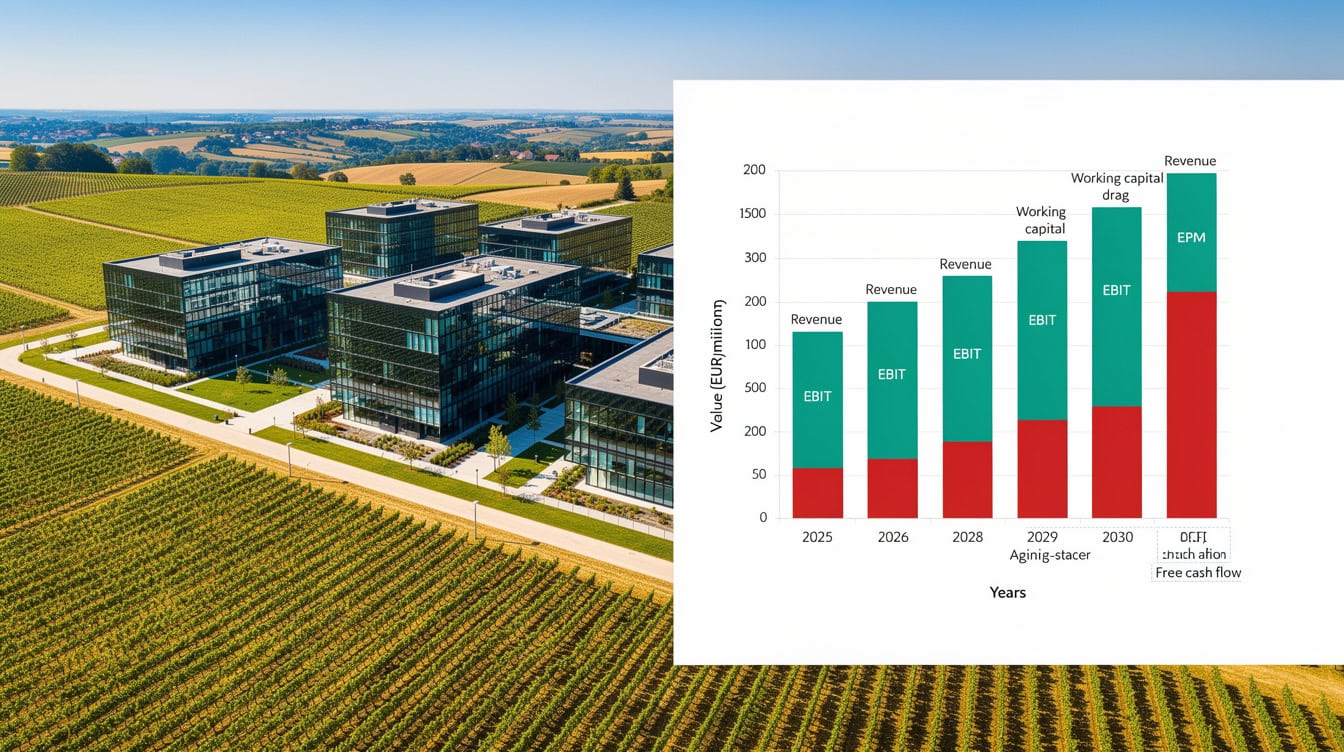
Here’s the math for a representative French Cognac négociant: EUR 200 million revenue in 2025, balanced VS/VSOP/XO tier mix, approximately 50% US export exposure, approximately 12% China direct exposure, balance to Europe and rest of world.
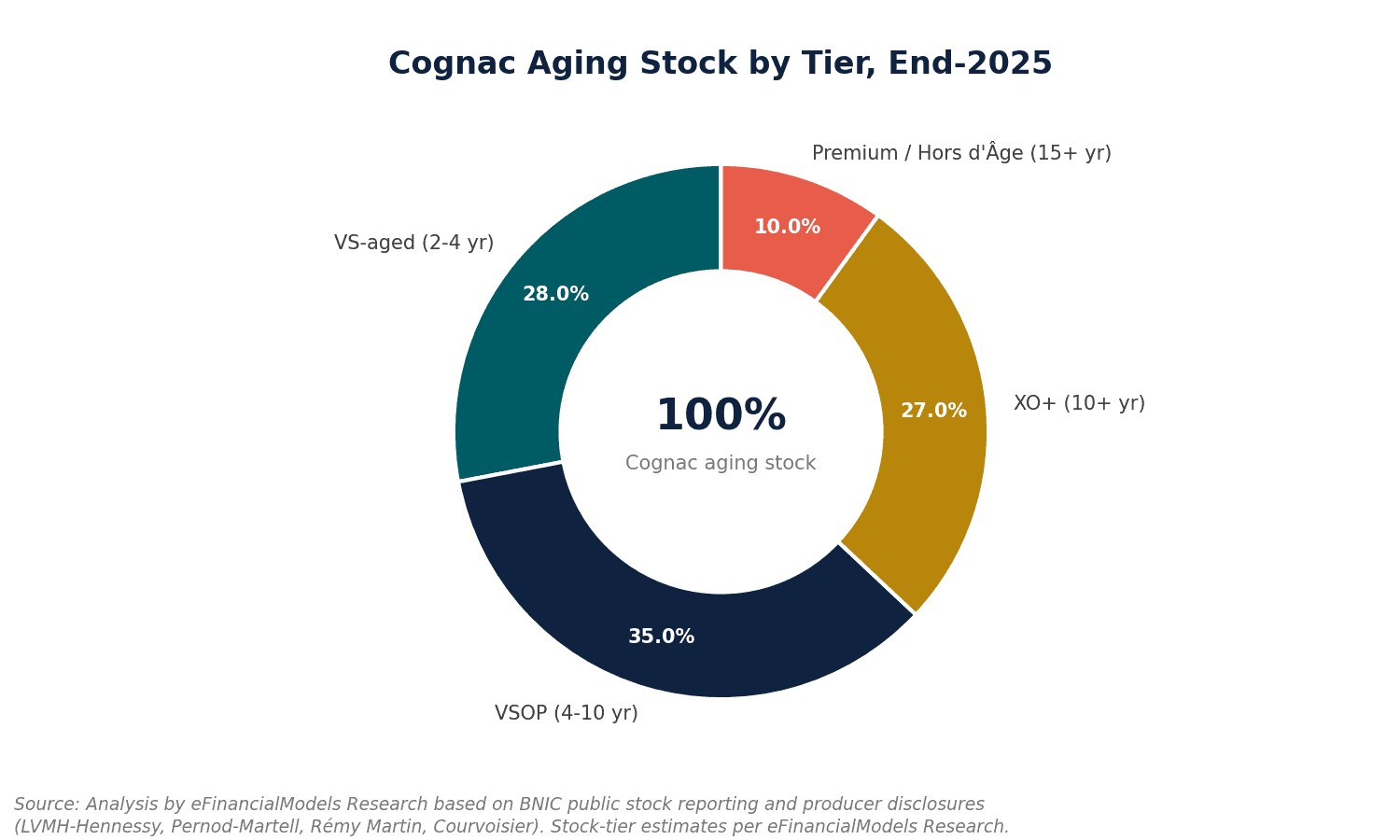
The working-capital intensity ratio for this producer sits at roughly 90-120% of one year of revenue, driven by the multi-year aging cash drag locked into the AOC tier structure. A négociant holding a VSOP blend (minimum 4-year aging) carries inventory cost for the full window before bottled revenue arrives. For XO (minimum 10-year aging) and XXO (minimum 14-year aging), the cash drag is correspondingly longer. Under EU spirits regulations, Cognac XO must be aged for a minimum of 10 years (European Commission), a mandatory aging floor that directly drives the working-capital intensity ratios modeled here.
Scenario outputs (2031 index, 2025 = 100):
| Metric | Bear (25%) | Base (55%) | Bull (20%) |
|---|---|---|---|
| Revenue index | 82 | 115 | 148 |
| EBIT index | 62 | 112 | 148 |
| Cognac shipment volume index | 96 | 124 | 130 |
| Bulk eau-de-vie price index (2020=100) | 92 | 108 | 128 |
| Cumulative capex (% of 2025 revenue) | 75% | 105% | 140% |
| PPWR+CSRD compliance capex (EUR m) | 8-12 | 12-18 | 15-25 |
| Working-capital intensity 2031 (% revenue) | 115% | 100% | 90% |
Source: eFinancialModels Research, representative négociant assumptions.
In the base case, the Cognac shipment trough occurs in 2026-2027, with partial recovery to approximately 160 million bottles by 2029 and approximately 175 million bottles by 2031. Total French spirits export value rebuilds from the 2025 trough to approximately EUR 4.5 billion by 2031. The bull case (20% probability) envisages a full US tariff resolution to zero and Cognac shipments recovering to approximately 180 million bottles by 2031. The bear case (25% probability) sees the 200% US tariff implemented, French spirits export value stagnating near EUR 3.5 billion through 2028, and material consolidation across the Cognac négociant cohort.
French Whisky: The Fastest-Growing Category
French whisky is the standout growth story within the French distilleries landscape. The distillery count expanded from roughly 10 in the early 2010s to approximately 145 operational distilleries in 2025, according to the France Distilleries Market Study 2026-2031. Category turnover is on a trajectory to exceed EUR 2.9 billion within a few years, with leading houses including Rozelieures, Warenghem (Armorik), Distillerie des Menhirs (Eddu), Bellevoye, Brenne, and Domaine des Hautes Glaces.
The premiumization story for French whisky centers on single-cask, single-malt, terroir, and limited-release expressions priced at EUR 50-150 per 70cl. This is an earlier-stage premiumization cycle than Cognac, but the structural tailwinds are strong: French consumers are trading up from imported Scotch to domestically produced alternatives, and export interest from the UK, Germany, and the US is growing.
The principal financial risk for craft French whisky distilleries is working-capital strain. Capex of approximately EUR 12-18 million is followed by 3-7 years of working-capital build before flagship-bottling revenue arrives. Bridge revenue typically comes from visitor-center operations, contract distilling, and young new-make sales. Distilleries that fail to secure this bridge revenue face material financial pressure through 2026-2027.
Armagnac and Calvados: Smaller, Family-Owned, and M&A Targets
Armagnac and Calvados represent the quieter, family-owned end of the French distilleries spectrum. Both face a version of the same structural challenge: an ageing consumer base in France, slow renewal in younger cohorts, and pressure to reposition through super-premium expressions.
Armagnac holds at 6-7 million bottles per year across 800 vineyards, 300 distillers, and 40-50 négociants (BNIA). The category’s natural skew toward older expressions and single-vintage millésimes (individual harvest-year bottlings) supports a higher average price per bottle than Cognac. Calvados ships roughly 5 million bottles per year from approximately 300 producers. The super-premium pocket — Christian Drouin’s Coeur de Lion XO range, Roger Groult 20-25 year vintages, Père Magloire VS-VSOP-XO — is the only sub-segment growing while the standard tier declines.
Both categories are M&A targets for global brand houses through 2031. Succession-driven estate sales, combined with the 2026-2027 distressed-entry window, create acquisition opportunities at materially discounted multiples versus the 2022-2023 peak. Family-office capital with patience for the maturation cycle is the natural buyer profile.
Common Modeling Mistakes for French Distillery DCFs
Financial modellers working on French distillery valuations consistently make five specific errors that distort outputs.
1. Treating tariff pass-through as uniform across tiers. The correct approach applies tier-specific absorption assumptions: roughly 50-60% producer absorption at VS, 40-50% at VSOP, 25-35% at XO, and 10-20% at the prestige and luxury tier. Applying a single blended rate understates margin compression at the VS tier and overstates it at the prestige tier.
2. Ignoring the aging-stock working-capital sub-model. For Cognac négociants, the bulk-eau-de-vie purchase pipeline, tier-level stock-cover ratio (target 6-8 years for VSOP-equivalent steady state), and annual evaporative loss (approximately 2-3% per year) must be modeled as separate working-capital line items. Collapsing these into a single inventory line misrepresents cash conversion across the maturation cycle.
3. Treating the BNIC yield cut as temporary. The 2025-26 yield reduction to 7.65 hl AP/ha and the vineyard uprooting program represent permanent supply re-basing. Embedding a long-run vineyard area decline of approximately 5-10% from the 2024 base into supply-side projections reshapes terminal-value cash flows materially.
4. Omitting PPWR, CSRD, and CBAM compliance capex. EU PPWR (Regulation 2025/40, effective 12 August 2026) mandates recyclable packaging by 2030 and sets reuse targets of 40% by 2030 and 70% by 2040. Combined with CSRD (Corporate Sustainability Reporting Directive) and CBAM (Carbon Border Adjustment Mechanism), the cumulative compliance capex for a mid-sized négociant runs approximately EUR 8-25 million over 2026-2031. These are real cash items often missed in standalone DCF models.
5. Running a single-point forecast instead of probability-weighted scenarios. The recommended probability split is 25% bear / 55% base / 20% bull (per the eFinancialModels scenario architecture). For LBO work, stress-testing the cash-runway envelope under the bear case explicitly is essential given the covenant risk from the 200% tariff threat.
Competitive Landscape: Big-4 Cognac and the Craft Cohort
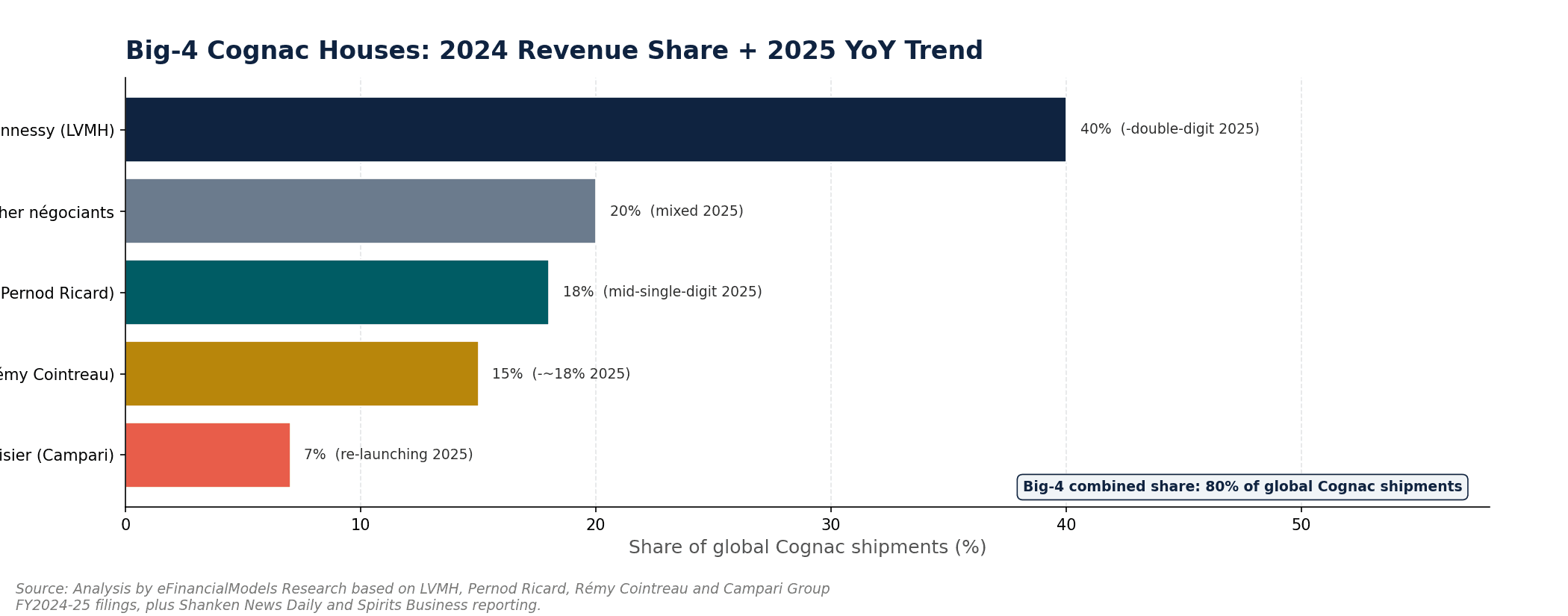
The Big-4 Cognac négociants dominate by volume and value but shed market share in 2025 to private-label, grower-distiller, and craft houses. LVMH-Hennessy holds approximately 40-45% of Cognac volume; Pernod-Martell around 18%; Rémy Martin approximately 15%; and Campari-Courvoisier approximately 7% following Campari’s 2024 USD 1.3 billion acquisition of Courvoisier. All four secured exemption from China’s 34.9% anti-dumping duty under the minimum-price commitment regime.
Below the Big-4, the competitive landscape includes Maison Ferrand (indicative EUR 100-150 million revenue, diversified across Cognac Ferrand, Citadelle gin, and Plantation rum), Camus, Delamain, Frapin, Hardy, and a long tail of grower-distillers and craft houses. This cohort faces the most acute financial pressure through 2026-2027 and represents the primary M&A opportunity set for strategic and financial buyers.
For context on how similar market dynamics play out across other European spirits markets, the Ireland Distilleries Market Study 2026-2031 and the United Kingdom Distilleries Market Study 2026-2031 provide directly comparable analytical frameworks.
Frequently Asked Questions
Why did Cognac shipments fall so sharply in 2025?
Cognac shipments fell 15.1% to 141 million bottles in 2025 because two demand shocks hit simultaneously: a US-China trade dispute that imposed new tariffs on both sides, and a prolonged destocking cycle in which US and Chinese distributors worked down excess inventory built during the 2021-2022 post-pandemic demand surge. Within the category, XO-and-above fell 23.2% — the steepest decline — because high-end gifting in China collapsed after the MOFCOM anti-dumping investigation began in January 2024. VS fell 16.2% and VSOP fell 11.5% (BNIC). This is the largest single-year category decline since the 2008-09 financial crisis, and it follows two prior years of softer shipments, making 2025 the third consecutive annual decline for total French spirits exports.
What does the China minimum-price commitment mean for Cognac exporters?
China’s MOFCOM final ruling of 4 July 2025 imposed a 34.9% anti-dumping duty on EU brandy for five years, effective 5 July 2025. However, 34 named companies — including LVMH-Hennessy, Pernod-Martell, and Rémy Martin — secured exemption by committing to minimum per-liter prices: CNY 46 per liter for VS-grade Cognac, scaling up to CNY 613 per liter for XXO. This exemption largely neutralises the duty for the Big-4 négociants but locks them into a price floor that constrains volume growth. All other EU brandy exporters face the full 34.9% duty, which effectively prices most smaller French Cognac houses out of the Chinese market at standard tier price points. The exemption regime is valid for five years, creating a compliance monitoring obligation through approximately 2030.
How should financial modellers handle the Cognac aging-stock cycle?
The aging-stock cycle is the most technically demanding element of any Cognac DCF or LBO model. A négociant holding VSOP blend (minimum 4-year aging) carries inventory cost — bulk eau-de-vie purchase, cask financing, warehouse, evaporative loss of approximately 2-3% per year, and blending — for the full aging window before bottled revenue arrives. For XO (minimum 10-year aging) and XXO (minimum 14-year aging), the cash drag is correspondingly longer. The correct approach builds the bulk-eau-de-vie purchase pipeline, tier-level stock-cover ratio (target 6-8 years for VSOP-equivalent steady state), and annual evaporative loss as separate working-capital line items. Under a representative négociant P&L with EUR 200 million revenue and a balanced VS/VSOP/XO mix, the working-capital intensity ratio sits at roughly 90-120% of one year of revenue. Solve for cash conversion across the full maturation cycle, not at a single snapshot.
Is French whisky a viable investment category in 2026-2031?
French whisky is the fastest-growing French distillery category and a viable investment category, but with specific financial risks. The distillery count grew from roughly 10 in the early 2010s to approximately 145 by 2025, and category turnover is on a trajectory to exceed EUR 2.9 billion within a few years. The investment thesis centers on premiumization: single-cask, single-malt, terroir, and limited-release expressions priced at EUR 50-150 per 70cl. The principal risk is working-capital strain: capex of approximately EUR 12-18 million is followed by 3-7 years of working-capital build before flagship-bottling revenue arrives. Bridge revenue from visitor-center operations, contract distilling, and young new-make sales is essential for survival through years 4-7. Distilleries with secured bridge revenue and regional charter membership (Whisky de Bretagne, Whisky d’Alsace) for shared marketing are the most defensible investment targets.
What is the EU PPWR and how does it affect French distilleries?
EU PPWR stands for the Packaging and Packaging Waste Regulation (Regulation 2025/40), which applies from 12 August 2026. It mandates recyclable packaging by 2030, sets a 40% reuse target by 2030 and a 70% reuse target by 2040, and limits empty space in parcels to a maximum of 40% from 12 August 2026. For French spirits producers, this directly affects glass bottles, cork closures, gift packaging, and secondary packaging across thousands of SKUs. Combined with CSRD (mandatory sustainability reporting) and CBAM (carbon border adjustment on imported inputs), the cumulative compliance capex for a mid-sized négociant runs approximately EUR 8-25 million over 2026-2031, and approximately EUR 2-8 million for a craft producer. Front-loading packaging redesign across 2026-2028 is materially cheaper than a cliff-edge program in 2029-2030.
What is the best entry strategy for investors in French distilleries in 2026-2027?
The 2026-2027 window is the best distressed-entry opportunity since 2009. Roughly 4-8 Cognac négociants below the Big-4, a number of Armagnac estates, succession-driven Calvados producers, and 10-25 French whisky craft distillers face material financial pressure through 2026-2027. Mature stock plus brand IP plus AOC vineyard land can be acquired at discounted transaction multiples versus the 2022-2023 peak. Bulk-eau-de-vie inventory in the compte-4 through compte-10 cohort (spirits aged 4-10 years) is a separable financial position: strategic and financial buyers can take positions in bulk Cognac and Armagnac without operating a distillery, capturing asymmetric upside as the BNIC yield cut and uprooting program drain the supply overhang from 2028 onward. Premium liqueur and Made-in-France gin are the most resilient sub-categories, with defensible high-gross-margin economics.
How does Armagnac differ from Cognac as an investment?
Armagnac and Cognac are both French AOC brandies but differ materially in scale, structure, and investment dynamics. Cognac is a global commodity-scale category at 141 million bottles per year, dominated by four large négociants and heavily exposed to US and China export markets. Armagnac is a smaller, family-owned category at 6-7 million bottles per year across approximately 800 vineyards, 300 distillers, and 40-50 négociants (BNIA), with 70% of volume consumed domestically. Armagnac’s natural skew toward older expressions and single-vintage millésimes supports a higher average price per bottle than Cognac, and the category is less exposed to the US and China tariff shocks. The investment case for Armagnac centers on succession-driven estate M&A, single-vintage inventory appreciation, and export expansion into the UK, Germany, and the US super-premium tier. Transaction multiples are lower than Cognac peak levels and the category is structurally less volatile.
Conclusion
France’s distilleries sector enters 2026-2031 at a cyclical inflection point. Cognac’s 15.1% shipment collapse in 2025, the dual tariff shocks from the US and China, and the BNIC’s permanent supply re-basing through yield cuts and vineyard uprooting all converge to create both the deepest near-term pressure and the most attractive medium-term entry opportunity in over a decade. French whisky’s 145-distillery ecosystem, Armagnac’s single-vintage premiumization story, and the resilience of premium liqueurs and gin provide genuine diversification within the French distilleries investment universe.
For financial modellers, the key discipline is building probability-weighted scenarios (25% bear / 55% base / 20% bull), modeling the aging-stock working-capital cycle correctly, and capturing PPWR, CSRD, and CBAM compliance capex as real cash items. The base case projects French spirits export value recovering to approximately EUR 4.5 billion by 2031 — a 22% rebuild from the 2025 trough.
I recommend downloading the France Distilleries Market Study 2026-2031 for the full scenario architecture, unit-economics tables, and assumption sets sized to drop directly into DCF, LBO, and refinancing models for any French distillery category.