0 ITEMS

Germany’s 113,400-Home Annual Shortfall: What Investors Must Know

Germany’s residential real estate market enters 2026 at a genuine inflection point: the country’s worst housing shortage in a generation collides with the most consequential rent-regulation and decarbonization agenda in its post-war history.
Key Takeaways
- Housing completions fell to roughly 206,600 dwellings in 2025, the lowest level since 2012, against an estimated annual need of 320,000 homes, creating a structural shortfall of about 113,400 units per year.
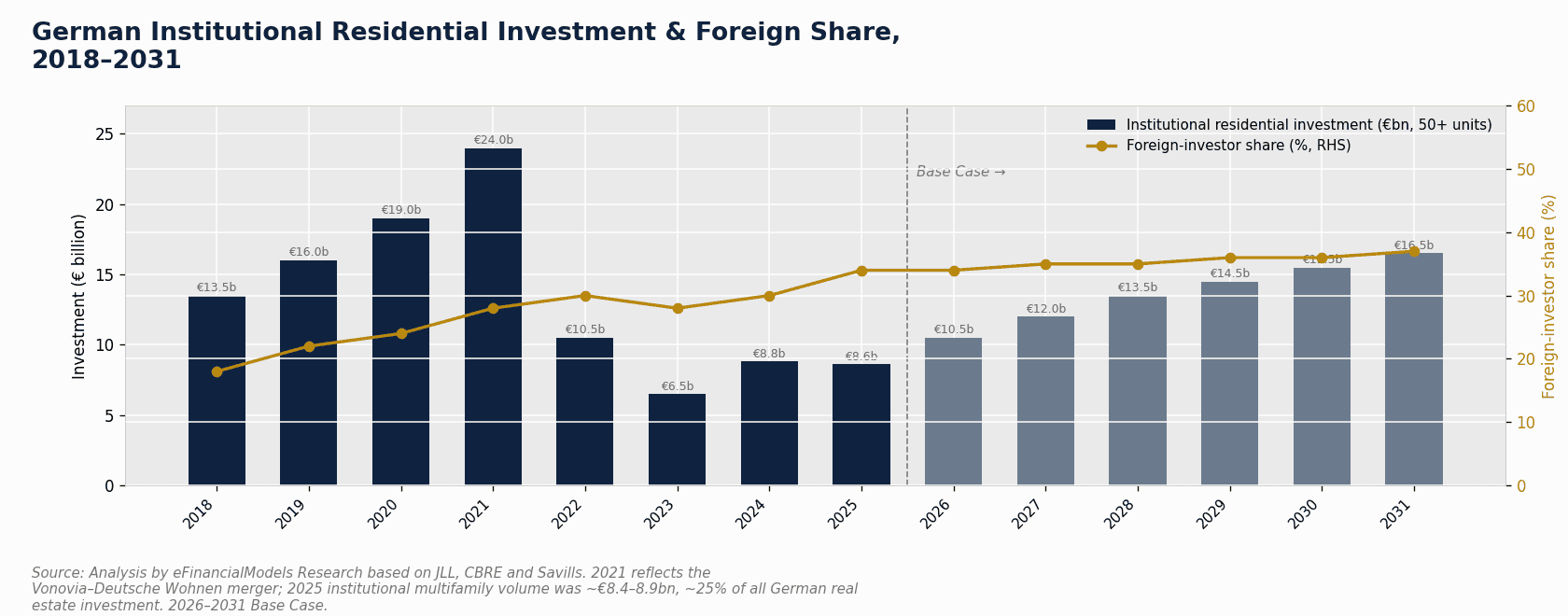
- Institutional multifamily investment reached approximately €8.4–8.9 billion in 2025, with deal count up more than 40% and the foreign investor share climbing to around 34%.
- New-let rents grew 5.7% nationally in 2025, with Düsseldorf leading at +9.7%, while Berlin’s quality-adjusted rents fell 1.5% under the weight of regulation.
- Prime A-city multifamily net initial yields settled near 3.6%, restoring a positive spread over the roughly 2.5% ten-year German Bund (Bundesanleihe) after the 2022–2024 repricing.
- The base-case scenario (50% probability) projects annual institutional residential investment climbing to roughly €16.5 billion by 2031, with regulated rent growth of about 3.0% per year.
- The Building Energy Act (GEG) requires new heating systems to use at least 65% renewable energy, converting ESG compliance from a narrative into a hard capital-expenditure line item.
- A backlog of approximately 760,700 approved-but-unbuilt dwellings sits idle because high build costs and financing rates make new starts uneconomic.
The Supply Crisis: Why 760,700 Homes Sit Unbuilt
Germany’s housing shortage is a viability problem, not a demand problem. Completions fell roughly 18% in 2025 to about 206,600 dwellings according to Destatis (Germany’s Federal Statistical Office), the second consecutive sharp annual decline after a drop of around 14% in 2024. Against an estimated annual need of some 320,000 homes, the gap widens every year.
The cause is a viability squeeze. Construction costs, financing rates, and labor shortages stretched the average period between permit and completion to about 27 months, leaving a backlog of roughly 760,700 approved-but-unbuilt dwellings at the end of 2025 (Destatis Bauüberhang press releases). Starts are uneconomic even when planning permission exists.
One early signal points toward recovery. Building permits turned up about 10.6% in 2025 to around 238,100, and first-quarter 2026 approvals rose a further 14.6% according to Destatis building permit data. KfW (Germany’s state development bank) cut its climate-friendly new construction program rates to as low as approximately 1.13%, directly targeting the viability gap that has stalled the pipeline.
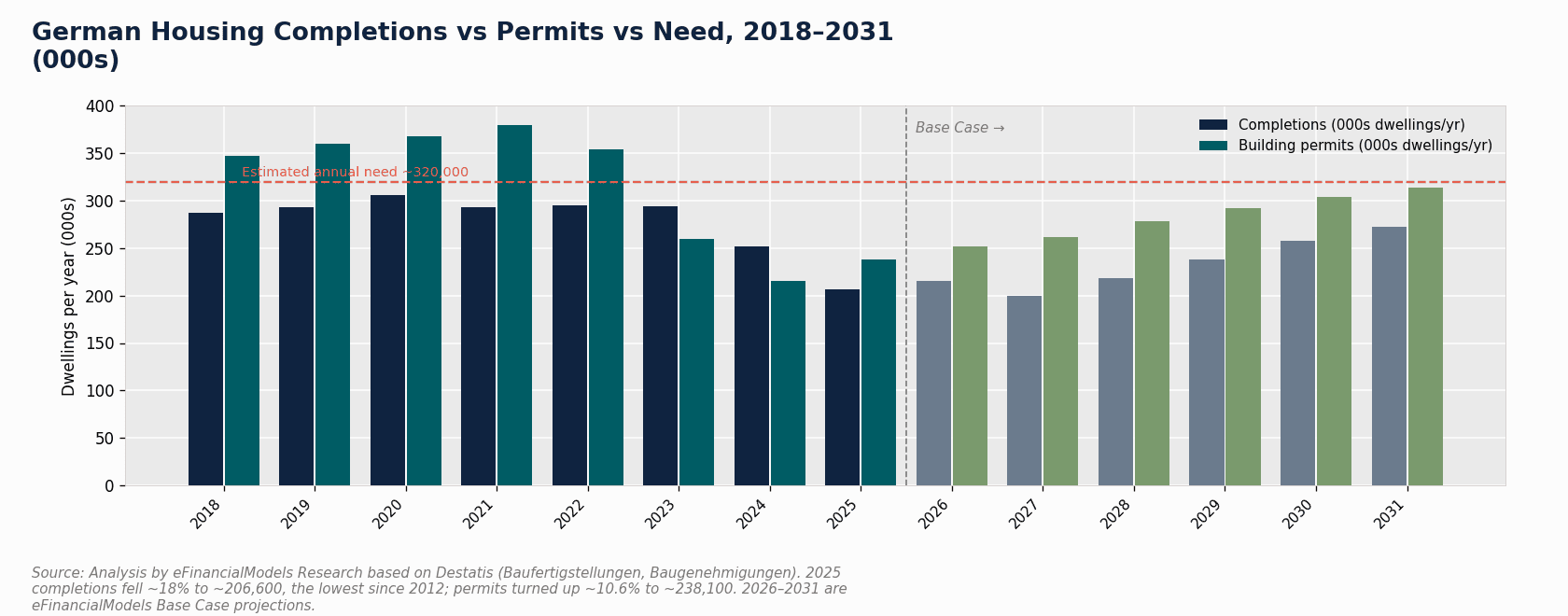
The 760,700-dwelling backlog reflects schemes that have planning permission but cannot start because build costs and financing rates make them uneconomic.
Rent Dynamics: 5.7% Growth Nationally, But Berlin Is the Exception
Where regulation permits it, rents are rising fast. New-let rents (Angebotsmiete, the asking rent on new contracts) grew about 5.7% nationally in 2025, up from 3.7% the prior year, led by Düsseldorf (+9.7%), Hamburg (+7.6%), and Munich (+6.6%), according to analysis in the Germany Real Estate Market Study 2026–2031. Germany is forecast to record the strongest rental growth in Europe over the next five years at roughly 3.6% per year, about 50 basis points above the European average, on the back of chronic undersupply.
Munich sits at the top of the A-city range. Median new-let rents there reached around €24.65 per square meter in 2025, with prime rents near €36.10, up about 4.2%. At the other end, more affordable A-cities cluster near €14 per square meter.
Berlin illustrates the regulatory ceiling. Its quality-adjusted new-let rent dipped about 1.5% in 2025, with new-build lettings down about 4.4% even as existing-tenancy rents rose about 1.8%. The Mietpreisbremse (federal rent brake, which caps re-letting rents at 10% above the local reference rent in designated tight markets) and the densest regulatory regime in the country interacted with affordability ceilings to suppress new-let pricing. A single blended national rent assumption is therefore inadequate for underwriting: reversion potential, pricing power, and regulatory exposure all vary materially by city.
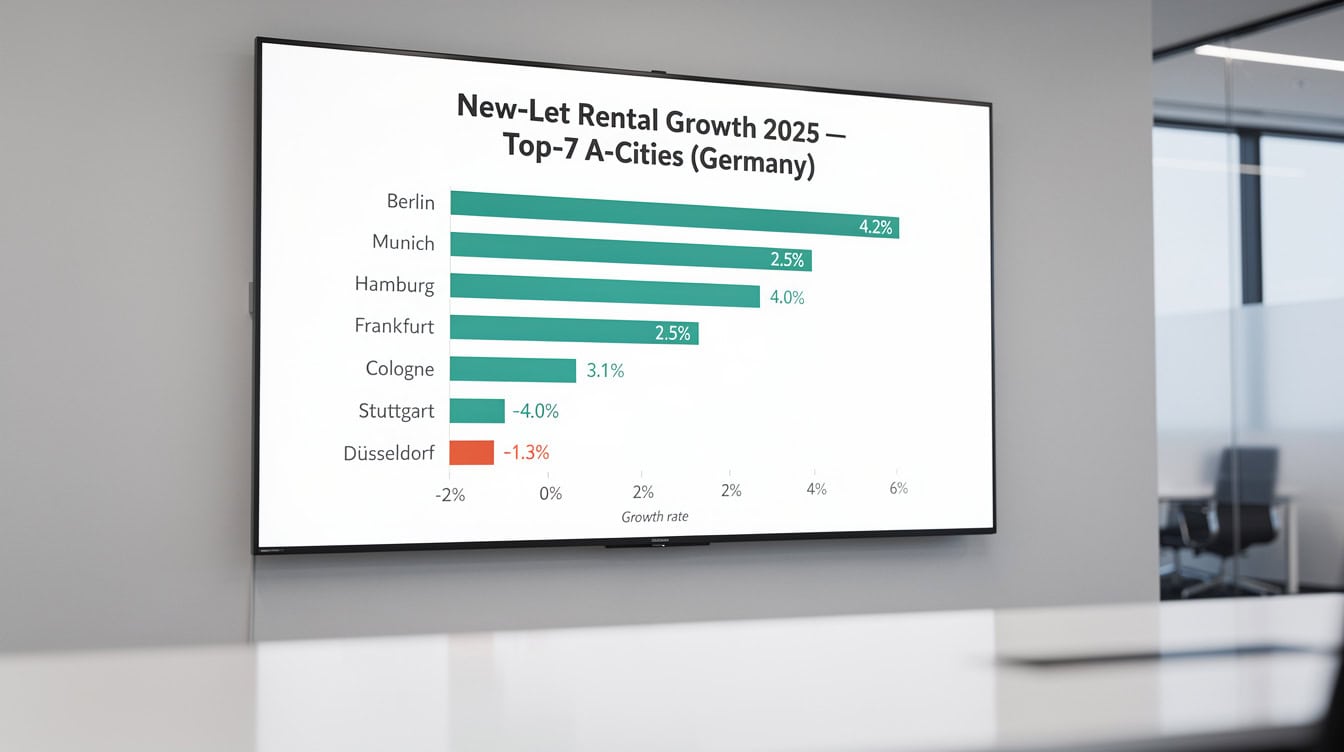
Düsseldorf led Germany’s A-cities with +9.7% new-let rent growth in 2025; Berlin was the sole decliner at -1.5% on a quality-adjusted basis.
Top-7 City Rent Snapshot (2025)
| City | New-Let Growth | Approx. Median Rent (€/sqm) | Regulatory Intensity |
|---|---|---|---|
| Düsseldorf | +9.7% | ~€16–17 | Moderate |
| Hamburg | +7.6% | ~€18–19 | High |
| Munich | +6.6% | ~€24.65 | High |
| Frankfurt | ~+5% | ~€17–18 | High |
| Cologne | ~+5% | ~€15–16 | Moderate |
| Stuttgart | ~+4% | ~€15–16 | Moderate |
| Berlin | -1.5% (quality-adj.) | ~€14–15 | Very High |
Source: eFinancialModels Research, based on Destatis, JLL, CBRE, and BNP Paribas Real Estate data.

Munich’s median new-let rent of approximately €24.65/sqm is nearly double that of the more affordable A-cities, underscoring why a single blended national assumption misprices risk.
Pricing and Yields: The Spread Is Positive Again
Valuations turn on the relationship between yields and the cost of money. Prime A-city multifamily net initial yields (stabilized net operating income divided by gross asset value) decompressed from sub-2.6% lows to around 3.6% through the 2022–2024 repricing as the ten-year Bund rose toward 2.5%. Average gross rental yields nationally stood near 3.4% in early 2026, down from 3.8% a year earlier as prices recovered, with higher yields available outside the prime A-cities: Leipzig at about 5.0%, Berlin at about 4.8%, and Stuttgart at about 4.5% according to Global Property Guide Germany rental yield data.
Residential prices rose about 3.2% in 2025, the first full-year increase since 2022, confirming that the post-2022 correction has bottomed. The European Central Bank eased policy through 2025, and all-in real-estate debt costs have come off their 2023 peak toward levels that make accretive leverage possible again.
The practical underwriting lesson: German prime residential is a spread business. When the gap between the asset’s income yield and the cost of debt is positive and widening, leverage is accretive and capital flows in. When it inverts, transactions freeze regardless of how strong underlying demand looks. The spread is positive again, but historically thin, which is why exit yields should be modeled at or above entry.
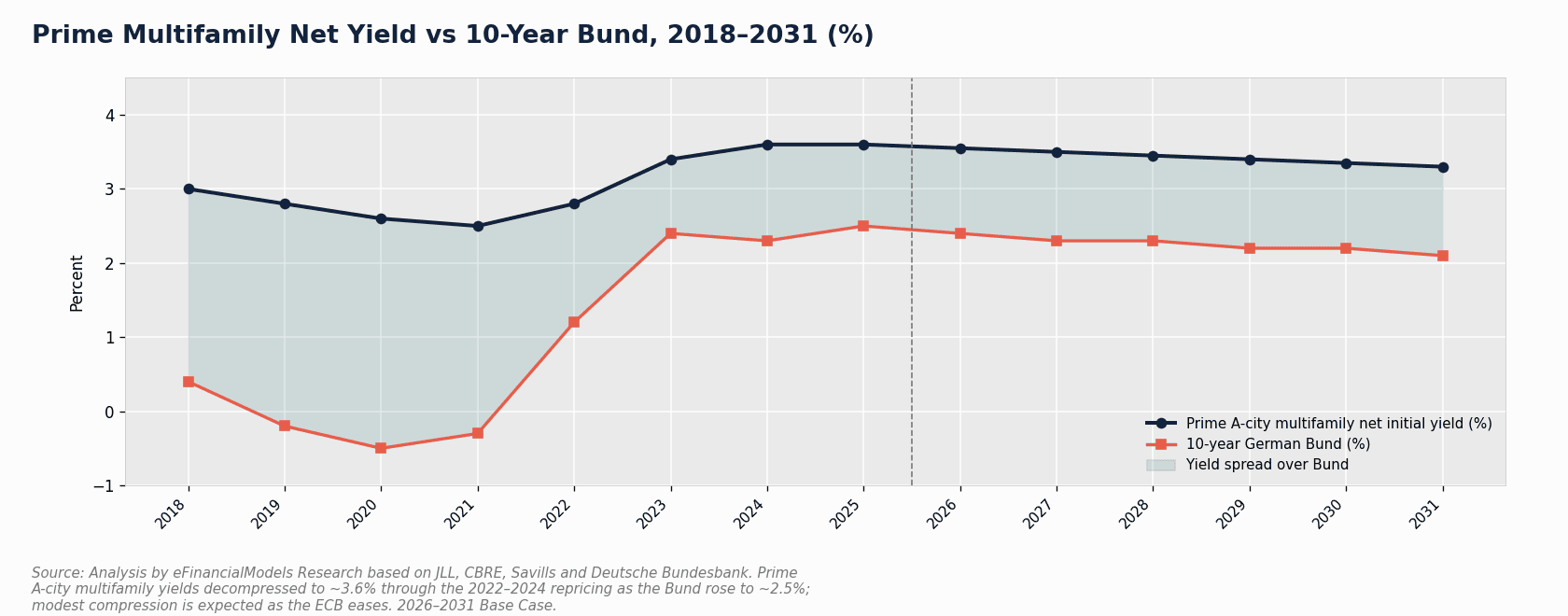
Prime A-city multifamily net yields near 3.6% now sit above the roughly 2.5% Bund, restoring a positive risk spread after the 2022–2024 compression.
Worked Example: Levered IRR Sensitivity for an A-City Multifamily Asset
Here’s the math for a stabilized A-city multifamily hold at approximately 50% loan-to-value (LTV), using the base-case assumptions from the eFinancialModels Research pricing model.
Inputs (Base Case):
- Entry net initial yield: 3.6%
- Regulated rent growth (CAGR 2026–2031): 3.0% per year
- Exit net yield: 3.6% (modeled at entry, no compression assumed)
- All-in debt cost: approximately 4.1% (midpoint of 3.9–4.3% range)
- LTV: 50%
- Hold period: 7 years
- Equity hurdle: approximately 9%
Step 1: Estimate income return. At a 3.6% entry yield and 3.0% annual rent growth, net operating income (NOI) grows from an index of 100 to approximately 123 over 7 years (100 × 1.03^7 = 122.99).
Step 2: Estimate exit value. If the exit yield equals the entry yield (3.6%), exit value grows in line with NOI, so capital value also rises roughly 23% over the hold.
Step 3: Calculate levered equity return. At 50% LTV and a 4.1% debt cost, the income yield on equity is approximately (3.6% − 4.1% × 0.5) / 0.5 = 3.1% in year 1, rising as rents grow. Blending income return with the capital gain produces an illustrative 7-year levered IRR of approximately 11% in the base case.
Scenario comparison:
| Scenario | Rent CAGR | Exit Yield | 7-Yr Levered IRR |
|---|---|---|---|
| Bear (25% prob.) | 1.5% | ~3.9% | ~4% |
| Base (50% prob.) | 3.0% | ~3.6% | ~11% |
| Bull (25% prob.) | 4.5% | ~3.1% | ~18% |
Source: eFinancialModels Research base-case pricing model assumptions. IRR figures are illustrative for a stabilized German A-city multifamily asset; not a specific asset valuation.
The asymmetry is the key takeaway: because entry yields are low, even modest exit-yield expansion (from 3.6% to 3.9%) can erase the benefit of strong rent growth. Yield compression should never be assumed as a source of return.
Base case: entry yield 3.6%, 3.0% rent CAGR, exit yield 3.6%, 50% LTV, 7-year hold. Illustrative IRR ~11%. Source: eFinancialModels Research pricing model assumptions.
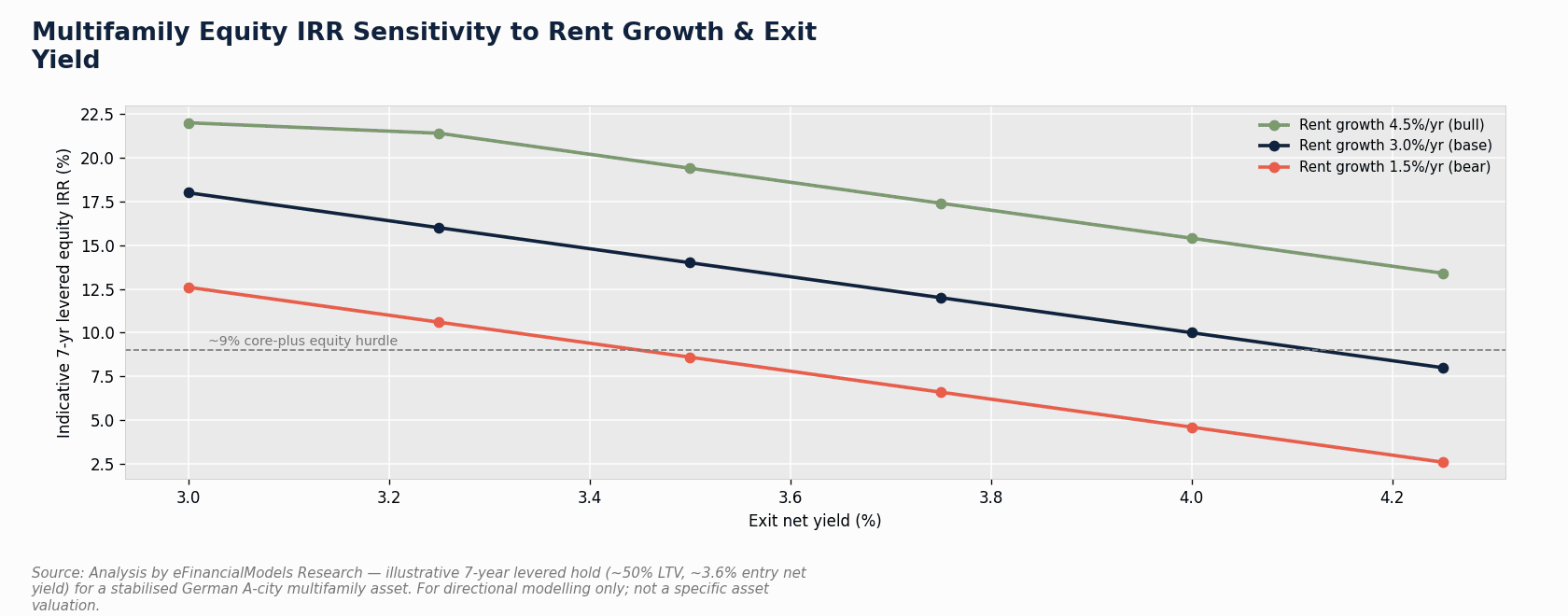
Even modest exit-yield expansion from 3.6% to 3.9% can erase the benefit of strong rent growth, confirming that yield compression should never be assumed as a return source.
Regulation: Mietpreisbremse, Mietendeckel, and What Comes Next
Regulation is the defining swing factor for operating models and underwriting. The federal Mietpreisbremse was extended unchanged to the end of 2029 by a June 2025 Bundestag vote. A draft “second rent package” would cap index-linked rents at 3.5% per year. A renewed debate over a nationwide rent cap echoes the Berlin Mietendeckel, Berlin’s 2020 rent cap that the Federal Constitutional Court struck down as void in April 2021 because rent regulation is a matter of federal, not state, law.
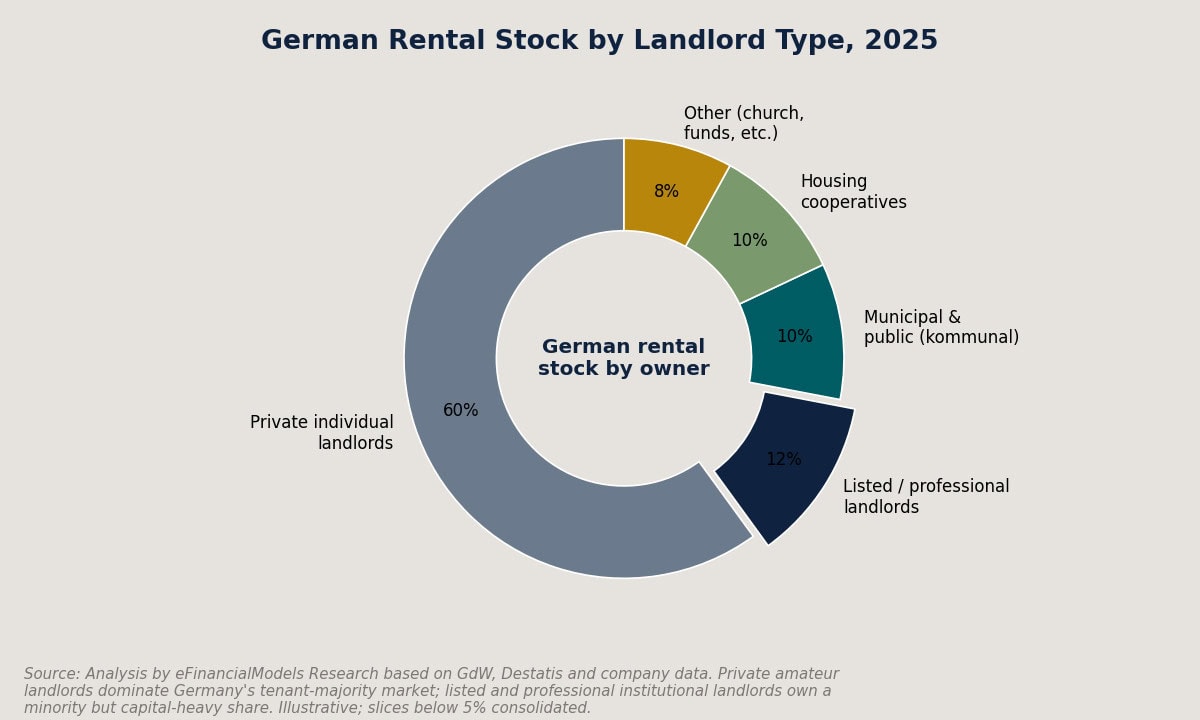
The Mietendeckel episode is a reminder that constitutional limits, not political will, set the ceiling on intervention. Institutional, well-managed, regulation-compliant portfolios are advantaged relative to fragmented private landlords, accelerating the professionalization of Germany’s rental market.
Post-2014 new-build stock and recently modernized dwellings are exempt from the Mietpreisbremse, which is the single most important structural advantage available to developers and investors targeting new supply. Concentrating on this exempt stock in supply-starved A-cities is the primary way to capture reversionary rent growth without regulatory drag.
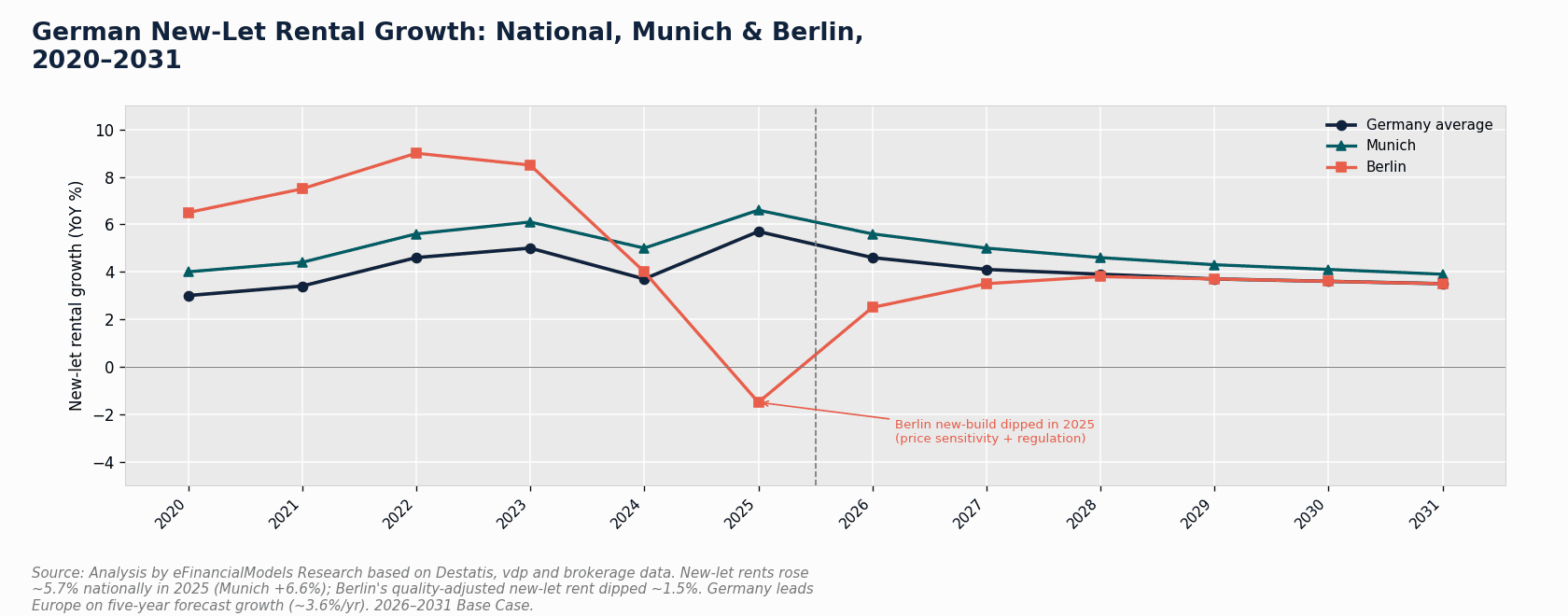
Post-2014 new-build stock is exempt from the Mietpreisbremse, making it the primary vehicle for capturing full-market reversionary rent growth.
ESG and the Building Energy Act: Brown Discount Is Now a Valuation Risk
ESG (environmental, social, and governance) compliance has moved from a reporting narrative to a hard capital-expenditure and valuation driver. The Building Energy Act (GEG, Gebäudeenergiegesetz) requires that new heating systems use at least 65% renewable energy, combined with municipal heat planning that is driving heat-pump installation and district heating connections across Germany’s housing stock. The EU Taxonomy for sustainable activities defines which building investments qualify as environmentally sustainable, directly affecting access to green-labeled debt and institutional capital.
Owners of older, energy-inefficient assets face mandatory upgrade capital expenditure. Owners and developers of taxonomy-aligned, efficient product capture cheaper finance (KfW programs at approximately 1.13%), stronger tenant demand, and a measurable valuation edge. The widening green-premium and brown-discount spread means that the owners who decarbonize their stock fastest will capture both the valuation upside and the lowest cost of capital, while laggards face stranding risk.
For modelers, the practical instruction is to budget ESG and energy-efficiency capital expenditure explicitly, grow operating costs (energy, maintenance, compliance) at or above CPI, and model net operating income growth rather than gross rent growth as the value driver.
KfW climate-friendly new construction rates cut to approximately 1.13% directly subsidize the viability of GEG-compliant development, turning ESG compliance into a cost-of-capital advantage.
Three Scenarios to 2031: Bounding the Plausible Range
The outlook to 2031 is framed as three scenarios, each defined by a coherent combination of the ECB rate path, the supply response, the trajectory of rent regulation, and the cost of the energy transition.
Base Case (50% probability). The ECB holds policy modestly accommodative, debt costs normalize, and regulated rental growth runs around 3.0% per year nationally. Permits convert gradually into starts as KfW support and easing finance improve viability, though completions stay below need throughout. Annual institutional residential investment climbs toward roughly €16.5 billion by 2031.
Bear Case (25% probability). Build costs and the Bund stay elevated, starts fail to recover, and a weaker economy combined with harder rent regulation squeezes reversionary rent capture to around 1.5% growth. Annual institutional investment stalls near €9 billion and some highly levered owners face refinancing stress.
Bull Case (25% probability). Inflation is tamed, the ECB eases faster, and the Bund declines, restoring a healthy yield spread and cheap debt. Regulated rental growth runs around 4.5% on chronic undersupply, and taxonomy-aligned product commands a clear green premium. Annual institutional residential investment exceeds €23 billion by 2031.
The base case (50% probability) projects €16.5bn in annual institutional investment by 2031; the bull case exceeds €23bn if the ECB eases faster and supply recovers.
Common Underwriting Mistakes to Avoid
Five specific errors appear repeatedly in German residential underwriting, and each has a direct fix.
1. Using a blended national rent assumption. Munich median new-let rents are approximately €24.65 per square meter; some A-cities sit near €14. A single national figure misprices both reversion potential and regulatory exposure. Fix: use city- and product-specific rent levels and growth curves.
2. Assuming yield compression as a source of return. The historical spread between prime multifamily yields and the Bund is thin. Assuming compression flatters IRR in a way the evidence does not support. Fix: model exit yields at or modestly above entry (approximately 3.6%), never below.
3. Ignoring the Mietpreisbremse on reversionary assumptions. The rent brake caps re-letting rents at 10% above the local reference rent (ortsübliche Vergleichsmiete) in designated tight markets. Underwriting full-market reversion on regulated stock overstates income. Fix: apply the relevant regulatory caps explicitly to reversionary rent capture.
4. Underbudgeting ESG capital expenditure. The GEG and EU Taxonomy impose mandatory upgrade costs on older stock. Treating these as optional or deferrable creates a brown-discount risk that erodes exit value. Fix: budget energy-efficiency capex explicitly and use KfW finance for compliant new build.
5. Stress-testing only at acquisition. Assets levered at the 2023 rate peak refinance into a still-elevated curve. Testing interest-cover ratio (ICR), debt-service-cover ratio (DSCR), and LTV only at acquisition misses refinancing risk. Fix: stress ICR, DSCR, and LTV at refinancing and exit, not just at entry.
Frequently Asked Questions
What is the Mietpreisbremse and how does it affect investment returns?
The Mietpreisbremse (federal rent brake) is a German law that caps re-letting rents at 10% above the local reference rent (ortsübliche Vergleichsmiete, recorded in the Mietspiegel) in designated tight housing markets. It was extended unchanged to the end of 2029 by a June 2025 Bundestag vote. For investors, the practical effect is that reversionary rent capture on regulated stock is constrained: even if market rents have risen well above the reference rent, a new tenancy can only be priced at 10% above that reference level. Post-2014 new-build stock and recently modernized dwellings are exempt, which is why institutional capital increasingly targets new or recently upgraded product in supply-starved A-cities. Underwriting must apply the cap explicitly to reversionary assumptions rather than assuming full-market reversion.
Why did Berlin’s rents fall in 2025 while other German cities saw strong growth?
Berlin’s quality-adjusted new-let rents dipped about 1.5% in 2025, with new-build lettings down about 4.4%, even as existing-tenancy rents rose about 1.8%. The city combines the densest regulatory regime in Germany with the highest affordability pressure, meaning price-sensitive tenants and regulatory caps interact to suppress new-let pricing. This contrasts sharply with Düsseldorf (+9.7%) and Hamburg (+7.6%), where supply is tighter relative to demand and regulation is less restrictive. The Berlin Mietendeckel, a 2020 city-level rent cap struck down by the Federal Constitutional Court in April 2021, demonstrated that even aggressive intervention has constitutional limits, but the regulatory environment in Berlin remains the most restrictive of the Top-7 A-cities.
What does the Building Energy Act (GEG) require, and what does it cost?
The GEG (Gebäudeenergiegesetz, or Building Energy Act) requires that new heating systems installed from 2024 onward use at least 65% renewable energy. This drives heat-pump installation, district heating connections, and phased elimination of gas and oil boilers. For existing stock, the EU Taxonomy for sustainable activities and municipal heat planning create a parallel pressure to retrofit toward energy efficiency. The financial consequence is a widening green-premium and brown-discount spread in valuations: taxonomy-aligned, efficient assets attract cheaper KfW finance (rates cut to approximately 1.13% for compliant new build) and stronger institutional demand, while inefficient older stock faces mandatory upgrade capital expenditure and potential stranding if it cannot economically reach the required standard. Investors should budget ESG capex explicitly and model it as a recurring cost growing at or above CPI.
What are the three scenarios for German residential investment returns to 2031?
The eFinancialModels Research base-case pricing model frames three scenarios. The base case (50% probability) projects regulated rent growth of about 3.0% per year, prime net yields near 3.4% by 2031, and annual institutional residential investment of roughly €16.5 billion, producing an illustrative 7-year levered IRR of approximately 11% for a stabilized A-city multifamily asset at 50% LTV. The bear case (25% probability) assumes rent growth of only 1.5% per year, yields drifting to about 3.9%, investment stalling near €9 billion, and a levered IRR of approximately 4%. The bull case (25% probability) assumes 4.5% rent growth, yields compressing to about 3.1%, investment exceeding €23 billion, and a levered IRR of approximately 18%. The wide spread of outcomes reflects the sensitivity of a low-yield, long-duration asset to small movements in exit yield and regulated rent growth.
How does the construction backlog affect investment strategy?
The backlog of approximately 760,700 approved-but-unbuilt dwellings at the end of 2025 (Destatis, Bauüberhang) represents a structural constraint on new supply that protects the income of standing assets by limiting new competition. However, it also makes portfolio growth through development expensive and slow: the average permit-to-completion lag is about 27 months, and high build costs and financing rates make many schemes uneconomic even with planning permission. The permit upturn of 10.6% in 2025 and KfW rate cuts to approximately 1.13% are the leading indicators that a gradual recovery in starts can build over the forecast period. For investors, the backlog is a reason to favor standing, income-producing assets in the near term while tracking the permit and KfW signals as the trigger for development re-entry.
What is the yield spread over the Bund, and why does it matter?
The yield spread over the Bund is the difference between the net initial yield on a prime multifamily asset (approximately 3.6%) and the yield on the 10-year German government bond (Bundesanleihe, approximately 2.5%). This spread, currently about 110 basis points, is the risk premium investors earn for holding residential real estate over a risk-free government bond. It matters because German prime residential is a low-yield, long-duration asset: small movements in the Bund yield directly affect whether leverage is accretive (spread positive and widening) or destructive (spread compressed or negative). Through 2022–2024, the spread compressed to historically thin levels as the Bund rose sharply. With the ECB easing through 2025, the spread has widened again off the bottom, supporting current values and creating conditions for modest yield compression later in the cycle.
Which cities offer the best risk-adjusted entry points for institutional investors?
The answer depends on the investor’s risk tolerance and return target. Munich offers the deepest liquidity and strongest rent growth but the highest entry prices (median new-let rents near €24.65 per square meter) and significant regulatory exposure. Düsseldorf and Hamburg offer strong rent growth (+9.7% and +7.6% in 2025 respectively) with somewhat lower entry prices and moderate regulation. Leipzig and Stuttgart offer gross rental yields of approximately 5.0% and 4.5% respectively, above the prime A-city average of 3.4%, reflecting lower liquidity and less institutional depth but also less regulatory pressure. Berlin offers a gross yield of about 4.8% but carries the highest regulatory risk of any A-city. The study recommends concentrating on supply-starved A-cities where new-let rental growth is strongest, using city-specific rent curves rather than a blended national assumption.
Conclusion
Germany’s residential real estate market offers a structurally underpinned income opportunity for the 2026–2031 period, but returns are governed by regulation and energy efficiency as much as by the cycle. The 113,400-unit annual shortfall is real and widening. Capital has stabilized and is rotating back. The yield spread over the Bund is positive again. But the Mietpreisbremse, the draft 3.5% index-rent cap, and the GEG’s mandatory upgrade requirements mean that disciplined underwriting, not optimistic assumptions, separates the winners from the laggards.
I recommend downloading the Germany Real Estate Market Study 2026–2031 to access the full base-case assumption set, three-scenario sensitivity grid, and regulatory analysis, and pairing it with a commercial real estate financial model template or the real estate financial model bundle to translate these sector-level findings into property-level DCF, levered IRR, and debt sizing for your specific assets.