
0 ITEMS

Dog Obedience School Financial Model Excel Template
The Dog Training Financial Model helps users turn a dog training business concept into a structured five-year financial forecast. It is built for founders, dog trainers, pet service entrepreneurs, business owners, consultants, analysts, and anyone preparing a business plan, loan application, investor presentation, or internal operating budget. Instead of building projections from a blank spreadsheet, users can start with a ready-made model designed around the economics of dog training services, including class capacity, occupancy, pricing, retail add-ons, staffing, startup costs, operating expenses, cash flow, profitability, and break-even analysis. This financial model template gives users a practical way to connect their business assumptions to financial outcomes. You can adjust revenue assumptions for group classes, behavior workshops, obedience programs, training packages, and related pet product sales, then see how those assumptions flow through the profit and loss statement, cash flow forecast, balance sheet, and performance metrics. It is especially useful for understanding whether your planned pricing, class schedule, trainer capacity, and customer volume can support rent, payroll, marketing, insurance, supplies, equipment, and other operating expenses. The template is designed to support both launch planning and growth decision-making. Entrepreneurs can estimate how much startup capital may be needed before opening, evaluate monthly cash flow requirements, review profitability under different assumptions, and identify when the business may reach break-even. Existing dog training businesses can also use the model to test expansion plans, add new training programs, evaluate hiring needs, compare scenarios, and prepare cleaner financial reports for lenders, investors, partners, or advisors. With editable inputs, pre-built formulas, dashboard views, charts, revenue breakdowns, scenario analysis, and investor-ready reports, the Dog Training Financial Model provides a clear framework for professional financial planning. It helps users organize assumptions, reduce guesswork, evaluate risks, and make better decisions before committing capital, hiring staff, expanding services, or presenting the opportunity to stakeholders. The result is a more disciplined planning process for a dog training business that needs to balance service quality, customer demand, operating capacity, and sustainable profitability.
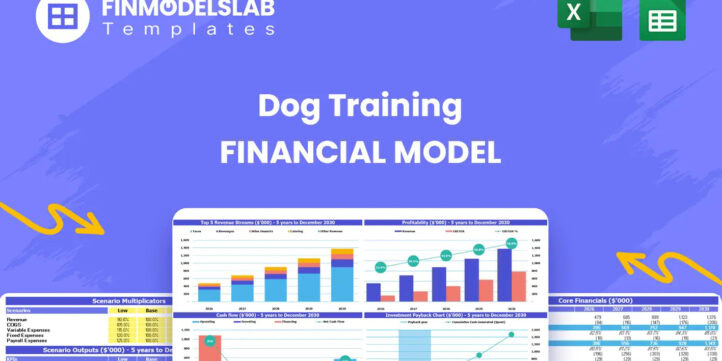


Financial Model Overview
The Dog Training Financial Model is a ready-to-use financial model template designed to help entrepreneurs, dog trainers, pet service business owners, consultants, and analysts plan the financial future of a dog training business. It brings together the core assumptions that drive this type of business, including class capacity, occupancy rates, monthly training fees, program mix, retail sales, payroll, startup costs, operating expenses, cash flow, profitability, and funding needs. Rather than starting from an empty spreadsheet, users can work from a structured model with editable inputs and automated outputs that support business planning, budgeting, loan preparation, investor discussions, and internal decision-making. The template is useful for launching a new dog training school, expanding an existing training service, opening a dedicated training facility, or evaluating whether a proposed service mix can generate enough revenue to cover costs and produce attractive returns over a five-year forecast period.
All-in-One Dashboard
The all-in-one dashboard gives users a central view of the most important inputs and outputs in the Dog Training Financial Model. This section is designed to connect the main planning assumptions with the key financial results, allowing users to update major drivers such as service pricing, class capacity, occupancy rates, retail sales assumptions, cost levels, staffing plans, and capital requirements while quickly reviewing the effect on revenue, profit, cash flow, and overall business performance. For a dog training business, this is especially valuable because small changes in class fill rates, trainer utilization, monthly fees, or program mix can significantly affect profitability. The dashboard helps users avoid getting lost in separate worksheets by providing an at-a-glance summary of the model’s most important conclusions. It can support quick internal reviews, business plan preparation, and stakeholder conversations by showing whether the business is generating enough income to support its operating structure and growth plans.
Low, Base, and High Scenario Analysis
The low, base, and high scenario analysis section helps users evaluate how the dog training business may perform under different operating conditions. Instead of relying on a single forecast, the model allows users to compare conservative, expected, and optimistic cases based on changes in assumptions such as customer demand, occupancy rates, service pricing, marketing effectiveness, payroll levels, variable costs, and expansion pace. A low scenario might show the effect of slower class enrollment, reduced retail sales, or higher operating expenses, while a high scenario may show the upside from stronger demand, better customer retention, or increased capacity utilization. This component is useful for risk management because it helps users understand how sensitive the business is to changes in the assumptions that matter most. For founders seeking funding, scenario analysis can also show lenders or investors that the plan has been stress-tested and that management has considered downside conditions, contingency planning, and upside potential before making financial commitments.
Professional Charts
The professional charts section transforms the financial model’s calculations into visual reports that are easier to interpret and present. These charts may display revenue growth, EBITDA trends, profitability margins, cash balances, expense categories, revenue mix, break-even timing, and other important performance indicators across the forecast period. For a dog training business, visualizing the numbers helps users quickly understand whether growth is driven by increased class occupancy, higher pricing, added services, retail sales, or improved cost control. Charts are particularly helpful when preparing a pitch deck, loan package, board update, or management presentation because they turn detailed spreadsheet outputs into stakeholder-friendly summaries. This component supports better decision-making by making trends, gaps, and performance changes more visible. Instead of presenting only rows of figures, users can show a clear financial story that explains where revenue comes from, how costs behave, and when the business is expected to become more profitable.
ROE Components and DuPont Analysis
The ROE components section uses a DuPont-style analysis to help users understand the drivers behind return on equity and overall investment performance. This component breaks financial returns into underlying factors such as profitability, asset efficiency, and leverage, giving users more insight than a single return percentage can provide. For a dog training business, this can help clarify whether strong returns are coming from healthy margins, efficient use of capital, disciplined cost management, or the way the business is funded. Inputs and outputs may include net income, revenue, assets, equity, margins, turnover measures, and leverage-related metrics. This is useful for investors, founders, and advisors who want to evaluate whether the business model is producing value in a sustainable way. It also helps users compare different strategic choices, such as investing in a larger facility, adding equipment, increasing debt financing, or scaling programs, and seeing how those decisions may influence return on equity over time.
Revenue Inputs
The revenue inputs section is where users define the commercial assumptions that drive the forecast. For a dog training business, revenue is commonly influenced by the number of available class spots, occupancy rates, monthly training fees, program types, private or group session assumptions, workshop participation, and retail sales of pet-related products. The model can be adapted to reflect services such as puppy kindergarten, basic obedience, advanced manners, specialized behavior workshops, and add-on product sales. Users can adjust pricing, demand levels, capacity, seasonality, and growth assumptions to reflect their local market and business strategy. The outputs from this section flow into the revenue forecast and then through the profit and loss statement, cash flow forecast, and dashboard metrics. This component is especially important because revenue assumptions are often the foundation of the entire business plan. By structuring those assumptions clearly, the model helps users test whether planned enrollment levels and service pricing are realistic, scalable, and sufficient to support the full cost structure.
Bank-Ready Reports
The bank-ready reports section provides lender-friendly financial outputs that can support loan applications, funding discussions, and professional business planning. This part of the Dog Training Financial Model typically includes organized financial statements such as projected profit and loss, cash flow, and balance sheet outputs, along with summaries of profitability, liquidity, debt capacity, and repayment potential. For a dog training business seeking financing, lenders often want to see not only projected revenue but also how cash will be generated, how operating costs will be managed, how startup expenses will be funded, and whether the business can meet its financial obligations. This component helps users present the model in a clean and structured format that is easier for banks, investors, grant reviewers, or business advisors to evaluate. It also supports internal planning by giving owners a clearer picture of financial performance across the forecast period and helping them understand whether the business can maintain adequate cash reserves while growing.
Revenue Breakdown
The revenue breakdown section gives users a detailed view of how each income stream contributes to total sales. Rather than showing only one combined revenue number, this component separates revenue by service or category, such as puppy classes, obedience programs, advanced training, behavior workshops, private sessions if added, and retail sales. Inputs may include the number of spots available, occupancy rates, fee levels, customer volume, sales per customer, and annual growth assumptions. Outputs may show monthly and annual revenue by stream, percentage contribution by category, and changes in revenue mix over time. This is particularly useful for a dog training business because not all services have the same pricing, capacity, margins, or growth potential. A detailed revenue breakdown helps users identify which programs are the strongest contributors, where there may be underused capacity, and which offerings may deserve more marketing attention. It also makes the forecast more credible because stakeholders can see exactly how total revenue is built from specific business activities.
KPI Dashboard
The KPI dashboard summarizes the key performance indicators that matter most for tracking the financial and operational health of the dog training business. This section may include metrics such as revenue growth, EBITDA margin, net profit margin, cash balance, occupancy rate, average monthly revenue, payback period, return metrics, expense ratios, and other benchmark-style measures. For users who are not financial specialists, the KPI dashboard makes it easier to monitor performance without reviewing every detailed schedule in the model. It helps founders and managers quickly identify whether the business is on track, whether costs are rising too quickly, whether margins are improving, and whether the company has enough liquidity to support operations. This component is also useful for investor and lender communication because it translates the financial forecast into concise indicators that show business quality, efficiency, profitability, and growth potential. By reviewing KPIs regularly, users can make more informed decisions about pricing, hiring, marketing, expansion, and cost control.
Startup Costs and Capital Planning
The startup costs and capital planning section helps users estimate the initial investment required to launch or expand a dog training business. This component organizes one-time costs such as facility build-out, training equipment, flooring, kenneling or safety equipment if applicable, office furniture, computer systems, software, signage, permits, licenses, legal setup, initial marketing, deposits, insurance setup, and working capital reserves. The model can separate these upfront costs from ongoing operating expenses so users can clearly see how much funding is needed before the business begins generating steady revenue. Outputs may include a total startup capital requirement, a breakdown by cost category, funding gap estimates, and a clearer view of how much owner investment, loan financing, or outside capital may be required. This section is valuable because underestimating launch costs can create cash pressure very early in the business. With a structured startup cost plan, users can prepare more realistic funding requests, avoid preventable shortfalls, and make better decisions about which investments are essential before opening and which can be delayed until the business grows.
Break-Even Analysis
The break-even analysis section helps users understand when the dog training business may generate enough revenue to cover its fixed and variable costs. This component can use assumptions related to pricing, class occupancy, service volume, payroll, rent, marketing, supplies, insurance, utilities, and other operating costs to estimate the point at which the business becomes self-sustaining. Outputs may include the break-even month, required revenue level, required customer or class volume, and the relationship between margins and fixed costs. For a dog training business, this is especially useful because profitability often depends on filling enough class spots and maintaining disciplined staffing and facility costs. The break-even analysis helps users evaluate whether their planned pricing and enrollment assumptions are realistic, whether a pre-launch campaign is needed to fill classes faster, and how much cash may be required before the business reaches stable operations. It also supports funding conversations by showing stakeholders the expected path to profitability and the assumptions that must be achieved for the business to become financially viable.
File types:
Excel – Single-User: .xlsx
Excel – Multi-User: .xlsx
Similar ProductsOther customers were also interested in...

 HenrySheykin
Day Care Financial Model Excel Template
The Daycare Center Financial Model helps entrepreneurs, childcare founders, consultants, analysts, a... Read more
Martial Arts School Financial Model Excel Template
The Martial Arts School Financial Model helps founders, school owners, consultants, and business pla... Read more

Driving School Financial Model Excel Template
The Driving School Financial Model Template helps users turn a driving school concept into a structu... Read more

Foreign Languages School Financial Model Excel Tem...
The Language School Financial Model helps users turn a language academy, tutoring center, or languag... Read more

Martial Arts School Financial Model Excel Template
The Martial Arts School Financial Model helps founders, school owners, consultants, and business pla... Read more

Dance School Financial Model Excel Template
The Dance School Financial Model helps users turn a studio concept into a structured financial forec... Read more

Beauty School Financial Model Excel Template
The Beauty School Financial Model helps entrepreneurs, founders, consultants, and business planners ... Read more

Child Care Financial Model Excel Template
The Daycare Center Financial Model helps entrepreneurs, childcare founders, consultants, analysts, a... Read more
Babysitting Financial Model Excel Template
The Babysitting Service Financial Model helps entrepreneurs, founders, business owners, consultants,... Read more
Pre-School Care Financial Model Excel Template
The Preschool Financial Model helps entrepreneurs, childcare founders, preschool owners, consultants... Read more
You must log in to submit a review.