0 ITEMS

Valuation Dispute Resolution: 7 Steps to Fairness Opinions

Valuation disputes in family businesses destroy more wealth than bad deals do. Here is how to resolve them with professional rigor before they reach a courtroom.
Key Takeaways
- 3 primary triggers drive most family business valuation disputes: generational transfers, shareholder buyouts, and divorce or estate settlements, each requiring a distinct procedural response.
- Qualified valuation mediators charge $250–$800 per hour and must hold credentials such as ASA, ABV, or CFA to be effective in technical disputes.
- Fairness opinions cost $25,000–$150,000+ depending on company size and typically take 4–8 weeks to deliver from engagement to final report.
- Independent business appraisals cost $15,000–$50,000 for mid-market companies, making them the most cost-effective first step before escalating to litigation.
- Earn-out structures, escrow holdbacks, and EBITDA-multiple formulas are the 3 most common pricing adjustment mechanisms used to bridge valuation gaps at closing.
- Professional standards including USPAP, IVS, and ASA Business Valuation Standards govern how arbitrators and courts weight competing expert opinions.
- Preventive documentation, specifically buy-sell agreements with predetermined valuation formulas, eliminates the most common dispute triggers before they arise.
When Valuation Disputes Arise in Family Businesses
Valuation disputes in family businesses cluster around three predictable triggers, and each trigger demands a different procedural response. Understanding which trigger applies determines the resolution pathway, the standard of value to apply, and whether minority interest discounts are even relevant.
Generational Transfers. When a founder transfers ownership to the next generation, the dispute typically centers on gift or estate tax valuation. The Internal Revenue Service requires fair market value (FMV) as the standard, defined as the price a hypothetical willing buyer and willing seller would agree upon with full knowledge and no compulsion to transact. Family members often disagree on discount rates, minority interest discounts (typically 15–35% for non-controlling stakes), and marketability discounts (typically 10–30% for illiquid private company shares). According to the American Society of Appraisers, these two discount categories are the most frequently contested items in estate and gift tax valuation disputes.
Shareholder Exits and Buyouts. When a minority shareholder exits or a co-owner demands a buyout, the applicable standard of value shifts. Many state statutes require “fair value” rather than FMV for dissenting shareholder appraisal rights, and fair value typically excludes minority and marketability discounts. This distinction alone can produce a 20–40% difference in the concluded value, which is why shareholder exit disputes are among the most technically complex to resolve.
Divorce and Estate Settlements. Courts in divorce proceedings often apply “investment value,” which reflects the specific value to a particular owner rather than a hypothetical market participant. This standard can produce values higher than FMV if the business owner has unique synergies or access to capital. Estate settlements involving multiple heirs introduce additional complexity when heirs disagree on whether to sell, hold, or recapitalize the business.

Each dispute trigger applies a different standard of value, making trigger identification the critical first step in any resolution process.
Mediator Selection for Valuation Conflicts: Credentials and Process
The right mediator for a valuation dispute is not a general civil mediator. You need someone who understands discounted cash flow analysis, EBITDA multiples, and the difference between fair market value and fair value before they can help parties bridge a gap.
Required Credentials. Look for mediators holding at least one of the following designations: Accredited Senior Appraiser (ASA) from the American Society of Appraisers, Accredited in Business Valuation (ABV) from the AICPA, or Chartered Financial Analyst (CFA) from the CFA Institute. The Certified Business Appraiser (CBA) designation from the Institute of Business Appraisers is also recognized, particularly for smaller private companies. Each designation requires demonstrated competency in business valuation methodology, not just general finance.
Industry Expertise. A mediator who has valued manufacturing companies for 20 years may not be the right choice for a dispute involving a professional services firm or a family-owned SaaS business. Industry-specific knowledge matters because revenue recognition, customer concentration risk, and working capital norms vary significantly across sectors.
Conflict-of-Interest Screening. Before engaging any mediator, require a written conflict-of-interest disclosure covering prior engagements with either party, their advisors, or competitors in the same industry. The American Arbitration Association’s Commercial Mediation Procedures provide a useful framework for this screening process.
Cost Structure. Qualified valuation mediators charge $250–$800 per hour, with the higher end reflecting ASA or CFA credentials combined with deep industry expertise. A typical two-day mediation session for a mid-market family business dispute runs $8,000–$25,000 in mediator fees alone, excluding legal counsel and expert witness costs.
Commissioning Fairness Opinions: Timing, Scope, and Deliverables
A fairness opinion is a formal written conclusion by an independent financial advisor stating whether the financial terms of a proposed transaction are fair, from a financial point of view, to a specified party. It is not a valuation report, though it incorporates valuation analysis as a core component.
When They Are Required Versus Optional. Fairness opinions are legally required in certain public company transactions under Delaware corporate law and SEC regulations. For private family businesses, they are optional but strategically valuable in three scenarios: when a controlling shareholder is buying out minority shareholders, when a board approves a related-party transaction, and when estate executors need to demonstrate procedural fairness to beneficiaries or tax authorities.
The Three Core Components. Every credible fairness opinion contains: (1) a valuation analysis using multiple methodologies (DCF, comparable company analysis, precedent transactions); (2) a comparable transaction review benchmarking the proposed deal terms against similar closed transactions; and (3) a procedural fairness assessment confirming that the process leading to the proposed terms was conducted at arm’s length.
Timeline. The typical fairness opinion engagement runs 4–8 weeks from signed engagement letter to final delivery. Complex transactions with multiple business units, international operations, or contested financial projections can extend to 12 weeks. Rushing this process below four weeks risks producing a superficial analysis that will not withstand scrutiny in litigation.
Cost Ranges. Fairness opinion fees range from $25,000 for small private companies with revenues under $10 million to $150,000 or more for companies with revenues exceeding $100 million or complex capital structures. Some investment banks charge a success fee tied to transaction completion, which creates an incentive conflict that parties should evaluate carefully before engagement.
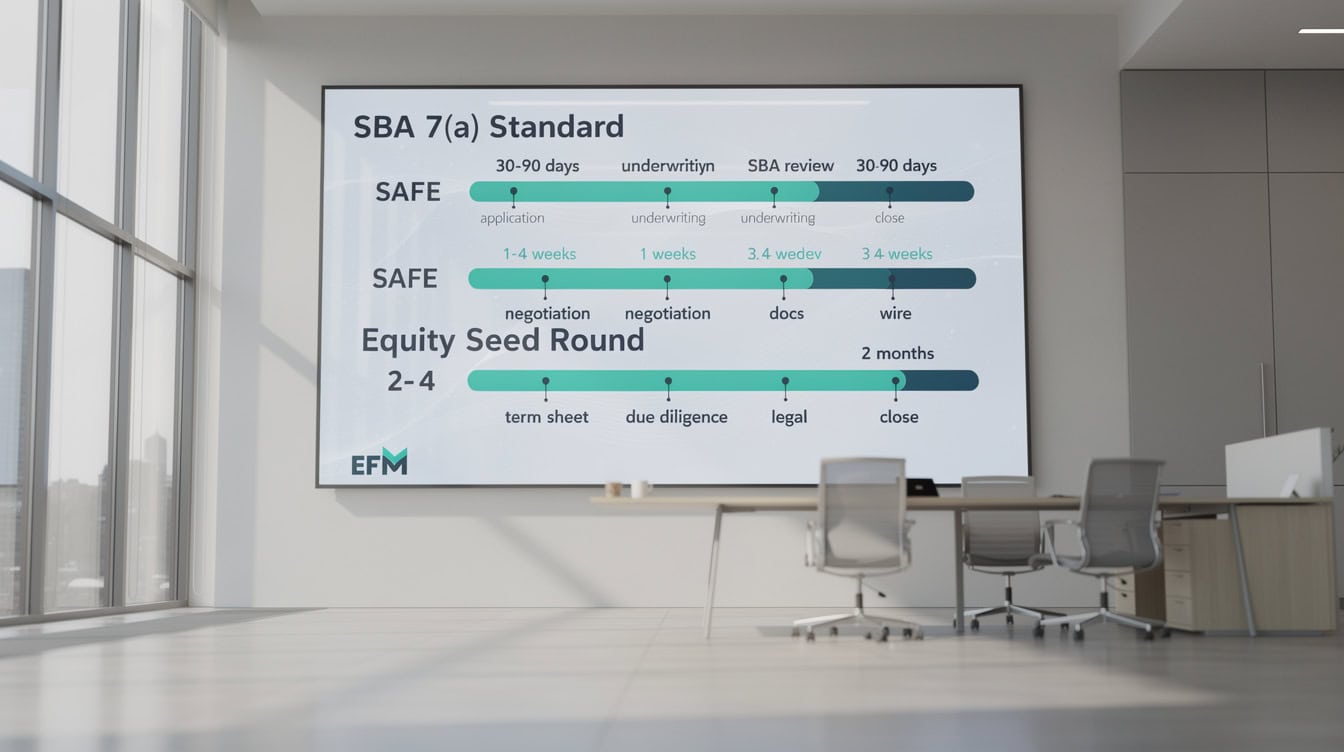
A standard fairness opinion engagement runs 4–8 weeks; complex multi-entity transactions can extend to 12 weeks.
Pricing Adjustment Mechanisms: Earn-Outs, Escrows, and Formula Approaches
When parties cannot agree on a single value at closing, pricing adjustment mechanisms allow the transaction to proceed while deferring part of the economic resolution to future events or verified facts.
Earn-Out Structures. An earn-out is a contractual provision where the seller receives additional consideration if the business achieves specified performance targets after closing. In family business transitions, earn-outs typically run 2–5 years and tie payments to EBITDA (earnings before interest, taxes, depreciation, and amortization), revenue, or gross profit thresholds. According to SRS Acquiom’s M&A Deal Terms Study, earn-outs appear in approximately 25–30% of private M&A transactions, with EBITDA being the most common metric.
Worked Example: EBITDA-Based Earn-Out. Here is the math for a simple earn-out structure:
- Base purchase price at closing: $8,000,000 (based on 6x trailing EBITDA of $1,333,333)
- Earn-out target: If Year 1 EBITDA exceeds $1,500,000, seller receives an additional payment
- Earn-out formula: (Actual EBITDA – $1,333,333) x 6x multiple, capped at $2,000,000
- If Year 1 EBITDA = $1,600,000: ($1,600,000 – $1,333,333) x 6 = $266,667 x 6 = $1,600,002 additional payment
- Total consideration: $8,000,000 + $1,600,002 = $9,600,002
This structure rewards the seller if the business outperforms the buyer’s conservative projections, while protecting the buyer from overpaying for optimistic forecasts.
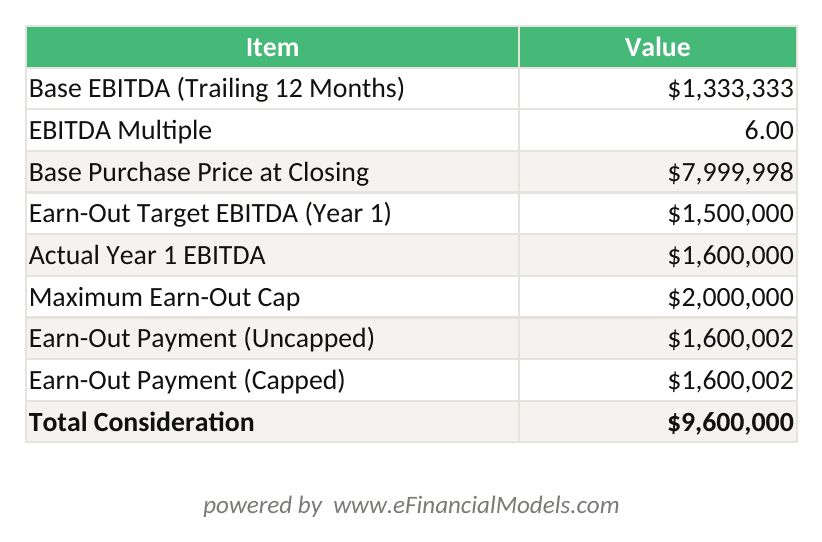
Earn-out formula: (Actual EBITDA – Base EBITDA) × Multiple = Additional Payment, capped at the maximum earn-out amount.
Escrow Holdbacks. An escrow holdback retains a portion of the purchase price (typically 5–15%) in a third-party escrow account for 12–24 months post-closing. The holdback covers indemnification claims, working capital adjustments, and representations and warranties breaches. For family business disputes involving disputed receivables or contingent liabilities, escrow holdbacks provide a structured resolution mechanism without requiring agreement on the disputed items at closing.
Working Capital Adjustment Clauses. Most M&A transactions include a working capital adjustment that compares actual working capital at closing to a target working capital level established during due diligence. If actual working capital falls short, the purchase price decreases dollar-for-dollar. If it exceeds the target, the purchase price increases. This mechanism prevents sellers from drawing down cash or deferring payables before closing.
Formula-Based Approaches. Some buy-sell agreements use predetermined formulas to eliminate valuation disputes entirely. Common formulas include a fixed EBITDA multiple (e.g., 5x trailing twelve-month EBITDA), book value plus a premium, or a blended approach averaging two or three methodologies. Formula approaches sacrifice precision for certainty, which is often the right trade-off in family business contexts where relationship preservation matters.
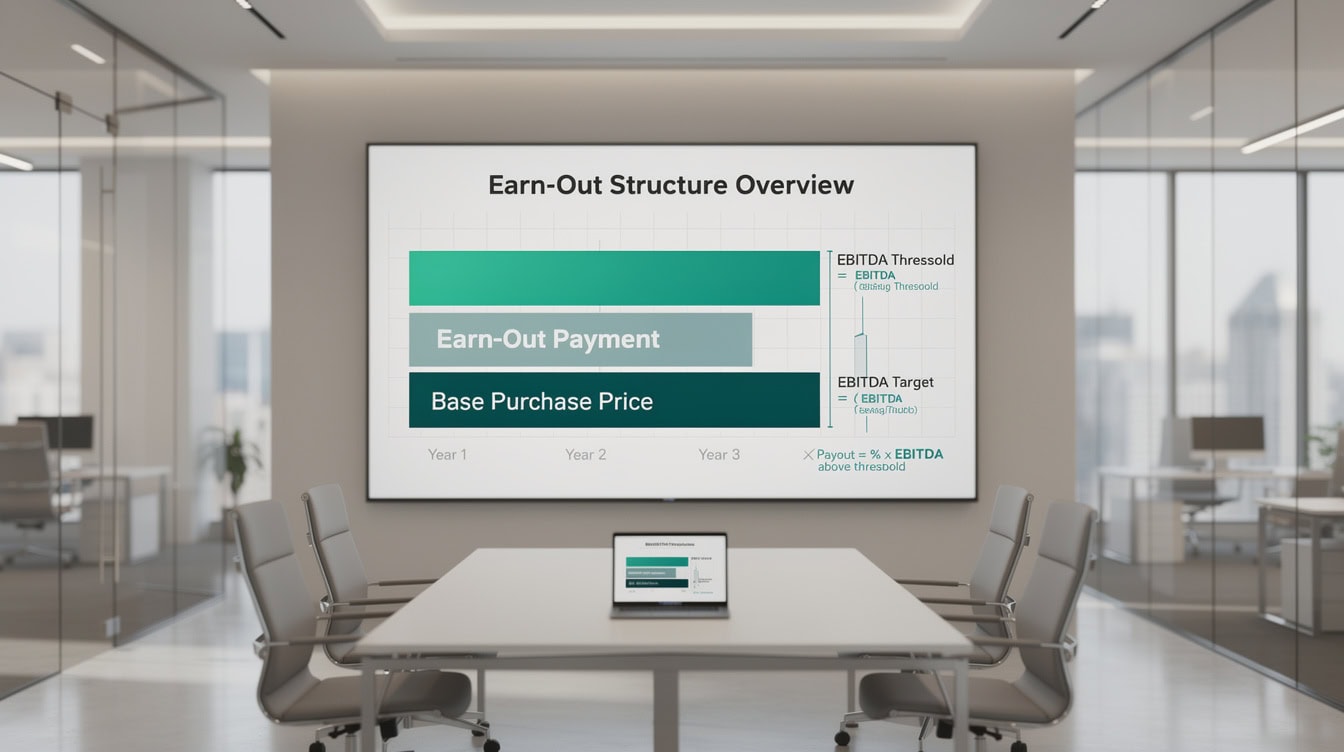
Earn-out structures bridge valuation gaps by tying deferred payments to verified post-closing EBITDA performance.
Engaging Independent Appraisers: Standards and Reconciliation
An independent business appraiser produces a formal valuation report that can withstand scrutiny in mediation, arbitration, or litigation. Selecting the right appraiser and structuring the engagement correctly prevents the appraisal itself from becoming a new source of dispute.
Professional Designations Comparison.
| Designation | Issuing Body | Jurisdiction | Focus |
|---|---|---|---|
| ASA | American Society of Appraisers | US, international | Business, real property, personal property |
| ABV | AICPA | US | Business valuation for CPAs |
| CBA | Institute of Business Appraisers | US | Small to mid-market businesses |
| CBV | CBV Institute | Canada | Business valuation, litigation support |
| CFA | CFA Institute | Global | Investment analysis, portfolio management |
Engagement Letter Essentials. The engagement letter must specify: the purpose of the appraisal (estate planning, shareholder buyout, litigation support), the standard of value (fair market value, fair value, or investment value), the premise of value (going concern versus liquidation), the effective date of the valuation, the scope of work, fee structure, and deliverable format. Ambiguity in any of these elements creates grounds for challenging the appraisal later.
Reconciling Multiple Appraisals. When two parties commission separate appraisals and the conclusions differ significantly, three reconciliation approaches exist: appointing a third neutral appraiser whose conclusion is binding, averaging the two conclusions (common in buy-sell agreements), or submitting both appraisals to a mediator or arbitrator who selects the more credible methodology. Courts generally prefer the third approach because it rewards methodological rigor rather than aggressive assumptions.
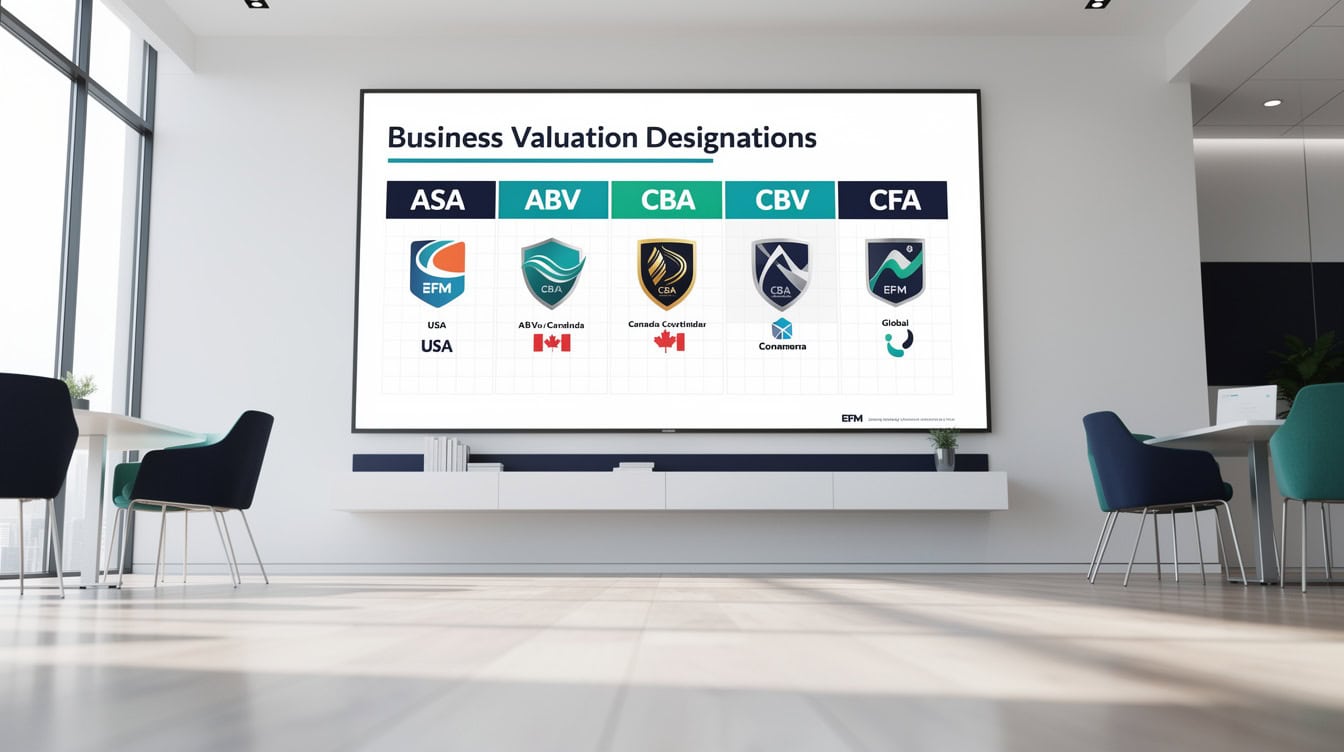
Selecting an appraiser with the right designation for your jurisdiction and dispute type is critical to producing a defensible valuation opinion.
The Role of Professional Standards and Peer-Reviewed Methodologies
Arbitrators and courts do not treat all valuation opinions equally. Opinions grounded in recognized professional standards carry significantly more weight than those relying solely on practitioner judgment.
Governing Standards. Three sets of standards govern business valuation practice in the United States and internationally. The Uniform Standards of Professional Appraisal Practice (USPAP), published by the Appraisal Foundation, establishes minimum competency and reporting requirements for all appraisers. The International Valuation Standards (IVS), published by the International Valuation Standards Council, provide a globally recognized framework increasingly cited in cross-border disputes. The ASA Business Valuation Standards, published by the American Society of Appraisers, provide detailed guidance on methodology selection, discount rate development, and report content.
How Courts Weight Competing Opinions. Federal Tax Court decisions in estate and gift tax valuation disputes consistently favor appraisers who document their methodology transparently, use multiple valuation approaches, and reconcile differences between approaches with reasoned analysis. The Tax Court has repeatedly rejected appraisals that rely on a single methodology without explaining why alternative approaches were excluded. According to a review of Tax Court decisions published in the Business Valuation Review (a peer-reviewed journal of the American Society of Appraisers), courts award greater credibility to opinions that cite recognized academic literature on discount rates and risk premiums.
Marketability and Minority Discounts as Dispute Flashpoints. The discount for lack of marketability (DLOM) and the discount for lack of control (DLOC) are the two most contested inputs in private company valuations. DLOM typically ranges from 10–35% depending on company size, profitability, and dividend history. DLOC ranges from 15–40% depending on the degree of control being valued. A 10-percentage-point difference in DLOM on a $10 million enterprise value produces a $1 million swing in concluded value, which explains why these discounts generate disproportionate dispute volume.
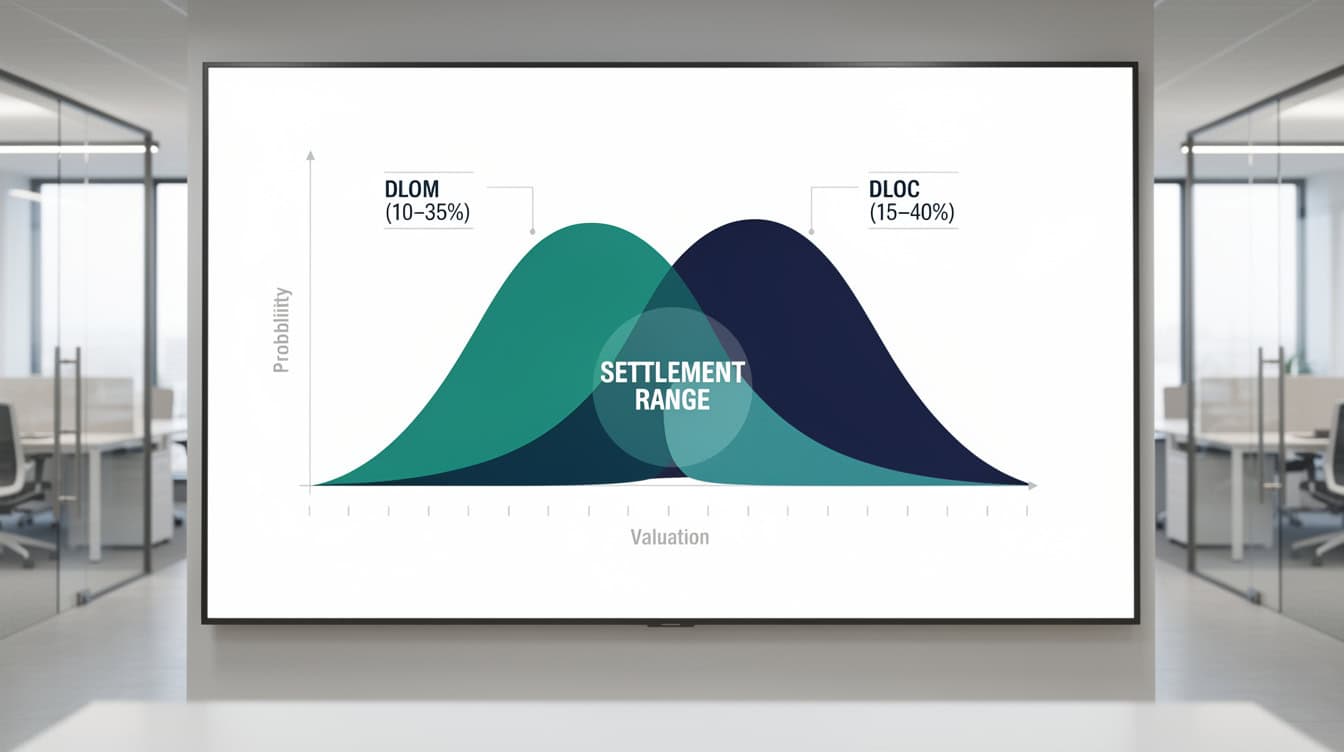
A 10-percentage-point difference in the discount for lack of marketability produces a $1 million swing on a $10 million enterprise value.
Dispute Resolution Pathways: Negotiation to Litigation
The right resolution pathway depends on dispute complexity, the dollar amount at stake, and how much the parties value preserving their relationship after the dispute concludes.
| Pathway | Cost | Timeline | Binding | Relationship Impact |
|---|---|---|---|---|
| Informal Negotiation | Low ($0–$5K) | Days to weeks | No | Minimal |
| Formal Mediation | Moderate ($8K–$50K) | 1–3 months | No | Low to moderate |
| Binding Arbitration | High ($50K–$200K) | 6–18 months | Yes | Moderate |
| Litigation | Very High ($200K+) | 2–5 years | Yes | Severe |
Informal negotiation works when the parties trust each other, the valuation gap is small (under 10%), and both sides have access to the same financial information. Formal mediation adds a neutral facilitator and works well when the gap is larger but the parties want to preserve the relationship. According to the American Arbitration Association, commercial mediation achieves settlement in approximately 85% of cases that reach a formal session.
Binding arbitration is appropriate when mediation fails, the dispute involves complex technical questions requiring expert testimony, and the parties want a faster resolution than litigation provides. Litigation is the last resort, appropriate only when one party acts in bad faith, the amount at stake justifies the cost and time, or a legal precedent is needed.
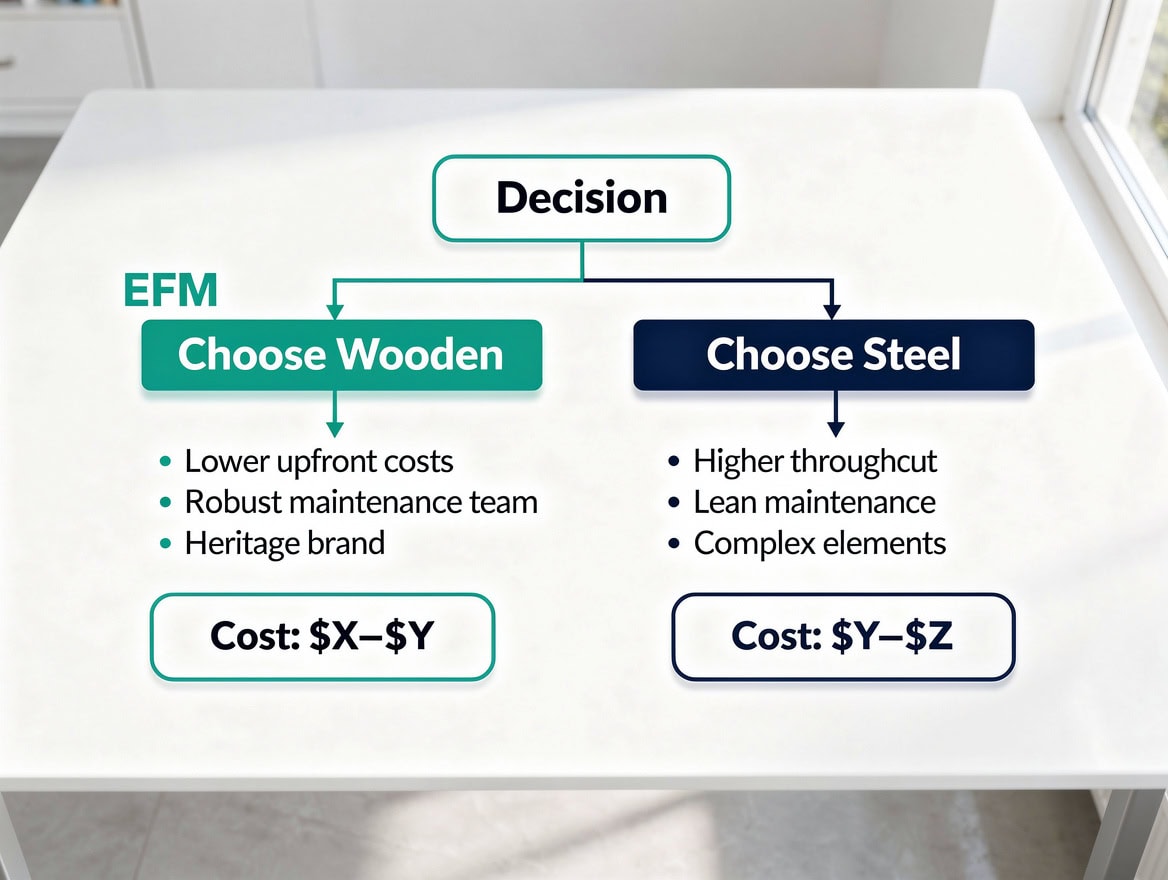
Commercial mediation achieves settlement in approximately 85% of cases that reach a formal session, according to the American Arbitration Association.
Preventive Documentation: Buy-Sell Agreements and Valuation Clauses
The most effective valuation dispute resolution strategy is preventing disputes before they arise. A well-drafted buy-sell agreement with clear valuation provisions eliminates ambiguity at the moment of maximum emotional tension.
Essential Buy-Sell Agreement Valuation Clauses. Every buy-sell agreement should specify: the triggering events that activate the buyout obligation (death, disability, divorce, voluntary exit, involuntary transfer), the standard of value applicable to each trigger, the valuation methodology or formula, the appraiser selection process, the timeline for completing the appraisal, and the payment terms for the buyout price.
Predetermined Formula Versus Independent Appraisal. Formula-based approaches (e.g., 5x trailing EBITDA) provide certainty and speed but can produce values that diverge significantly from market reality over time. Independent appraisal requirements produce more accurate values but introduce process risk and cost. A hybrid approach, using a formula as a starting point with an independent appraisal available if either party disputes the formula result, balances certainty with accuracy.
Appraisal Update Frequency. Buy-sell agreements should require appraisal updates at least every three years, or annually for businesses in rapidly changing industries. Stale appraisals create disputes because they fail to reflect current market conditions, recent performance changes, or shifts in industry valuation multiples. You can explore business valuation models to establish documented baselines that support regular update cycles.
Right of First Refusal Mechanics. A right of first refusal (ROFR) gives existing shareholders the right to purchase a departing shareholder’s interest at the same price and terms offered by a third party. For the ROFR to function without dispute, the agreement must specify how the third-party offer price is verified, the timeline for exercising the right, and what happens if the existing shareholders cannot finance the purchase at the offered price. Linking the ROFR price to an independent valuation rather than a third-party offer eliminates the risk of collusive low-ball offers.
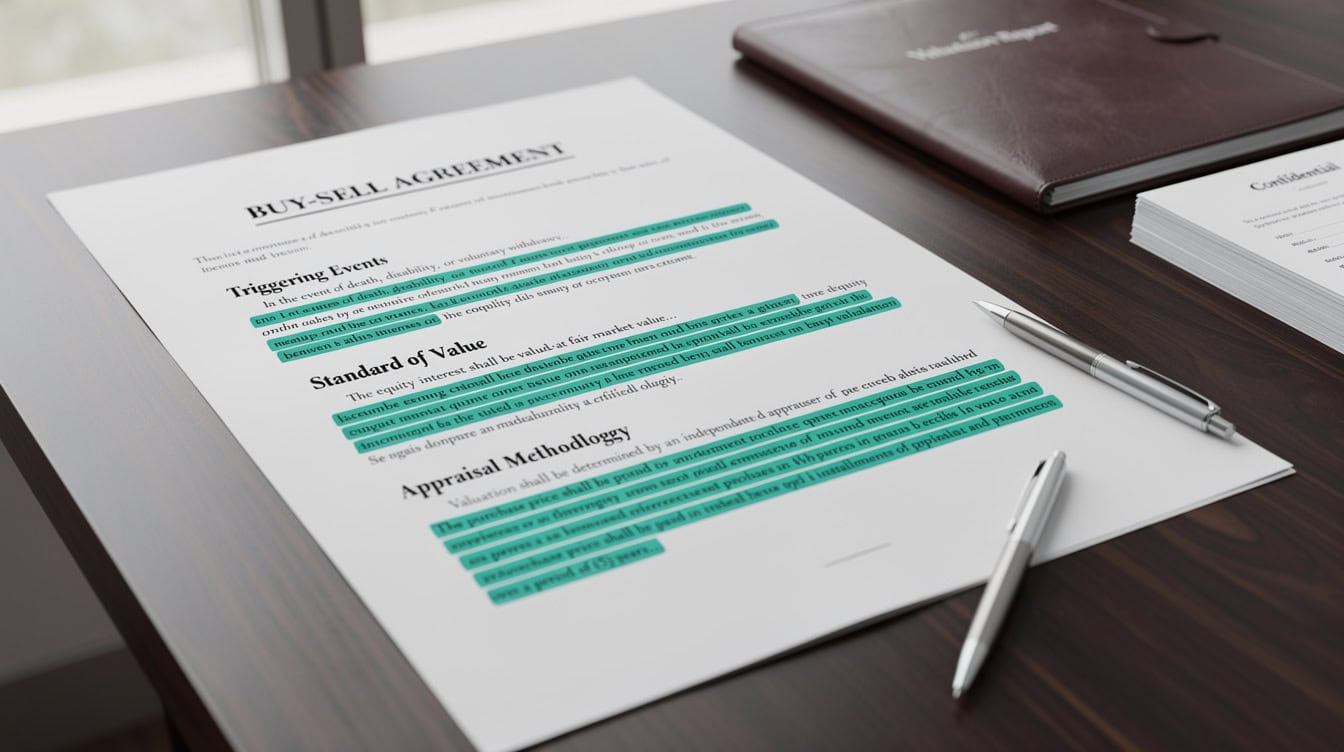
A well-drafted buy-sell agreement with clear valuation provisions eliminates the most common dispute triggers before they arise.
Cost-Benefit Analysis: When Professional Resolution Pays Off
Professional dispute resolution costs money, but the alternative, protracted litigation, costs far more in both dollars and relationships. Here is how to frame the cost-benefit decision.
An independent business appraisal costs $15,000–$50,000 for a mid-market company. A fairness opinion costs $25,000–$150,000. A full mediation process, including legal counsel and expert witnesses, costs $50,000–$200,000. Litigation discovery for a valuation dispute, including depositions, expert reports, and trial preparation, routinely exceeds $500,000 per side for disputes involving companies valued above $10 million.
The math is straightforward: if a valuation dispute involves a $5 million gap between the parties’ positions, spending $75,000 on a fairness opinion and mediation to resolve the dispute is a 1.5% cost on the disputed amount. Spending $600,000 on litigation to resolve the same dispute is a 12% cost, before accounting for the time value of money, management distraction, and relationship damage.
For family businesses specifically, the non-financial costs of litigation, including damaged family relationships, management team disruption, and reputational harm with customers and suppliers, often exceed the financial costs. This is why formal mediation with a credentialed valuation expert is the preferred pathway for disputes where the parties have an ongoing relationship. You can use a 3 Statement Modeling + Valuation framework to build the financial foundation that supports any of these resolution pathways.
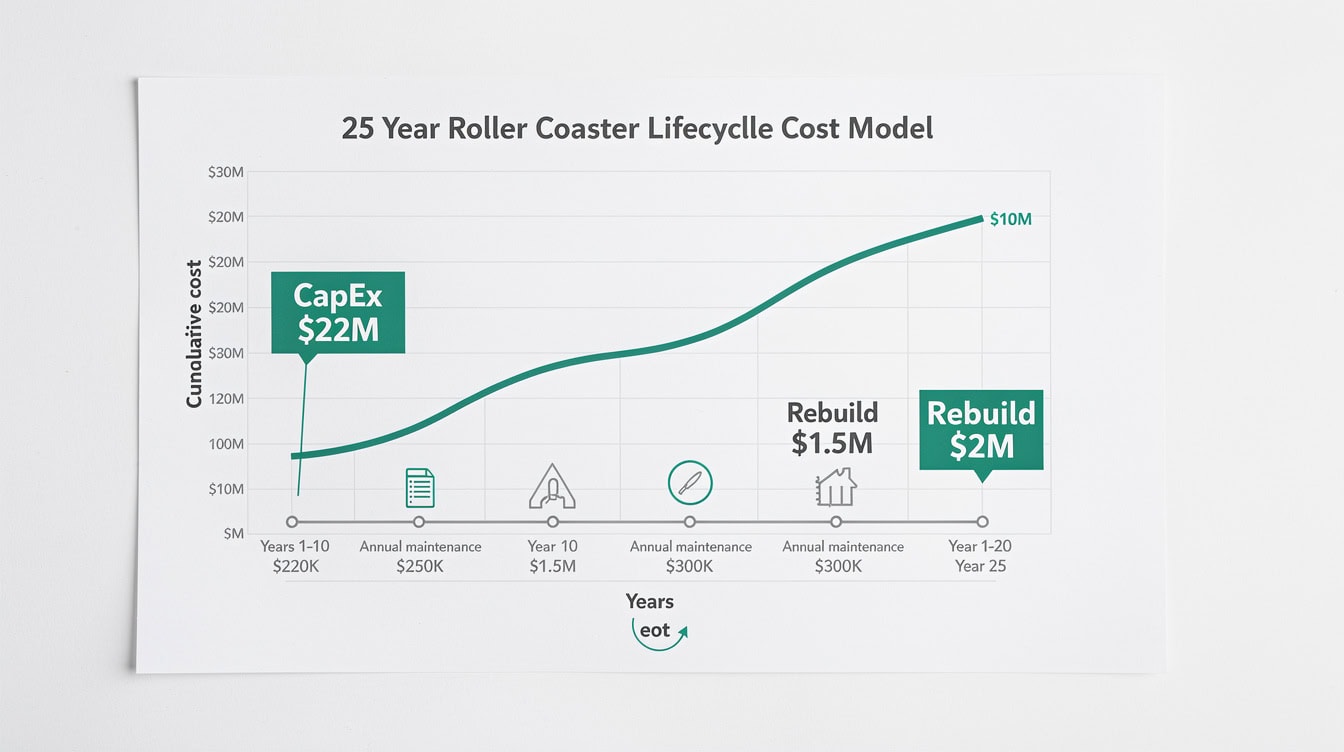
Litigation for a valuation dispute involving a $10M+ company routinely exceeds $500,000 per side, making mediation a 90%+ cost saving.
Frequently Asked Questions
How do I choose between a fairness opinion and an independent appraisal for a family business dispute?
The choice depends on the purpose and audience for the valuation. An independent appraisal produces a concluded value expressed as a specific number or range, and it is the right tool when you need a defensible value for tax purposes, a shareholder buyout, or estate settlement. A fairness opinion produces a conclusion about whether the financial terms of a proposed transaction are fair, and it is the right tool when a board or trustee needs to demonstrate procedural fairness to a third party such as a court, tax authority, or minority shareholder. Independent appraisals typically cost $15,000–$50,000 for mid-market companies. Fairness opinions cost $25,000–$150,000 or more. If you need both a concluded value and a procedural fairness conclusion, commission a fairness opinion, which incorporates valuation analysis as a component. If you only need a concluded value, an independent appraisal is more cost-effective.
What credentials should a valuation mediator have for a family business dispute?
A valuation mediator should hold at least one business valuation credential: ASA (Accredited Senior Appraiser) from the American Society of Appraisers, ABV (Accredited in Business Valuation) from the AICPA, or CBA (Certified Business Appraiser) from the Institute of Business Appraisers. General civil mediators without valuation credentials cannot effectively evaluate competing expert opinions on discount rates, EBITDA multiples, or working capital adjustments. The mediator should also have industry experience relevant to the business being valued. Expect to pay $250–$800 per hour for a mediator with these qualifications. A two-day mediation session typically costs $8,000–$25,000 in mediator fees, which is a fraction of the cost of arbitration or litigation for the same dispute.
What is the difference between fair market value, fair value, and investment value in a dispute context?
These three standards of value produce different numbers and apply in different contexts. Fair market value (FMV) is the price a hypothetical willing buyer and willing seller would agree upon, with both having full knowledge and neither under compulsion to transact. FMV is the standard for federal estate and gift tax purposes and most voluntary transactions. Fair value is a statutory standard used in shareholder appraisal rights cases and financial reporting under GAAP and IFRS. It typically excludes minority and marketability discounts, which can make it 20–40% higher than FMV for a minority interest. Investment value reflects the value to a specific buyer or owner, incorporating their unique synergies, cost of capital, and strategic plans. Courts in divorce proceedings often apply investment value. Selecting the wrong standard of value is one of the most common errors in family business dispute resolution, and it can invalidate an otherwise well-executed appraisal.
How do earn-out structures work in family business buyouts, and what are the common pitfalls?
An earn-out is a deferred payment mechanism where the seller receives additional consideration after closing if the business achieves specified performance targets. In family business buyouts, earn-outs typically run 2–5 years and tie payments to EBITDA, revenue, or gross profit. The most common pitfall is insufficient specificity in the earn-out formula: if the agreement does not define exactly how EBITDA is calculated (before or after management fees, owner compensation adjustments, or one-time items), disputes about the earn-out calculation are almost inevitable. A second common pitfall is failing to specify the buyer’s operational obligations during the earn-out period. If the buyer can change pricing, cut marketing spend, or shift revenue to an affiliate, the seller’s earn-out targets become unachievable. Earn-out agreements should include buyer conduct covenants, a defined accounting methodology, and a dispute resolution mechanism specific to earn-out calculation disputes.
When does a valuation dispute require binding arbitration rather than mediation?
Binding arbitration is appropriate when three conditions exist: mediation has failed or is unlikely to succeed because one party is acting in bad faith, the technical complexity of the dispute requires a decision-maker with financial expertise rather than a generalist judge, and the parties want a faster and more private resolution than litigation provides. Arbitration is also preferable when the buy-sell agreement or shareholder agreement contains a mandatory arbitration clause, which many well-drafted agreements include. The American Arbitration Association’s Commercial Arbitration Rules provide a framework for selecting arbitrators with business valuation expertise. Arbitration for a mid-market valuation dispute typically costs $50,000–$200,000 per side and takes 6–18 months, compared to 2–5 years for litigation. The arbitrator’s decision is binding and has very limited grounds for appeal, so parties should ensure the arbitrator has genuine valuation expertise before proceeding.
How often should a family business update its valuation to prevent disputes?
Buy-sell agreements should require valuation updates at least every three years, and annually for businesses in rapidly changing industries such as technology, healthcare, or consumer goods. Stale valuations create disputes because they fail to reflect current EBITDA levels, changes in industry multiples, or shifts in the company’s risk profile. A company that was valued at 5x EBITDA three years ago may now trade at 7x or 4x depending on market conditions, making a three-year-old formula-based valuation significantly inaccurate. Annual updates are also advisable when the company has experienced a major event such as a significant acquisition, loss of a key customer, or management change. The cost of an annual valuation update, typically $5,000–$15,000 for a refreshed analysis based on an existing appraisal, is far less than the cost of resolving a dispute triggered by a stale valuation.
What role do professional standards like USPAP play in a valuation dispute?
USPAP (Uniform Standards of Professional Appraisal Practice), published by the Appraisal Foundation, establishes the minimum competency and ethical requirements for appraisers in the United States. In a valuation dispute, USPAP compliance is the baseline credibility threshold: an appraisal that does not comply with USPAP is vulnerable to being excluded as evidence in arbitration or litigation. Beyond USPAP, the ASA Business Valuation Standards and the International Valuation Standards (IVS) provide more detailed methodology guidance. Courts and arbitrators give greater weight to appraisals that cite recognized academic literature on discount rates (such as the Duff and Phelps Cost of Capital Navigator data) and document the appraiser’s reasoning for selecting specific inputs. An appraisal that simply states a conclusion without showing the methodology and data sources is far less persuasive than one that walks through each assumption with supporting evidence.
Conclusion
Valuation disputes in family businesses are predictable, preventable, and resolvable, but only if you engage the right professionals with the right credentials at the right stage of the process. The cost of a credentialed mediator, a well-scoped fairness opinion, or a properly structured earn-out is always less than the cost of litigation, and far less than the cost of a permanently fractured family relationship.
Start with preventive documentation: a buy-sell agreement with clear valuation clauses, a predetermined formula or independent appraisal requirement, and a scheduled update cycle. When disputes arise despite good documentation, escalate through the resolution pathways in order: informal negotiation, formal mediation with a credentialed valuation expert, binding arbitration, and litigation only as a last resort.
I recommend downloading the Business Valuation templates from eFinancialModels to establish a documented valuation baseline that minimizes future disputes, or exploring the Break-Even Analysis, Forecast and Valuation model to build the financial foundation that supports any resolution pathway. For companies with real property components, the Apartment Complex Cash Flow and Valuation template provides a structured starting point for asset-level valuation disputes.