0 ITEMS

Convenience Store Startup Costs: $50K to $1M Breakdown

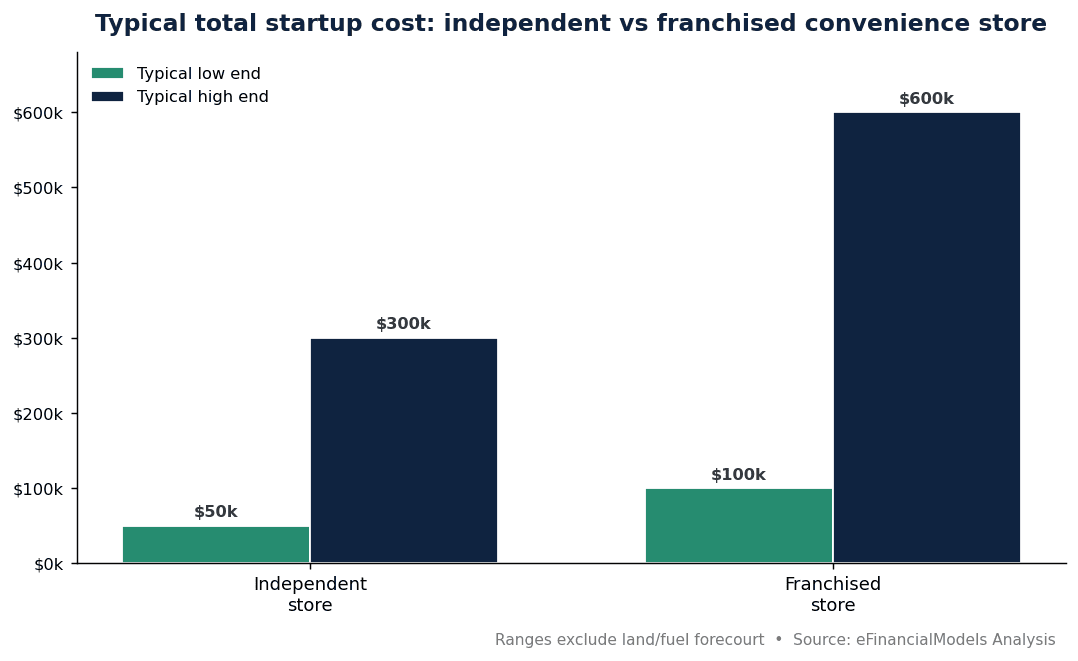
Opening a convenience store costs between $50,000 and $1,000,000 depending on size, location, and whether you buy or lease — and first-time owners routinely underestimate the gap between those two numbers.
Key Takeaways
- Total startup costs range from $50,000 (small leased format) to $1,000,000+ (large purchased location with fuel), with most independent stores landing between $150,000 and $400,000.
- Build-out costs run $50–$150 per square foot, meaning a 2,000 sq ft store can require $100,000–$300,000 in construction alone before a single product hits the shelf.
- Initial inventory typically costs $20,000–$75,000, with tobacco products consuming 30–40% of that budget and beverages accounting for another 15–20%.
- Licensing and permits add $500–$5,000 depending on state, with tobacco licenses ($200–$1,500) and food service permits ($100–$1,000) being the most variable line items.
- Franchise models (7-Eleven, Circle K) charge $10,000–$50,000 in upfront fees plus 4–8% of gross sales in ongoing royalties — a significant premium over independent ownership.
- Credit card processing fees of 1.5–3% of sales are one of the most overlooked recurring costs, reducing net margin on every transaction.
- A 3–6 month working capital reserve is non-negotiable: undercapitalization is a leading cause of small business failure in the first year, according to the U.S. Small Business Administration.
Total Investment Overview: What $50K vs. $500K vs. $1M Gets You
Your total convenience store investment scales directly with store size, location tier, and ownership structure. Here’s what each budget tier realistically delivers.
| Budget Tier | Store Size | Format | Key Tradeoffs |
|---|---|---|---|
| $50K–$150K | 800–1,200 sq ft | Leased, independent | Tight inventory, minimal build-out |
| $150K–$400K | 1,500–2,500 sq ft | Leased or purchased | Full product mix, standard equipment |
| $400K–$700K | 2,500–3,500 sq ft | Purchased or franchise | Fuel capability, expanded cold vault |
| $700K–$1M+ | 3,000+ sq ft | Franchise or fuel+store | Full fuel canopy, branded systems |
The U.S. convenience store industry comprises 151,975 stores nationwide, according to the 2026 NACS/NIQ TDLinx Convenience Industry Store Count, and the NACS convenience store format definitions put a traditional store at roughly 2,500 square feet and an expanded, foodservice-driven store at 2,800–3,600 square feet. Smaller formats under 1,500 sq ft remain viable in dense urban corridors where foot traffic compensates for limited SKU count.
Property Costs: Lease vs. Purchase With Regional Breakdowns
Property is typically the single largest cost variable in your convenience store budget, and the lease-vs.-purchase decision shapes your entire financial model.
Leasing requires a security deposit of 3–6 months’ rent upfront. In suburban markets, monthly rent for a 2,000 sq ft retail space runs $3,000–$8,000 per month. Urban locations in high-traffic corridors can reach $15,000–$25,000 per month. Purchasing commercial property requires a down payment of 10–30% of the purchase price; a $500,000 property demands $50,000–$150,000 at closing, plus closing costs of 2–5%.
Regional cost variation is significant. Retail space in Northeast and West Coast metros generally commands a sizeable premium over comparable square footage in the Midwest and Southeast. A location that costs $6,000/month in suburban Ohio might cost $14,000/month in suburban New Jersey, so rent should always be quoted from local comparables rather than a national average.
Lease vs. Purchase Comparison
| Factor | Lease | Purchase |
|---|---|---|
| Upfront cost | 3–6 months deposit | 10–30% down payment |
| Monthly obligation | Rent ($3K–$25K) | Mortgage + maintenance |
| Equity building | None | Yes |
| Renovation control | Landlord approval needed | Full control |
| Risk if business fails | Walk away at lease end | Property asset retained |
| Best for | First-time owners, urban sites | Established operators, suburban |
Build-Out and Renovation Expenses
Converting a raw or previously occupied retail space into a functioning convenience store costs $50–$150 per square foot, depending on the condition of the space and your local labor market.
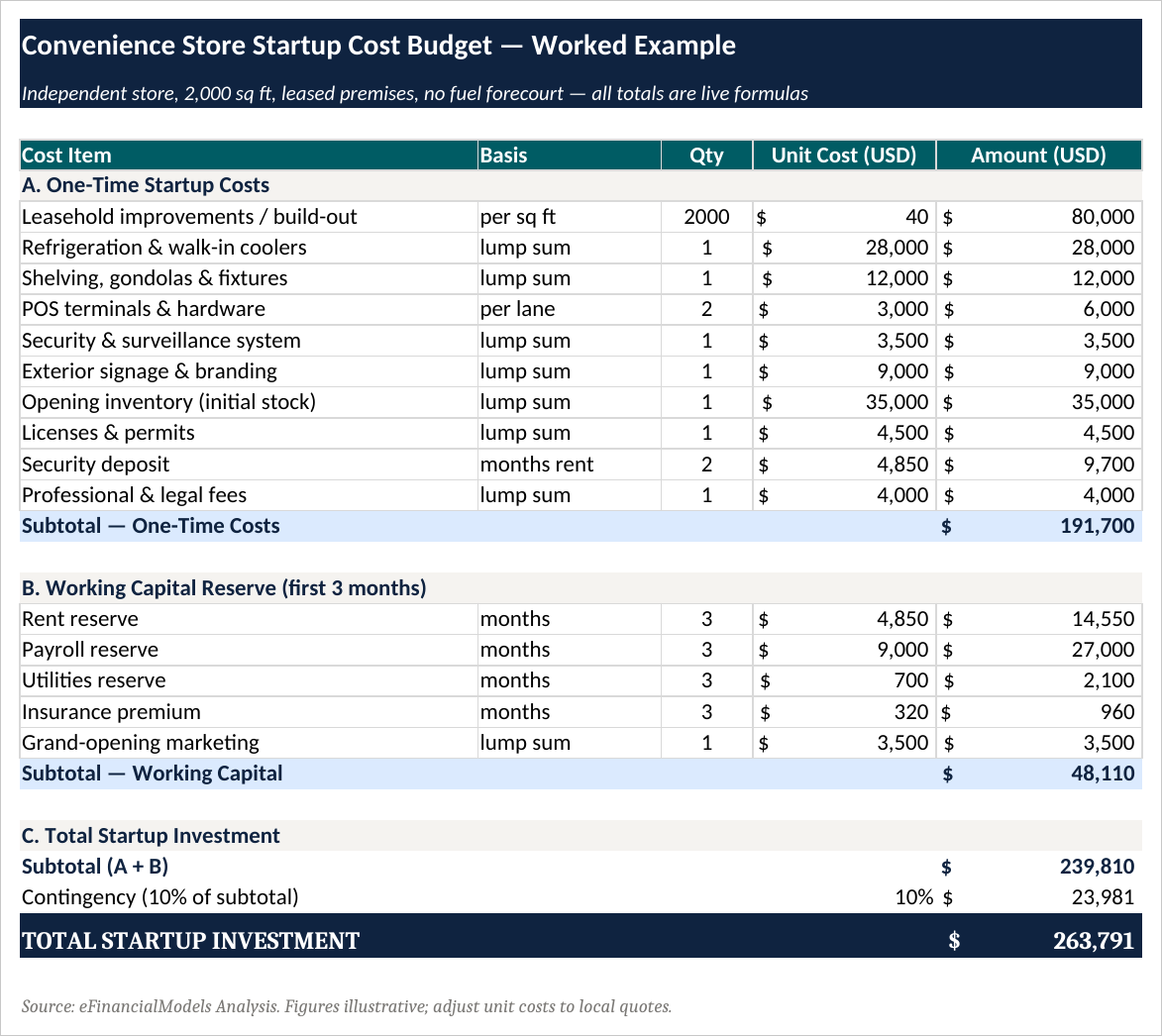
A 2,000 sq ft store at the midpoint of $100/sq ft requires $200,000 in build-out. That budget covers flooring, lighting, electrical upgrades for refrigeration, plumbing for a food prep area, HVAC, and interior framing. Shell spaces (unfinished interiors) sit at the higher end of the range. Second-generation retail spaces — previously occupied by a similar business — can reduce build-out costs by 30–50% because electrical and plumbing infrastructure already exists.
Here’s the math on a mid-range 2,000 sq ft build-out:
- Construction labor and materials: $120,000 (at $60/sq ft base)
- Electrical upgrades for refrigeration: $18,000
- Plumbing for food prep sink and restroom: $12,000
- HVAC modifications: $15,000
- Permits and inspections: $5,000
- Total build-out: $170,000
Initial Inventory Investment: Category-by-Category Budget
Initial inventory for a convenience store typically runs $20,000–$75,000, with the exact figure driven by store size and product mix. Category allocation matters as much as total spend.
Tobacco products consume 30–40% of the initial inventory budget because unit costs are high and regulatory requirements (age verification systems, display compliance) add complexity. Beverages — both cold vault and ambient — account for 15–20%. Snacks and confectionery represent 10–15%. The remaining 25–45% covers household essentials, health and beauty, automotive, and seasonal items.
Worked Example: $40,000 Initial Inventory Budget
| Category | Allocation | Dollar Amount |
|---|---|---|
| Tobacco products | 35% | $14,000 |
| Beverages (cold + ambient) | 18% | $7,200 |
| Snacks and confectionery | 12% | $4,800 |
| Household essentials | 15% | $6,000 |
| Health and beauty | 8% | $3,200 |
| Automotive / other | 7% | $2,800 |
| Seasonal / impulse | 5% | $2,000 |
| Total | 100% | $40,000 |
Convenience store inventory turns faster than most retail categories. High-velocity items like beverages and snacks can turn 20–30 times per year, meaning your $40,000 investment cycles through roughly every 2–3 weeks on those SKUs. Tobacco turns more slowly (8–12 times per year) but at higher unit margins.
Equipment and Technology: The Essential Systems Breakdown
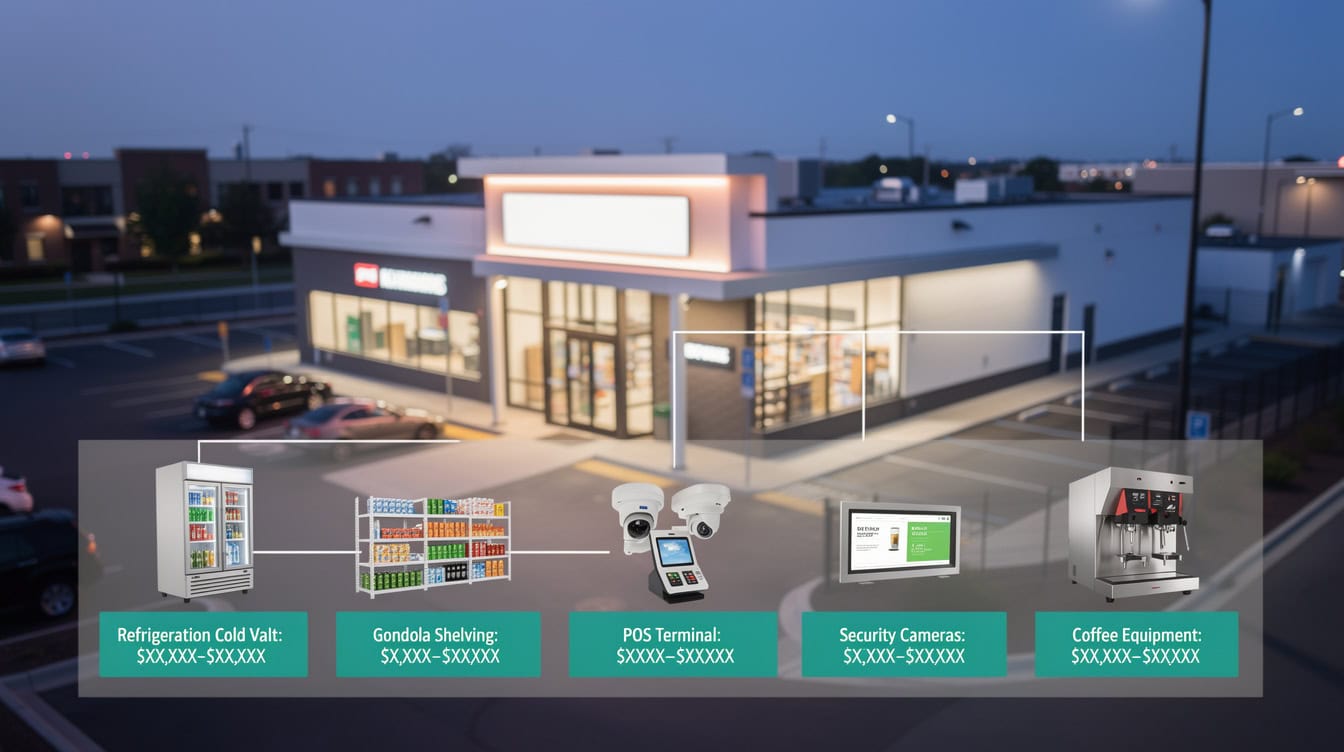
Equipping a convenience store requires capital across five core categories: refrigeration, shelving, point-of-sale (POS) systems, security, and signage.
Refrigeration units are the largest equipment line item. A standard cold vault with 4–6 glass-door cooler sections costs $15,000–$40,000 installed. Individual reach-in coolers run $5,000–$12,000 each. Shelving for a 2,000 sq ft store requires $3,000–$10,000 in gondola units (the freestanding double-sided shelving racks standard in convenience retail). A modern POS system — which must handle age verification for tobacco and alcohol, lottery ticket integration, and EBT/SNAP payments — costs $1,200–$5,000 per terminal. Security camera systems with DVR storage run $2,000–$8,000 depending on camera count and resolution. Exterior and interior signage costs $2,000–$15,000.
Equipment Cost Summary
| Equipment | Low | High |
|---|---|---|
| Refrigeration (cold vault) | $15,000 | $40,000 |
| Gondola shelving | $3,000 | $10,000 |
| POS system (per terminal) | $1,200 | $5,000 |
| Security cameras + DVR | $2,000 | $8,000 |
| Signage (interior + exterior) | $2,000 | $15,000 |
| Coffee and hot food equipment | $3,000 | $12,000 |
| Safe and cash management | $500 | $2,500 |
| Total range | $26,700 | $92,500 |
Licenses, Permits, and Legal Compliance Costs
Every convenience store needs a stack of licenses before opening day, and the total cost varies by state and product mix. Budget $500–$5,000 for the full compliance package.
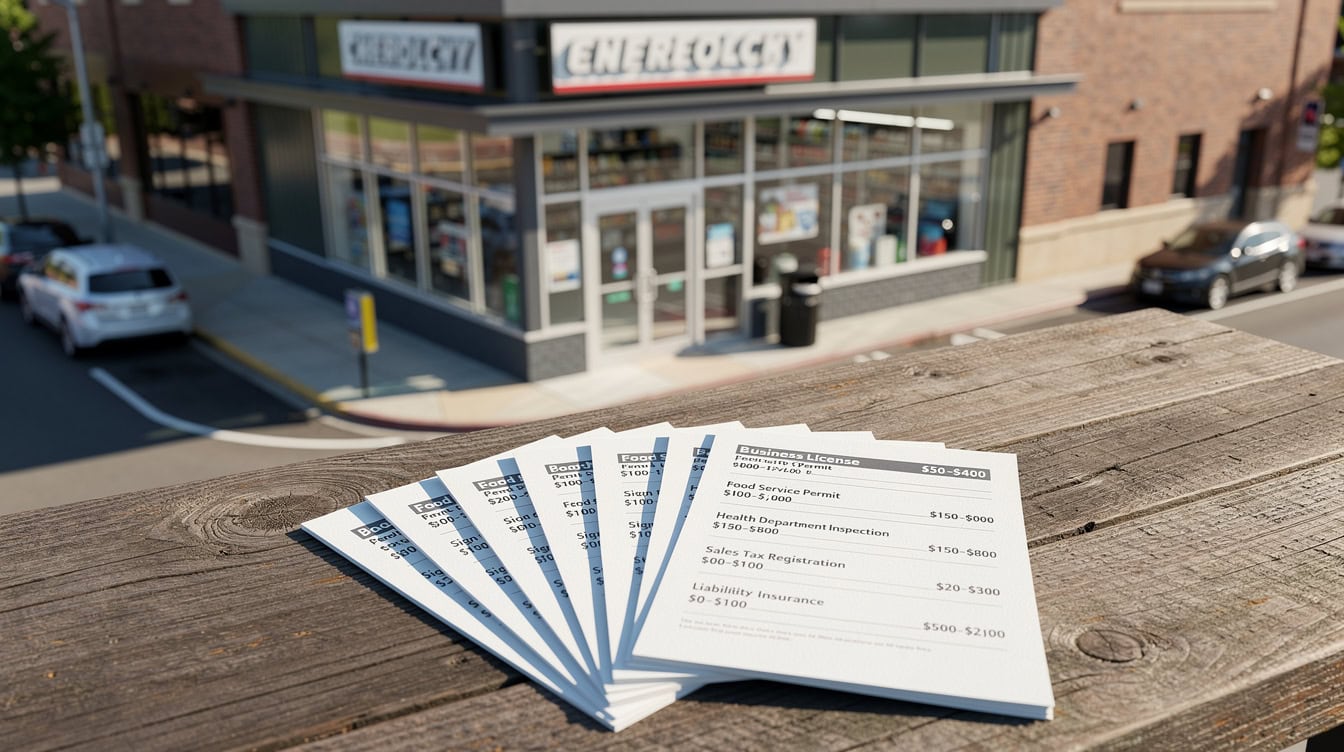
A standard business license costs $50–$400 depending on municipality. A food service permit (required if you sell prepared food, hot dogs, or fountain drinks) runs $100–$1,000 annually. A tobacco retailer license costs $200–$1,500 per year — California charges among the highest at $265 per location, while some states charge under $100. If you sell lottery tickets, a lottery retailer license typically requires a refundable bond of $5,000–$10,000 in addition to the application fee. Alcohol licenses are the most expensive and variable: a beer and wine license can cost $300–$14,000 depending on state, while a full liquor license in some jurisdictions exceeds $50,000.
Legal entity formation (LLC or S-Corp) adds $500–$2,000 in attorney fees and state filing costs. The U.S. Small Business Administration recommends consulting a business attorney before signing any commercial lease or franchise agreement, as lease terms and personal guarantee clauses carry significant long-term financial risk.
Pre-Opening Operational Expenses and Working Capital
Beyond build-out and inventory, you need cash reserves to cover the period between opening day and the point where daily sales cover daily expenses. That window typically runs 3–6 months.
Insurance is a day-one requirement. General liability insurance for a convenience store costs $500–$2,000 per year. Property insurance adds $1,000–$4,000 annually. Workers’ compensation insurance — mandatory in most states if you have employees — runs $1,500–$5,000 per year depending on payroll size and state rates. Utility deposits (electricity, gas, water) typically require 1–2 months of estimated usage upfront, adding $1,500–$4,000 before you flip the lights on.
Pre-opening marketing — grand opening signage, social media ads, local flyers, and a Google Business Profile setup — costs $2,000–$10,000. Employee training for a staff of 3–5 people adds $1,000–$3,000 in paid training hours before the store generates revenue.
A 3–6 month working capital reserve for a store with $50,000 in monthly operating costs requires $150,000–$300,000 set aside. The SBA identifies undercapitalization as one of the primary reasons small businesses fail in their first year, making this reserve non-negotiable rather than optional.

Franchise vs. Independent: Complete Cost Comparison
Franchising with a major brand like 7-Eleven or Circle K provides systems, supply chain access, and brand recognition — but at a measurable cost premium over independent ownership.
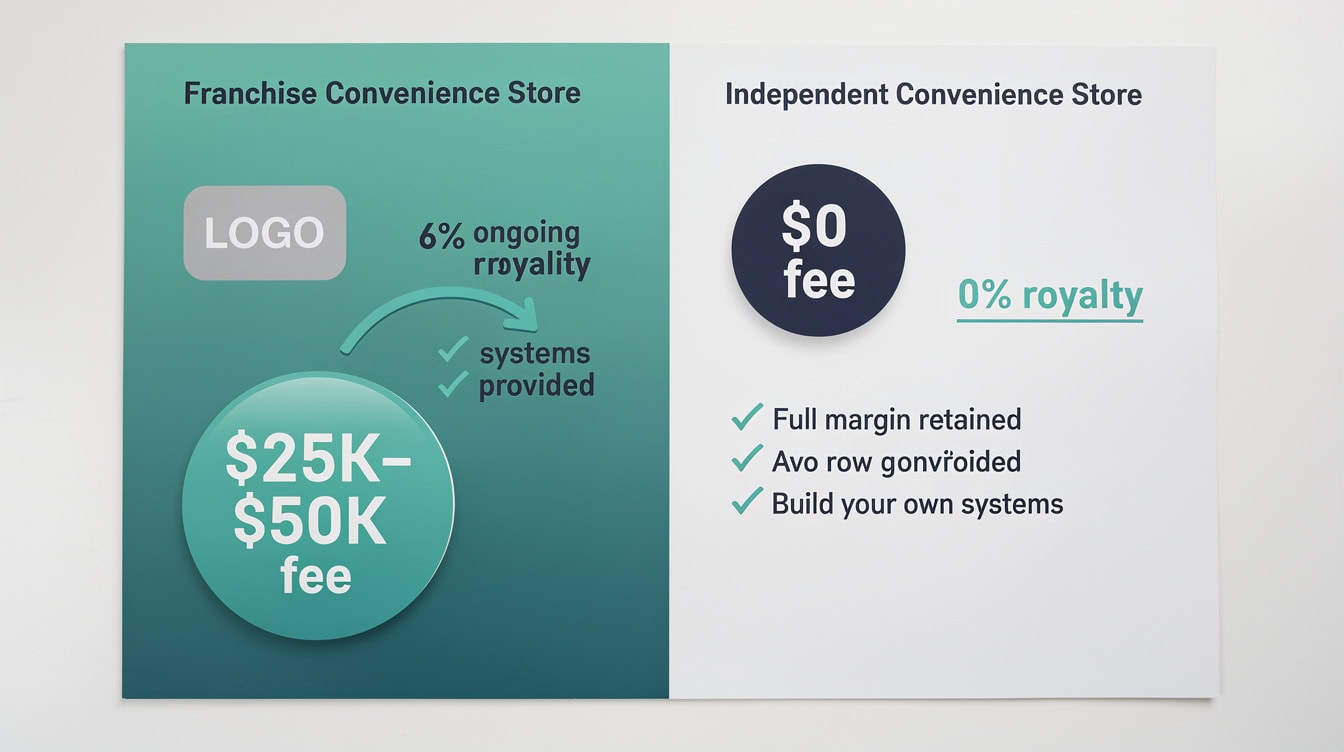
7-Eleven’s franchise disclosure document (FDD) shows initial franchise fees ranging from $10,000 to $1,000,000 depending on store type and location, with a typical range of $25,000–$50,000 for a standard conversion. Ongoing royalties run 4–8% of gross sales. On a store generating $1,200,000 in annual sales, a 6% royalty equals $72,000 per year — a significant recurring cost that independent owners avoid entirely. The SBA 7(a) loan program carries a maximum loan amount of $5 million. This makes franchise financing accessible even for first-time owners who need to cover both the franchise fee and build-out in a single loan.
| Cost Factor | Franchise | Independent |
|---|---|---|
| Initial franchise fee | $10,000–$50,000 | $0 |
| Ongoing royalties | 4–8% of gross sales | $0 |
| Brand recognition | Immediate | Must build |
| Supply chain | Negotiated centrally | Owner-negotiated |
| Training and systems | Provided | Owner-sourced |
| Total 5-year royalty cost | $360,000 | $0 |
Assumes $1.2M annual sales at 6% royalty over 5 years.
The tradeoff is real: franchise stores benefit from proven systems, national marketing, and supplier pricing that independent operators can’t easily replicate. For first-time owners without retail experience, the franchise premium may be worth it. For experienced operators, independence preserves more margin.
Hidden Costs That Catch First-Time Owners Off Guard
Several cost categories consistently surprise new convenience store owners because they don’t appear in basic startup checklists.
Credit card processing fees run 1.5–3% of every card transaction. If 70% of your $1,200,000 in annual sales are card-based, you’re paying $12,600–$25,200 per year in processing fees alone. Negotiating interchange-plus pricing (a pricing model where you pay the actual card network cost plus a fixed markup) instead of flat-rate pricing can save $3,000–$8,000 annually on a mid-size store.
Shrinkage and grand opening losses are real. Industry data from NACS shows convenience stores lose 1–2% of sales to shrinkage (theft, spoilage, and administrative error). On $100,000 in opening inventory, budget $1,000–$2,000 for first-month losses as staff learn inventory procedures.
POS software subscriptions add $50–$300 per month ($600–$3,600/year) for cloud-based systems with age verification, loyalty programs, and reporting modules. Size eligibility is rarely the obstacle: the SBA table of small business size standards sets retail thresholds by average annual receipts, and an independent convenience store sits well below the limit for its industry code. This means most convenience stores qualify for SBA-backed financing and federal small business programs — a meaningful advantage when managing these recurring technology costs.
Waste management contracts run $200–$600 per month depending on pickup frequency and dumpster size.
Common mistakes and fixes:
- Underestimating tobacco compliance costs. Fix: Budget $500–$1,000 for age verification hardware and staff training before opening.
- Skipping the working capital reserve. Fix: Treat 3 months of operating expenses as a non-negotiable line item in your startup budget.
- Ignoring credit card processing in margin calculations. Fix: Model your net margin after processing fees, not before.
- Buying new equipment when used is available. Fix: Refurbished refrigeration units from restaurant liquidators can save 40–60% versus new.
- Signing a long lease without a co-tenancy or exit clause. Fix: Have an attorney review all lease terms before signing.
Financing Options: How Convenience Store Owners Fund Their Launch
Most convenience store owners combine 2–3 funding sources rather than relying on a single loan or personal savings.
SBA 7(a) loans are the most common financing vehicle for convenience store startups. The SBA 7(a) program allows loans up to $5 million, and the SBA’s published 7(a) terms and conditions set maturities of 10 years or less for working capital and a maximum of 25 years for real estate. Variable interest rates are capped at the base rate plus 3.0% on loans above $350,000, scaling up to base plus 6.5% on loans of $50,000 or less. According to the SBA, retail businesses (including convenience stores) represent one of the most common categories for 7(a) loan approvals.
SBA 504 loans work specifically for real estate and equipment purchases over $150,000, with fixed interest rates and 10–25 year terms. Conventional bank loans require stronger credit profiles (typically 680+ FICO) and 20–30% down payments but offer faster approval timelines than SBA programs.
Franchisor financing is available through some major brands: 7-Eleven offers direct financing to qualified franchisees, covering a portion of the initial investment. Seller financing — where the existing store owner carries part of the purchase price — is common in acquisition deals and can reduce the bank financing requirement by 20–40%.
Frequently Asked Questions
How much does it cost to open a convenience store from scratch?
Opening a convenience store from scratch — meaning a new build or raw shell space — costs $150,000 to $500,000 for a typical 1,500–2,500 sq ft independent store. That range covers a security deposit of 3–6 months’ rent ($9,000–$48,000), build-out at $50–$150 per sq ft ($75,000–$375,000), initial inventory of $20,000–$75,000, equipment of $26,000–$92,000, permits and licenses of $500–$5,000, and a 3-month working capital reserve. Franchise stores add $10,000–$50,000 in franchise fees on top of those figures. The SBA recommends having at least 20–30% of total startup costs in liquid personal funds before applying for a business loan.
What is the most expensive part of opening a convenience store?
For most first-time owners, build-out and property costs are the largest combined expense, often representing 40–60% of total startup investment. A 2,000 sq ft build-out at $100/sq ft costs $200,000 before equipment or inventory. However, if you’re purchasing real estate rather than leasing, the property acquisition itself can dwarf all other costs: a commercial property in a suburban market might cost $400,000–$800,000, requiring a $80,000–$240,000 down payment. Equipment — particularly refrigeration — is the next largest single category at $15,000–$40,000 for a standard cold vault.
How much inventory do I need to open a convenience store?
A standard convenience store needs $20,000–$75,000 in opening inventory, depending on store size and product mix. A small 1,000 sq ft store can open with $20,000–$30,000 in stock. A 2,500 sq ft store with a full tobacco wall, cold vault, and hot food program needs $50,000–$75,000. Allocate 30–40% of your inventory budget to tobacco products, 15–20% to beverages, 10–15% to snacks, and the remainder to household, health, and seasonal items. Order conservatively for opening week — you’ll learn your velocity patterns in the first 30 days and can reorder accordingly.
What licenses do I need to open a convenience store?
At minimum, you need a business license ($50–$400), a sales tax permit (free in most states), and a food service permit ($100–$1,000) if you sell any prepared or packaged food. If you sell tobacco, a tobacco retailer license costs $200–$1,500 per year depending on state. Alcohol sales require a separate beer/wine or liquor license, which ranges from $300 in some states to over $14,000 in others. Lottery retailer licenses typically require a refundable bond of $5,000–$10,000. Start the licensing process 60–90 days before your target opening date, as some permits take 4–8 weeks to process.
Is a convenience store a profitable business?
Convenience stores generate average gross margins of 30–35% on merchandise and 3–7 cents per gallon on fuel, according to NACS industry data. A 2,000 sq ft store generating $1,200,000 in annual merchandise sales at a 32% gross margin produces $384,000 in gross profit. After labor (typically 10–15% of sales), rent, utilities, insurance, and other operating costs, net profit margins for well-run independent stores run 2–6% of sales — or $24,000–$72,000 on $1.2M in revenue. Stores with fuel, lottery, and foodservice programs consistently outperform merchandise-only formats. Break-even typically occurs 12–24 months after opening.
Can I get an SBA loan to open a convenience store?
Yes. The SBA 7(a) loan program is one of the most common financing tools for convenience store startups and acquisitions. You can borrow up to $5,000,000 with repayment terms of up to 10 years for working capital and 25 years for real estate. To qualify, you typically need a personal credit score of 650 or higher, 2+ years of business or relevant industry experience, and a detailed business plan with financial projections. The SBA requires that you inject at least 10–20% of the total project cost from personal funds. Loan approval timelines run 30–90 days for SBA-preferred lenders.
What are the ongoing monthly costs of running a convenience store?
Monthly operating costs for a 2,000 sq ft convenience store typically run $35,000–$65,000, broken down as follows: inventory restocking ($20,000–$40,000), labor for 3–5 employees ($8,000–$15,000), rent or mortgage ($3,000–$8,000), utilities ($1,500–$3,500), insurance ($200–$600), credit card processing fees ($1,000–$2,500), waste management ($200–$600), and POS/software subscriptions ($50–$300). These figures exclude owner compensation. Tracking these costs monthly against revenue is essential for identifying margin compression early — a retail store financial model makes this tracking systematic.
Conclusion
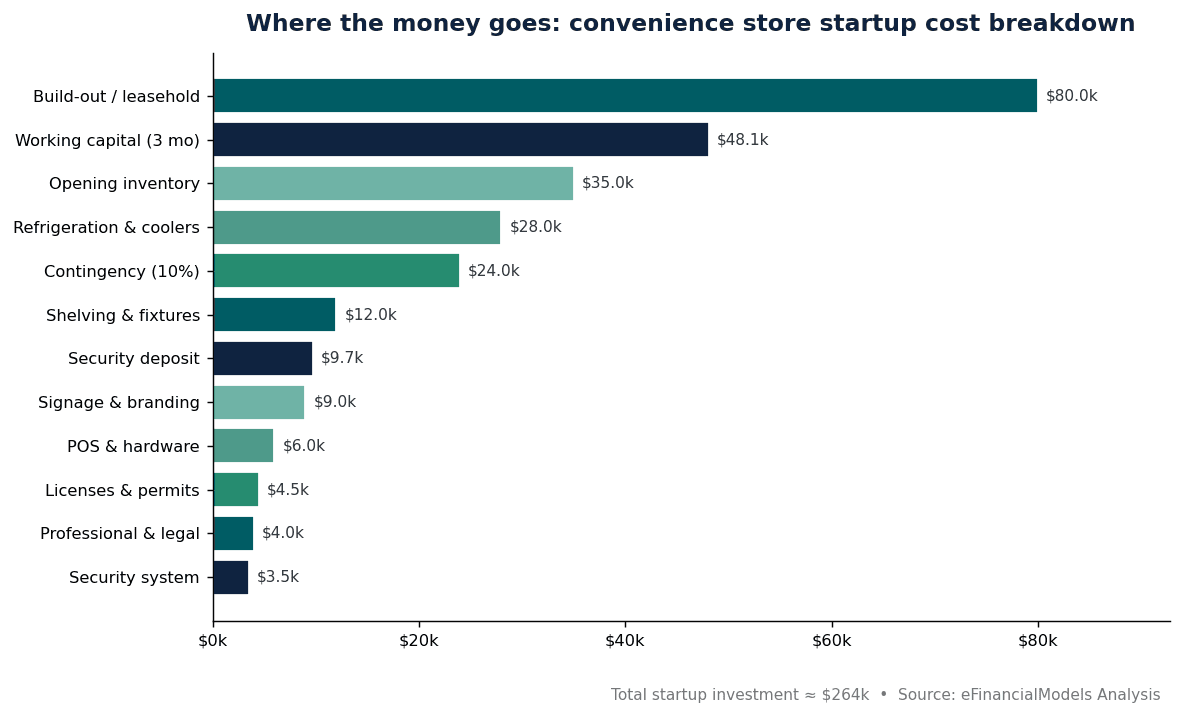
Opening a convenience store is a capital-intensive venture with a wide cost range, but it’s entirely plannable when you break it into specific line items. A small leased format can launch for $50,000–$150,000. A full-size independent store with equipment and working capital typically requires $250,000–$500,000. Franchise models add $10,000–$50,000 in fees plus ongoing royalties of 4–8% of gross sales.
The owners who succeed treat their startup budget as a financial model, not a rough estimate. They account for build-out at $50–$150/sq ft, inventory by category, equipment by line item, and 3–6 months of working capital before they sign a lease.
I recommend downloading the Retail Store Financial Model and Valuation template to build your complete startup cost projection, monthly cash flow forecast, and break-even analysis before you commit to a location or sign any agreements. You can also explore cost projection tools and the Weighted Average Cost of Capital calculator if you’re evaluating financing structures for your store.