0 ITEMS

Spain’s 734,000-Home Deficit: What Investors Must Know

Spain’s residential market is running its strongest expansion since the pre-2008 boom, powered by a structural housing shortage that no near-term supply pipeline can close, while its coastal holiday-rental sector faces the most aggressive short-term-rental (STR) clampdown in Europe.
Key Takeaways
- Spain’s cumulative housing deficit reached approximately 734,000 dwellings by end-2025 and is still widening, making scarcity the durable demand floor for every price and rent forecast through 2031.
- House prices rose about 12.7 percent in 2025, the largest annual jump since 2007, and CaixaBank and BBVA Research both project roughly 10 percent growth in 2026 before easing toward mid-single digits.
- Foreign buyers purchased approximately 97,300 homes in 2025, a record 13.8 percent of all sales, concentrated in the Balearics, Valencian Community, Canaries, and Andalusia.
- Spain recorded 96.8 million international visitors in 2025, but the national STR registry (mandatory from 1 July 2025) and Barcelona’s full tourist-apartment phase-out by November 2028 are contracting legal holiday-rental supply.
- The national gross rental yield sits near 5.45 percent, with Barcelona near 7 percent and the Costa Blanca near 6.6 percent, while prime coastal markets such as Málaga (about 4.65 percent) and Palma (about 4.68 percent) price tighter.
- The Base Case scenario (50 percent probability) projects a house-price CAGR of about 4.5 percent through 2031 and STR stock settling roughly 20 percent below its 2024 peak.
- Modelers must treat the STR license as a binary, market-specific input and run a forced-conversion downside in which every coastal holiday let reverts to long-term letting at the regulated market rent.
The Supply Crisis Driving Spanish House Prices
Spain’s housing shortage is structural, not cyclical, and it is the single most important fact for anyone underwriting Spanish residential real estate through 2031. Spain formed approximately 1.2 million new households between 2021 and 2025 while completing only around 474,000 homes, leaving a cumulative deficit near 734,000 dwellings by end-2025 according to analysis by eFinancialModels Research based on INE and Ministerio de Vivienda data. Even the optimistic supply path leaves an 800,000-home deficit by 2027.
New-build permits (visados de obra nueva, the construction authorizations issued before a project breaks ground) are recovering: from 128,000 in 2024 to an estimated 140,000 in 2025 and a projected 150,000 in 2026, trending toward roughly 160,000 by 2026-2027 according to BBVA Research. But completions, the dwellings actually certified as finished, lag permits by two to three years and ran at only about 95,000 in 2025. Household formation, the net number of new households created each year, ran near 226,000 in 2025. The math is unambiguous: completions are less than half of household formation, and the gap is not closing fast enough to matter before 2031.
For modelers, the deficit functions as a demand floor. It makes occupancy and absorption assumptions reliable and keeps the bear case a slowdown rather than a crash. The five provinces where the deficit concentrates, Madrid, Barcelona, Valencia, Alicante, and Santa Cruz de Tenerife, are also the five provinces that anchor foreign demand and coastal investment.
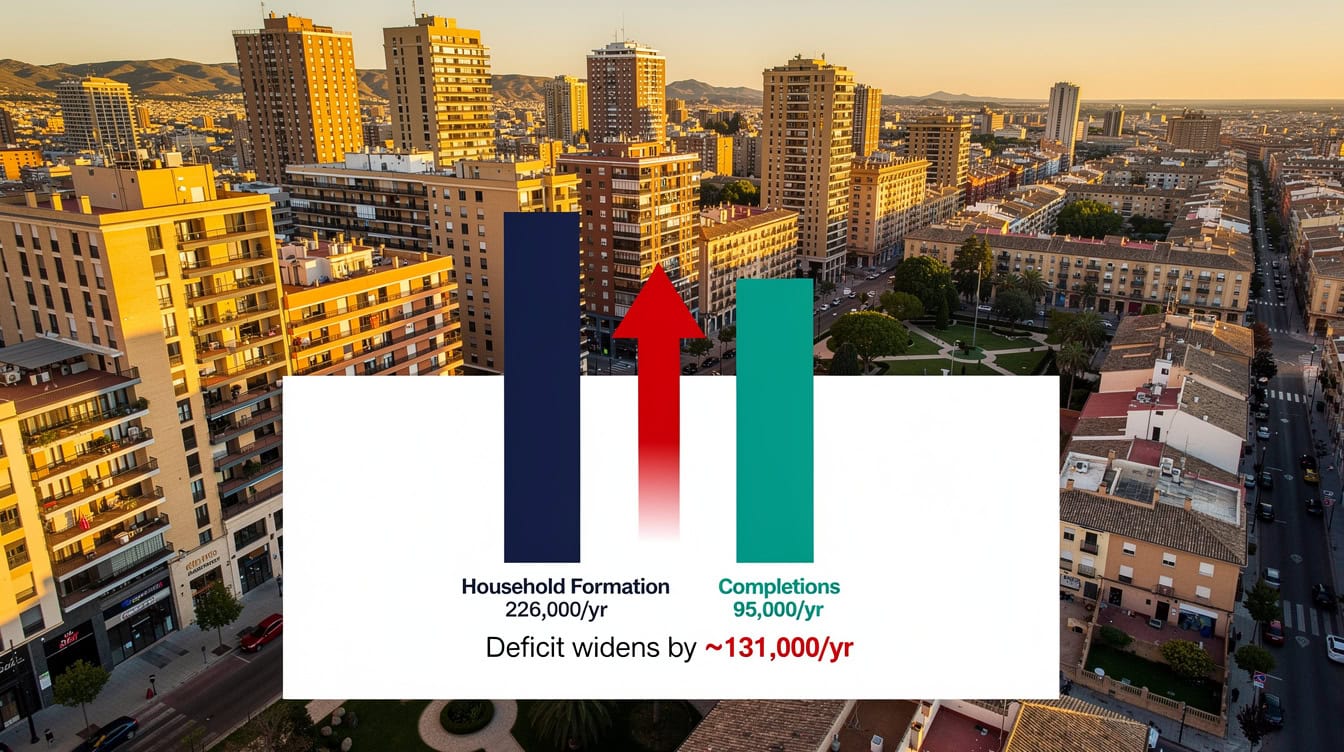
Spain completes fewer than half the homes needed to match household formation each year, widening the structural deficit.
Demand Accelerants: Cheaper Finance and Record Foreign Buyers
Two forces sit on top of the structural shortage and are accelerating price growth in the near term. The first is cheaper mortgage finance. The 12-month Euribor, the benchmark rate for Spanish mortgages, eased to about 2.3 percent by late 2025 from a 4.2 percent peak in 2023 according to Banco de España data, taking new fixed-rate mortgages to roughly 2.8 to 3.2 percent and reviving domestic lending to one of its strongest growth rates in a decade. Spain’s mortgage market saw new lending volumes rise by approximately 17 percent year-on-year in 2024 Source, reflecting the direct pass-through of falling Euribor rates into household borrowing capacity.
The second accelerant is foreign demand. Non-nationals bought approximately 97,300 homes in 2025, a record 13.8 percent of all registered sales, led by British, German, and Dutch buyers according to INE and Colegio de Registradores data. In the Balearic Islands, foreigners account for nearly a third of all buyers. Two policy changes target the non-EU investor end of this cohort: the €500,000 golden-visa route closed in April 2025, and a proposed 100 percent tax on non-EU non-resident purchases was announced in January 2025 but had not been enacted at the study’s production date. Both measures target the marginal non-EU investor rather than the dominant EU and resident buyer, so their base-case impact is real but bounded.
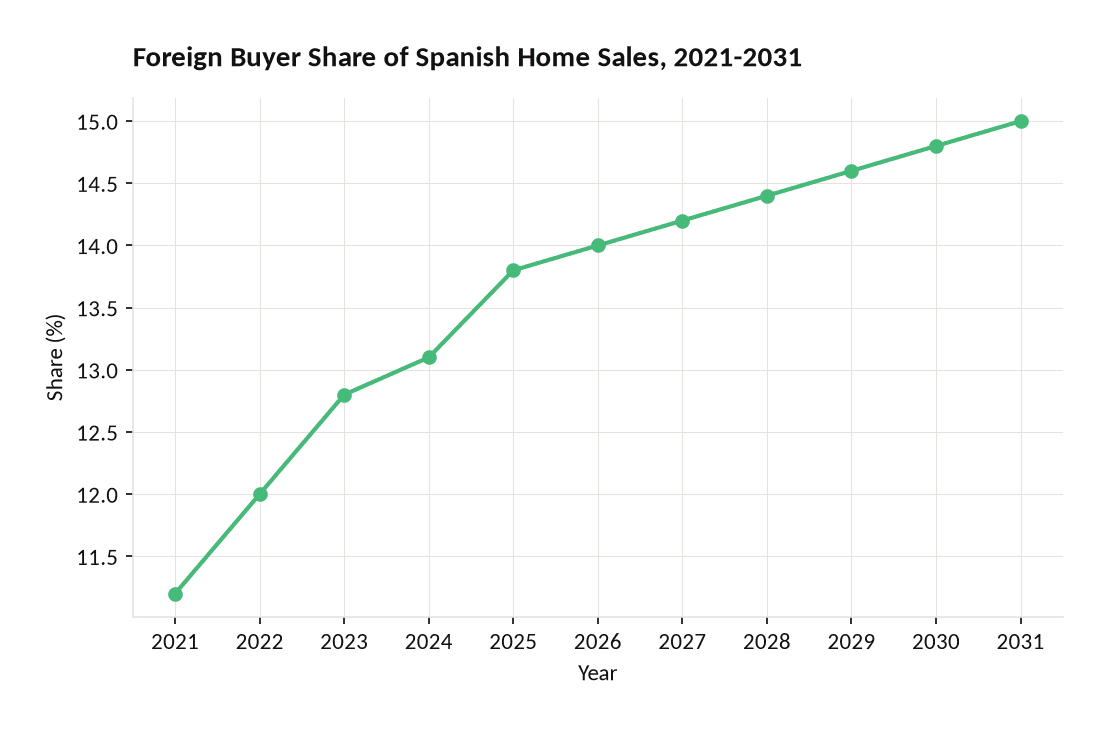
Foreign buyers’ share of Spanish home sales reached a record 13.8% in 2025 and is projected to rise toward 15% by 2031 in the Base Case. Source
STR Regulation: The License Is Now the Asset
Spain’s holiday-rental sector is being reshaped by the most aggressive short-term-rental clampdown in Europe, and understanding it is non-negotiable for any coastal investment thesis. The national STR registry, the Ventanilla Única Digital, became mandatory from 1 July 2025, transposing EU Regulation 2024/1028 and purging tens of thousands of unlicensed listings. Barcelona will phase out all approximately 10,000 of its tourist apartments by November 2028, a plan the Constitutional Court upheld in March 2025. Málaga, Alicante, the Balearics, and the Canaries have layered on freezes, moratoria, and capacity caps.
The net effect is a managed contraction of legal STR supply. For a holiday-let investor, the license has become the asset: in restricted markets, existing licences gain scarcity value while new entry is blocked. The study’s Spain Residential and Costa Holiday-Rental STR Market Study 2026-2031 frames the regulatory regime as a binary, market-specific input that must be modeled explicitly, not assumed away.

Spain recorded 96.8 million international visitors in 2025, spending about €134.7 billion according to INE FRONTUR data, so tourism demand is structurally strong. The EU’s Short-Term Rental Regulation 2024/1028, which underpins Spain’s national registry, requires platforms to share data with authorities on a monthly basis for rentals of 90 nights or fewer Source, creating an enforcement mechanism that makes unlicensed operation increasingly untenable. The binding constraint on holiday-rental returns is increasingly the license and the regulatory regime, not visitor demand.
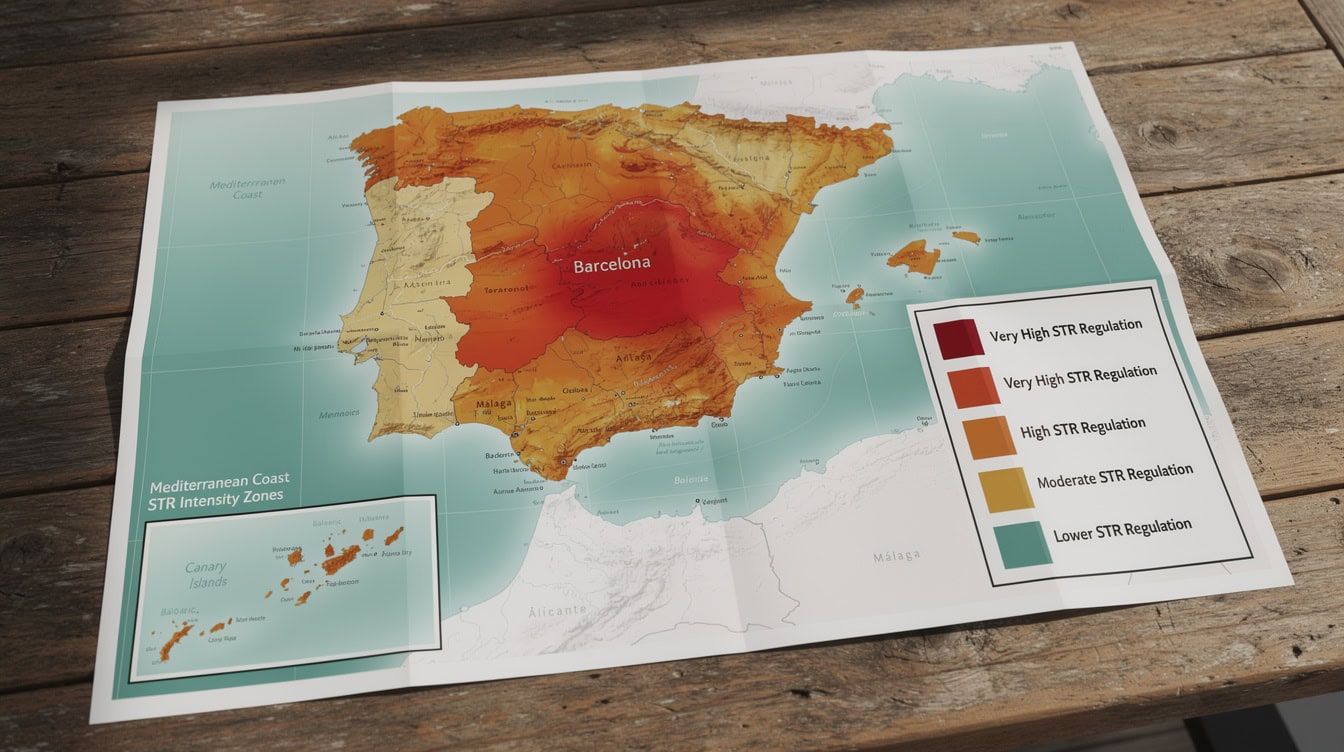
STR restriction intensity varies sharply by market: Barcelona phases out all tourist apartments by 2028 while other coastal regions apply freezes and caps.
Pricing, Yields, and the Regulated Rental Market
Residential pricing through 2031 is governed by the interaction of a structural shortage, recovering but not cheap finance, and a regulated rental market. House prices rose about 12.7 percent in 2025, the largest annual jump since 2007, and CaixaBank and BBVA Research both project roughly 10 percent growth in 2026 before easing toward mid-single digits as affordability bites.
The national gross rental yield sits near 5.45 percent, but the spread across cities is wide. Barcelona leads near 7 percent, the Costa Blanca near 6.6 percent, Valencia and Murcia around 6 percent, while Madrid sits at about 5.0 percent and prime coastal markets such as Málaga (about 4.65 percent) and Palma (about 4.68 percent) price tighter as capital values run ahead of regulated rents.
Spain’s 2023 Housing Law (Ley 12/2023) introduced a regulated rental market (a system of statutory caps on annual rent increases for sitting tenants) that is a first-order modeling input. Annual rent updates on existing contracts were capped at 2 percent in 2024 and 3 percent in 2025, with a new INE reference index (IRAV) replacing the consumer-price index for updates from 2025 onward. Catalonia has adopted zona tensionada (stressed-market) rent caps that apply additional ceilings in designated high-pressure areas. The practical effect is a growing gap between the regulated in-place rent on a sitting tenancy and the higher market rent achievable on re-letting. Spain’s Housing Law designates areas as tensionadas when rental costs exceed 30 percent of average household income in that zone Source, a threshold that is already breached in Barcelona, Madrid, and several coastal capitals, meaning the cap regime is likely to expand rather than contract through 2031.
Gross Rental Yield by City (2026 Base Case)
| City / Market | Gross Yield | Yield Driver |
|---|---|---|
| Barcelona | ~7.0% | High demand, STR reversion supply |
| Costa Blanca | ~6.6% | Foreign buyer depth |
| Valencia | ~6.0% | Domestic + foreign demand |
| Murcia | ~6.0% | Affordability, growth market |
| Madrid (prime) | ~5.0% | Capital values outpacing rents |
| Málaga | ~4.65% | Values ahead of regulated rents |
| Palma | ~4.68% | Values ahead of regulated rents |
| National average | ~5.45% | Blended across all markets |
Source: eFinancialModels Research based on INE, Banco de España, CaixaBank, and BBVA Research. 2026 figures are Base Case projections.

Barcelona’s 7.0% gross yield is 235 basis points above Málaga’s 4.65%, making city-level underwriting essential.
Three Scenarios to 2031: A Worked Numerical Example
The study frames three scenarios whose probabilities reflect senior-analyst judgment on the interaction of rates, foreign demand, and the STR regulatory path. Here is how the numbers work for a buy-to-let investor underwriting a €300,000 property at the national average gross yield of 5.45 percent.
Base inputs:
- Purchase price: €300,000
- Gross annual rent: €300,000 × 5.45% = €16,350
- Transaction costs (ITP transfer tax at 8%, notary and registry fees at ~1.5%): €28,500
- Total acquisition cost: €328,500
- Annual mortgage interest (65% LTV at 3.0% fixed): €300,000 × 65% × 3.0% = €5,850
- Net operating income after management (10%) and IBI property tax (~0.5% of value): €16,350 – €1,635 – €1,500 = €13,215
- Levered cash yield on equity: €13,215 / (€328,500 – €195,000 debt) = approximately 9.9%
Scenario sensitivity at 2031:
| Metric | Bear (25%) | Base (50%) | Bull (25%) |
|---|---|---|---|
| House-price CAGR | 2.0% | 4.5% | 7.0% |
| 12-month Euribor 2031 | ~3.5% | ~2.7% | ~1.8% |
| Gross rental yield 2031 | ~5.8% | ~5.6% | ~5.3% |
| STR stock (2020=100) | ~78 | ~88 | ~96 |
| Foreign demand | Weaker | Holds at record | Strong/rising |
Source: eFinancialModels Research. Figures are illustrative central estimates; not a specific asset valuation.
The levered margin narrows quickly if the Euribor rises from its current level. A 100-basis-point rise in the mortgage rate on a 65% LTV loan adds roughly €1,950 in annual interest cost on a €300,000 property, compressing the levered cash yield by approximately 145 basis points. This is why the study identifies the mortgage-rate path as the principal valuation risk, not demand.
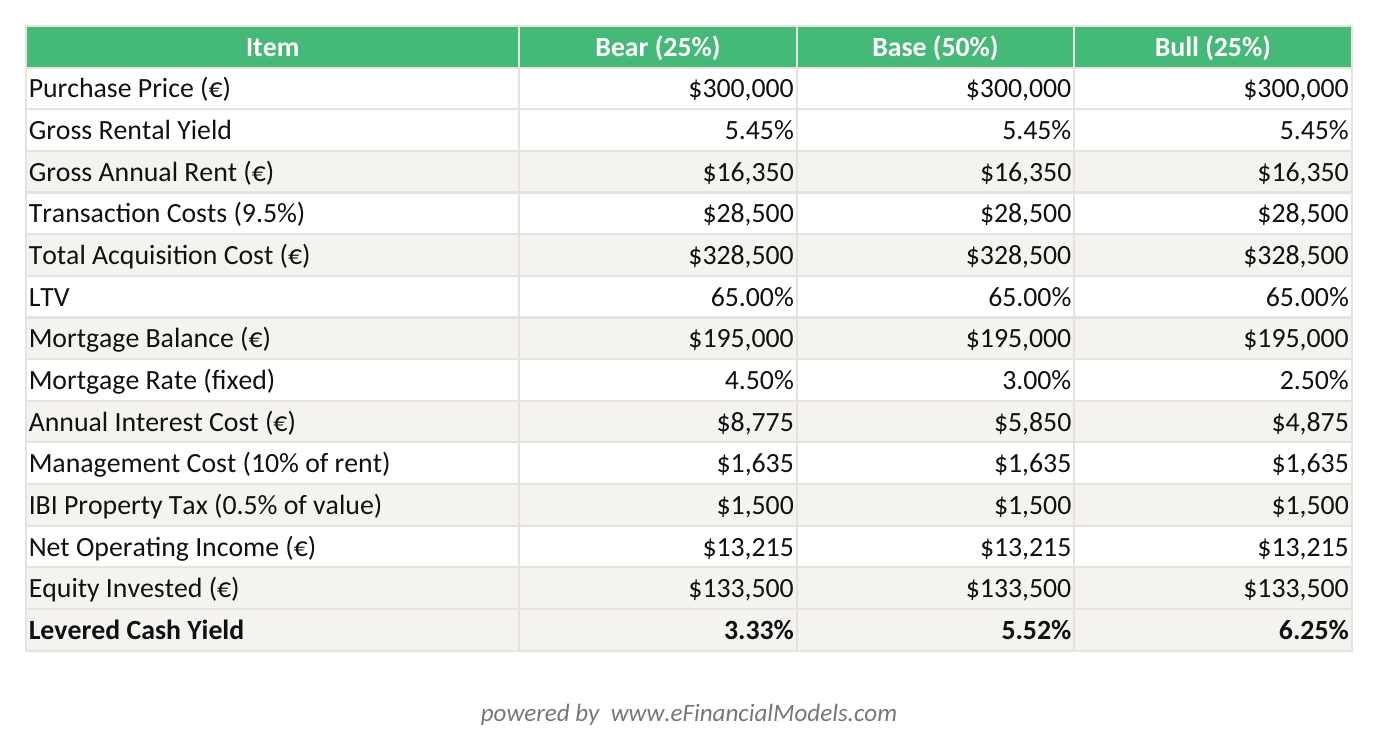
Levered cash yield on a €300,000 Spanish buy-to-let at 5.45% gross yield and 65% LTV: ~9.9% in the Base Case, compressing to ~8.5% in the Bear Case if Euribor rises to 3.5%.
The Base Case projects a 4.5% house-price CAGR through 2031; the Bear Case (2.0%) is a slowdown, not a crash, because the deficit provides a structural demand floor.
Common Modeling Mistakes and How to Fix Them
Modelers working on Spanish residential or coastal holiday-rental deals consistently make five errors that distort returns.
Mistake 1: Using the national average yield as a proxy for a specific city. The spread between Barcelona (7.0%) and Málaga (4.65%) is 235 basis points. Applying the 5.45% national average to a prime coastal deal overstates the yield by up to 80 basis points. Fix: underwrite yield to the city and submarket, not the national figure.
Mistake 2: Treating the STR license as a permanent cash-flow assumption. In Barcelona, the license goes to zero by 2028. In Málaga and Alicante, new licences are frozen. Fix: model the license as a binary input and run a forced-conversion downside in which the property reverts to long-term letting at the regulated market rent.
Mistake 3: Modeling a single rent figure instead of separating in-place and re-letting rent. The 2023 Housing Law caps annual escalation on sitting tenancies at 2-3 percent, but market rents on re-letting can be materially higher. Fix: model two rent variables, the regulated in-place rent and the higher market re-letting rent, and apply the escalation cap as a hard ceiling on the former.
Mistake 4: Omitting transaction and holding costs from the net return. ITP (resale transfer tax, typically 6-10% depending on the autonomous community), IVA (VAT at 10% on new build), notary and registry fees, and annual IBI (property tax) are material in Spain. Fix: build all four cost categories into the net return from day one.
Mistake 5: Stress-testing demand and shortage simultaneously. The housing deficit is the structural offset that keeps the bear case a slowdown rather than a crash. Applying both a severe demand haircut and a continued-shortage assumption in the same scenario double-counts the downside. Fix: in the bear case, flex rates and foreign demand, but keep the deficit as the demand floor.
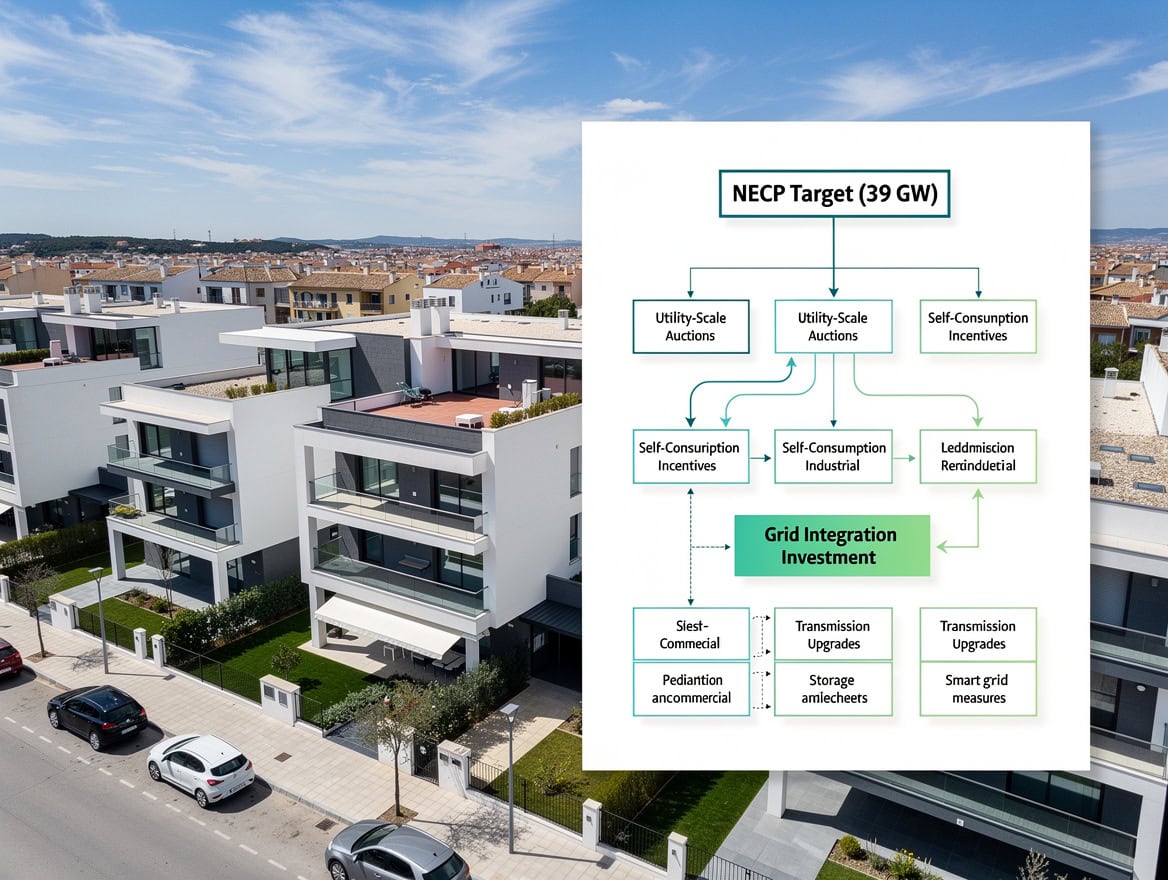
Separating regulated in-place rent from market re-letting rent and treating the STR license as a binary input are the two most critical modeling disciplines for Spanish real estate.
Tools and Templates for Spanish Real Estate Modeling
Property-level analysis of Spanish residential or coastal holiday-rental deals requires a financial model that handles the regulated-rent regime, the STR license binary, and Spain’s layered transaction costs. The Spain Residential and Costa Holiday-Rental STR Market Study 2026-2031 provides the macro framework; property-level DCF, levered IRR, and debt sizing require a dedicated model.
For residential buy-to-let and development deals, the Commercial Real Estate Excel Model Template and the Real Estate Financial Model Bundle provide the structured framework for building in regulated-rent caps, ITP/IVA costs, and Euribor sensitivity tables. For build-to-rent and institutional residential platforms, the Real Estate Developer Model handles pre-sale absorption, construction-cost inflation, and phased delivery.
For joint-venture structures, which are common in Spanish coastal development between domestic developers and international capital, the Waterfall Model for Joint Venture Real Estate Project handles preferred returns, promote structures, and co-investment splits.
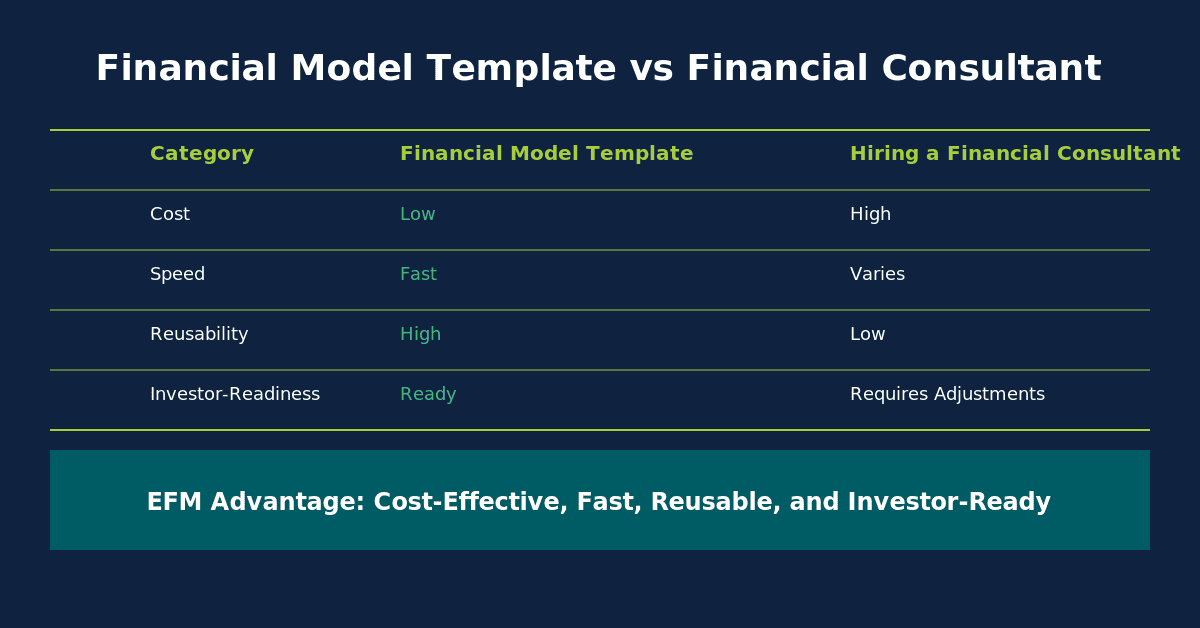
A structured real estate financial model handles Spain’s regulated-rent caps, STR license binary, and ITP/IVA transaction costs in a single integrated framework.
Frequently Asked Questions
Why are Spanish house prices rising so fast if the economy is not booming?
The driver is scarcity, not speculation. Spain formed approximately 1.2 million new households between 2021 and 2025 while completing only around 474,000 homes, leaving a cumulative deficit near 734,000 dwellings according to INE and Ministerio de Vivienda data. Completions run at roughly 95,000 a year while household formation runs near 200,000, so the gap widens every year. On top of the shortage, the 12-month Euribor fell from a 4.2 percent peak in 2023 to about 2.3 percent by late 2025, cutting new fixed-rate mortgages to roughly 2.8 to 3.2 percent and reviving domestic buyer demand. The combination of structural scarcity and cheaper finance produced the 12.7 percent price rise in 2025, the largest annual jump since 2007. The study’s base case projects about 10 percent growth in 2026 easing toward 3 to 4.5 percent per year through 2031 as affordability bites.
What does the STR registry mean for existing holiday-rental owners?
The Ventanilla Única Digital, Spain’s national short-term rental registry, became mandatory from 1 July 2025, transposing EU Regulation 2024/1028. Every STR listing must carry a valid registration code (NRA/VUD ID) to be advertised on platforms such as Airbnb or Booking. Listings without a code are being removed. In Barcelona, the phase-out goes further: all approximately 10,000 tourist apartments will be eliminated by November 2028, a plan the Constitutional Court upheld in March 2025. In Málaga, Alicante, the Balearics, and the Canaries, new licences are frozen or capped. For existing license holders in restricted markets, the license gains scarcity value because new competition cannot enter. For unlicensed operators, the registry is an existential risk. Every coastal holiday-let model should include a forced-conversion downside in which the property reverts to long-term letting at the regulated market rent.
How does the golden-visa repeal affect foreign demand for Spanish property?
The €500,000 golden-visa route, which granted Spanish residency in exchange for a qualifying property investment, closed effective 3 April 2025. Existing permits remain valid for their terms. The route was a visible but modest channel for non-EU capital into coastal and prime urban property. The dominant foreign buyers, British, German, Dutch, and other EU nationals, are unaffected by the repeal because they do not need a golden visa for residency rights. A proposed 100 percent tax on non-EU non-resident purchases was announced in January 2025 but had not been enacted at the study’s production date. The base case assumes the golden-visa repeal trims marginal non-EU investor demand without changing the structural foreign-buyer trend, which is projected to rise from 13.8 percent of sales in 2025 to approximately 15 percent by 2031.
What is a zona tensionada and how does it affect rental modeling?
A zona tensionada, or stressed rental-market area, is a designation under Spain’s 2023 Housing Law (Ley 12/2023) that allows autonomous communities to apply additional rent caps beyond the national escalation limits. Catalonia has adopted the designation most aggressively. In a zona tensionada, landlords cannot raise rents on new contracts above the previous tenant’s rent plus the annual cap, effectively preventing re-letting at market rates. This creates a critical modeling distinction: the regulated in-place rent on a sitting tenancy (capped at 2 percent in 2024, 3 percent in 2025, and an INE reference index thereafter) is materially lower than the market rent achievable on re-letting in a non-tensioned area. Modelers must build both variables into the cash flow and apply the escalation cap as a hard ceiling on in-place rent, regardless of market conditions. Ignoring this distinction overstates rental income by a potentially significant margin in Catalonia and any other community that adopts the designation.
How should I underwrite a coastal holiday-let deal given the regulatory uncertainty?
The study recommends a three-step approach. First, determine the regulatory regime for the specific market: Barcelona is zero by 2028, Málaga and Alicante are frozen for new licences, the Balearics and Canaries have capacity caps and moratoria. Second, model the license as a binary input: either the property holds a valid, compliant license or it does not, and if it does not, the STR cash flow is zero. Third, run a forced-conversion downside in which the property reverts to long-term letting at the regulated market rent, because in several markets that downside is now the central case rather than a tail risk. Layer in higher compliance, management, cleaning, turnover, and platform costs for the post-registry STR regime. The holiday-let premium over long-term rent is real and substantial in high-season coastal markets, but it is only accessible to operators who hold and run licences compliantly.
Which Spanish cities offer the best gross rental yields in 2026?
Barcelona leads at approximately 7.0 percent gross, followed by the Costa Blanca at approximately 6.6 percent, and Valencia and Murcia at around 6.0 percent. Madrid prime sits at about 5.0 percent, while Málaga and Palma price tighter at approximately 4.65 and 4.68 percent respectively, because capital values have run ahead of regulated rents in those markets. The national average gross rental yield is approximately 5.45 percent. These figures are gross yields before management costs, IBI property tax, financing costs, and vacancy, so the net levered return depends heavily on the mortgage rate. At a 3.0 percent fixed rate and 65 percent LTV, a mid-5 percent gross yield clears a levered return hurdle comfortably, but a 100-basis-point rise in the Euribor compresses that margin by roughly 145 basis points on a typical deal. Always underwrite to the city and submarket, not the national average.
What is the difference between the Bear, Base, and Bull scenarios for 2031?
The study frames three scenarios with explicit probabilities. The Base Case (50 percent probability) projects a house-price CAGR of approximately 4.5 percent through 2031, a 12-month Euribor of about 2.7 percent by 2031, a national gross rental yield of approximately 5.6 percent, and STR stock settling at an index of about 88 (2020=100), roughly 20 percent below the 2024 peak. The Bear Case (25 percent probability) projects a 2.0 percent price CAGR, a Euribor of about 3.5 percent, a yield of approximately 5.8 percent, and STR stock at an index of about 78, driven by higher-for-longer rates, weaker foreign demand, and a deeper STR clampdown. The Bull Case (25 percent probability) projects a 7.0 percent price CAGR, a Euribor of about 1.8 percent, a yield of approximately 5.3 percent, and STR stock at an index of about 96, driven by falling rates, durable migration and tourism, and a partial regulatory thaw. The bear case is a slowdown, not a crash, because the housing deficit provides a structural demand floor in all three scenarios.
Conclusion
Spain’s residential and coastal holiday-rental market through 2031 is defined by one structural fact and one regulatory shift. The structural fact is a 734,000-home deficit that makes demand durable and keeps the downside a slowdown rather than a crash. The regulatory shift is the STR clampdown that is contracting legal holiday-rental supply, turning the license into a scarce asset, and forcing modelers to treat the regulatory regime as a binary input rather than a background assumption.
The opportunity is real: a 4.5 percent annual price CAGR in the base case, gross yields of 5.45 to 7.0 percent depending on city, and a foreign-buyer share projected to rise toward 15 percent by 2031. But the risks, mortgage-rate sensitivity, rent-cap tightening, STR license loss, and affordability ceilings, require disciplined underwriting that builds Spain’s transaction costs, regulated-rent caps, and license assumptions into the model from day one.
I recommend starting with the Spain Residential and Costa Holiday-Rental STR Market Study 2026-2031 for the macro framework, then pairing it with the Real Estate Financial Model Bundle to build the property-level DCF, levered IRR, and debt-sizing analysis that turns this market data into an investable underwriting.
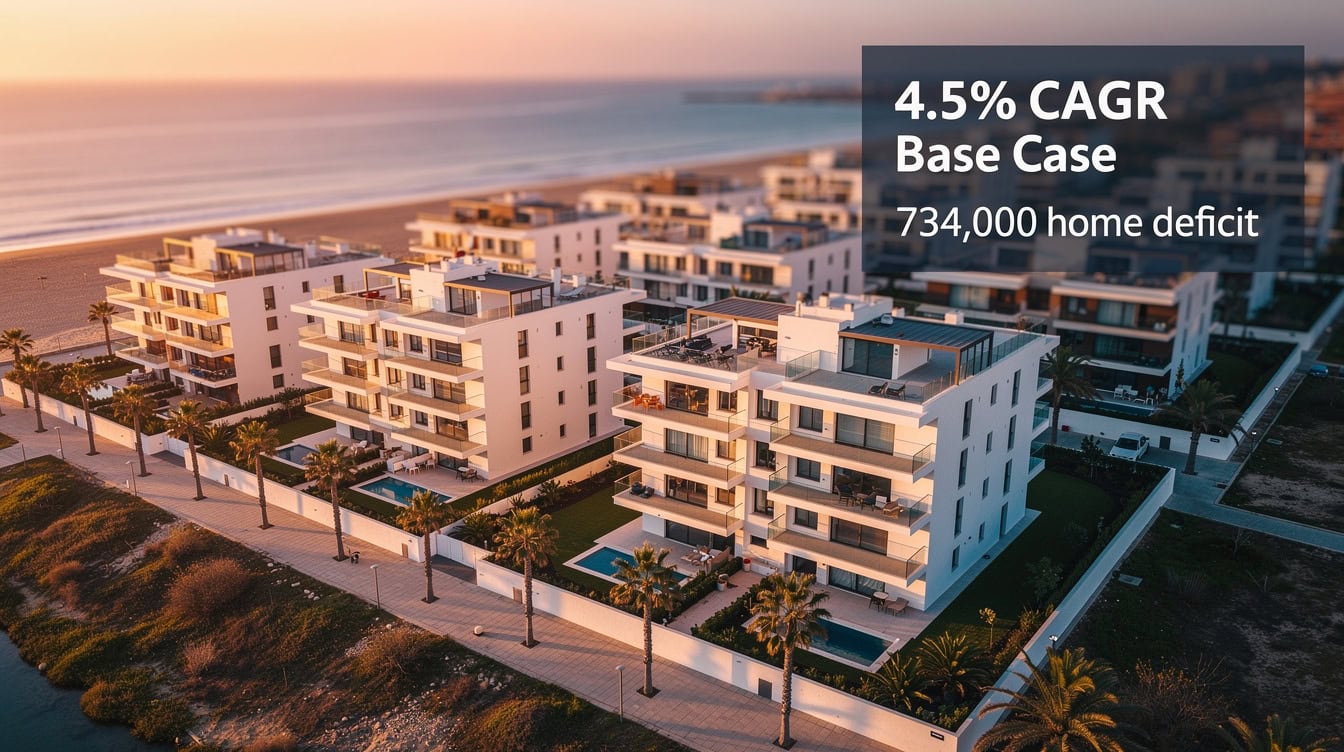
Build-to-rent and professionalized long-term rental are the clearest institutional opportunities through 2031, underwritten to the regulated-rent regime.