0 ITEMS

South Africa’s Distilleries: Gin Hits 110, Brandy Falls 86%

South Africa’s spirits sector is simultaneously contracting in its oldest category and exploding in its newest, making it one of the most structurally complex distillery markets on the continent right now.
Key Takeaways
- South Africa’s spirits market reached approximately USD 1.08 billion in 2025, with Statista projecting growth to USD 1.16 billion by 2029 at a +2.33% CAGR.
- Brandy production has collapsed from a historical peak near 40 million LPA (liters of pure alcohol) to just 5.7 million LPA today, an 86% decline.
- Craft gin operators grew from roughly 20 in 2015 to approximately 110 by 2025, but a consolidation cycle is now underway following Pernod Ricard’s full acquisition of Inverroche on 6 February 2025.
- Three Ships Bourbon Cask Finish was named World’s Best Blended Whisky at the 2025 World Whiskies Awards, anchoring South Africa’s premium craft whisky export story.
- The SARS Budget 2026 set spirits excise duty at R97.66 per 750ml bottle effective 1 April 2026, a 3.4% increase that tracks CPI for the first time in several years.
- The AfCFTA (African Continental Free Trade Area) framework opens an addressable spirits opportunity exceeding USD 1.2 billion by 2031 across Nigeria, Kenya, Ghana, Egypt, and other continental markets.
- The Liquor Amendment Bill B21-2025, which proposes a total advertising ban, is the single largest bear-case risk across all three sub-segments through 2031.
The Industry Today: Three Structurally Distinct Sub-Segments
South Africa’s distillery sector organizes around three analytically separate categories: a mature but contracting brandy segment, a fast-growing craft gin landscape approaching a consolidation inflection, and a small but globally decorated craft whisky cohort. Understanding each sub-segment separately is essential before drawing any investment or operational conclusion.
The South African spirits market recorded approximately USD 1.08 billion in value in 2025 (Statista Spirits South Africa outlook). IWSR’s 2025-2026 commentary identifies South Africa as one of three beverage-alcohol bright spots globally, with +4% volume growth and +12% value growth in 2025 even as global spirits suffered their worst year on record. That headline performance, however, masks sharply divergent trajectories underneath it.
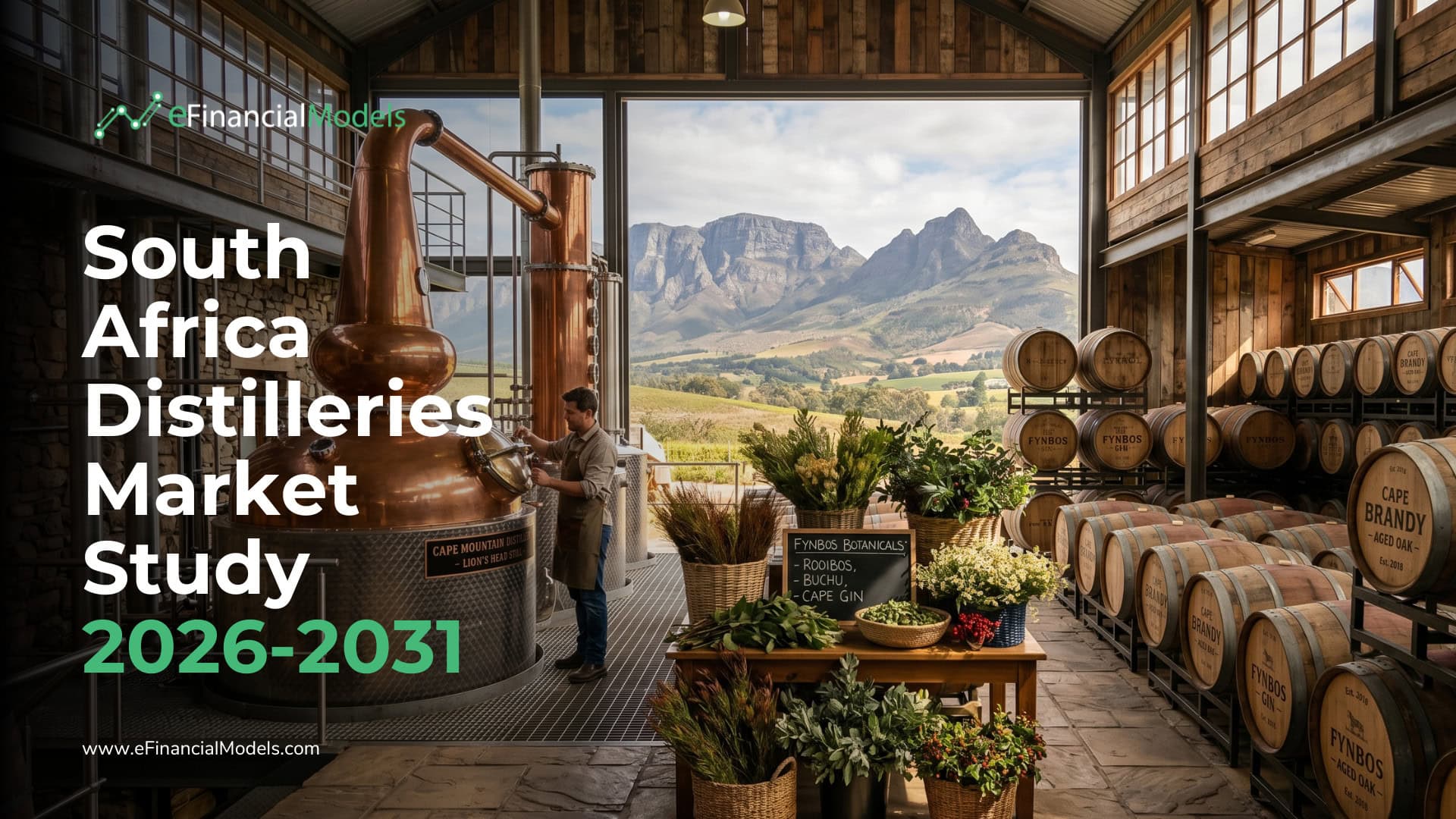
Three structurally distinct sub-segments define South Africa’s distillery sector, each with a different growth trajectory through 2031.
Brandy: A Structural Decline With a Premium Counter-Narrative
Brandy is South Africa’s oldest and largest distillery sub-segment by historical volume, but it is the most challenged by trajectory. The SA Brandy Foundation anchors current production at approximately 5.7 million LPA annually, down from a historical peak near 40 million LPA, a decline of roughly 86% over several decades. The structural driver is a well-documented generational shift away from traditional brandy occasions.
The strategic counter-narrative is the Cape Brandy PDO (Protected Designation of Origin), a Cognac-style geographic designation administered by the Cape Brandy Distillers Guild. Cape Brandy PDO retail pricing in 2025 sits at roughly 30% of Cognac at the prestige tier: standard Cape Brandy retails at approximately USD 22 per 750ml versus Cognac VS at USD 40, and prestige 20-plus-year single-cask Cape Brandy releases retail near USD 240 versus Cognac XO at USD 200. That pricing gap leaves meaningful headroom for value-led premiumization, particularly given the AfCFTA export opportunity.
Heineken Beverages SA, formed through Heineken’s April 2023 acquisition of Distell, now dominates the brandy structure as the anchor operator. Competition Tribunal ring-fencing conditions on selected brandy assets within Heineken Beverages SA create a 2026-2027 disposal window that PE and family-office buyers should monitor.
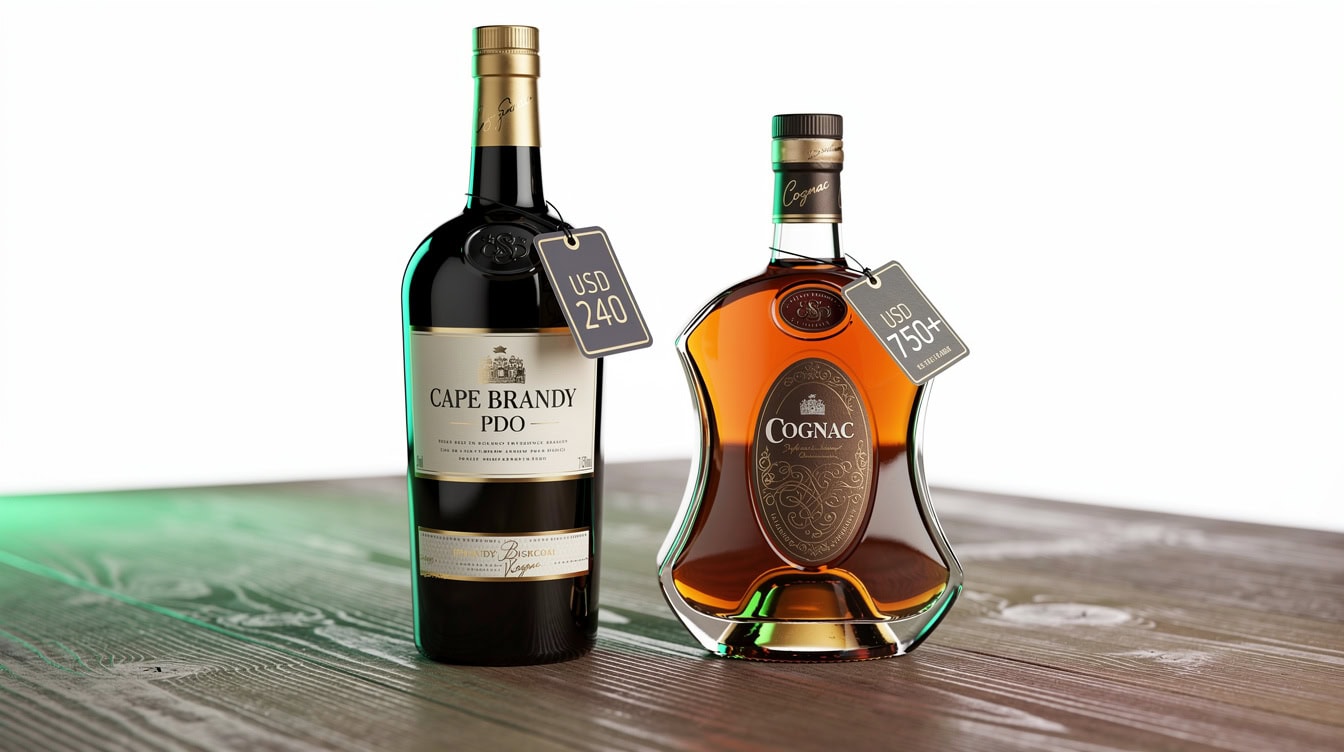
Cape Brandy PDO prestige-tier pricing sits at roughly 30% of equivalent Cognac, leaving significant headroom for premiumization-led export growth.
Craft Gin: 110 Operators, One Consolidation Cycle
Craft gin is South Africa’s highest-velocity formation story. The operator count expanded from roughly 20 distilleries in 2015 to approximately 110 by 2025, driven by fynbos botanical differentiation, on-trade gin-bar formats, and Cape terroir narratives. Fynbos botanicals are endemic plant species from the Cape Floral Kingdom, a globally unique biodiversity hotspot, and they give South African craft gin a defensible provenance story that imported gin brands cannot replicate. South Africa’s Cape Floral Kingdom is recognized as one of the world’s 6 floral kingdoms (South African National Biodiversity Institute), underscoring the genuine scarcity value of fynbos-botanical provenance in craft gin.
Pernod Ricard’s full acquisition of Inverroche on 6 February 2025 confirmed that multinational consolidation of South African craft gin is now an active trade. The South Africa Distilleries Market Study 2026-2031 models 2 to 4 further transactions through 2027, drawing the operator count from approximately 110 toward approximately 105 by 2031. Credible acquisition candidates include Hope on Hopkins, Wilderer, Pienaar and Son, Cape Town Gin Co., Six Dogs, Musgrave Gin, and Bloedlemoen.
SA craft gin retail pricing benchmarks closely against imported premium gins: domestic craft gin retails at R380 to R450 per 750ml, comparable to Bombay Sapphire (R380-450) and below Hendrick’s (R580-680), giving operators room to move upmarket as brand equity builds.
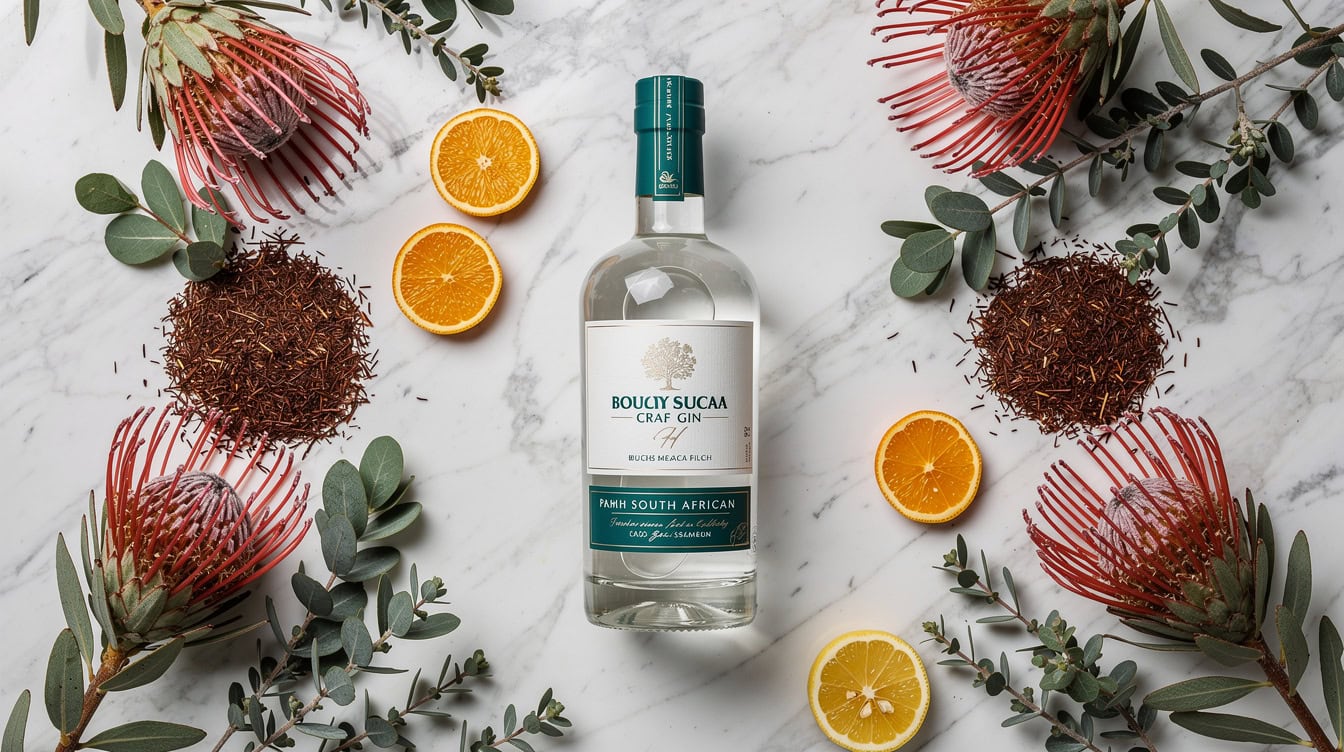
Fynbos botanicals from the Cape Floral Kingdom give South African craft gin a defensible terroir story that imported competitors cannot replicate.
Craft Whisky: Supply-Constrained, Award-Winning
South Africa’s craft whisky cohort is small but globally recognized. Three Ships Bourbon Cask Finish was named World’s Best Blended Whisky at the 2025 World Whiskies Awards, and Bain’s Cape Mountain Whisky was named World’s Best Grain Whisky in 2024. Both brands are produced at Heineken Beverages’ James Sedgwick Distillery.
Craft whisky is structurally supply-constrained by the three-year regulatory minimum aging floor under the South African Liquor Products Act. New-make spirit (the raw, unaged distillate that enters barrels) cannot be sold as whisky until it has matured for at least three years in oak. Maturing stock availability is modeled to rise from 2.8 million LPA in 2025 to roughly 4.4 million LPA by 2031 as new-fill volumes from 2022 to 2028 reach bottling age. This supply curve means that any export growth ambition must be planned and funded three to five years in advance.
South Africa’s three-year regulatory aging minimum means craft whisky supply decisions made today determine export capacity in 2028 and beyond.
Pricing and Cost Dynamics: Excise, Tariffs, and Export Margins
Pricing dynamics in South African distilleries are shaped by three overlapping forces: SARS excise duty, the US tariff regime, and export destination mix.
The SARS Budget 2026 set spirits excise duty at R97.66 per 750ml bottle effective 1 April 2026, a 3.4% increase on the prior year’s R94.45 (South African Revenue Service Budget 2026 FAQ). At a 40% ABV reference, this equates to R130.21 per liter of bottled spirit or R325.53 per LPA. South Africa applies excise duties to alcohol based on the volume of absolute alcohol, with spirits taxed at a rate that in 2026 equates to approximately R325.53 per liter of pure alcohol (South African Revenue Service), making excise one of the most significant cost-of-goods line items for any domestic distillery operator. The base-case projection compounds this at approximately 4.5% per annum to reach roughly R121.69 per 750ml by 2031. The bear-case path assumes above-CPI tracking, reaching approximately R140 per 750ml over the same horizon.
The 30% US tariff imposed under the 2025 Trump trade-policy realignment is the most material export-side variable for craft whisky. For a representative SA craft whisky export program with USD 20 million in revenue and 18% US exposure, the net EBIT impact of the 30% tariff is estimated at roughly -8% to -15% in the first 12 to 18 months. The tariff’s impact is asymmetric across price tiers: producers absorb roughly 50% to 60% of the tariff at entry-premium tier (where demand is more price-elastic) but only 15% to 25% at prestige tier (where consumer-pull is stronger and more of the tariff passes through to retail shelf).

The 30% US tariff hits entry-premium SKUs hardest: producers absorb 50-60% of the cost, versus only 15-25% at prestige tier where consumer demand is less price-elastic.
Worked Example: Excise Duty Impact on a Craft Whisky P&L
Here’s the math for a mid-sized SA craft whisky operator producing 100,000 LPA annually and selling primarily in the domestic market at a 40% ABV reference.
Step 1: Calculate excise duty per LPA. R97.66 per 750ml bottle divided by 0.75 liters equals R130.21 per liter of bottled spirit. At 40% ABV, each liter of bottled spirit contains 0.4 LPA, so excise per LPA equals R130.21 divided by 0.4, which equals R325.53 per LPA.
Step 2: Calculate total annual excise liability. 100,000 LPA multiplied by R325.53 equals R32,553,000 per year.
Step 3: Apply the bear-case stress (above-CPI excise at 7.7% per annum compounding from 2026 to 2031). R97.66 compounded at 7.7% for 5 years equals approximately R141.80 per 750ml. Recalculating: R141.80 divided by 0.75 equals R189.07 per liter, divided by 0.4 ABV equals R472.67 per LPA. Total bear-case excise liability: 100,000 LPA multiplied by R472.67 equals R47,267,000, a 45% increase versus the 2026 base.
Step 4: Interpret the margin impact. If the operator’s 2026 gross margin is R650 per LPA, the bear-case excise increase of R147.14 per LPA (R472.67 minus R325.53) represents a 22.6 percentage-point compression of gross margin, assuming zero pass-through to retail price. Even at 70% pass-through (the bear-case assumption), the operator absorbs R44.14 per LPA, compressing gross margin by approximately 6.8 percentage points.
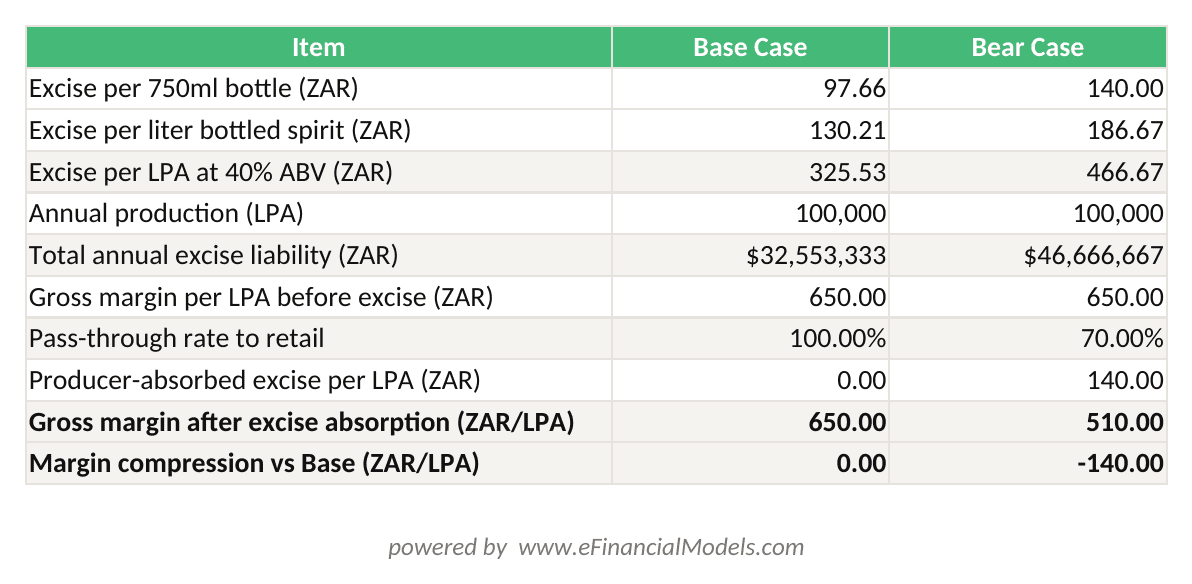
Bear-case excise (R140/750ml by 2031) compresses gross margin by approximately 6.8 percentage points even at 70% pass-through to retail.
Three Scenarios for 2026-2031
The 2026-2031 outlook frames three probability-weighted scenarios. Each scenario reflects a distinct combination of regulatory, tariff, and demand outcomes.
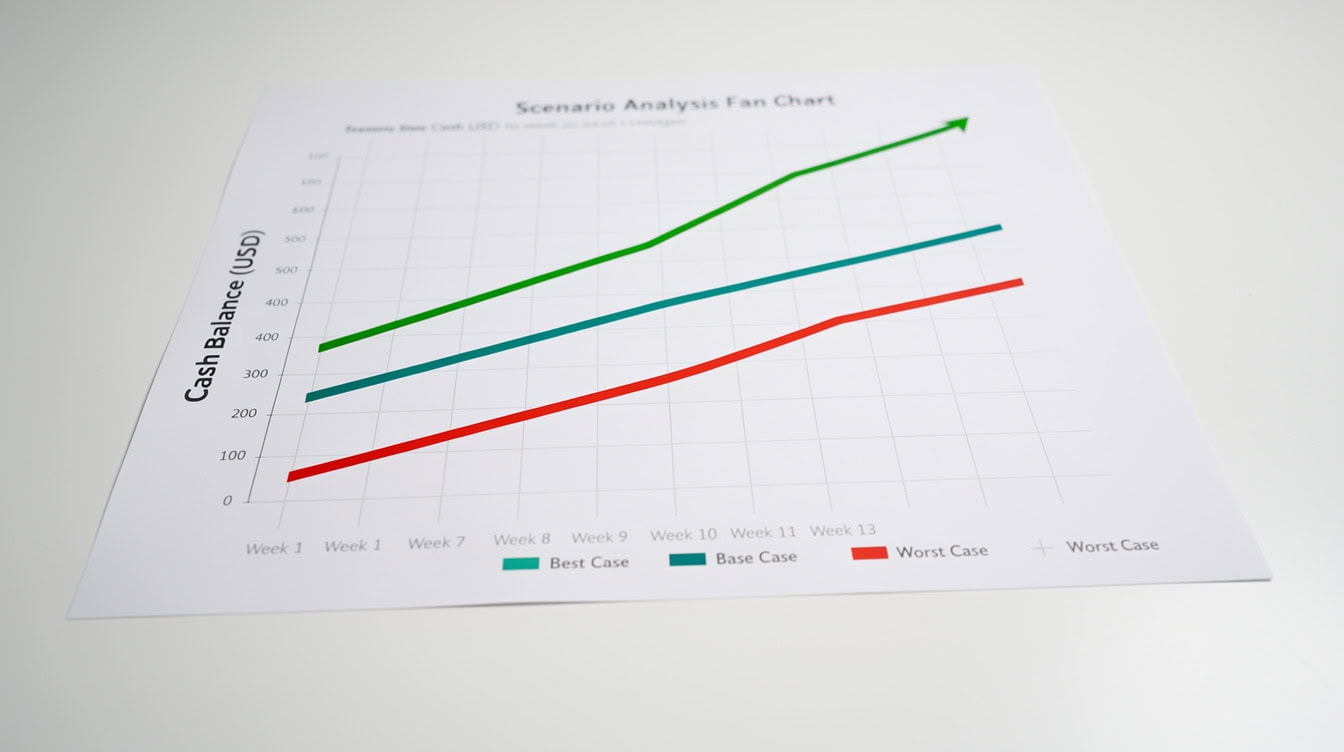
The base case (55% probability) projects SA spirits reaching USD 1.22 billion by 2031; the bull case requires AfCFTA capture and US tariff resolution to reach USD 1.35 billion.
| KPI | Bear (25%) | Base (55%) | Bull (20%) |
|---|---|---|---|
| 2031 SA spirits market (USD bn) | 1.145 | 1.22 | 1.35 |
| 2031 brandy production (M LPA) | 4.4 | 6.2 | 7.6 |
| 2031 craft gin operators | 85-95 | ~105 | 105-115 |
| 2031 craft whisky stock (M LPA) | 3.6 | 4.4 | 5.2 |
| Liquor Amendment Bill outcome | Passed 2027-28 | Stalled/watered down | Withdrawn |
| US tariff trajectory | 30% through 2028+ | 30% to 2027, partial relief | Resolved to ~0% late 2026 |
| SARS excise 2031 (ZAR/750ml) | ~R140 | ~R122 | ~R118 |
| AfCFTA capture rate by 2031 | 3-5% | 7-10% | 12-15% |
The base case (55% probability) assumes the Statista trajectory holds, the Liquor Amendment Bill stalls in committee, the US tariff persists through 2027 with partial resolution from 2028, and Cape Brandy PDO export pricing grows at a 5% to 8% CAGR. The bull case (20% probability) requires AfCFTA preferential access to translate into a 10% to 15% capture rate against the addressable continental spirits opportunity, which the AfCFTA Secretariat models at over USD 1.2 billion by 2031 across Nigeria, Kenya, Ghana, Egypt, Côte d’Ivoire, and the DRC. The AfCFTA agreement covers 54 of the 55 African Union member states (African Union), representing a combined GDP of over USD 3.4 trillion and a consumer base of 1.3 billion people that SA distillers are only beginning to access.
Common Mistakes Investors and Operators Make
Five specific errors recur in South African distillery investment and operational analysis.
Mistake 1: Treating brandy as a single homogeneous category. Standard Cape Brandy and Cape Brandy PDO premium-tier are structurally different investment propositions. The PDO tier has a defensible export pricing story; the standard tier is in structural volume decline. Fix: separate the two in any DCF or LBO model.
Mistake 2: Ignoring the whisky maturing-stock working-capital cycle. Craft whisky operators lock up cash for three to five years before the first revenue dollar lands. Modelers who apply a standard FMCG working-capital assumption (30 to 60 days) will dramatically underestimate cash burn. Fix: build the new-fill schedule, cohort-level stock cover ratio, and annual evaporative loss (approximately 1.5% to 2.5% per year under SA conditions) as separate working-capital line items.
Mistake 3: Applying a flat tariff pass-through assumption across all price tiers. The 30% US tariff hits entry-premium and prestige SKUs very differently. Fix: apply tier-specific absorption rates (50% to 60% producer absorption at entry-premium, 15% to 25% at prestige).
Mistake 4: Underweighting the Liquor Amendment Bill B21-2025 risk. A total advertising ban would force a wholesale replatforming of brand-building economics across all three sub-segments. Fix: model a discrete bear-of-bear stress that allocates a 20% to 30% step-up in alternative-channel marketing spend (retail, content, sponsorship, events) over 2027 to 2029.
Mistake 5: Overestimating AfCFTA capture rates. AfCFTA implementation has been uneven country-by-country. Even a 10% to 15% capture rate against the USD 1.2 billion addressable opportunity by 2031 would be a material category boost, but it is not guaranteed. Fix: model 3% to 5% (bear), 7% to 10% (base), and 12% to 15% (bull) as discrete scenario layers rather than a single optimistic assumption.
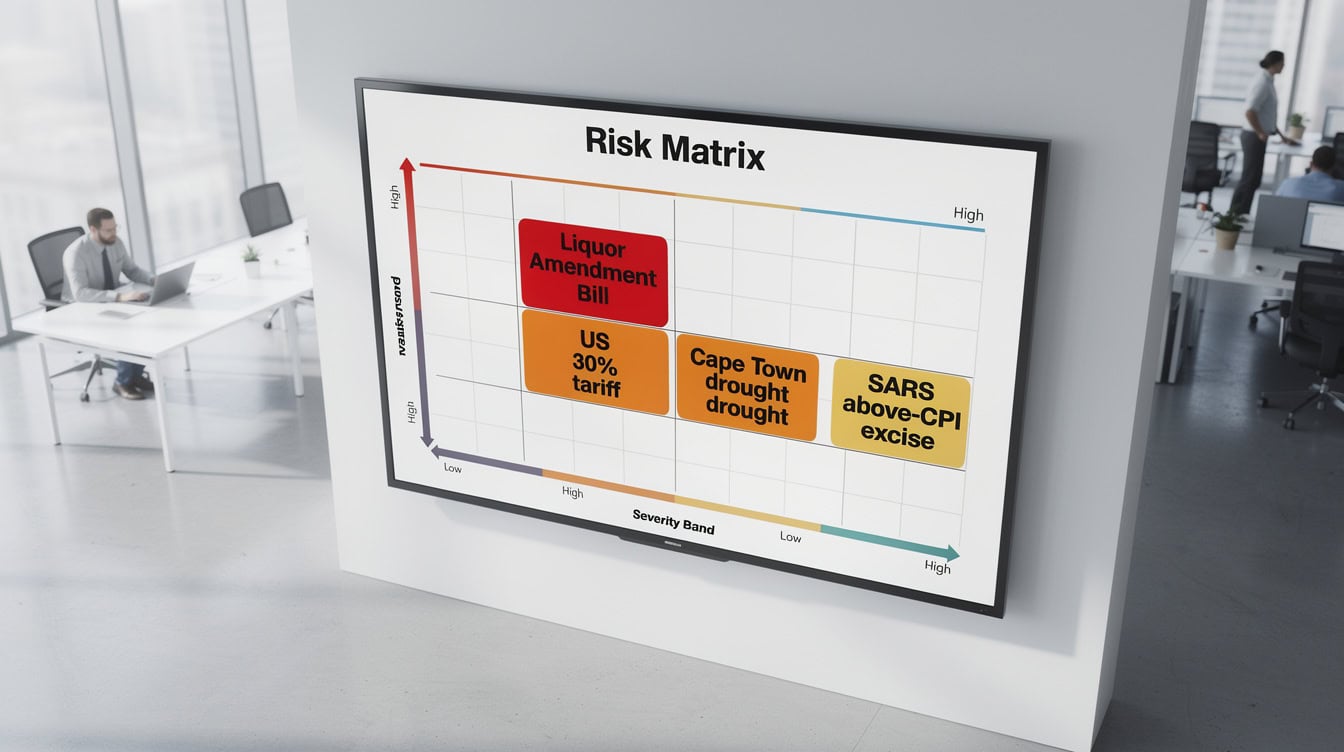
The Liquor Amendment Bill B21-2025 is the only Critical-severity risk; the US tariff, Cape Town drought, and above-CPI excise all rank High severity through 2031.
Tools, Templates, and Financial Modeling Resources
Financial modelers working on South African distillery investments need purpose-built scaffolding that handles the sector’s structural complexity: multi-year aging cycles, tier-asymmetric tariff pass-through, AfCFTA scenario layers, and SARS excise trajectories.
The South Africa Distilleries Market Study 2026-2031 provides the category-level scenario data, assumption sets, and unit economics sized to drop directly into DCF, LBO, and refinancing models. The study’s Appendix A consolidates base-case assumptions across macro and FX (ZAR/USD at 18.5 plus or minus 1.5), excise duty trajectories, tariff pass-through rates, and AfCFTA capture-rate scenarios.
For comparable solar energy market studies covering other high-growth emerging markets, EFM also publishes the South Africa Solar Energy Market Study 2026-2031 and a full suite of European market studies. For distillery market context in neighboring markets, the Ireland Distilleries Market Study 2026-2031 and United Kingdom Distilleries Market Study 2026-2031 provide useful benchmarks for Cape Brandy PDO and craft whisky export pricing comparisons.
For project-level cash-flow construction, pair the market study with a dedicated distillery financial model that handles the three-year whisky aging cycle as a working-capital sub-model, not a simple inventory line.
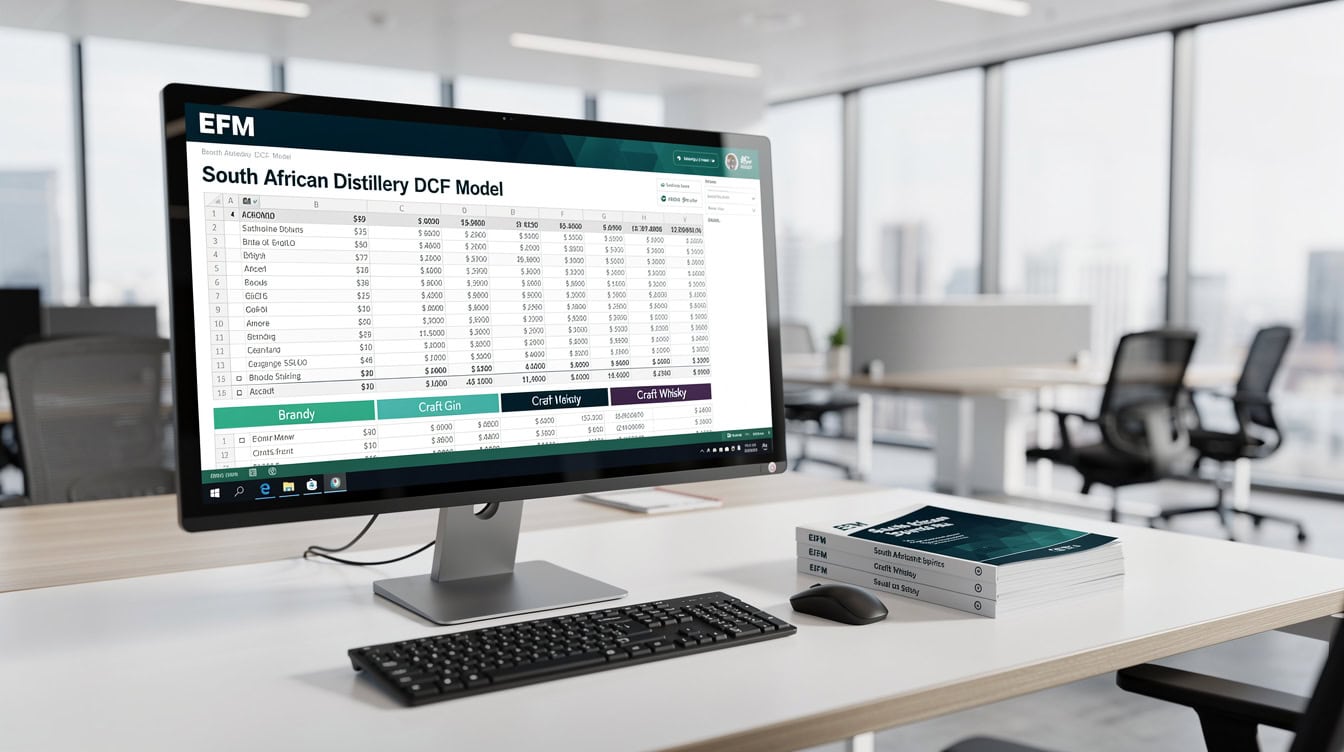
Purpose-built financial models for SA distilleries must handle multi-year whisky aging cycles, tier-asymmetric tariff pass-through, and AfCFTA scenario layers simultaneously.
Frequently Asked Questions
How large is South Africa’s spirits market in 2025, and how fast is it growing?
South Africa’s spirits market reached approximately USD 1.08 billion in value in 2025, according to Statista’s Spirits South Africa outlook. The market is projected to reach USD 1.16 billion by 2029 on a compound annual growth rate of +2.33%. IWSR’s 2025-2026 commentary is more bullish on the near term, identifying South Africa as one of three global beverage-alcohol bright spots with +4% volume growth and +12% value growth in 2025 alone, even as global spirits overall suffered their worst year on record. The base-case scenario in the EFM market study projects the market reaching approximately USD 1.22 billion by 2031, while the bull case reaches USD 1.35 billion if AfCFTA preferential access and US tariff resolution both materialize.
Why has South African brandy production fallen so dramatically?
Brandy production has declined from a historical peak near 40 million LPA to approximately 5.7 million LPA today, a fall of roughly 86%. The SA Brandy Foundation anchors the current production figure. The structural driver is a well-documented generational shift away from traditional brandy occasions: younger South African consumers are moving toward craft gin, premium whisky, and RTD (ready-to-drink) formats. The strategic counter-narrative is the Cape Brandy PDO, which protects the 100% pot-still premium tier with a Cognac-style geographic designation. Cape Brandy PDO retail pricing at roughly 30% of equivalent-tier Cognac leaves meaningful headroom for value-led premiumization, particularly in the UK and EU export markets where the PDO framework is well understood.
What does the Pernod Ricard acquisition of Inverroche mean for craft gin investors?
Pernod Ricard’s full acquisition of Inverroche on 6 February 2025 confirmed the multinational entry playbook into South African craft gin. It signals that the craft gin consolidation cycle is now active, not hypothetical. The EFM market study models 2 to 4 further transactions through 2027 as the operator count consolidates from approximately 110 toward approximately 105. For investors, 2026-2027 is the prime entry window: credible acquisition candidates include Hope on Hopkins, Wilderer, Pienaar and Son, Cape Town Gin Co., Six Dogs, Musgrave Gin, and Bloedlemoen. Strategic and PE buyers with patient capital and brand-building infrastructure are the natural acquirers; multinational gin houses including Diageo, Bacardi, and Suntory are the principal competitor bid sources.
How does the US 30% tariff affect South African craft whisky exports?
The 30% US tariff imposed under the 2025 Trump trade-policy realignment directly compresses margin and volume on the most strategically important export market for SA craft whisky. For a representative SA craft whisky export program with USD 20 million in revenue and 18% US exposure, the net EBIT impact is estimated at -8% to -15% in the first 12 to 18 months. The tariff’s impact is asymmetric: at entry-premium tier, producers absorb roughly 50% to 60% of the tariff through reduced shipper-gate price; at prestige tier (Three Ships Bourbon Cask, Bain’s Founders Collection), consumer-pull is stronger and 75% to 85% of the tariff passes through to retail shelf with less volume erosion. The principal mitigation is geographic mix-shift toward AfCFTA, UK, and EU destinations.
What is the AfCFTA opportunity for South African distilleries?
The African Continental Free Trade Area framework opens preferential tariff access for SA-distilled spirits to a continental market of 1.3 billion people and USD 3.4 trillion of combined GDP. The EFM market study’s bull-case model quantifies the 2031 addressable spirits market by destination: Nigeria at approximately USD 340 million, Kenya at USD 185 million, Ghana at USD 145 million, Egypt at USD 130 million, Côte d’Ivoire at USD 95 million, the DRC at USD 70 million, Tanzania at USD 65 million, and Uganda at USD 45 million, plus a long-tail of approximately USD 175 million across the rest of AfCFTA. The combined addressable opportunity exceeds USD 1.2 billion by 2031. Even a 10% to 15% capture rate would represent a material category boost. Realization risk is real: AfCFTA implementation has been uneven country-by-country, and the actual capture rate for SA spirits will be a small fraction of the headline addressable in the near term.
What is the Liquor Amendment Bill B21-2025 and why does it matter?
The Liquor Amendment Bill B21-2025 was introduced on 8 September 2025 by EFF MP Mente-Nkuna and currently sits in the Trade, Industry and Competition portfolio committee. In its introduced form, the bill proposes a total advertising ban on alcoholic beverages. If enacted close to its introduced form, it would eliminate the primary brand-building channel for all three SA distillery sub-segments and force a wholesale replatforming toward content, retail, sponsorship, and event platforms. The EFM market study rates this as a Critical-severity risk and assigns it a 25% probability of enactment by 2028 (the bear-case scenario). Its status as a private member’s bill rather than executive-branch legislation moderates the passage probability, but the impact if enacted is material enough to warrant contingency planning in 2026-2027.
How should financial modelers handle SARS excise duty in a South African distillery model?
Use R97.66 per 750ml bottle as the 2026 effective rate (SARS Budget 2026 FAQ, effective 1 April 2026). This equates to R130.21 per liter of bottled spirit or R325.53 per LPA at 40% ABV. For the base-case trajectory, compound at approximately 4.5% per annum to reach roughly R121.69 per 750ml by 2031. For the bear-case stress, apply approximately 7.7% per annum compounding to reach approximately R140 per 750ml by 2031. Excise is a direct cost-of-goods line in any SA distillery model, not a below-the-line item. For pass-through assumptions, use 100% in the base case, 70% in the bear case (operators absorb margin to preserve volume), and 100% in the bull case. Always model excise on a per-LPA basis to maintain consistency across production volume scenarios.
Conclusion
South Africa’s distillery sector offers one of the most structurally interesting investment landscapes in emerging-market spirits: a premium brandy category with a defensible PDO and a 30% Cognac pricing gap, a craft gin cohort entering a multinational consolidation cycle, and a globally award-winning craft whisky segment supply-constrained by biology and regulation. The risks are real: a potential total advertising ban, a 30% US tariff, and above-CPI excise pressure in the bear case. But the AfCFTA addressable opportunity exceeding USD 1.2 billion by 2031, combined with South Africa’s banking infrastructure and regulatory familiarity, gives well-positioned operators a credible continental growth path.
I recommend downloading the South Africa Distilleries Market Study 2026-2031 for the full scenario architecture, unit economics, and assumption sets sized to drop directly into your DCF, LBO, or refinancing model for any of the three sub-segments.
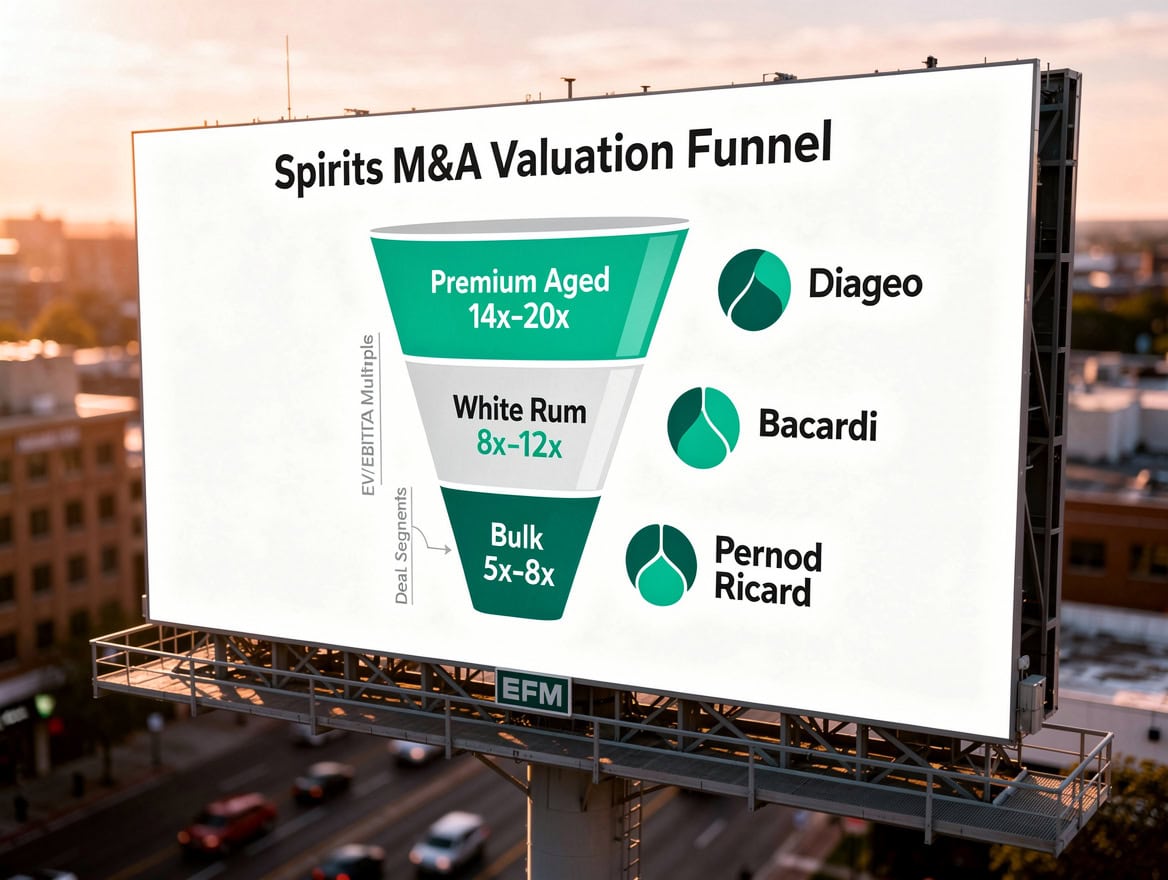
The AfCFTA addressable spirits opportunity exceeds USD 1.2 billion by 2031; Nigeria alone represents USD 340 million of that total at full preferential-access implementation.