
0 ITEMS

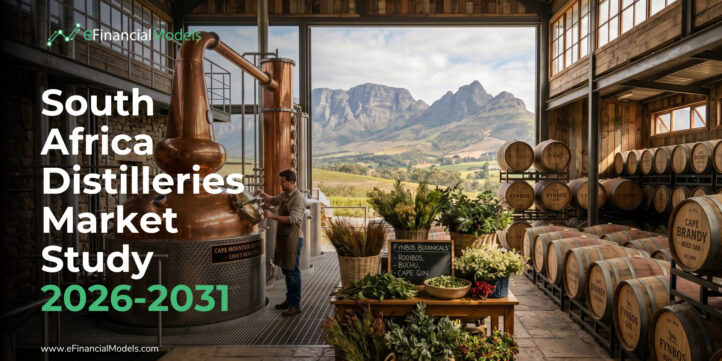
South Africa Distilleries Market Study 2026–2031
SA spirits to USD 1.16bn by 2029. Brandy at 5.7M LPA, craft gin 3.1M LPA, whisky 55% premium share. Heineken-Distell, Pernod-Inverroche M&A. Free 40-page PDF.
| Distillery, F&B (Food & Beverages), Financial Model |
| Financial Modeling, Financial Planning, Free Financial Model Templates, Market Studies, PDF |


South Africa Distilleries Market Study 2026–2031
A 42-page strategic outlook on South African spirits — production, regulation, scenarios, and named operator profiles for investors, M&A advisors, financial modelers, and brand owners.
South Africa’s distilleries sector is one of the most structurally interesting spirits markets in the world: brandy production has contracted from a historical peak of approximately 40 million liters of pure alcohol per year to roughly 5.7 million LPA today, while craft gin has grown from a handful of operators in 2015 to more than 100 distilleries in 2025 and craft whisky has begun to win the top global awards. Heineken’s April 2023 acquisition of Distell created Heineken Beverages — anchor owner of Klipdrift, Richelieu, Van Ryn’s, Three Ships, and Bain’s via the James Sedgwick Distillery in Wellington — and Pernod Ricard’s full acquisition of Inverroche on 6 February 2025 marked the multinational’s first wholly-owned African spirits brand. KWV remains independent under Vasari Global. This study models the bear–base–bull pathway for brandy, craft gin, and craft whisky through 2031 — with unit-economics tables, the maturing-whisky-stock supply curve, scenario sensitivities for the Liquor Amendment Bill [B21-2025], and the South African Revenue Service excise duty trajectory after the February 2026 Budget set the spirits rate at R97.66 per 750 ml bottle (effective 1 April 2026).
Download the market study here:
Key findings
- South African brandy is now a 5.7 million LPA category (SA Brandy Foundation), down from an historical peak of approximately 40 million LPA. The structural decline has produced a smaller but more sophisticated industry led by Cape Brandy potstill producers (KWV, Van Ryn’s, Oude Meester, Klipdrift Gold, Collison’s, Tokara) operating under the Cape Brandy Distillers Guild’s Protected Designation of Origin.
- The South African spirits market is projected to reach US$1,160 million by 2029 (Statista; +2.33% CAGR 2024–2029). Premium spirits accounted for 13% of the market and grew at roughly 2% CAGR in 1H 2024; in 2025 South Africa was up 4% in volume and 12% in value (IWSR), one of the few global bright spots in an otherwise contracting spirits category.
- Craft gin grew from roughly 20 operators in 2015 to over 100 in 2025 — driven by fynbos botanical differentiation (Inverroche, Wilderer, Six Dogs, Musgrave, Hope on Hopkins, Pienaar & Son, Bloedlemoen, Cape Town Gin Company, New Harbour, Hammer & Son). The Statista 2025 baseline is approximately 3.1 million LPA in volume and US$36.3 million in revenue, with on-trade only 4% of the total.
- Pernod Ricard’s full acquisition of Inverroche on 6 February 2025 is the multinational’s first wholly-owned African spirits brand and signals the multinational consolidation cycle is open. Combined with Heineken’s April 2023 acquisition of Distell — and the Competition Tribunal’s brandy-asset ring-fencing conditions — South African distilling is in its largest structural reshuffle since the 1979 Wine and Spirit Control Act amendments.
- The South African Revenue Service set the 2026/27 spirits excise duty at R97.66 per 750 ml bottle (+3.4% YoY, effective 1 April 2026), in line with inflation and materially below industry-feared levels above 6%. The R97.66 rate equates to roughly R130.21 per liter and R325.53 per liter of pure alcohol at 40% ABV. National Treasury’s 2026 Budget Review (Chapter 4) confirms annual 1 April effective dates from 2027 onward.
- Three Ships Bourbon Cask was named World’s Best Blended Whisky at the 2025 World Whiskies Awards in London, and Bain’s Cape Mountain was named World’s Best Grain Whisky in both 2013 and 2024. Both are produced at the James Sedgwick Distillery in Wellington — now under Heineken Beverages — and have positioned South African whisky as a globally credible single-origin category.
- The United States imposed a 30% tariff on South African exports in 2025 under the Trump trade policy realignment, materially affecting Three Ships and Bain’s US shipments and craft gin export aspirations. The bear case for the craft whisky export trajectory assumes the tariff remains through 2027.
- The Liquor Amendment Bill [B21-2025] was introduced on 8 September 2025 by EFF MP Ntombovuyo Veronica Mente-Nkuna as a private members’ bill. It proposes a total ban on alcohol advertising, promotion, product placement, and sponsorship of organized events. The bill sits in the Trade, Industry and Competition portfolio committee; passage is uncertain but high-impact, modeled as a 25% probability in the bear scenario.
- Heineken Beverages South Africa is the dominant brandy and SA-whisky producer post-2023, owning Klipdrift, Richelieu, Viceroy, Olof Bergh, Oude Meester, Van Ryn’s, Collison’s, Flight of the Fish Eagle, Three Ships, and Bain’s via the James Sedgwick Distillery. KWV remains independent under Vasari Global (since 2016), with Masimong Group and Rand Merchant Bank as minority shareholders (since 2024). Disposal disposition of the ring-fenced Distell brandy assets remains an open M&A question.
- AfCFTA preferential access opens an addressable spirits market of 1.3 billion people and combined GDP of US$3.4 trillion across the African continent. Nigeria, Kenya, Ghana, Egypt, Côte d’Ivoire, and DRC are the largest near-term spirits demand pools; South African distillers are positioned as the regional hub. The bull case assumes a meaningful AfCFTA breakthrough by 2029.
What’s inside
- Executive Summary plus Key Findings for at-a-glance investor and M&A decisions.
- Section 1 to Section 14 plus three Appendices — methodology, the industry today, supply-side analysis (including the maturing whisky stock supply curve), demand-side analysis (domestic plus named export markets), pricing and cost dynamics, three scenarios, technology and innovation, regulatory and policy context, competitive landscape, best-practice benchmarks, risk matrix, recommendations, sources, and glossary.
- 12 EFM-branded charts including South African spirits market value 2024 to 2031F, brandy production volume 2010 to 2031F, spirits category mix 2025, craft gin operator count 2015 to 2031F, SARS excise duty trajectory 2020 to 2031F, top operators by 2024 volume share, Cape Brandy versus Cognac export pricing tiers, Three Ships and Bain’s export market split 2024, the whisky maturing-stock supply curve 2025 to 2031, the 2031 scenario summary, craft distillery startup capex composition, and the AfCFTA addressable spirits market 2031F by destination country.
- Unit-economics and scenario tables including craft gin startup capex, craft whisky maturation working-capital model, brandy gross-margin trajectory, Bear/Base/Bull KPI matrix, the Liquor Amendment Bill probability map, and the SARS excise pass-through by tier.
Over 30 cited sources in Section 13 — SA Brandy Foundation, SAWIS, SACDI, Cape Brandy Distillers Guild, National Treasury, SARS, the dtic, Statista, IWSR, Euromonitor, Daily Maverick, The Spirits Business, The Whiskey Wash, Vinetur, Bona, Craft Cask, Adams and Adams, polity.org.za, Heineken corporate filings, Pernod Ricard press releases, Vasari Global, KWV, and others — every URL verified.
Data sources
- SA Brandy Foundation (sabrandy.co.za) — brandy production volume, Cape Brandy positioning, category narrative
- SAWIS (South African Wine Information and Systems) — wine and brandy production statistics
- SACDI (Southern African Craft Distillers Institute) — craft distillery membership baseline and category definition
- Cape Brandy Distillers Guild (capebrandy.co.za) — Cape Brandy Protected Designation of Origin framework, member producers
- National Treasury and SARS — Budget 2026 Review Chapter 4, excise duty schedule, 1 April 2026 effective date for the R97.66 per 750 ml spirits rate
- The dtic (Department of Trade, Industry and Competition) — National Liquor Authority, Liquor Act 59 of 2003 administration, AfCFTA framework
- Statista — Spirits in South Africa outlook, Brandy in South Africa outlook, Gin in South Africa outlook
- IWSR Drinks Market Analysis — South Africa as TBA growth bright spot 2025; super-premium-plus spirits dynamics
- Euromonitor International — Spirits in South Africa country report
- Daily Maverick, The Spirits Business, The Whiskey Wash, Bona, Craft Cask, Vinetur — trade press on the Pernod-Inverroche deal, Three Ships and Bain’s award trajectory, US tariff impact, Liquor Amendment Bill introduction
- Heineken corporate filings, Pernod Ricard press releases, Vasari Global, KWV — operator-level disclosures on the Distell acquisition close (April 2023), the Inverroche acquisition close (6 February 2025), and ownership structures
- Competition Tribunal — Heineken-Distell merger approval and brandy-asset ring-fencing conditions
Audience
| You are… | This study tells you… |
|---|---|
| A private equity or family-office investor (primary audience) | Where the 2026 to 2027 deal flow sits — the ring-fenced Distell brandy assets, KWV’s strategic optionality under Vasari Global, the craft gin consolidation candidates post-Pernod-Inverroche, the craft whisky maturation-stock asset class. Bear/base/bull producer-EBIT trajectories for sizing equity and debt. |
| An M&A advisor on a buy-side or sell-side mandate | The named-operator landscape, sub-segment volume and value shares, the Cape Brandy PDO premium-pricing thesis, the Pernod-Inverroche comparable, the multinational consolidation arc, and which competitors are realistic next-leg buyers. |
| A financial modeler or consultant | The base/bear/bull assumptions to drop into a South African distillery DCF or LBO; the maturing-whisky-stock supply curve as a working-capital sub-model; how to model the SARS excise trajectory; the AfCFTA addressable-market bull-case envelope. |
| A brand owner or distillery operator | The category outlook by sub-segment; the Liquor Amendment Bill scenario implications; the export-tariff envelope on US-bound shipments; the craft gin oversupply risk and consolidation cycle; the maturation-cycle working-capital lock for new craft whisky entrants. |
Methodology
This study covers the production, maturation, blending, and bottling of distilled spirits on South African soil over the period 2026 to 2031, with focused analytical treatment of three sub-segments — brandy, craft gin, and craft whisky — weighted approximately equally despite the underlying volume reality (brandy approximately 5.7 million LPA; craft gin approximately 3.1 million LPA; craft whisky low single-digit million LPA). The equal weighting reflects the primary investor and M&A advisor audience, for which craft gin and craft whisky carry disproportionate consolidation and growth-narrative relevance. Sources include primary regulator and industry-association publications (SA Brandy Foundation, SAWIS, SACDI, Cape Brandy Distillers Guild, National Treasury, SARS, the dtic), regulatory texts (Liquor Act 59 of 2003, Liquor Amendment Bill [B21-2025], Budget 2026 Review Chapter 4), market-data analysts (Statista, IWSR, Euromonitor), operator filings (Heineken Beverages, Pernod Ricard, KWV under Vasari Global), and trade press. Every claim is cited inline; every URL verified. The study uses American English throughout and reflects analyst judgment grounded in the intake protocol — not statistical-model output. AI-assisted research and drafting were used alongside human verification per eFinancialModels’ production methodology.
Pair this study with an eFinancialModels template
This market study delivers the sector-level context — demand drivers, the Cape Brandy PDO framework, pricing dynamics, competitive landscape, scenarios. To translate the findings into project-level cash flows, pair it with one of these distillery and beverage financial-model templates:
- Liquor Distillery Financial Plan Template
- Tequila Distillery Financial Model
- Brandy Distillery Business Plan
- Cider Distillery Financial Model
- Distillery Business Financial Model category
Download the free 42-page PDF
Trademarks and disclaimers
All trademarks referenced (Klipdrift, Richelieu, Viceroy, Olof Bergh, Oude Meester, Van Ryn’s, Collison’s, Flight of the Fish Eagle, Three Ships, Bain’s Cape Mountain, Inverroche, Hope on Hopkins, Wilderer, Pienaar & Son, Six Dogs, Musgrave, Bloedlemoen, Cape Town Gin Company, New Harbour, Hammer & Son, Drayman’s, Boplaas, KWV, Heineken Beverages, Pernod Ricard, Vasari Global, and others) are the property of their respective owners. This study is for informational and strategic-planning purposes only and does not constitute investment, financial, legal, or tax advice. © 2026 eFinancialModels. All rights reserved.
Similar ProductsOther customers were also interested in...



 eFinancialModels
Electric Vehicle (EV) Charging Station Financial M...
With this comprehensive 5- or 10-year monthly tool, investors can assess the viability of setting up... Read more

Financial Model for Mobile App | Mobile App Busine...
The Mobile App Financial Plan Template in Excel allows you to develop financial projections when lau... Read more

 HenrySheykin
Food Truck Financial Model Excel Template
The Food Truck Financial Model helps entrepreneurs, founders, business owners, consultants, and anal... Read more

Green Hydrogen Production from Wind Energy Financi...
The Green Hydrogen from Wind Financial Model aims to comprehensively forecast a horizon of 40 years ... Read more

Simple Mutual Non-Disclosure Agreement Template
Protect your business secrets with ease using our Simple Mutual Non-Disclosure Agreement Template. S... Read more

Solar Energy Financial Model
The Solar Energy Financial Model Spreadsheet Template in Excel assists you in preparing a sophistica... Read more

 Peter Graf
The Customer-Centric Financial Model for Restauran...
Starting a restaurant without a financial plan is like driving a car blindfolded. You wouldn´t do i... Read more
You must log in to submit a review.