
0 ITEMS

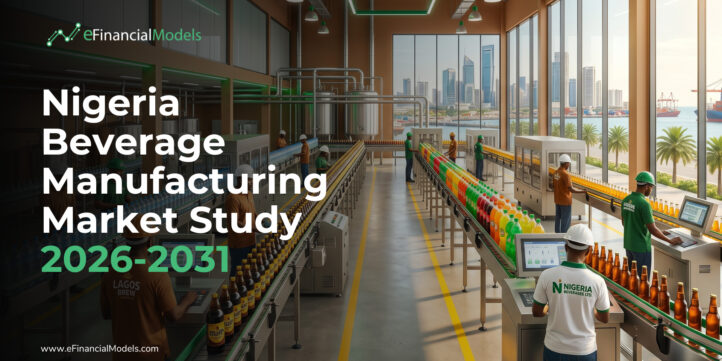
Nigeria Beverage Manufacturing Market Study 2026–2031
Comprehensive 30+ page eFinancialModels research on Nigeria’s beer, soft drinks, malt and packaged water — Naira FX, SSB tax, sachet EPR scenarios.
| Distillery, F&B (Food & Beverages), Financial Model |
| Financial Modeling, Financial Planning, Free Financial Model Templates, Market Studies, PDF |


Soft Drinks · Beer · Non-alcoholic Malt · Packaged Water — Demand–Supply Outlook
Published by eFinancialModels Research, May 2026 — Version 1.0
Nigeria’s beverage manufacturing complex is the largest in Sub-Saharan Africa by combined volume and the second-largest beer-producing market on the continent. With 17.7 million hectolitres of beer produced in 2024, 2.5+ billion litres of sachet “pure water” across 32,000+ producers, US$11.3 bn in soft drinks value, and US$5.3 bn in packaged water revenue, the industry sits inside a triple inflection over 2026–2031: the Nigeria Tax Act 2025 reshapes excise on beer and stout (₦72/L 2026 rising to ₦80/L 2028); the sugar-sweetened beverage tax debate (currently ₦10/L) is heading toward ad-valorem ≥20% under CAPPA and Health-Ministry pressure; and the post-2023 Naira float (₦460 to ₦1,580/USD, >70% devaluation) has fundamentally repriced unit economics for every PET-resin- and malt-intensive operator.
This 30+ page eFinancialModels study delivers the quantitative answer Nigerian beverage investors, brand operators, and modellers need: Bear/Base/Bull scenarios bracketing the 2031 outlook with explicit FX, regulatory, and consumer-pricing assumptions; a Competitive Coverage Map showing where every major analyst (Statista, Euromonitor, Mordor, Agusto, 6Wresearch, Vyansa) stops and where this study extends; and a unit-economics cost stack across beer, CSDs, and sachet water that grounds every brand-by-brand operator playbook.
What’s inside
1. The SSB-tax trajectory is the single most important pricing variable for 2026–2031 across non-alcoholic. The current ₦10/L specific excise (Finance Act 2021) is under active legislative review. CAPPA’s May 2025 report proposed a ₦130/L escalation; the Coordinating Minister of Health publicly recommended a minimum of 20% of retail price; the Senate has been working on bills to replace the specific levy with an ad-valorem framework. The study runs sensitivity from ₦10/L flat (Bull, 20% probability) through ~7–8% ad-valorem incidence (Base, 55%) to ≥20% ad-valorem (Bear, 25%), with explicit price-pass-through math.
2. The Tolaram–Heineken–AB InBev three-way contest is structurally locked but margin-volatile. Following the 30 September 2024 Tolaram acquisition of Diageo’s 58.02% Guinness Nigeria stake (₦81.60/share, ₦103.7 bn total) and Heineken’s stake in NB Plc rising from 56.7% to 72.9% via the September 2024 ₦599 bn rights issue, the three brewers together control ~98% of formal beer volume. The Nigeria Tax Act 2026 excise schedule (₦72/L → ₦80/L 2026–2028) compresses operator EBITDA margins by an estimated 200–400 bps absent pass-through.
3. Sachet water is structurally dominant but regulatorily vulnerable. Sachet “pure water” volume is 2.5+ billion litres per year across 32,000+ producers — the largest single packaged-beverage format in Nigeria by volume. NESREA’s national Extended Producer Responsibility framework, formalised through the September 2024 National Stakeholders’ Meeting with UNEP and the World Bank, requires 25% PET recycled content by 2029. Bear-case full enforcement consolidates producers below 8,000.
4. FX is the cross-cutting margin lever. The June 2023 NAFEM unification and resulting Naira float lifted NGN/USD from ~₦460 to a 2024 peak above ₦1,800 before settling near ₦1,580 by mid-2026. For PET-resin-intensive bottlers (NBC, Seven-Up Bottling, Rite Foods, sachet producers, premium PET water), landed input costs have risen 250–300% in Naira terms since 2022. Local-content programs (NB Plc’s 60% sorghum-cassava target, Guinness Nigeria’s FUSE program) are the structural FX hedge.
What you’ll get
- A 30+ page Word/PDF research report covering market sizing, supply-side analysis, demand fundamentals, pricing and cost dynamics, scenario modelling, technology trends, regulatory deep-dive, competitive landscape, and actionable recommendations.
- 12 EFM-branded charts including beverage volume by sub-segment (2019–2031), beer market share by brewer (2025), SSB-tax sensitivity, CSD brand share, packaged water PET-vs-sachet split, brewer revenue trajectory (2023–2025), Naira/PET-resin pass-through, three-scenario beer outlook, energy-drinks share, beer/CSD/sachet cost stack, zonal demand mix by geopolitical zone, and beer excise schedule.
The study draws on the Central Bank of Nigeria (NAFEM data), the National Bureau of Statistics (GDP and NLSS), NAFDAC (Food Hygiene Regulations 2025), NESREA (EPR framework), the Manufacturers Association of Nigeria (Economic Reviews), the Nigerian Tax Act 2025 (signed 26 June 2025, effective 1 January 2026), operator disclosures (Nigerian Breweries, Guinness Nigeria, International Breweries, NBC/Coca-Cola HBC, Seven-Up Bottling Company), and major-publisher analysts including Statista, Euromonitor, Mordor Intelligence, Agusto Research, 6Wresearch, Vyansa Intelligence, and Kirin Holdings’ Global Beer Survey. Trade-press anchors include Nairametrics, BusinessDay, Vanguard, ThisDay, Premium Times, and Marketing Edge. Multilateral context comes from the World Bank, UNDP, and UNEP.
Audience
Primary. Private-equity and strategic investors valuing Nigerian beverage assets — live deal context (Tolaram–Diageo Guinness Nigeria deal closure 2024, Heineken’s increased NB Plc stake via the ₦599 bn rights issue, Coca-Cola HBC’s pending US$2.6 bn CCBA acquisition targeting end-2026).
Secondary. Corporate development teams at multinational brewers (Heineken, AB InBev, Tolaram, Diageo), bottlers (Coca-Cola HBC, PepsiCo, Affelka), and packaging suppliers; brand managers at Nigerian Breweries, Guinness Nigeria, International Breweries, NBC, SBC, Rite Foods, Chi Limited, Nestlé Waters Nigeria.
Tertiary. Financial-modelling professionals, ECOWAS strategic-planning teams, IMF and World Bank desk economists, and consultants using eFinancialModels templates.
Methodology
eFinancialModels uses AI-assisted research and drafting tools as part of its market-study production methodology, alongside human research, source verification, and editorial review. Every claim, statistic, source, chart, and recommendation in this study was reviewed and verified by the eFinancialModels editorial team before publication. All sources are cited inline; forward-looking statements are explicitly labelled and reflect analyst judgment. AI tools are used to accelerate research and drafting; we do not publish unverified content. Readers are responsible for their own due diligence.
The study uses a Phase A / Phase B / Phase C intake protocol (question analysis, clarification round, competitive research with gap analysis) that ensures coverage is a strict superset of the most thorough competitor study on the same country-and-industry pairing. Probabilities on the three scenarios reflect senior-analyst judgment grounded in the regulatory, FX, and operator-pipeline evidence assembled during intake — they are NOT outputs of a statistical model.
Pair this study with an eFinancialModels template
This study provides the sector-level context. To build project-level cash flows for a Nigerian brewery, bottler, or sachet-water rollup, pair the study with the Beverage Manufacturing Financial Model — the most flexible 150-segment × 5-pack-size × 40-beverage template with a 10-year horizon and a 3-phase volume ramp. Adjacent templates include the Manufacturing Industry Template Bundle. Browse all Food and Beverage Manufacturing Templates or the broader Manufacturing Financial Models category.
Disclaimer
This market study is provided by eFinancialModels for general informational, educational, and strategic-planning purposes only. It does not constitute investment, financial, legal, or tax advice. Forward-looking statements and scenarios reflect analyst judgment at the date of writing and are subject to material uncertainty. Readers must conduct their own due diligence. Third-party trademarks remain the property of their respective owners. Copyright 2026 eFinancialModels. All rights reserved.
Similar ProductsOther customers were also interested in...



 eFinancialModels
Electric Vehicle (EV) Charging Station Financial M...
With this comprehensive 5- or 10-year monthly tool, investors can assess the viability of setting up... Read more

Financial Model for Mobile App | Mobile App Busine...
The Mobile App Financial Plan Template in Excel allows you to develop financial projections when lau... Read more

 HenrySheykin
Food Truck Financial Model Excel Template
The Food Truck Financial Model helps entrepreneurs, founders, business owners, consultants, and anal... Read more

Green Hydrogen Production from Wind Energy Financi...
The Green Hydrogen from Wind Financial Model aims to comprehensively forecast a horizon of 40 years ... Read more

Simple Mutual Non-Disclosure Agreement Template
Protect your business secrets with ease using our Simple Mutual Non-Disclosure Agreement Template. S... Read more

Solar Energy Financial Model
The Solar Energy Financial Model Spreadsheet Template in Excel assists you in preparing a sophistica... Read more

 Peter Graf
The Customer-Centric Financial Model for Restauran...
Starting a restaurant without a financial plan is like driving a car blindfolded. You wouldn´t do i... Read more
You must log in to submit a review.