
0 ITEMS

Homeopathy Center Financial Model Excel Template
This Homeopathy Clinic Financial Model helps users turn a clinic concept into a structured financial plan that can be used for launch preparation, expansion planning, funding discussions, and internal decision-making. Instead of starting with a blank spreadsheet, entrepreneurs and planners can work from a ready-to-use model tailored to the economics of a homeopathy practice, including patient appointments, practitioner capacity, service pricing, utilization, startup costs, operating expenses, payroll, cash flow, profitability, and investor returns. The template is designed for founders, clinic owners, consultants, analysts, and business plan writers who need to understand whether a homeopathy clinic can become financially sustainable. It supports planning for key revenue assumptions such as initial consultations, follow-up appointments, acute care visits, practitioner availability, patient volume, and pricing. It also helps users estimate the cost of opening the clinic, including fit-out, furniture, technology, patient management systems, and working capital, while connecting those launch needs to ongoing monthly expenses and projected cash requirements. With built-in forecasts, editable assumptions, scenario analysis, financial statements, charts, and performance dashboards, the Homeopathy Clinic Financial Model gives users a practical way to evaluate the business before committing capital. Users can test how changes in utilization, pricing, staffing, marketing spend, or service mix affect revenue, EBITDA, cash flow, profit margins, and break-even analysis. This makes the model useful not only for funding documents, but also for operational planning and day-to-day financial decision-making. The template is especially helpful for anyone preparing an investor-ready or lender-ready financial plan. It organizes financial planning into a clear structure, helping users communicate how the clinic will generate revenue, control costs, manage payroll, maintain liquidity, and reach profitability over time. Fully editable and compatible with Excel and Google Sheets, it can be customized for a new clinic, an existing practice, or a broader natural healthcare and wellness center business model.
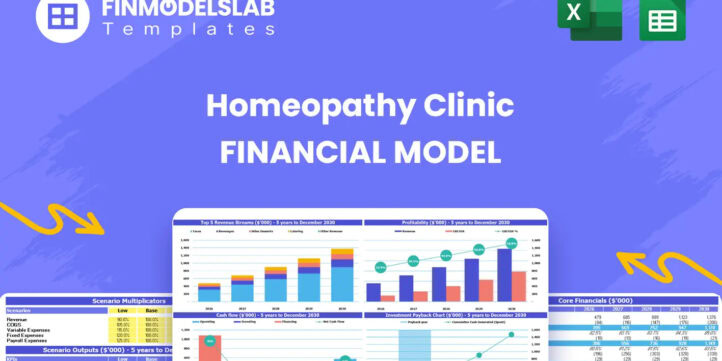


Financial Model Overview
The Homeopathy Clinic Financial Model is a ready-to-use financial model template designed to help entrepreneurs, clinic owners, consultants, and analysts plan the financial performance of a homeopathy practice with greater structure and confidence. A homeopathy clinic depends on a specific set of business drivers, including practitioner capacity, patient utilization, service pricing, appointment mix, clinic setup costs, payroll, rent, marketing, supplies, and working capital. This template brings those assumptions into one connected planning tool, allowing users to forecast revenue, expenses, cash flow, profitability, funding needs, and investment returns over a multi-year period. It is useful for new clinic launches, expansion planning, business plan preparation, investor discussions, bank loan applications, and internal decision-making. The model is fully editable, so users can replace the pre-populated assumptions with their own figures, adapt it to their local market, and test how different strategies affect the financial outcome of the clinic.
All-in-One Dashboard
The all-in-one dashboard gives users a centralized view of the most important inputs and outputs in the Homeopathy Clinic Financial Model. Instead of searching through separate worksheets to understand the financial position of the clinic, users can review key assumptions, headline revenue figures, cost behavior, profitability metrics, cash flow movement, and investment indicators from one organized area. This component is useful because a homeopathy clinic has several interconnected drivers, including the number of practitioners, the maximum monthly treatment capacity, the utilization rate, the pricing of initial consultations and follow-up visits, and the level of fixed and variable operating expenses. By consolidating these drivers into a clear dashboard, the model helps users quickly understand whether the business plan is financially realistic. The dashboard can support management reviews, partner discussions, and investor presentations by showing the overall financial story of the clinic in a concise, visual, and decision-ready format.
Low, Base, and High Scenario Analysis
The low, base, and high scenario analysis section helps users evaluate how the clinic may perform under different operating conditions. A homeopathy practice may not always achieve its expected patient volume, utilization rate, pricing level, or growth schedule, especially in the early months after launch. This component allows users to compare a conservative case, a realistic base case, and an upside case without rebuilding the entire model. Inputs may include patient demand assumptions, practitioner capacity, appointment pricing, marketing effectiveness, payroll timing, cost inflation, and utilization growth. The outputs show how each scenario affects revenue, profit margins, EBITDA, cash flow, funding requirements, and long-term sustainability. This is especially valuable for risk management because it helps users understand what happens if patient acquisition is slower than expected, if operating expenses are higher than planned, or if the clinic scales faster than anticipated. For funding preparation, scenario analysis also demonstrates to investors and lenders that the business plan has been stress-tested rather than based on a single optimistic forecast.
Professional Charts and Visual Reports
The professional charts and visual reports component converts the financial projections into presentation-ready visuals that are easier to understand and communicate. Financial statements can be detailed, but charts help users quickly interpret trends in revenue growth, expense movement, EBITDA, net profit, cash balance, and other performance indicators. For a homeopathy clinic, this can be particularly helpful when explaining how patient volume ramps up over time, how practitioner utilization improves, and how fixed costs become more efficient as the clinic grows. Inputs are drawn from the underlying forecast assumptions and financial statements, while outputs may include revenue trend charts, profitability graphs, cash flow visuals, cost structure summaries, and comparative performance views. These visuals support investor decks, bank meetings, internal planning sessions, and management reporting. They also help non-financial stakeholders understand the plan without needing to examine every formula or spreadsheet line. By presenting the numbers clearly, this component makes the Homeopathy Clinic Financial Model more practical for both analysis and communication.
ROE Components and DuPont Analysis
The ROE components and DuPont analysis section helps users understand how efficiently the homeopathy clinic uses shareholder equity to generate returns. Return on equity is an important investor metric, but the DuPont framework goes further by breaking that return into underlying performance drivers such as profitability, asset efficiency, and financial leverage. In a clinic setting, this can help users assess whether returns are being driven by healthy service margins, effective use of clinic assets, appropriate funding structure, or a combination of these factors. Inputs may include net income, revenue, total assets, equity, debt, and other balance sheet figures generated by the financial model. The outputs help users evaluate whether the business is improving its return profile over time and whether additional investment, borrowing, or reinvestment is producing sufficient financial benefit. This component is useful for founders and investors because it connects operational performance with capital efficiency. It also supports strategic decision-making around expansion, hiring, equipment investment, and funding structure by showing how those choices may influence overall return on equity.
Revenue Inputs and Assumptions
The revenue inputs and assumptions section is one of the core planning areas of the Homeopathy Clinic Financial Model because it defines how the clinic earns money. A homeopathy practice typically generates revenue from services such as initial consultations, follow-up appointments, acute care visits, and appointments with senior or junior practitioners. This component allows users to enter assumptions for practitioner count, maximum monthly treatments, utilization rates, appointment pricing, service mix, growth timing, and the introduction of additional revenue streams. The outputs flow into the revenue forecast, profitability projections, cash flow statement, and financial dashboard. This section is especially useful because it connects clinic operations directly to financial results. Users can test how many patients must be served each month to support the cost structure, how pricing changes affect revenue, and how adding practitioners expands capacity. It also helps identify whether the clinic is overly dependent on one service category or whether revenue can be strengthened through a balanced mix of consultations, follow-ups, acute care, packages, and complementary wellness offerings.
Bank-Ready Financial Reports
The bank-ready financial reports component organizes the financial projections into a format suitable for lenders, investors, advisors, and other stakeholders who expect clear and professional outputs. A bank or funding partner will typically want to review the clinic’s income statement, cash flow forecast, balance sheet, startup funding needs, repayment capacity, profitability outlook, and key assumptions. This section helps users present those outputs in a structured way, using connected calculations rather than disconnected estimates. Inputs are driven by revenue assumptions, staffing plans, operating expenses, capital expenditures, financing assumptions, and tax or working capital settings. The outputs may include monthly and annual financial statements, profit and loss summaries, cash flow projections, balance sheet forecasts, and lender-friendly performance indicators. For a homeopathy clinic seeking a loan, lease financing, investor capital, or partner funding, this component helps communicate the financial plan with clarity. It also helps users identify gaps before approaching a lender, such as whether the clinic has enough cash buffer, whether profitability supports debt service, and whether the launch budget is aligned with the requested funding amount.
Revenue Breakdown by Service Stream
The revenue breakdown by service stream gives users a detailed view of how each part of the clinic contributes to total revenue. A homeopathy clinic may offer several services with different pricing, appointment duration, practitioner requirements, and patient demand patterns. This component separates revenue into streams such as initial consultations, follow-up appointments, acute care visits, senior practitioner services, junior practitioner services, wellness packages, or related natural health offerings if the user chooses to add them. Inputs may include service prices, expected appointment volume, utilization rates, practitioner capacity, and monthly growth assumptions. Outputs help users see which services generate the most revenue, which services are growing fastest, and how the service mix affects margins and capacity planning. This is useful for making practical business decisions, such as whether to hire another practitioner, increase prices for initial consultations, promote follow-up care, or introduce bundled treatment plans. It also helps users understand concentration risk, because a clinic that relies too heavily on one service may be more vulnerable if patient demand shifts.
KPI Dashboard and Performance Benchmarks
The KPI dashboard and performance benchmarks section helps users monitor the operational and financial health of the homeopathy clinic through measurable indicators. Key performance indicators may include revenue per practitioner, patient utilization rate, average revenue per appointment, gross margin, EBITDA margin, net profit margin, patient acquisition cost, cash balance, burn rate, payback period, and return metrics. This component may also allow users to compare selected metrics against relevant healthcare, wellness, or alternative medicine benchmarks to validate assumptions and identify improvement opportunities. Inputs are drawn from the clinic’s revenue forecast, cost structure, payroll plan, marketing assumptions, and financial statements. Outputs provide a performance snapshot that can be used for monthly management reviews, investor updates, and strategic planning. For decision-making, the KPI dashboard is valuable because it turns financial projections into actionable signals. If utilization is too low, users can revisit marketing or practitioner scheduling. If margins are weaker than expected, they can review pricing, supplies, or payroll. If cash flow is tightening, they can adjust spending, funding, or growth timing before the issue becomes more serious.
Startup Cost Breakdown and Capital Planning
The startup cost breakdown and capital planning component helps users estimate the amount of funding required before the homeopathy clinic can open and operate effectively. Launching a clinic often involves one-time investments such as clinic renovation and fit-out, furniture and fixtures, IT infrastructure, patient management software, treatment room setup, deposits, licenses, professional fees, initial marketing, equipment, supplies, and working capital reserves. This section allows users to itemize those startup costs, adjust budget assumptions, and separate one-time launch investments from ongoing operating expenses. The outputs help calculate total initial capital needed, funding gaps, pre-opening cash requirements, and the level of investment or loan proceeds required to support the launch. This component is useful for budgeting because it reduces the risk of underestimating setup costs and running short of cash before the clinic reaches stable revenue. It also supports funding conversations by giving investors, lenders, and partners a transparent view of how capital will be used. For founders, it provides a practical checklist for planning the launch budget and prioritizing spending based on what is essential for opening, patient service delivery, and early growth.
Break-Even Analysis and Profitability Timing
The break-even analysis and profitability timing component helps users identify when the homeopathy clinic is expected to cover its costs and begin generating profit. Break-even planning is especially important for service-based healthcare and wellness businesses because profitability depends on the relationship between appointment volume, pricing, practitioner utilization, payroll, rent, marketing, supplies, and fixed overhead. This section uses the model’s revenue assumptions and cost structure to estimate the point at which total revenue is sufficient to cover total expenses. Inputs may include service prices, monthly patient volume, utilization rates, variable costs, fixed operating expenses, payroll, startup costs, and growth assumptions. Outputs may include break-even date, break-even revenue, required appointment volume, margin progression, and the time needed to recover the initial investment. This is useful for founders because it clarifies how much activity the clinic must generate to become sustainable. It is also useful for investors and lenders because it shows whether the business can reach profitability within a reasonable timeframe. By understanding break-even dynamics, users can make better decisions about launch pricing, staffing levels, marketing intensity, cash reserves, and expansion timing.
File types:
Excel – Single-User: .xlsx
Excel – Multi-User: .xlsx
Similar ProductsOther customers were also interested in...

 HenrySheykin
Mental Health Center Financial Model Excel Templat...
The Mental Health Clinic Financial Model helps users build a structured financial forecast for a the... Read more
Orthopedic Center Financial Model Excel Template
The Orthopedic Clinic Financial Model helps users build a structured five-year forecast for a capita... Read more
Drug Treatment Center Financial Model Excel Templa...
The Residential Treatment Center Financial Model helps users turn a live-in behavioral health, menta... Read more
Hypnotherapy Center Financial Model Excel Template
The Hypnotherapy Practice Financial Model helps users turn a wellness practice concept into a struct... Read more
Yoga Studio Financial Model Excel Template
The Yoga Studio Financial Model helps entrepreneurs, founders, studio owners, consultants, and finan... Read more
Weight Loss Center Financial Model Excel Template
The Weight Loss Center Financial Model helps entrepreneurs, clinic owners, consultants, and analysts... Read more
Sports Therapy Financial Model Excel Template
The Sports Medicine Clinic Financial Model helps users turn a clinic concept, launch plan, or expans... Read more
Tai Chi Center Financial Model Excel Template
The Martial Arts School Financial Model helps founders, school owners, consultants, and business pla... Read more
Osteopathic Center Financial Model Excel Template
The Holistic Health Center Financial Model helps entrepreneurs, founders, consultants, analysts, and... Read more

Oriental Medicine Center Financial Model Excel Tem...
The Traditional Chinese Medicine Clinic Financial Model helps entrepreneurs, clinic owners, consulta... Read more
You must log in to submit a review.