
0 ITEMS

Construction WIP Schedule & Percentage-of-Completion Model (Excel + Google Sheets) | Bonding Capacity · Bank Covenants · AIA Billing · EAC Fade
A 14-tab contractor model: cost-to-cost percentage-of-completion across 20 jobs, contract asset/liability per ASC 606-10-45-1, current-period revenue and EAC fade, working-capital bonding capacity, four covenant ratios, AIA-style billing. No macros.
| Construction, Financial Model |
| Excel, Financial Planning, Google Sheet |


The Construction Financial Model is a self-contained work-in-progress, bonding and covenant model for contractors, construction controllers, and the CPAs and fractional CFOs who prepare schedules for them. It is built for the moment a bank or a surety asks for a WIP schedule and will not accept a percent-done bar. Enter each job’s contract value, approved change orders, estimated total cost, cost to date and billings, and the model produces cost-to-cost percentage-of-completion, earned revenue, over/(under) billing, and the contract asset and contract liability that belong on the balance sheet — then rolls the portfolio into working capital, indicative bonding capacity, four covenant ratios and a one-page bank/surety package. It ships pre-filled with a complete, tied-out worked example.
**Method**
Percent complete is the cost-to-cost input method described at ASC 606-10-55-20/21: cost incurred to date divided by estimated total cost at completion. Earned revenue is contract value — including approved change orders only — multiplied by percent complete. Costs and estimated earnings in excess of billings (a contract asset) and billings in excess of costs and estimated earnings (a contract liability) are computed per contract as mutually exclusive amounts and then aggregated, which is the presentation ASC 606-10-45-1 calls for; the “one row is one contract” assumption that makes this correct is stated explicitly in the workbook. Estimated gross profit is contract value less estimated total cost, and gross-profit fade is measured against the prior period’s estimate rather than inferred. A job carried at an estimated loss is flagged for immediate full provisioning (ASC 605-35-25-46 / IAS 37 onerous contract).
**What it contains (14 tabs)**
START HERE · Settings · Bid Estimate · WIP Schedule · Progress Billing · Period & EAC · Bonding & WC · Financial Covenants · Change Order Log · Portfolio Trend · Audit Checks · Dashboard · Bank & Surety Package · AI Prompts.
The WIP Schedule carries up to 20 jobs. Period & EAC converts the inception-to-date schedule into current-period revenue, cost and gross profit and compares the original estimate at completion with the current one, so fade is explainable rather than merely visible. Bonding & WC builds working capital from your balance sheet with the contract asset and liability pulled directly from the schedule, then applies your surety’s own aggregate and single-job multiples. Financial Covenants computes the current ratio, a contractor-adjusted quick ratio (excluding retainage receivable and underbillings from the numerator, and billings in excess from the denominator — a disclosed convention, stated in-cell and in the tab’s own note), debt-to-equity and debt-to-tangible-net-worth. The current ratio, quick ratio and debt-to-tangible-net-worth each carry an OK / WATCH / FLAG status against a typical range; debt-to-equity is shown for reference, because a single typical threshold for it would be misleading. The Change Order Log runs a pending / approved / rejected workflow and reconciles its approved total back to the schedule so an unapproved change order cannot inflate contract value. Eleven integrity checks run before the schedule leaves the building.
**Worked example (included, tied out)**
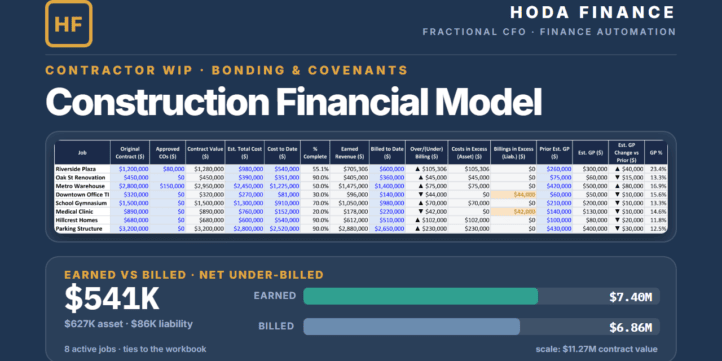
Granite Ridge Construction LLC: 8 active jobs, $11,270,000 contract value including $230,000 of approved change orders, 66.2% complete cost-to-cost. Earned revenue $7,401,306 against billings of $6,860,000 — net under-billed $541,306, comprising a $627,306 contract asset and an $86,000 contract liability. Backlog $3,868,694. Estimated gross profit $1,720,000, up $25,000 period over period, with 6 of 8 jobs eroding. Working capital $1,821,306, indicating roughly $27.3M aggregate and $18.2M single-job bonding capacity at the sample’s 15× / 10× multiples. Current ratio 2.30×, quick ratio 1.56×, debt-to-tangible-net-worth 0.83×. Current progress-billing draw $61,975 after $49,775 of retainage. Bid estimate: $199,060 direct cost → $251,811 bid at 13.0% margin after overhead.
**Specification**
14 tabs · 607 formula cells, each independently recomputed · Excel 2019 / 2021 / 365 (Windows & Mac) and Google Sheets · arithmetic and common functions only, no macros, no add-ins, no 365-only functions · calculated cells locked in Excel, inputs unlocked, no password (Google Sheets may not carry the sheet protection on import) · both editions plus a 2-page methodology PDF included in one price.
**Scope**
Covered: multi-job WIP, approved change orders, contract asset/liability, current-period revenue and EAC fade, AIA-style schedule-of-values billing with retainage, working capital and bonding capacity, four covenant ratios, change-order reconciliation, portfolio trend, integrity checks, bank/surety cover sheet. Not covered: cost-code-level job costing within a job, payroll or certified payroll, equipment depreciation, retainage receivable aging, multi-entity or joint-venture consolidation, percentage-of-completion for income tax including the look-back method, multi-currency, or a general ledger. This model sits on top of an accounting system; it does not replace one.
ABOUT THE AUTHOR
Built by Hoda Elmorshidy — Financial Controller & Fractional CFO, 9+ years in IFRS reporting, FP&A, commodity trading, CFO/board reporting, UAE VAT & Corporate Tax, and finance automation. Practitioner-grade tools, not generic templates.
DISCLAIMER
This template is an analytical and educational tool, not professional accounting, tax, financial or legal advice, and its use creates no professional relationship. Verify all figures before use in any decision. Percentage-of-completion outputs are only as good as your estimated total cost (IFRS 15.B19 / ASC 606-10-55-21). The schedule presumes revenue is recognised over time (IFRS 15.35 / ASC 606 criteria met). Bonding capacity and covenant figures are indicative planning numbers based on multiples and thresholds you enter — not a commitment, quote, or guarantee of bonding or credit, and not a surety’s underwriting. “AIA-style” refers to the schedule-of-values format only. The sample company is fictional.
LICENSE & LIABILITY
LICENSE GRANT: Single-user license for your own or your organization’s internal use. No resale, redistribution, sublicensing, or repackaging of the file or its templates.
AS IS: Provided “as is” without warranty of any kind, express or implied, including merchantability or fitness for a particular purpose.
LIMITATION OF LIABILITY: To the maximum extent permitted by law, total liability for any claim arising from this product is limited to the amount you paid for it. Not liable for indirect, incidental, or consequential losses.
NON-WAIVABLE RIGHTS: Nothing here limits rights that cannot be excluded under the consumer-protection law of your jurisdiction.
GOVERNING LAW: This purchase is governed by the terms of the platform you bought it on and by the consumer-protection law of your own country of residence. Where those permit, the limitations above apply to the maximum extent allowed.
Past or sample results are not indicative.
TRADEMARKS & NON-AFFILIATION: “AIA”, G702 and G703 are trademarks/forms of The American Institute of Architects; this product uses the schedule-of-values FORMAT only and is NOT affiliated with, endorsed by, or sponsored by the AIA. Microsoft Excel and Google Sheets are trademarks of Microsoft Corporation and Google LLC respectively. FASB (ASC) and IFRS references are for methodological attribution only.
Similar ProductsOther customers were also interested in...



 eFinancialModels
Electric Vehicle (EV) Charging Station Financial M...
With this comprehensive 5- or 10-year monthly tool, investors can assess the viability of setting up... Read more

Financial Model for Mobile App | Mobile App Busine...
The Mobile App Financial Plan Template in Excel allows you to develop financial projections when lau... Read more

 HenrySheykin
Food Truck Financial Model Excel Template
The Food Truck Financial Model helps entrepreneurs, founders, business owners, consultants, and anal... Read more

Green Hydrogen Production from Wind Energy Financi...
The Green Hydrogen from Wind Financial Model aims to comprehensively forecast a horizon of 40 years ... Read more

Simple Mutual Non-Disclosure Agreement Template
Protect your business secrets with ease using our Simple Mutual Non-Disclosure Agreement Template. S... Read more

Solar Energy Financial Model
The Solar Energy Financial Model Spreadsheet Template in Excel assists you in preparing a sophistica... Read more

 Peter Graf
The Customer-Centric Financial Model for Restauran...
Starting a restaurant without a financial plan is like driving a car blindfolded. You wouldn´t do i... Read more
You must log in to submit a review.