
0 ITEMS

Accounting for Leases & Right-of-Use Assets Template
User friendly template for the classification and analysis of Finance & Operating Leases.


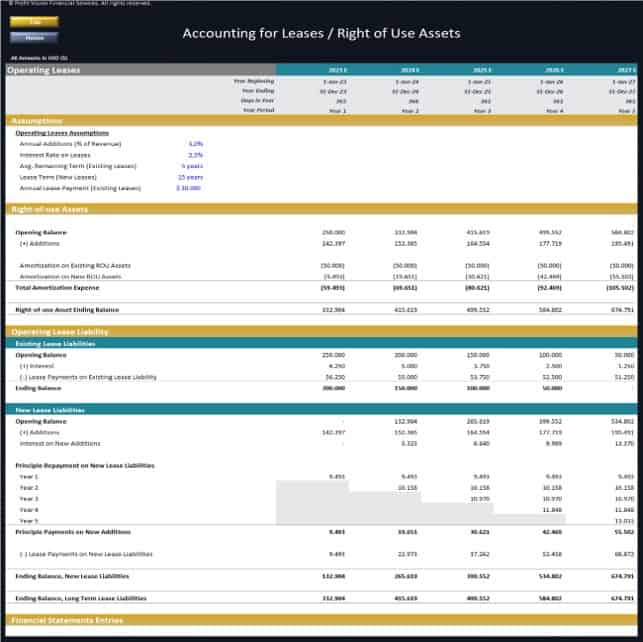


Leasing is important within many areas of the business as it doesn’t require large initial investments. It’s also beneficial for businesses in terms of cash flow, flexibility, convenience, and scalability. Start-ups or new small businesses often look for leasing options because their resources are limited, and the owners don’t want to invest so much money in acquiring assets to support the business in the beginning.
A leasing contract is an agreement in which a business has the right to use assets in return for regular payments over a particular length of time. Finance lease and operating lease are the two common accounting methods for asset leasing and are used for different purposes.
• Finance Leases
A finance lease is typically a full pay-out agreement; this means that the sum of the rentals includes the full capital cost of the asset plus the interest accrued.
Leases classified as ‘finance’ are counted as debt in a lessor’s finances and are treated like assets on a company’s balance sheet. This means that they depreciate and incur interest over time. Finance leases require the lessee to recognize interest expense and amortization expense, which means expenses will be higher at the beginning of the lease and decrease over time.
At the end of the lease, you can either hand the asset back and upgrade to the latest technology or extend the lease period for continued use of the current asset. Finally, ownership options may be available once the lease has been terminated at the end of the minimum lease term.
Under IFRS, lease classification has been abandoned as a practice, and all leases are treated as “Finance” leases.
Under ASC 842, Finance leases must now have at least one of the following conditions in their contract to be recognized as compliant with the US GAAP:
1. A transferal of ownership of an asset to the lessee at the end of the term of the initial lease.
2. The lessee is reasonably certain that they will exercise a purchase option at the end of the term of the lease.
3. The leased asset has no alternative use to the lessor at the end of the lease.
4. The lease term is a major part of the economic life of the underlying asset (most organizations use 75% to determine the “major part”).
5. The present value of lease payments is substantially all of the fair value of the leased asset (most organizations continue to use 90% to determine “substantially all”).
• Operating Leases
An operating lease is a contract where an owner of an asset, referred to as the lessor, gives someone, the lessee, access to that asset.
Typically, the lessee is able to use the asset for a period of time, which is less than the economic life of the asset, in exchange for the lessee making payments for an agreed-upon period of time. Operating leases are defined as a contract that permits the use of a certain asset without transferring the ownership right of that asset for any less than a major part of the asset’s life.
Any lease that does not cover the 5 conditions outlined in the Finance Leases above is classified as an Operating Lease.
This template is a useful tool assisting users in classifying the lease as Finance or Operating, performing an analysis of each lease type, and calculating the entries that should be recorded in the Financial Statements.
Template Contents:
• Lease Classification Tool
• Finance Leases Analysis incl. Existing and New Leases and Financial Statements entries
• Operating Leases Analysis incl. Existing and New Leases and Financial Statements entries
• Financial Statements (3-statement model) with Actual Figures and a 5-Year Forecast, including the Leases entries on Income Statement, Balance Sheet, and Cash Flow.
Help & Support
Committed to high quality and customer satisfaction, all our templates follow best-practice financial modeling principles and are thoughtfully and carefully designed, keeping the user’s needs and comfort in mind.
No matter if you have no experience or are well versed in finance, accounting, and the use of Microsoft Excel, our professional financial models are the right tools to boost your business operations!
If you, however, experience any difficulty while using this template, please feel free to contact us for assistance.
If you need a template customized for your business requirements, please e-mail us and provide a brief explanation of your specific needs.
Similar ProductsOther customers were also interested in...



 Giorgos
Advanced Financial Model with DCF and Valuation
Dynamic 10-Year Financial Model, suitable for any type of business, supporting strategic planning, i... Read more

Startup Company Financial Model – 5 Year Fin...
Highly-sophisticated and user-friendly financial model for Startup Companies providing a 5-Year adva... Read more
Budgeting & Forecasting Model Template
Budgeting & Forecasting Template suitable for either a Trade or Service company in any type of i... Read more

General Financial Models – All-in-One Bundle
A collection of templates suitable for various types of businesses/industries, covering major accoun... Read more

Three Statement Financial Model – 5 Year For...
A 3 statement model linking the income statement, balance sheet, and cash flow statement into one dy... Read more
Leveraged Buyout (LBO) Financial Model
Advanced Financial Model presenting a potential acquisition of a public or private company using a s... Read more

Mergers & Acquisitions (M&A) Financial Mod...
M&A financial model providing transaction analysis, valuation, deal financing, synergies, and ac... Read more
From Trial Balance to Business Valuation – M...
Management Accounts Template, providing full reporting cycle and mapping between accounting and fina... Read more

Cap Tables & Investor Returns Model
User-friendly Cap Table Model for a startup company or early-stage venture including multiple rounds... Read more
Annual Operating Plan – Actual vs Budget Tem...
User friendly template enabling user to prepare an operating budget to project company’s performan... Read more
You must log in to submit a review.