0 ITEMS

Buy a Financial Model Template or Build One: What Is Faster?
A ready-made financial model template is usually the faster route to a working model, because its statements, formulas and layout already exist, while a scratch build wins mainly when a template would need rewriting rather than filling in. Either route also needs testing before readers can trust the result, so checking time belongs in the schedule for both.
Key Takeaways
- A template is usually the faster route to a working model, excluding the time to find and learn it, because its structure already exists.
- Small Business Administration guidance for business plans suggests five years of forecast statements, a useful scope target for either route.
- Building from scratch can still win when the revenue logic is unusual or a template would need rewriting rather than filling in.
- A 2015 review of spreadsheet audits found errors in most spreadsheets studied, so checking time belongs in every speed estimate.
- Choose by scope, fit and review time: match the template to the business, then test it with scenarios before anyone relies on it.
What does a working financial model have to contain?
A working model is one that a lender, investor or manager can read and rely on, and public guidance describes what that takes. The U.S. Small Business Administration’s guidance for business plans says to include forecasted income statements, balance sheets, cash flow statements and capital expenditure budgets, to provide a financial outlook for the next five years, and to use quarterly or even monthly projections for the first year, according to its business plan guide.
For a model that will go into a business plan for lenders or investors, that list is a useful scope target. A model that covers three statements and a capital expenditure budget across five years, with a more detailed first year, is a large file, and a reader who wants to compare a cautious case with an optimistic one needs the inputs separated from the calculations. Whichever route is chosen, the file should reach that scope before the first reader opens it, so the real question is how quickly each route gets there.
Why is a template usually faster to a working model?
A template arrives with the layout fixed, the statements linked and the formulas written, so the buyer’s work is replacing assumptions with the business’s own numbers. A scratch build starts one step earlier: the builder designs the sheets, writes every formula, links the statements so the balance sheet balances, and only then begins entering assumptions. Each of those steps takes time before the first usable output appears.
Published surveys give no standard build time for a financial model, and durations depend on the builder’s experience and the complexity of the business, so speed is best judged by the work each route leaves undone. Only the buyer can time the first pass of mapping the business onto a template, and the steps below turn that pass into a short test. Planning surveys still show how long structured finance work can take. The Association for Financial Professionals, in a survey of corporate finance teams whose page does not state a sample size, reported that the average time required to create a budget was 8.7 weeks in 2025, against 8.5 weeks in 2022, and that organizations using structured scenario planning averaged 8.1 weeks against 9.2 weeks for the rest, in its 2026 budgeting article. That survey measures corporate budgeting rather than a startup model and does not measure template use, so it serves as context only: planning cycles take weeks, and organizations using structured scenario planning finished sooner.
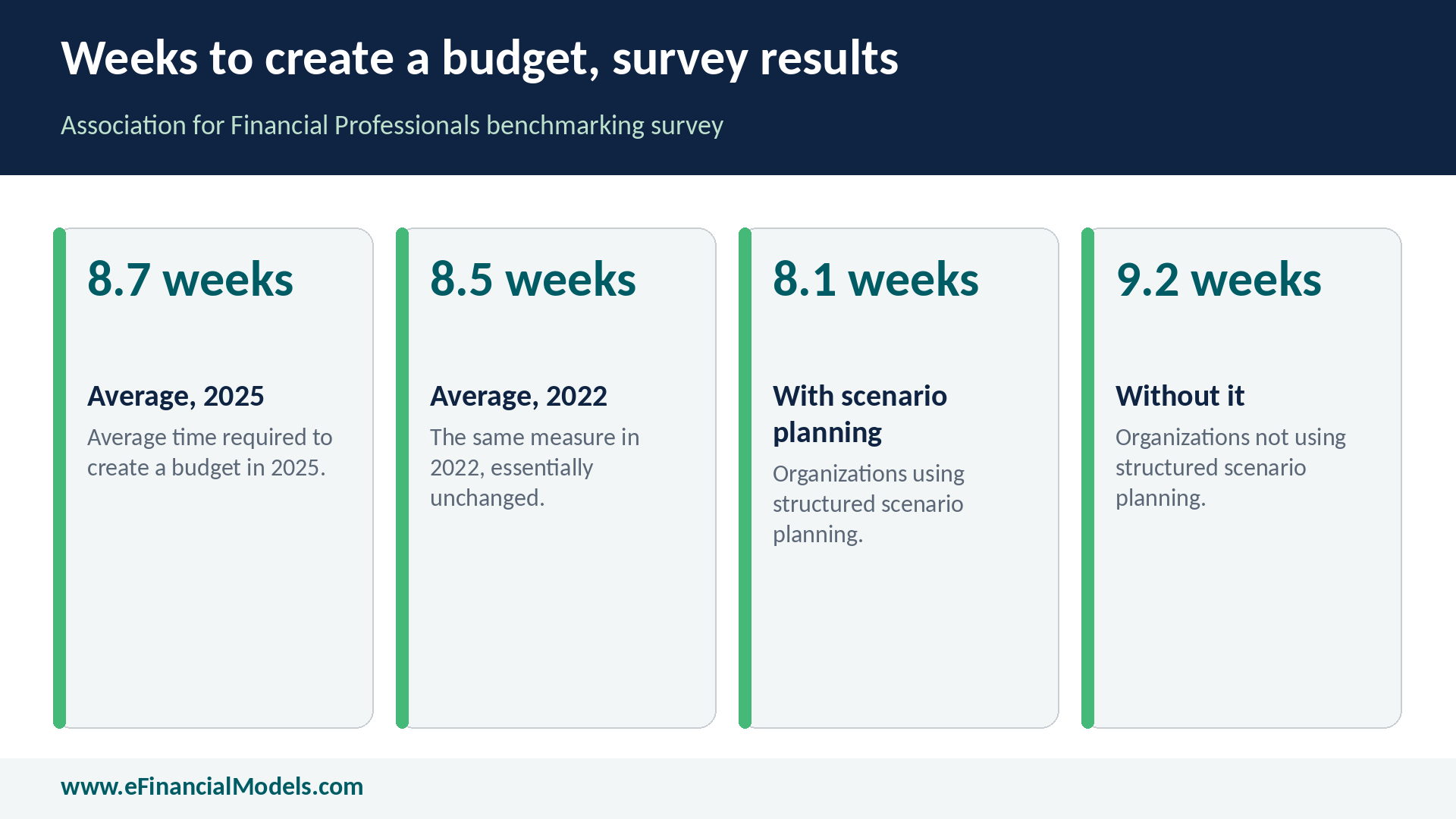
Average weeks to create a budget in the Association for Financial Professionals benchmarking survey, with and without structured scenario planning.
A template supplies a ready structure of a similar kind, though the survey does not test that. Buyers who want to test the idea cheaply can start from the free financial model templates collection and see how many rows of their own business map onto the layout.
When does building from scratch still win?
Building wins mainly when the template would have to be rewritten rather than filled in, or when a custom structure will be reused. Three cases stand out: revenue that follows unusual logic, such as milestone payments or usage tiers that no template models; a business with several legal entities or currencies that need consolidated reporting; and a builder who will reuse the same custom structure across many projects.
A simple test settles most cases. If most of the template’s input rows match facts the business already knows (as a rule of thumb, roughly two thirds, not a measured threshold), filling them in is faster than designing anything. If the revenue and cost logic must be replaced, the template becomes a scratch build with extra reading, and starting clean is quicker. The financial model category groups ready-made models by industry, which helps buyers see quickly whether their business type already has a matching structure.
Why does checking belong in the speed estimate?
Checking adds time to both routes, and it is where fast files turn into slow ones.
Spreadsheets also remain the main planning tool, so the checks matter on either route. In the 2025 benchmarking survey of 362 financial planning and analysis practitioners run by the Association for Financial Professionals, 96% of respondents used spreadsheets for planning and 93% used them for reporting on a daily or weekly basis, according to its technology and data report.
A 2015 review by researcher Raymond Panko, which collected audits of real spreadsheets, reported that “Collectively, these studies found errors in 94% of the spreadsheets studied”, and that commercial spreadsheet inspections found cell error rates of 1.2%, 2.2% and 2.5%, according to the paper on spreadsheet errors. The review is older than most sources here, so it supports a general caution about spreadsheets, not a precise error rate for any one template.
The same caution applies to public bodies. The UK National Audit Office wrote in 2023 that “Errors in government models have directly caused significant losses of public money and delays to critical public programmes”, in its guide to quality assurance of models.
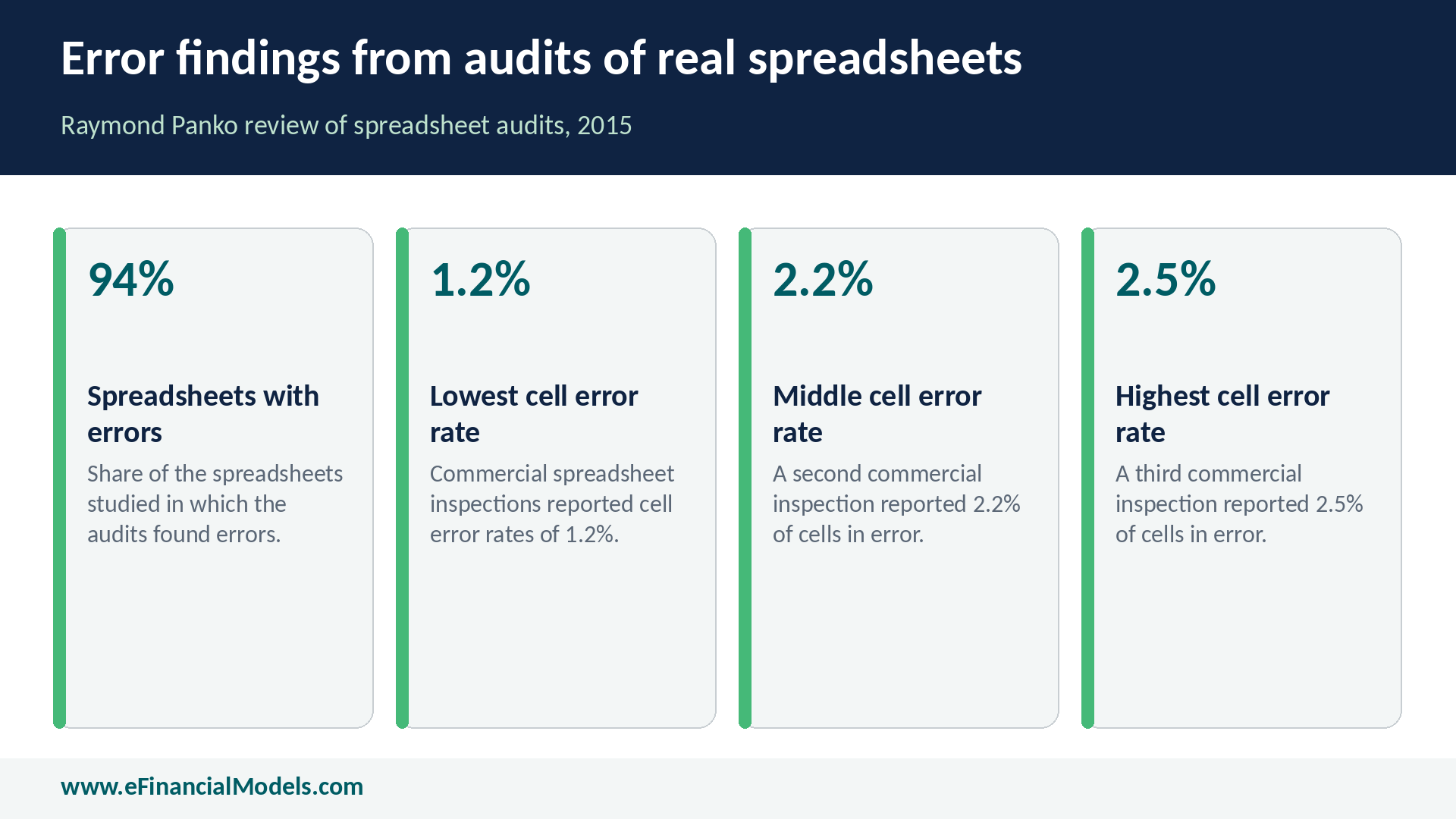
Error findings from Raymond Panko’s 2015 review of spreadsheet audits, shown as share of spreadsheets and share of cells.
A template moves the risk of formula mistakes to its author and does not remove input mistakes or a poor fit, so the same checks apply to both routes. Changing one input and watching the outputs move, confirming that the balance sheet balances in every period, and recomputing one period by hand are quick checks that catch many common faults.
What is the fastest way to a trusted model?
The fastest trusted model comes from a short, fixed sequence that treats the checks as part of the schedule.
- List what readers need: which statements, how many years, and which scenarios.
- Map the business onto a template: count how many input rows already match.
- Decide by fit: fill in the template when roughly two thirds of the rows match, build when the logic must be replaced.
- Test and document: run best, base and worst cases, then record every assumption.
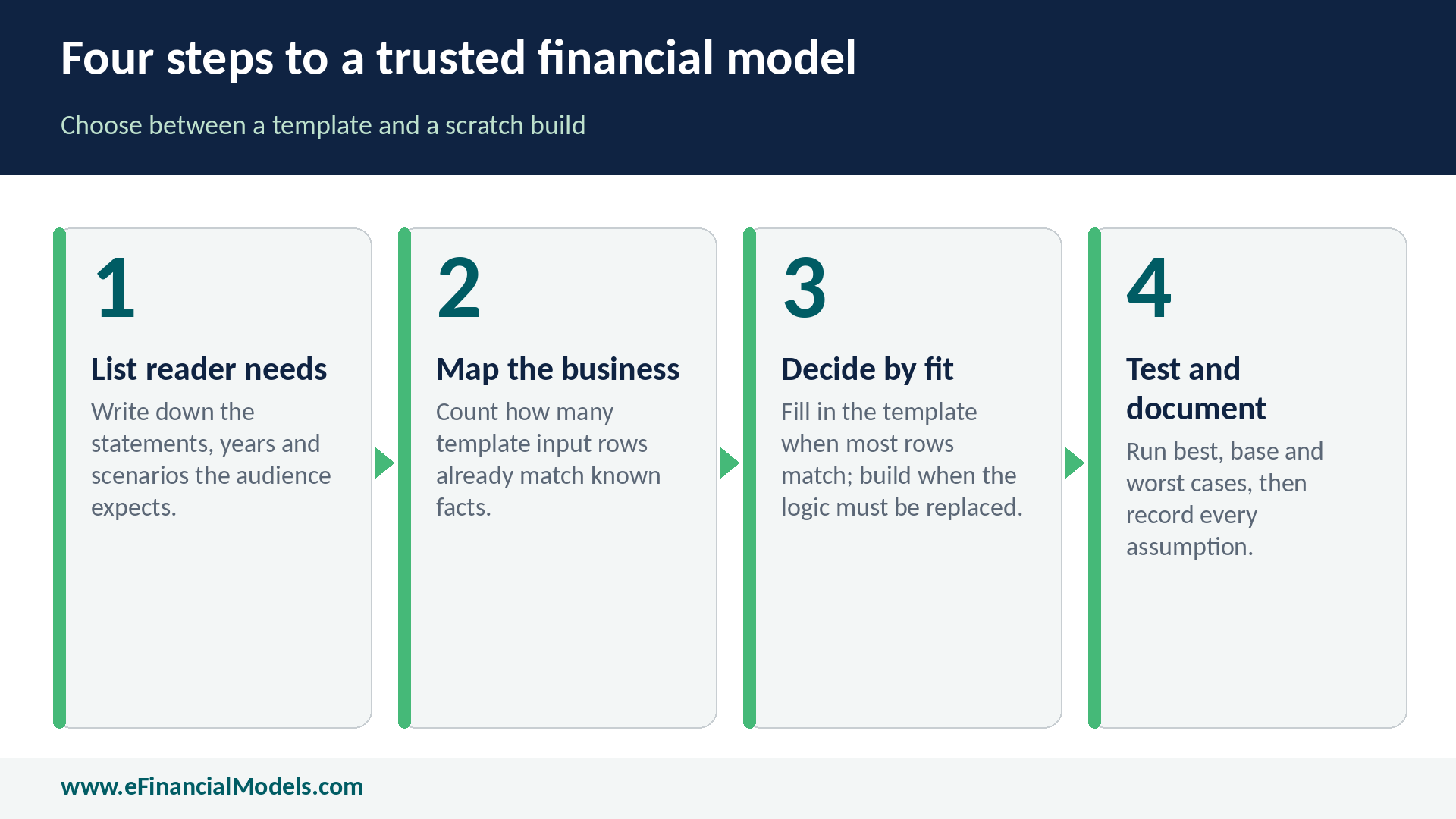
A four-step sequence that puts the audience first and the checks last, so the schedule includes review time.
Conclusion
A template is the faster path to a working model whenever the business fits its structure, and a scratch build earns its extra time mainly when the logic is unusual, entities must be consolidated, or the structure will be reused. Founders weighing a ready-made option can look at the eFinancialModels SaaS Business Financial Model, which its product page says “comes pre-filled with an example forecast of a SaaS business to illustrate clearly how the spreadsheet works”, and follow the four steps above before sharing any model.
Frequently Asked Questions
Can a template be customised without breaking it?
Yes, when changes follow a few habits. Inputs belong on their own sheet, new rows should be created by copying an existing row so formulas travel with it, and formula cells should never be typed over with fixed numbers. After each batch of edits, a balance check and one changed input confirm that the links still hold. Heavy restructuring is the warning sign, because that is when a buyer is effectively rebuilding the file.
Does buying a template make the numbers trustworthy?
No. A template shows how the numbers connect, but the assumptions inside it still belong to the buyer, and a poor fit can hide wrong logic behind a tidy layout. Trust comes from the buyer’s own review: tracing a few results back to inputs, trying extreme assumptions to see whether outputs react sensibly, and asking a second person to read the file before any lender or investor sees it.
Who should own the model after the first draft?
One named person should own it, because a model with several editors drifts quickly. The owner keeps the assumptions list current, records each change with a date, and decides when the file is updated after actuals arrive. Handing the model over then means passing on the file, the assumption notes and the change record together, so the next owner starts from a documented state rather than from guesswork.
Is a free template enough to start with?
For a simple case, often yes. A free template suits a single product line, a short horizon and a reader who wants only a rough picture, and it also works as a cheap way to learn what a full model contains. A fundraising round or a bank application usually needs more detail, so the free file becomes a learning draft, without the five-year scope described earlier, before a fuller model replaces it.