0 ITEMS

AI-Enabled Modeling Cuts Founder Build Time by 80%

AI-enabled modeling is giving early-stage founders a genuine shortcut to investor-ready financial models, but only if you know where the tools help and where they break.
Key Takeaways
- AI tools like ChatGPT and Claude can reduce the time to build a first-draft three-statement model from 20+ hours to under 4 hours for most founders.
- 5 core models every founder needs: three-statement model, unit economics, cash runway, fundraising scenarios, and sensitivity analysis.
- Prompt quality determines output quality: a vague prompt produces a generic template; a context-rich prompt produces a model specific to your business.
- AI makes predictable errors in financial logic, including circular references in debt schedules, incorrect revenue recognition timing, and missing working capital adjustments.
- Financial modeling consultants charge $150 to $400 per hour, against Bureau of Labor Statistics median pay of $101,910 a year for an in-house financial analyst; AI subscriptions run $20 to $200 per month, making the cost case clear for early drafts.
- Investors still expect Excel-based deliverables with auditable formulas; AI output must be validated and reformatted before any pitch.
- The strongest AI-assisted workflow combines AI for structure and formula generation with human review for assumptions and logic.
Why Founders Are Turning to AI for Financial Modeling
Building a financial model used to require either a finance background or a $5,000 to $15,000 engagement with a consultant. AI changes that equation significantly, though not completely.
Financial planning is routinely one of the hardest operational problems early-stage founders face, and it is rarely the skill they arrived with.
Most founders are product or sales people first. They understand their business deeply but struggle to translate that understanding into the three-statement model (income statement, balance sheet, and cash flow statement linked together) that investors expect to see.
AI tools now handle the scaffolding: generating formula structures, suggesting line items, and running scenario logic. What used to take a junior analyst two weeks now takes a founder two days, with the right workflow. The U.S. Bureau of Labor Statistics Occupational Outlook Handbook for financial analysts puts median pay at $101,910 per year, or $48.99 per hour, for in-house talent, while boutique advisory firms typically quote $150 to $400 per hour for external modeling work.
A $20 monthly ChatGPT Plus subscription looks compelling against that baseline.
The honest caveat: AI does not understand your business. It understands patterns in text. That distinction matters enormously when you’re building assumptions.
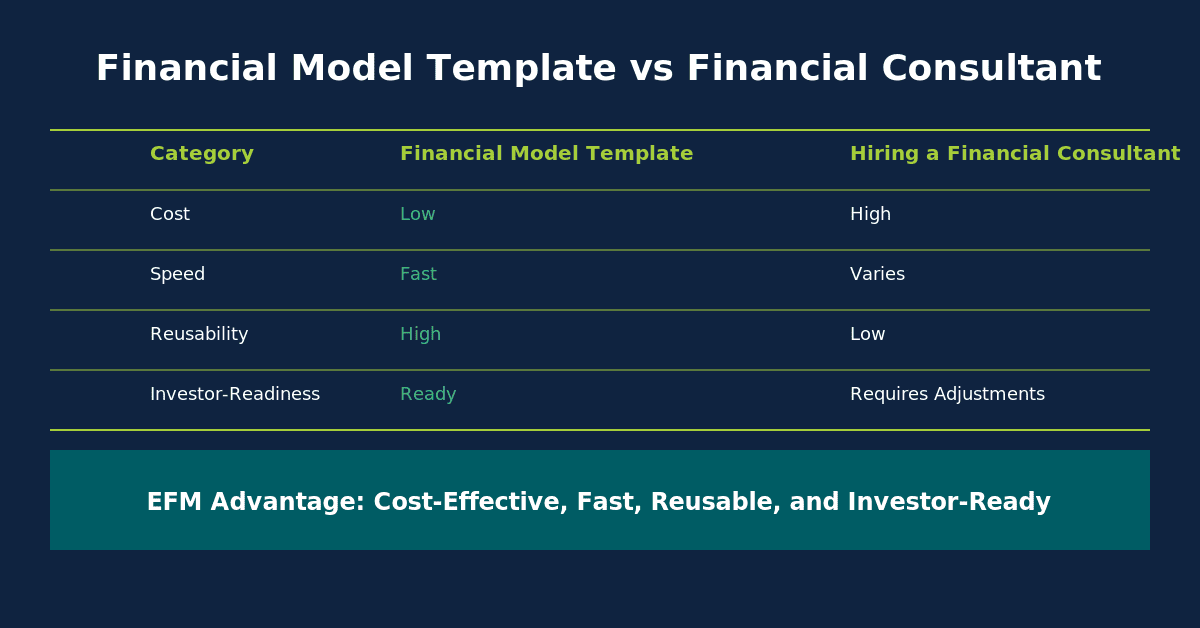
At $20/month for ChatGPT Plus versus $150-$400/hour for a consultant, the cost case for AI-assisted first drafts is compelling for pre-seed founders.
The 5 Financial Models Every Founder Needs
Every investor-ready financial package covers five core models, and AI accelerates each one differently.
Three-Statement Model: The integrated income statement, balance sheet, and cash flow statement is the foundation of any fundraising package. AI excels at generating the structural skeleton: row labels, formula logic connecting net income to retained earnings, and depreciation schedules. It struggles with the balance sheet plug (the cell that forces assets to equal liabilities plus equity) and often produces circular references in interest expense calculations. Excel allows up to 64 nested levels of functions in a single formula, per Microsoft’s Excel specifications and limits reference.
AI-generated formulas sometimes exceed practical nesting depth unnecessarily.
Unit Economics Model: Unit economics measures the profitability of a single customer or transaction. Key metrics include Customer Acquisition Cost (CAC, the total sales and marketing spend divided by new customers acquired), Lifetime Value (LTV, the average revenue per customer multiplied by gross margin and divided by churn rate), and the LTV:CAC ratio. AI can generate these formulas instantly if you provide your input data.
Cash Runway Model: Runway is the number of months your current cash balance covers at your current burn rate. AI builds a 24-month rolling cash model in minutes. The critical human input is the burn rate assumption, which AI cannot know without your actual expense data.
Fundraising Scenario Model: This model shows investors what happens to your financials under three scenarios: base, bull, and bear. AI handles the scenario-switching logic well using IF statements and named ranges.
Sensitivity Analysis: Sensitivity analysis (also called a data table in Excel) shows how your key output, usually net income or runway, changes as you vary two input assumptions simultaneously. Microsoft’s guide to calculating multiple results by using a data table notes that a data table cannot accommodate more than two variables, one for the row input cell and one for the column input cell.
AI generates the table structure and you supply the assumption ranges.
For structured templates that work directly with AI-generated outputs, the financial modeling resources at EFM give you Excel frameworks that are already formatted for investor review.
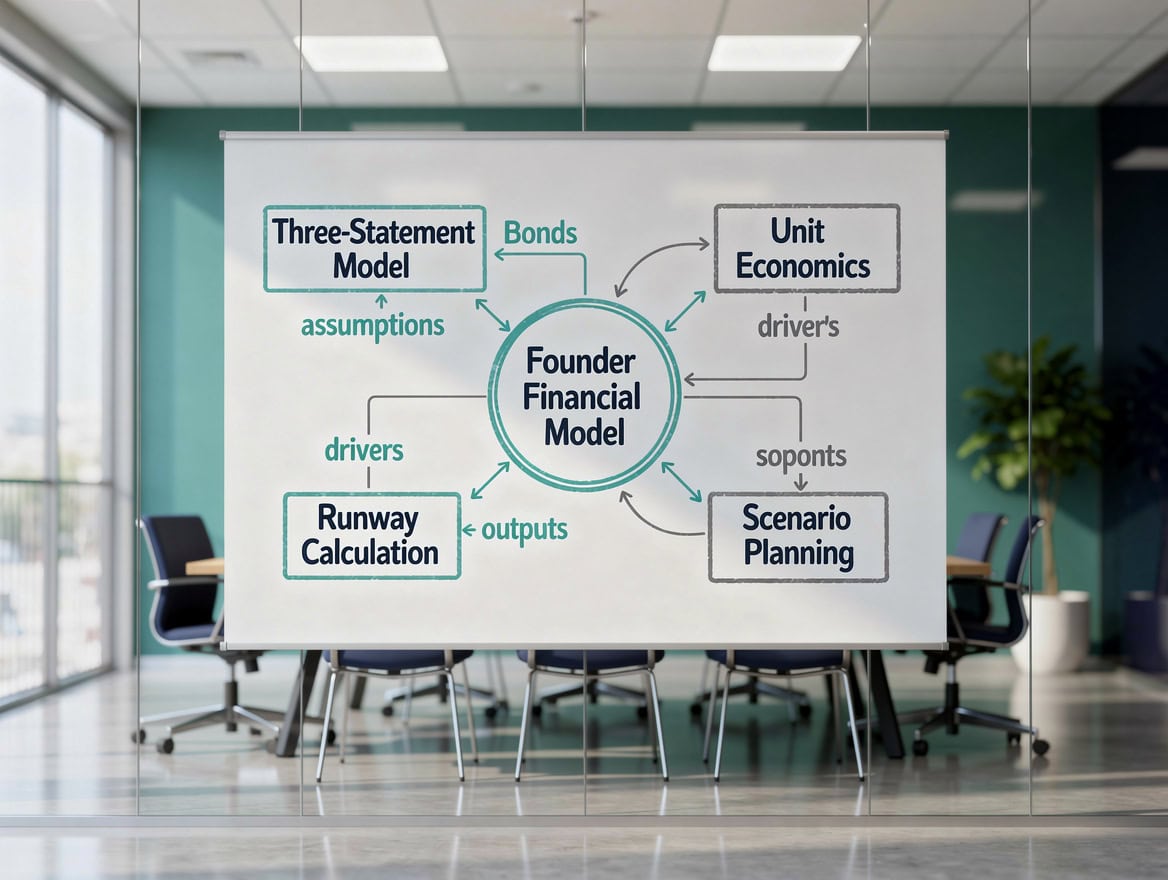
The five core models form an interconnected system: unit economics feed the three-statement model, which drives the cash runway and scenario outputs.
AI Tools for Financial Modeling: A Founder’s Comparison
Not all AI tools perform equally on financial modeling tasks. Here is a direct comparison of the four most relevant options for founders.
| Tool | Best For | Formula Output | Export | Monthly Cost |
|---|---|---|---|---|
| ChatGPT Plus | Structure + formulas | Strong | Copy/paste to Excel | $20 |
| Claude (Artifacts) | Long model logic | Strong | Rendered table | $20 |
| Microsoft Copilot | Excel integration | Native | Direct to .xlsx | $30 |
| Runway (fintech) | SaaS metrics | Moderate | CSV/Excel | $200+ |
ChatGPT Plus with Advanced Data Analysis (formerly Code Interpreter) lets you upload a CSV of your actuals and ask it to build projections. It runs Python in the background and can output a downloadable Excel file. This is the most versatile option for founders who want to go from raw data to a draft model.
Claude with Artifacts renders financial tables directly in the chat window. It handles longer context windows, which matters when you’re pasting in 12 months of transaction data. Claude tends to produce cleaner narrative explanations of its assumptions, which helps founders understand the logic.
Microsoft Copilot in Excel integrates directly into the spreadsheet. You highlight a range and ask it to write a formula. For founders already working in Excel, this is the lowest-friction entry point. It does not generate full model structures from scratch as effectively as ChatGPT.
Runway and Pigment are purpose-built financial planning tools with AI features layered on top. They cost significantly more but offer better audit trails and collaboration features. They make more sense at Series A and beyond, when you have a finance team.

ChatGPT and Claude handle full model generation; Microsoft Copilot integrates directly into Excel; purpose-built tools like Runway suit later-stage teams.
Step-by-Step: Using AI to Build Your First Financial Model
The fastest path from zero to a working draft follows four steps, each with a specific AI prompt you can copy.
Step 1: Define your model structure. Start with this prompt:
“I’m building a SaaS startup financial model for a B2B product with a $500/month average contract value, 15% monthly churn, and a 6-month average sales cycle. Generate a three-statement model structure with monthly columns for 36 months. Include revenue, COGS, gross profit, operating expenses broken into sales, marketing, R&D, and G&A, EBITDA, and net income. Then link net income to a cash flow statement and balance sheet.”
Step 2: Input your actual data. Paste your last 12 months of revenue and expense data as a table in the chat. Then prompt:
“Here are my actual financials for the last 12 months paste table. Use these as the base period. Project forward 24 months using the following assumptions: 10% monthly revenue growth in months 1-12, 7% in months 13-24. Keep COGS at 22% of revenue. Grow headcount by 2 people per quarter at an average fully-loaded cost of $120,000 per year.”
Step 3: Build your unit economics block. Prompt:
“Calculate my LTV:CAC ratio. My CAC is $3,200 (total sales and marketing spend divided by new customers last quarter). My average monthly revenue per customer is $500. My gross margin is 78%. My monthly churn is 3.5%. Show the formula and the result.”
Here’s the math: LTV = ($500 × 0.78) / 0.035 = $390 / 0.035 = $11,143. LTV:CAC = $11,143 / $3,200 = 3.5x. A ratio above 3x is generally considered healthy by SaaS investors.
Step 4: Generate scenarios. Prompt:
“Create three scenarios for my 24-month model: Base (10% monthly growth), Bull (15% monthly growth), Bear (5% monthly growth). Show the ending cash balance and runway in months for each scenario, assuming I raise $1.5M at month 1.”
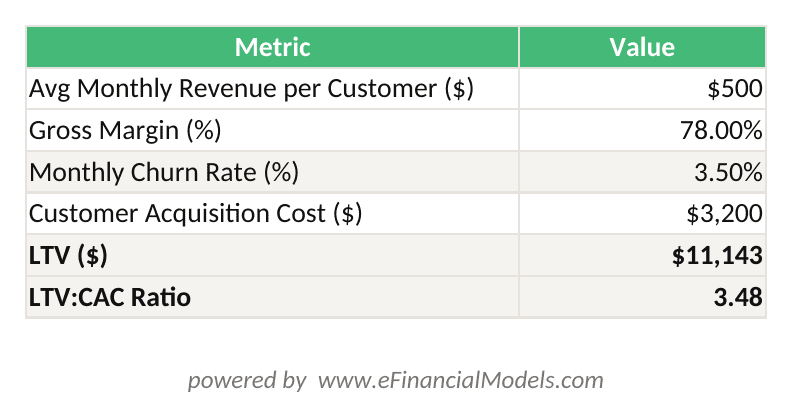
LTV:CAC = ($500 × 78%) / 3.5% / $3,200 = 3.5x. Base scenario runway: 18 months. Bull scenario: 24+ months. Bear scenario: 12 months.
For forecasting workflows that integrate with these AI outputs, EFM’s template library provides pre-built Excel structures you can populate with AI-generated numbers.
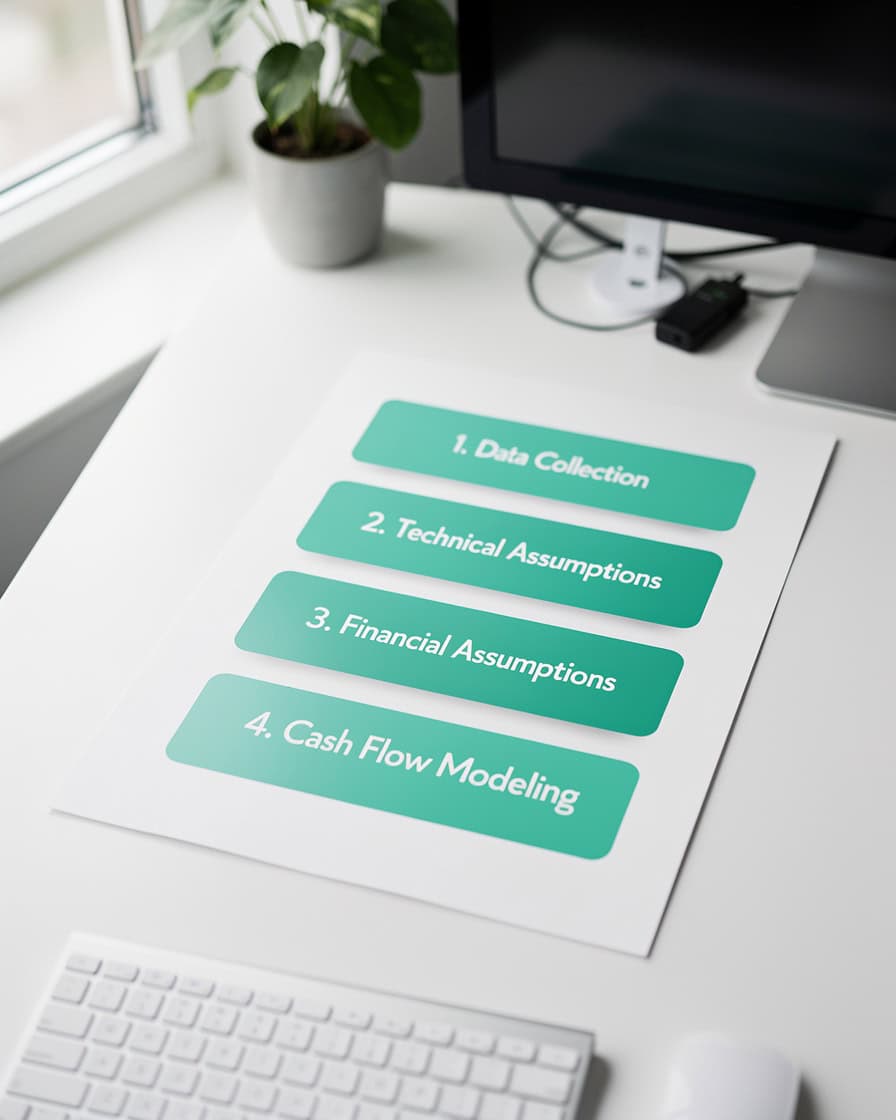
The four-step AI modeling workflow moves from structure to data to unit economics to scenarios, with each step building on the last.
Where AI Excels and Where It Falls Short
AI is genuinely strong at financial modeling tasks that involve pattern recognition and formula generation. It falls short on tasks that require business judgment or accounting precision.
Where AI performs well:
- Generating formula structures for standard financial statements
- Writing Excel formulas for common calculations (NPV, IRR, PMT, VLOOKUP)
- Creating scenario-switching logic with IF statements
- Suggesting relevant line items for a given business model
- Explaining what a formula does in plain English
Where AI fails predictably:
Circular references in debt schedules. When interest expense depends on the ending debt balance, and the ending debt balance depends on interest expense, you get a circular reference. AI often generates this error without flagging it. Fix: use a prior-period balance for interest calculations, or enable iterative calculation in Excel settings.
Incorrect revenue recognition timing. AI frequently books revenue in the wrong period, especially for subscription businesses with annual contracts paid upfront. Fix: always specify your revenue recognition policy explicitly in your prompt.
Missing working capital adjustments. AI-generated cash flow statements often omit changes in accounts receivable, accounts payable, and deferred revenue. These can swing your cash position by tens of thousands of dollars. Fix: manually add a working capital section and verify each line.
Hallucinated industry benchmarks. AI will confidently state that “SaaS companies typically have 70-80% gross margins” without citing a source. Sometimes that’s right; sometimes it’s wrong for your specific sub-sector. Fix: verify every benchmark against a named source like the SaaS Capital Index or Bessemer Venture Partners’ State of the Cloud report.

Circular references in debt schedules and missing working capital adjustments are the two most common AI-generated model errors founders encounter.
Preparing Your Business Data for AI Model Generation
The quality of your AI model output depends almost entirely on the quality of the context you provide. Garbage in, garbage out applies more strictly to AI than to any other tool.
Before you open ChatGPT or Claude, prepare these five data inputs:
- 12 months of actuals: Export your P&L from QuickBooks, Xero, or your accounting system as a CSV. Clean it so each row is a line item and each column is a month.
- Customer cohort data: Number of new customers per month, churn per month, and average revenue per customer. This is the raw material for unit economics.
- Headcount plan: Current team size, planned hires by quarter, and average fully-loaded cost per role (salary plus benefits plus payroll taxes, typically 1.25x to 1.35x base salary).
- Capital structure: Current cash balance, any existing debt, and your target raise amount and timing.
- Key business assumptions: Your growth rate thesis, pricing strategy, and any known step-changes in cost structure (like a new office lease or a major software contract).
With these five inputs structured as tables, a single well-crafted prompt produces a model that reflects your actual business rather than a generic SaaS template.

Preparing these five data inputs before prompting AI is the single biggest factor in output quality.
From AI Output to Investor-Ready Model: The Validation Process
AI output is a first draft, not a finished deliverable. Every AI-generated model requires a structured validation pass before it goes to an investor.
Run through this 6-point checklist:
- Balance sheet balances: Assets must equal liabilities plus equity in every period. If they don’t, find the plug error.
- Cash flow ties to balance sheet: The ending cash on your cash flow statement must match the cash line on your balance sheet.
- Revenue builds correctly: Trace revenue from your unit economics inputs (new customers × ACV) to your income statement. They must match.
- No hardcoded numbers in formula cells: Every assumption should live in a dedicated input section. Formula cells should reference those inputs, not contain raw numbers.
- Scenarios switch cleanly: Test each scenario toggle and confirm that all downstream cells update correctly.
- Formatting matches investor expectations: Use consistent number formats, clear section headers, and a cover tab with your key metrics summary.
The KPIs and performance tracking templates at EFM include pre-built validation checks that catch the most common AI-generated errors automatically.
Cost, Time, and Accuracy: The Real Trade-Offs
AI-enabled modeling delivers a clear time advantage but introduces accuracy risks that require human oversight to manage.
A traditional financial modeling engagement with a boutique CFO advisory firm runs $5,000 to $20,000 for a fundraising-ready model, based on typical consulting rates. The same model built with AI tools and a founder’s time investment costs roughly $20 to $200 in software plus 8 to 20 hours of founder time. The average small business owner values their time at $50 to $150 per hour, making the total AI-assisted cost $400 to $3,000 for a comparable output.
The accuracy trade-off is real. AI-generated models require 2 to 4 hours of validation work to catch formula errors and logic gaps. Founders without accounting backgrounds will miss some errors. The practical recommendation: use AI for the first 80% of the build, then have a CFO advisor or experienced operator review the model for 2 to 3 hours before any investor meeting. That review costs $300 to $900 and catches the errors that matter.
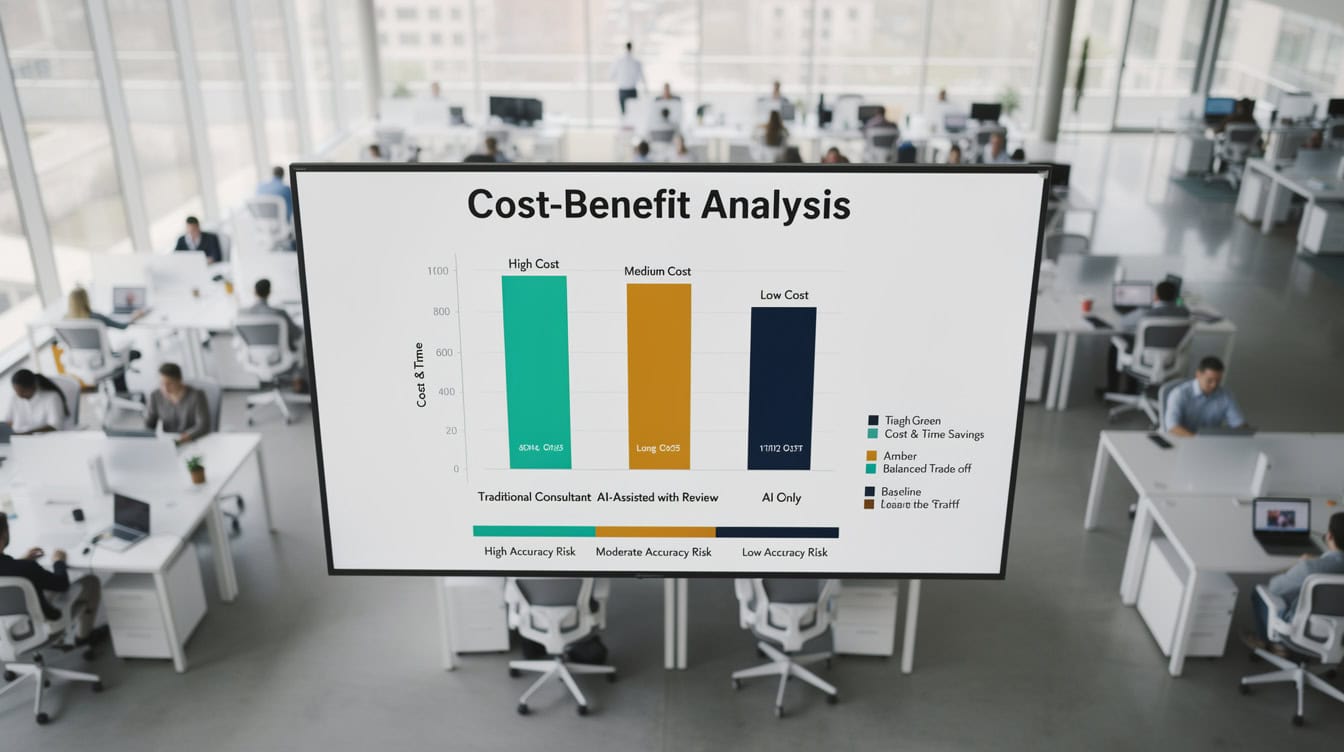
The AI-assisted with review approach delivers 80% of the cost savings while managing the accuracy risks that pure AI modeling introduces.
How Investors View AI-Generated Financial Models
Venture capitalists and angel investors care about the quality of your assumptions, not the tool you used to build the model. That said, they do have specific expectations about format and auditability.
Most early-stage investors (pre-seed through Series A) expect an Excel or Google Sheets model with visible, auditable formulas. A PDF export or a screenshot of an AI-generated table is not sufficient. The model must be interactive: investors want to change your growth rate assumption and see how runway changes.
Seed-stage valuations and check sizes shift every quarter, so it is worth checking the current benchmarks in the PitchBook-NVCA Venture Monitor before you lock in the raise assumptions in your model.
Investors at this stage write checks large enough that they will spend real time in your model. It needs to hold up to scrutiny.
The strongest framing when presenting an AI-assisted model: “I used AI to generate the structure and formula logic, then validated every assumption against our actual data and had our fractional CFO review the output.” That framing signals resourcefulness without overstating AI’s role.
For forecasting models that are already formatted to investor standards, EFM’s template library gives you the Excel framework that passes that scrutiny.

Investors evaluate the quality of your assumptions and the auditability of your formulas, not the tool you used to build the model.
Frequently Asked Questions
Can ChatGPT build a complete financial model from scratch?
ChatGPT can generate a complete structural draft of a three-statement financial model, including formula logic, in a single session. However, “complete” means structurally complete, not assumption-complete. The model will contain placeholder growth rates, generic cost ratios, and industry benchmarks that may not match your business. You must replace every assumption with your actual data. ChatGPT Plus with Advanced Data Analysis can also accept a CSV upload of your actuals and build projections from real numbers, which produces a significantly more useful output than a prompt-only session. Plan for 4 to 8 hours of total work: 1 to 2 hours prompting, 2 to 4 hours validating, and 1 to 2 hours formatting for investor presentation.
What is the best AI prompt for building a startup financial model?
The best prompts are specific about business model, metrics, and time horizon. A strong prompt includes: your revenue model (subscription, transactional, marketplace), your current monthly revenue and growth rate, your key cost drivers (headcount, COGS percentage, key vendor contracts), your target raise amount, and the number of months you want to model. Example: “Build a 36-month monthly financial model for a B2B SaaS company with $45,000 MRR growing at 8% per month. COGS is 20% of revenue. I have 12 employees at an average fully-loaded cost of $110,000 per year and plan to hire 2 people per quarter. Show revenue, gross profit, operating expenses, EBITDA, and ending cash balance assuming a $2M raise at month 3.”
How accurate are AI-generated financial models?
AI-generated models are structurally accurate roughly 70 to 80 percent of the time for standard business models. The most common errors are circular references in debt and interest calculations, incorrect cash flow timing for deferred revenue, and missing working capital line items. These errors are fixable but require someone who understands basic accounting to catch them. For non-standard business models (marketplaces, hardware, biotech), accuracy drops significantly because AI has less training data for those structures. Always run the 6-point validation checklist described above before sharing any AI-generated model with an investor.
Do investors accept AI-generated financial models?
Investors accept models that are accurate, auditable, and built on defensible assumptions. They do not care whether you used AI, Excel, or a consultant to build the model. What they do care about is whether the formulas are visible and editable, whether the assumptions are grounded in your actual business data, and whether you can explain every line item. An AI-generated model that has been properly validated and formatted in Excel is indistinguishable from a consultant-built model. The risk is presenting an AI-generated model that has not been validated: investors who find formula errors or circular references will lose confidence in your financial judgment, regardless of how the model was built.
What financial data do I need before using AI for modeling?
You need five categories of data before prompting an AI tool: 12 months of actual P&L data (revenue and expenses by month), customer cohort data (new customers, churned customers, and average revenue per customer per month), headcount and compensation data (current team plus planned hires), your current cash balance and any existing debt, and your key business assumptions (pricing, growth rate thesis, and any known cost step-changes). Without this data, AI produces a generic template that requires so many manual adjustments it would have been faster to start from a pre-built Excel template. Prepare your data as clean tables before you open any AI tool.
How long does it take to build a model with AI versus without?
A founder with no finance background typically spends 40 to 80 hours building a first financial model from scratch using online tutorials and Excel. With AI assistance and a structured workflow, that same founder can produce a comparable draft in 8 to 20 hours. The time savings are largest in the structural setup phase (generating row labels, formula logic, and scenario switches) and smallest in the assumption-setting phase (which still requires business judgment). A founder with some finance background who uses AI effectively can produce a fundraising-ready model in 4 to 8 hours, compared to 10 to 20 hours without AI. The validation step adds 2 to 4 hours regardless of how the model was built.
When should I hire a financial expert instead of using AI?
Hire a human financial expert when any of these conditions apply: you are raising a Series A or later round where investors will conduct detailed financial due diligence; your business model is non-standard (hardware, biotech, marketplace with complex take rates); you have existing debt covenants that require specific accounting treatment; or you have found errors in your AI-generated model that you cannot diagnose yourself. For pre-seed and seed rounds, AI-assisted modeling with a 2 to 3 hour fractional CFO review is typically sufficient. The inflection point is usually around $2 million to $5 million in funding, where the cost of a modeling error in investor negotiations exceeds the cost of a full professional engagement.
Conclusion
AI-enabled modeling is the most significant shift in founder financial planning in a decade. It does not replace financial expertise, but it removes the blank-page problem and compresses the build time from weeks to days. The founders who use it most effectively treat AI as a co-pilot for structure and formula generation, then apply their own business judgment to every assumption.
The workflow is straightforward: prepare your data, prompt with specificity, validate against the 6-point checklist, and format for investor review. The tools are affordable and accessible today.
I recommend downloading the financial modeling templates from EFM as your starting framework. These Excel structures are already formatted to investor standards and designed to work directly with AI-generated outputs, so you spend your time on assumptions rather than formatting.