0 ITEMS

Acquisition vs Startup Financial Models: A Buyer’s Guide

Yes, templates built for buying an existing business exist, and they differ from startup models because they begin with a seller’s historical results, a purchase price and a financing package instead of a blank forecast. A buyer should pick a model that handles price, lender requirements and earnouts together.
Key Takeaways
- An acquisition model starts from the seller’s historical results and a purchase price, while a startup model starts from forecast assumptions.
- A buyer should model the whole deal: price, financing, seller terms and the cash available to repay debt in year one.
- Government-backed lending adds an equity injection and a lender cash-flow test that startup templates rarely include.
- An earnout ties part of the price to future results, so the model needs a separate scenario-based line for contingent payments.
- Compare templates on three tests: a sources and uses schedule, a debt schedule and an earnout schedule.
Is there a template for buying an existing business?
Yes. The Mergers and Acquisitions Model collection on eFinancialModels lists Excel templates for deals, and a good acquisition template models the target’s past earnings, the price, the debt and the buyer’s returns in one workbook. A startup template cannot do this job, because it has no seller history to start from.
The market gives a useful yardstick. BizBuySell, an online marketplace for businesses for sale, reported in its 2025 year in review that the median sale price was $350,000, the average cash flow multiple was 2.61x and the median time to close was 170 days (BizBuySell, 2025 Year in Review). A cash flow multiple is the purchase price divided by the annual cash flow the business produces, so 2.61x means a price of about 2.6 years of cash flow.
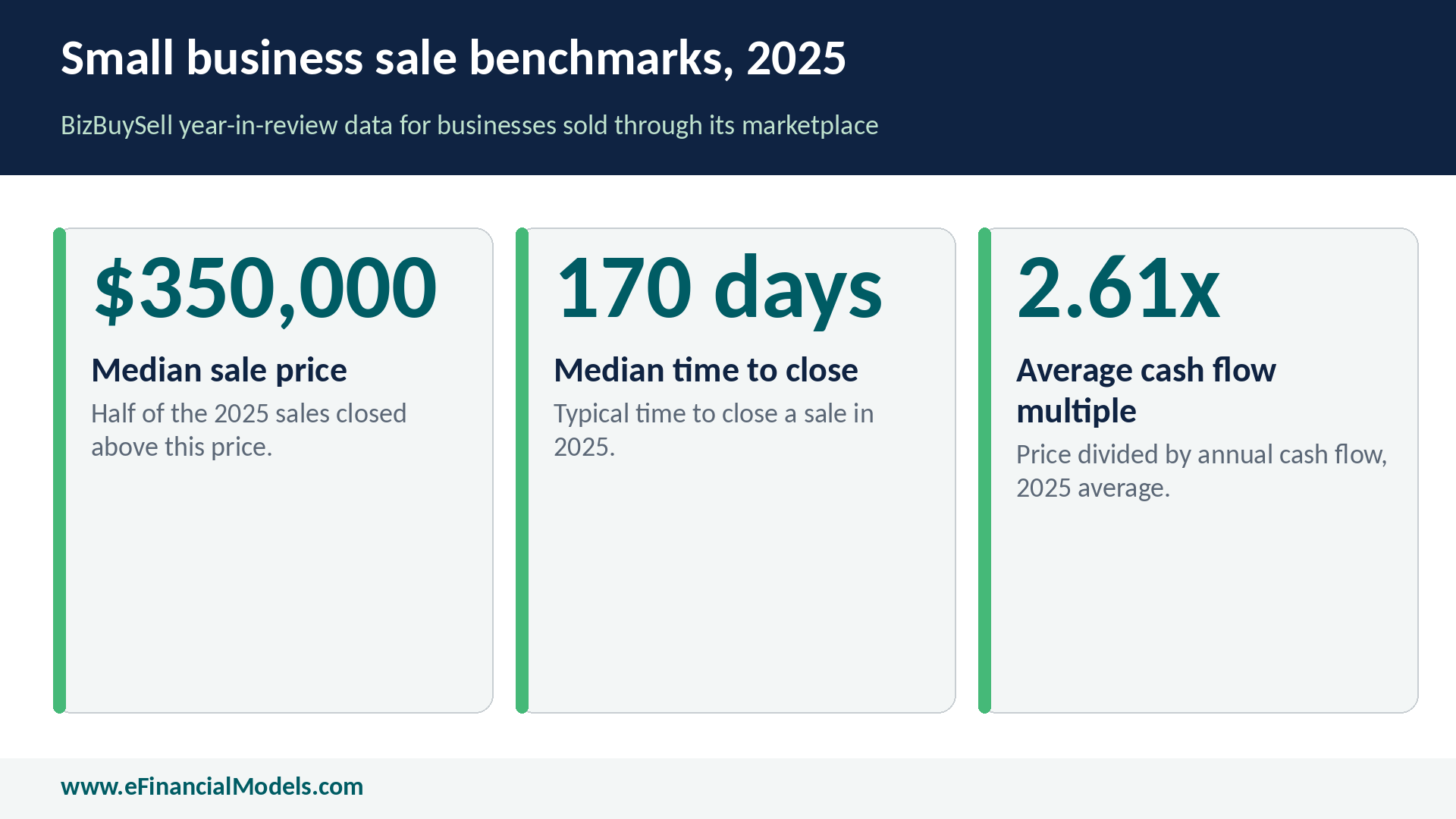
Infographic: the three small-business sale benchmarks that a buyer’s model should be tested against, as reported by BizBuySell for 2025.
How does an acquisition model differ from a startup model?
An acquisition model is anchored to evidence from the past, and a startup model is anchored to assumptions about the future. The table compares the two on the points that matter most to a growth-stage owner who is buying.
| Question | Acquisition model | Startup model |
|---|---|---|
| Starting point | Seller’s past statements, adjusted for one-off items | Founder’s assumptions about customers, prices and costs |
| Price | A negotiated purchase price and a split between cash at closing and later payments | No purchase price; funding is raised or invested |
| Buyer workflow | Review, adjust, price, structure, finance, then test downside cases | Plan, launch, then raise funds and track results |
| Government-backed lending | Equity injection, loan term and a lender repayment test shape the structure | Rarely modeled; investors or founders fund the gap |
| Earnout | Contingent payment to the seller, modeled in upside and downside cases | Does not exist |
| Main risk | Overpaying for earnings that do not continue | Revenue that never arrives |
A buyer reads an acquisition model from the price down, while a founder reads a startup model from the first customer up. The Startup Financial Models collection serves the second reader well and is a poor fit for the first.
What does a buyer’s workflow look like?
A sound buyer workflow has five steps, and a model should have one area for each. First, normalise the seller’s earnings, which means restating profit after removing one-off items and the owner’s personal costs. Second, set the price and its structure. Third, build a sources and uses schedule, a table that lists where the money comes from (loan, buyer cash, seller note) and where it goes (price, fees, cash left in the business). Fourth, test whether the business can repay the debt. Fifth, run downside cases and earnout cases.
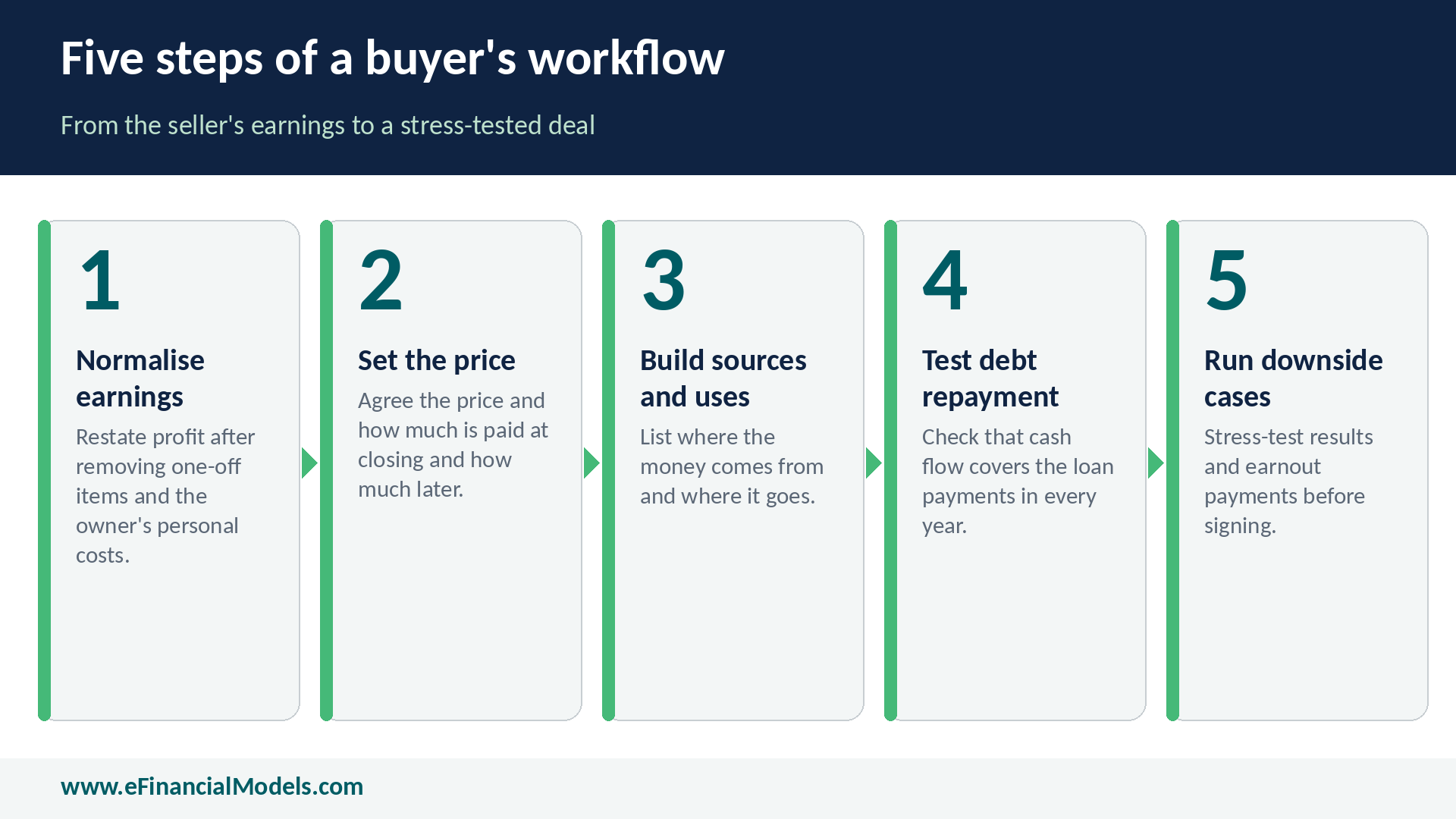
Infographic: the order of work in an acquisition model, from adjusting the seller’s earnings to stress-testing the deal.
The fourth step usually relies on the debt service coverage ratio (DSCR), the cash available for loan payments divided by the loan payments due in the same period. A ratio above one means the business covers its payments, and a lender normally wants a margin of safety above that. Buyers who need price support can also browse the Business Valuation collection.
How does Small Business Administration lending change the model?
It adds fixed rules that the model must respect, so the financing section has to be built around them. The US Small Business Administration (SBA) states that the maximum loan amount for a 7(a) loan is $5 million (SBA, 7(a) loans), which sets a ceiling on how much of a price a single loan can fund.
The buyer’s own cash is the second rule. An equity injection is the cash the buyer puts into the deal from the buyer’s own resources, and lenders commonly ask for one on a change of ownership. SBA sets the required percentage in its loan rules and revises those rules from time to time, so the model should keep the injection percentage as an input that can be changed once the lender confirms the current requirement.
The lender’s repayment test is the third rule. The model should show the DSCR for each year of the loan and flag any year where the ratio drops toward one.
How should the model handle an earnout?
It should treat the earnout as a separate schedule with its own cases, because the payment depends on results that nobody knows yet. An earnout is the part of a purchase price that the buyer pays later, and only if the business reaches agreed targets such as revenue or earnings.
Earnouts are not universal. A 2026 deal terms study by a deal settlement and data firm reported that earnouts staged a small comeback, appearing in 24% of private-target deals (Fasken, deal terms study takeaways).
Length matters for the model too. The same study reported that the most common earnout length was one to two years, at 38% of earnouts, compared with 23% for one year or less and 20% for two to three years (Fasken, deal terms study takeaways).
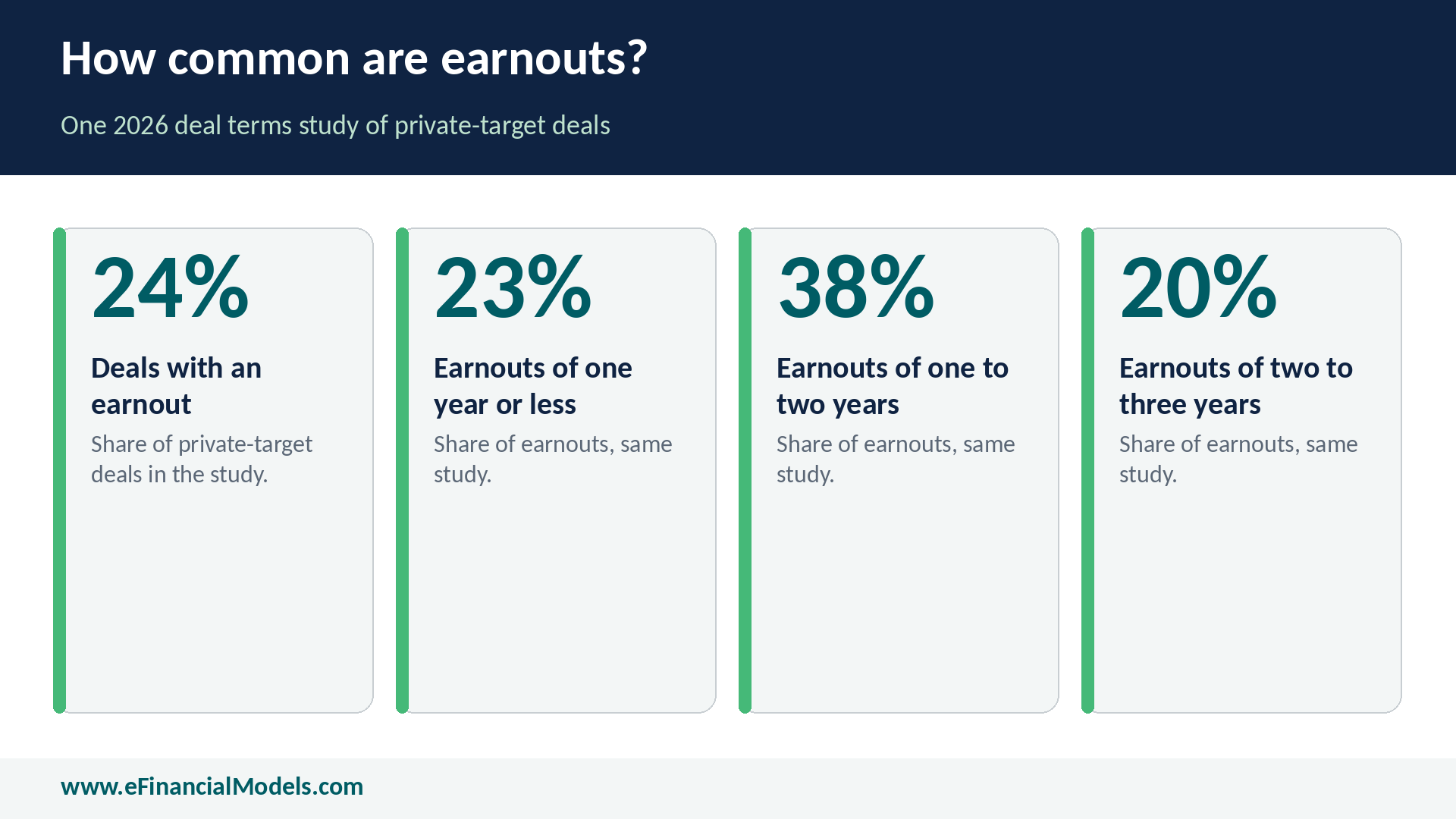
Infographic: how often earnouts appear in private-target deals and how long they usually run, from one 2026 deal terms study.
Worked example: a $1,000,000 purchase
This worked example uses illustrative numbers, in two separate deals, to show how each financing feature changes the amounts. It covers payment structure only, so it does not use the cash flow multiple from the benchmarks above. Assume a $1,000,000 purchase price paid entirely at closing, financed with a 7(a) loan and a 10% equity injection. The injection equals $100,000 (10% of $1,000,000), so the loan covers $900,000 ($1,000,000 minus $100,000).
For the earnout, assume a separate illustrative deal at the same $1,000,000 price, where $800,000 is paid at closing and $200,000 is contingent on hitting a revenue target. The contingent part is 20% of the price ($200,000 divided by $1,000,000). In the downside case the target is missed and the buyer pays $800,000 in total, while in the upside case the target is hit and the buyer pays the full $1,000,000. Each case needs its own column in the model.
Which template features should a buyer check?
Three features separate an acquisition template from a repurposed startup file: a sources and uses schedule, a debt schedule with a coverage ratio for each year, and an earnout schedule with upside and downside cases.
Conclusion
A buyer should choose an acquisition-shaped model, not a startup file, because the price, the lender’s rules and the earnout all depend on a seller’s history. Growth-stage owners comparing options can start with the Mergers and Acquisitions Financial Model from eFinancialModels, a ready-made template for acquisition deals, and test it against the three-feature check above.
Frequently Asked Questions
What records should a buyer collect before building the model?
A buyer should gather the seller’s tax returns, monthly profit and loss statements, balance sheets, a list of what customers owe, loan statements and any lease documents for the past three years. Those records let the buyer rebuild earnings from evidence and spot owner perks, one-off gains or falling months that a seller’s summary may smooth over. Missing records are themselves a warning that the price may be harder to defend with a lender.
Can a startup template be adapted to value an acquisition?
It can be bent that way, but the buyer then has to add the purchase price, the sources and uses schedule, the debt schedule and the earnout lines by hand, and each added link between sheets is a chance for an error. A startup file also forecasts from zero customers, while a purchased business already has customers, staff and contracts. Starting from an acquisition template usually costs less time than retrofitting a startup one.
What happens to an earnout if the business misses its target?
The buyer normally pays less or nothing for the contingent portion, depending on how the agreement scales the payment. Some agreements pay in steps as results rise, and others pay only when a single target is met. Because the seller often still influences results during the earnout period, the contract usually defines how the metric is measured, and a model should mirror that definition exactly to avoid disputes later.
How is seller financing different from an earnout?
Seller financing is a loan from the seller that the buyer must repay on a fixed schedule whatever the business earns, while an earnout is paid only if targets are met. In the model, a seller note appears in the debt schedule with an interest rate and a term, and an earnout appears as a contingent line with its own cases. Mixing them up overstates certainty in one place and understates it in the other.
Should the model include costs after the purchase closes?
Yes. A buyer should add a line for costs in the first months after closing, such as legal fees, software changes, staff retention payments and any equipment the seller deferred. These items reduce the cash left in the business and the coverage ratio in the first year, which is the year a lender watches most closely. Leaving them out makes the early cash flow look healthier than it will be in practice.
Sources
- BizBuySell, 2025 Year in Review, posted January 30, 2026: https://www.bizbuysell.com/blog/2025-year-in-review/
- US Small Business Administration, 7(a) loans, page modified 2026: https://www.sba.gov/loans/7a-loans/
- Fasken, Private M&A deal trends: key takeaways from SRS Acquiom’s 2026 study, 2026: https://www.fasken.com/en/knowledge/2026/05/private-ma-deal-trends-to-watch-key-takeaways-from-srs-acquioms-2026-study