0 ITEMS

How Much Does a Financial Model Cost? Templates vs Services

A financial model costs anything from a free demo template to a few thousand dollars for a simple freelance or managed build, with larger investor-grade builds taking longer, so the fair comparison is the price of the file plus the hours needed to make it reliable. Templates cost the least in cash and ask the most of the buyer, while managed services cost more in cash and move the build and the checking to a professional.
Key Takeaways
- A template is a one-off purchase, but the buyer supplies the adaptation and testing time, which is the cost that rarely appears on the price tag.
- Rates depend on the provider: Upwork freelancers typically charge $25-65 per hour, while fractional CFO pricing typically runs $175 to $400 per hour.
- Time is part of the price: a managed build is measured in calendar weeks, while a template costs the buyer’s own working hours.
- The cheaper route depends on how many hours the buyer must spend adapting a template, so the worked example shows how to find that break-even point.
- Errors are common: a published review of spreadsheet studies reports errors in 94% of the spreadsheets studied, so a second person’s check belongs in the budget.
What does a ready-made financial model template cost?
Each seller sets its own template prices, and they vary widely by product. Readers can browse the Financial Model templates page at eFinancialModels.
The cash price is only part of the cost. A buyer still has to enter the business’s own assumptions, test the formulas and fix any structure that does not fit, and that adaptation time is paid in the buyer’s own hours rather than on an invoice. The more the business differs from the template’s design, the more of those hours the file consumes.
What does a managed or freelance modeling service cost?
A service costs hourly or per project, and published rates span more than a factor of ten because the sources describe different kinds of provider: freelancers, contract staff and senior fractional executives. Three sources show the spread.
Freelance financial modeling consultants on Upwork typically charge $25-65 per hour, according to the Upwork financial modelers hiring guide.
Job adverts tracked by IT Jobs Watch show a median daily rate of £625 for Financial Modeller contract roles in the United Kingdom in 2026, according to the financial modeller rate page. That figure comes from advertised rates, so it describes asking prices rather than final invoices.
At the senior end, the firm Fraction CFO states that hourly pricing typically ranges between $175 and $400 per hour depending on the CFO’s experience, in a Fraction CFO article on financial model costs (2026). The same article says a simple internal planning model may cost a few thousand dollars.
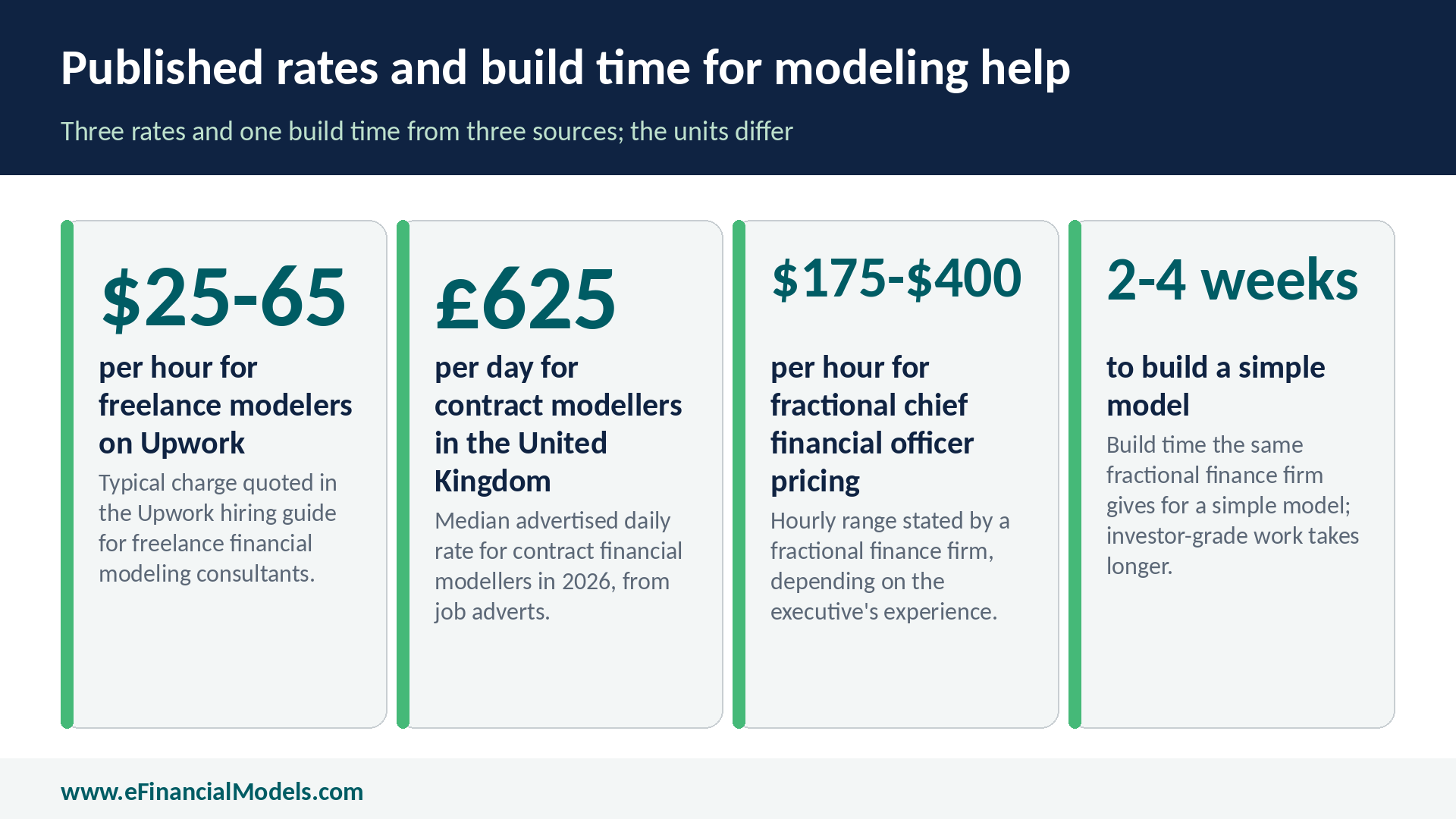
Three published rates and one build time, each from the source named on its card; the units differ, so the cards are not directly comparable.
Readers can also browse the custom financial modeling services collection at eFinancialModels.
How long does each route take?
A managed build takes weeks, while a template can be in use sooner if the business fits its design. Fraction CFO says simple models may take 2 to 4 weeks and more complex investor-grade models 4 to 8 weeks depending on scope, per the same Fraction CFO article.
None of the sources cited here gives a figure for adapting a template, because the hours depend on the buyer’s skill and the fit between the file and the business. The worked example below therefore treats adaptation time as an explicit assumption that a reader can replace with their own estimate.
How do templates and managed services compare side by side?
The two routes trade cash cost against the buyer’s time and skill. The table sets them side by side, using return on investment (ROI), which is the gain from a purchase minus its cost, divided by its cost, as the return measure.
| Factor | Ready-made template | Managed service |
|---|---|---|
| Cash cost | One-off price per file; free and paid versions exist | Hourly rate or project fee, as listed above |
| Build time | Hours to days to adapt if the business fits the design (12 hours assumed in the example) | Weeks, longer for investor-grade work |
| Expertise needed from the buyer | Enough finance skill to adapt and test the file | Mainly a clear brief and time to review the result |
| Who checks the formulas | The buyer, unless a reviewer is added | The provider, before handover |
| How ROI is judged | Gain from avoided errors against the route’s total cost | Gain from avoided errors against the route’s total cost |
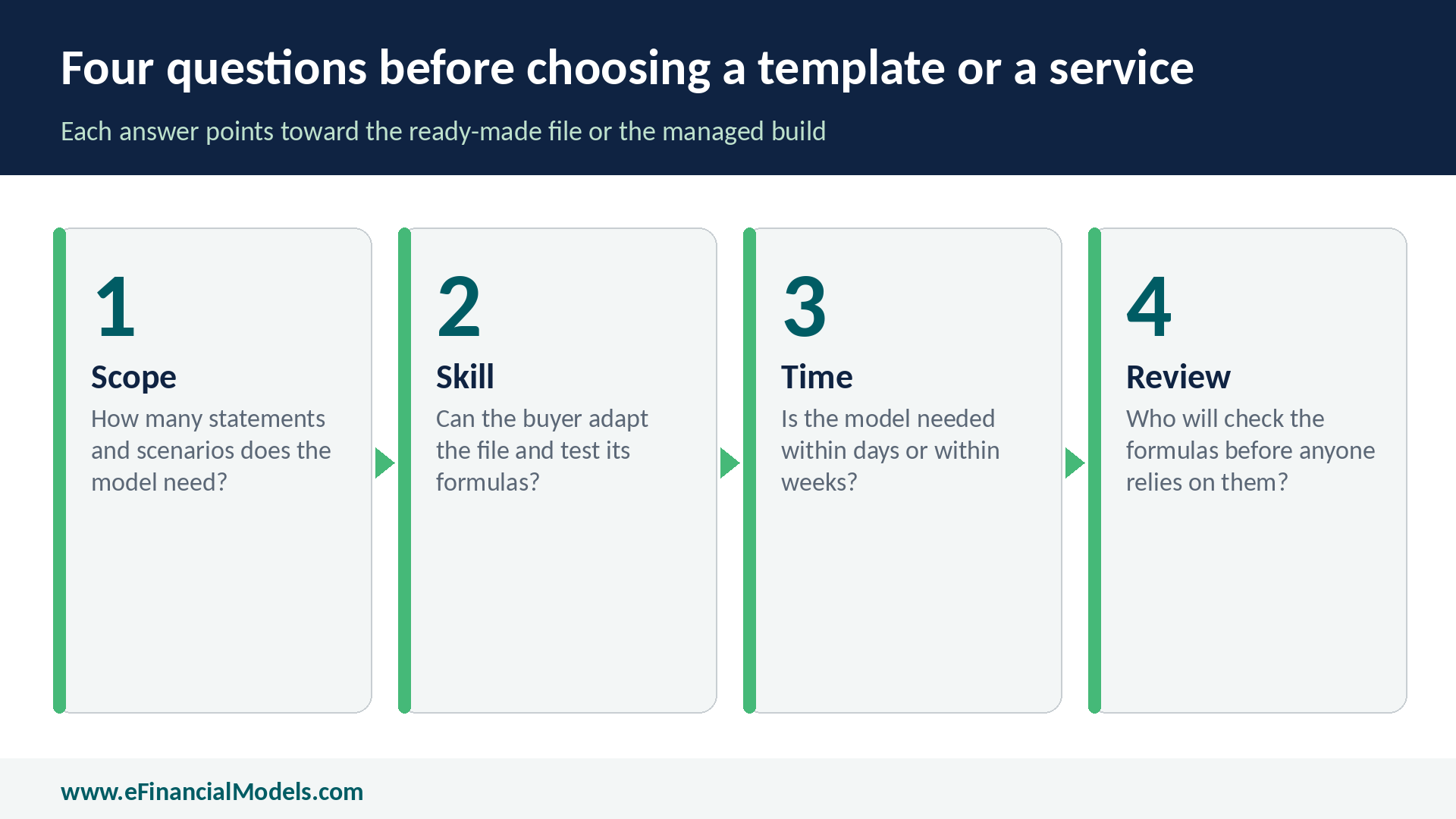
A four-step decision path from scope to review; each question points toward the template or the service.
Worked example: when does a managed service become cheaper?
A managed service becomes cheaper than a template once adapting the template takes more than 68 hours of the buyer’s time, under the assumptions below. The figures are illustrative assumptions, not market prices.
- Assume a template costs $100.
- Assume adapting and testing it takes 12 hours of the buyer’s own time, valued at $50 per hour.
- Assume, for illustration only, that a managed service charges a fixed fee of $3,500 for the whole project.
The template route costs 12 hours × $50 per hour = $600 of time, so $100 + $600 = $700 in total. The service costs $3,500, which is $2,800 more.
The break-even point is the number of buyer hours at which both routes cost the same. It is reached when the template’s total cost, $100 plus $50 for each hour, equals the service’s total cost of $3,500, so the break-even hours are ($3,500 − $100) ÷ $50 = 68. Below 68 hours the template is cheaper, at exactly 68 hours the two cost the same, and above 68 hours the service is cheaper.
Cost is only half of the return. Assume a reviewed model would prevent one $10,000 mistake. The service’s ROI is then ($10,000 − $3,500) ÷ $3,500 ≈ 1.86, or about 186%.
The template route earns the same avoided-loss benefit only if a reviewer is added, and its ROI is then worked out the same way, using the template route’s full total: the file price, the buyer’s adaptation hours and the reviewer’s fee. Either result holds only if the review really prevents the mistake, which is why checking, not price, drives the return.
What does review add to the return?
Review adds protection against errors, which are common in spreadsheets. Raymond Panko’s review of spreadsheet error research reports that, collectively, the studies it covers found errors in 94% of the spreadsheets studied, according to the Panko spreadsheet error paper (2015).
A bought template and a custom build are both spreadsheets, so both can carry errors, and the usual safeguard is a person who did not build the file repeating its tests. The review cost can be small next to the cost of a wrong figure reaching an investor or a lender, as a review fee of a few hundred dollars against an assumed $10,000 mistake would show.
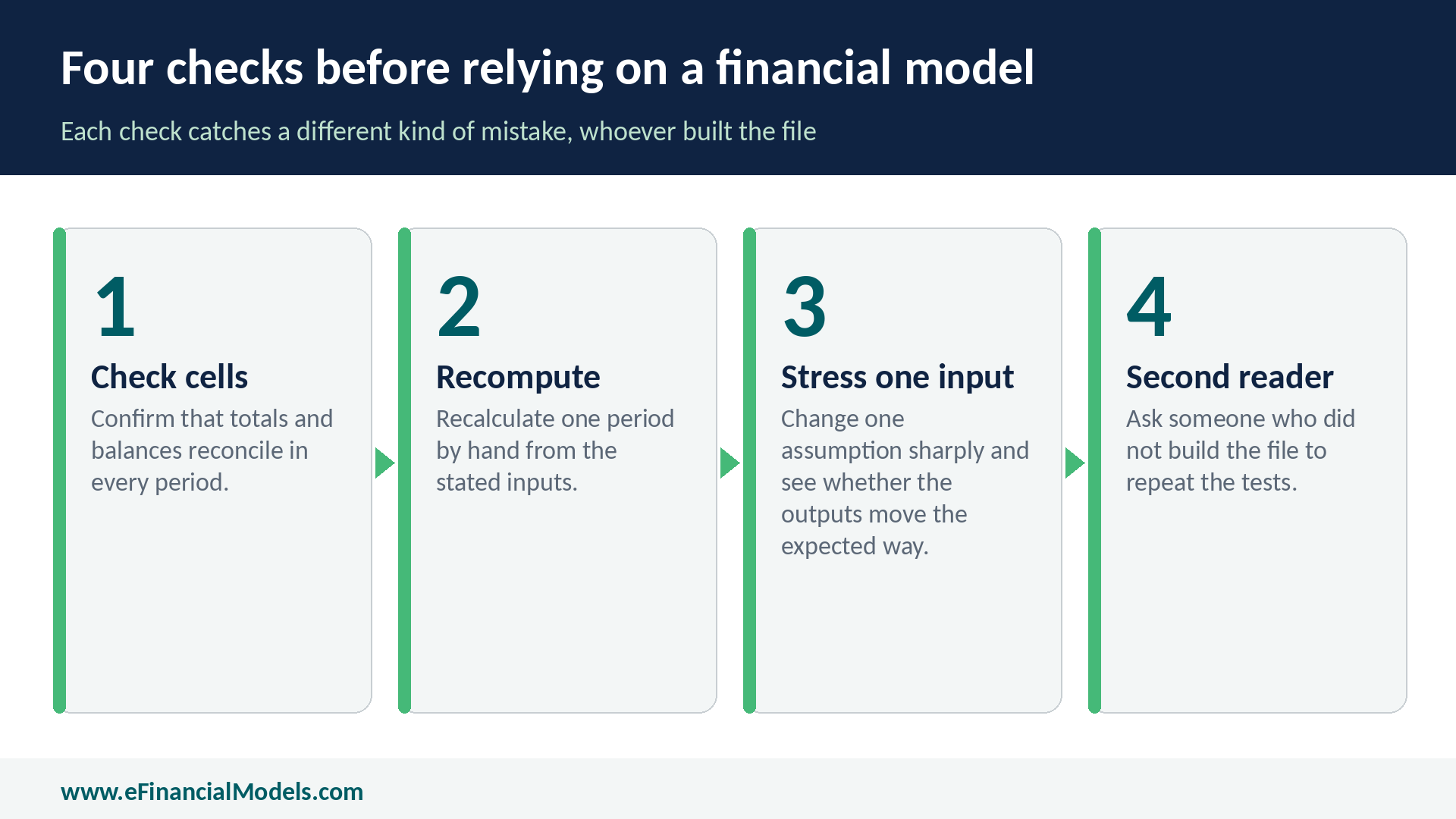
Four checks that apply to a template or a custom build alike; the cost of running them belongs in either route’s total.
Conclusion
A financial model costs the price of the file or the fee of the builder plus the hours spent making it trustworthy, so the cheaper route in cash is not always the cheaper route in total. Founders who choose the template route can start from the Simple Fundraising Model from eFinancialModels and budget for an independent check of any figure that drives a decision.
Frequently Asked Questions
Is a free template enough for an early-stage startup?
A free template can be enough for a first rough plan, such as testing whether monthly costs fit inside a small budget. It becomes risky when the numbers go to investors or a lender, because those readers expect documented assumptions and a model that balances. The sensible step is to use the free file for learning, then pay for a review or a custom build when real money depends on the output.
Why do quotes for the same model differ so much?
Quotes differ because scope, deliverables and seniority differ. One provider may price only the spreadsheet, while another includes interviews, assumptions research, documentation and a handover session. Region and the number of revision rounds change the fee too. Comparing two quotes only works when both state the same outputs, the same timeline and what happens if the buyer later asks for changes.
Can a template and a service be combined?
Yes. A practical pattern is to buy a template that matches the industry, fill in the assumptions, then pay a modeler for a few hours to review the formulas and adapt anything that does not fit. This keeps the cash cost closer to the template route while adding a second reader, which is a step that reduces the chance of a hidden error.
What should a buyer ask before paying for a custom build?
Ask who owns the finished file, whether the formulas stay unlocked, and how the provider tests the model before handover. Ask for a written scope that lists the statements, scenarios and checks included, and for a stated fee for changes after delivery. A provider who cannot explain how the balance sheet is tested is a warning sign, whatever the hourly rate.
Does a higher price mean fewer errors?
Not by itself. Price reflects scope, seniority and time, while error rates depend on how the work is checked. A cheap file that a second person has tested can be safer than an expensive one that nobody reviewed. Buyers should look for evidence of testing, such as visible check cells, a documented assumptions sheet and a named person who is accountable for the result.
Sources
- Upwork financial modelers hiring guide
- IT Jobs Watch financial modeller rate page (2026)
- Fraction CFO article on financial model costs (2026)
- Panko spreadsheet error paper (2015)