0 ITEMS

Professional vs Generic Financial Model Templates: What Sets Them
A professional-grade financial model template differs from a generic one in four ways: it covers the business in depth, it shows evidence of testing through built-in checks, it changes safely as the business changes, and its seller supports it after the sale. A first-time founder can test all four before buying with a short checklist.
Key Takeaways
- Depth means the template models the whole business, from revenue drivers to cash, not just a tidy summary page of totals.
- Accuracy cannot be seen from a screenshot; built-in checks and a clean review are the visible evidence of a trustworthy model.
- Customization is safe when inputs are separated from formulas, so a founder can change assumptions without breaking calculations.
- Support includes documentation inside the file, a named contact and a clear policy for fixing errors after the purchase.
- A five-step test, run before paying, helps a founder spot a weak template early.
What separates a professional template from a generic one?
Four qualities separate them: depth, accuracy, customization and support. A generic template is a summary page with typed-in totals that looks like a model, while a professional-grade template is built so that every number can be traced, tested and changed on purpose. The table sets the two side by side.
| Criterion | Professional-grade template | Generic template |
|---|---|---|
| Depth | Revenue drivers, costs, cash and funding linked in one structure | A summary page with typed-in totals |
| Accuracy | Built-in checks, consistent formulas and a documented review | No checks; errors found only by accident |
| Customization | Inputs kept apart from formulas, with notes on what to change | Inputs and formulas mixed in the same cells |
| Support | In-file documentation, a named contact and a fix policy | A download link and nothing after it |
A founder who reads each row against a template’s product page already has a basis for comparison before opening the file.
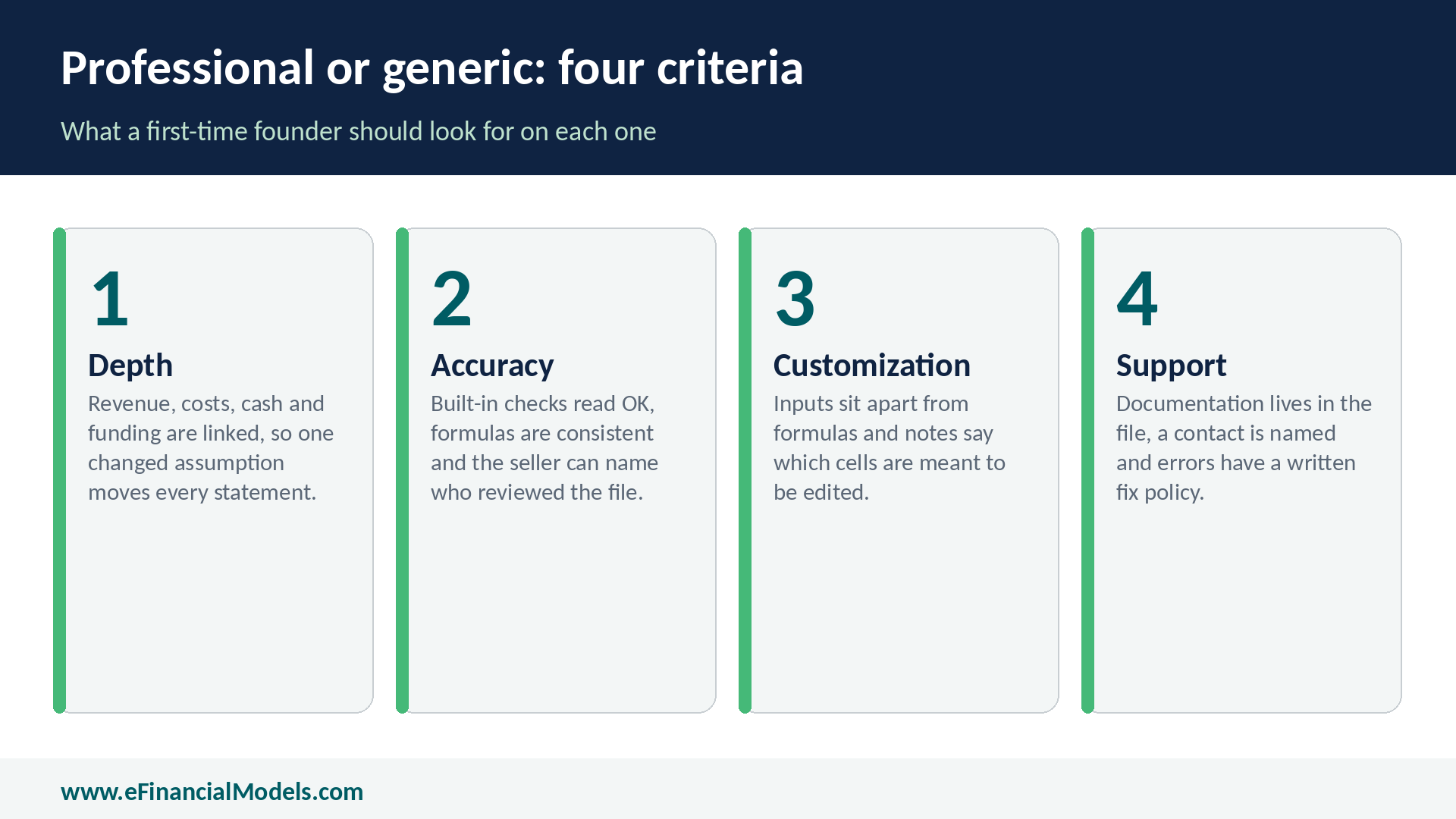
The four criteria that separate a professional-grade template from a generic one, each with the quality to look for.
How deep does the template go?
Depth is the share of the business the template actually models, and a deep template links revenue, costs, cash and funding so that one changed assumption flows through the income statement, the balance sheet and the cash flow statement. A shallow template stops at a summary. It may look complete, but the numbers on it were typed in rather than calculated, so changing a price or a hiring date moves nothing.
Cash is where small firms feel the strain. The Federal Reserve Banks’ 2025 Small Business Credit Survey report on employer firms states: “More than half of firms cited paying operating expenses (56%) or uneven cash flows (51%) as challenges.” A template that links cash to revenue and costs lets a founder test those pressures before they arrive.
Funding requests also need projections that hold together. In its guide to writing a business plan, the United States Small Business Administration (SBA) tells owners to “Supplement your funding request with financial projections” and to “Provide a prospective financial outlook for the next five years.” Newer firms face a tougher test as well, since the Federal Reserve Banks’ 2024 report on startup firms found that 43% of startup employer applicants were fully approved for financing, compared with 54% of older employer applicants. A template that cannot produce a five-year outlook from linked assumptions leaves the founder to rebuild it by hand.
How can a founder judge accuracy before buying?
Accuracy is judged by evidence of testing, because a screenshot cannot show whether a formula is correct. Spreadsheets are error-prone in general. Computerworld reported in 2004: “Anecdotal evidence suggests that 20% to 40% of spreadsheets have errors, but recent audits of 54 spreadsheets found that 49 (or 91%) had errors, according to research by Raymond R. Panko, a professor at the University of Hawaii.” The audits are old, but the pattern they describe is the reason a buyer should ask how a template was checked.
The Institute of Chartered Accountants in England and Wales (ICAEW) publishes a Financial Modelling Code from 2024 that includes safeguards as short principles. One reads “Build in checks, controls, and alerts from the outset.” Another reads “Test and review to reduce the risk of error and identify inefficiencies.” A template that follows them carries visible checks, such as a balance test (a cell that reads OK when the balance sheet balances), and its seller can say who reviewed it.
Input controls are a second visible sign. Microsoft’s guidance on data validation says to “Use data validation to restrict the type of data or the values that users enter into a cell, like a dropdown list.” A professional template applies that to its input cells, so an entry outside the allowed range, such as a growth rate far above any realistic figure, is blocked at entry.
Can the template change as the business changes?
Customization is safe only when the template separates inputs from formulas. In a professional-grade template, every assumption sits in clearly marked input cells, formulas are locked or colour-coded, and notes explain which parts are meant to be edited. A founder can then change prices, hiring dates or funding amounts and trust that the rest recalculates.
Generic templates often hide numbers inside formulas, which is the quickest way to break a model during an edit. A simple test is to change one input and watch whether the totals, the cash line and every summary move together. Sheet protection helps too, although Microsoft notes that “Worksheet level protection isn’t intended as a security feature”, so it guards against accidents rather than determined edits.
Founders can browse the Excel templates collection on eFinancialModels and compare how each listing describes its inputs.
What support should come with a template?
Support is everything a buyer can rely on after the download: documentation, a contact and a policy for errors. The ICAEW code also addresses documentation, advising modellers not to keep it in a separate file or email that may become detached from the model itself. For a buyer, that means instructions should live in the workbook, on a notes or guide sheet, where they cannot be lost.
A professional seller also names who answers questions and how long replies usually take, and states what happens when a formula error is reported: a corrected file, a version note, or a refund. A generic template usually offers none of this. When a founder builds the first financial forecast on a file, an unanswered question can delay a funding conversation, so support is part of the price even when it is not itemised.
Founders who want a modeller to adapt a template can review the custom financial modeling services listings on eFinancialModels.
How can a first-time founder test a template before buying?
Run five quick checks, each testing at least one of the four criteria: the first and third checks test depth and customization, the second tests accuracy, and the fourth and fifth test support. They need no modelling background, but they do need access to the file, so ask for a free preview, a demo file or a refund window first, and treat a seller who offers none as a warning sign.
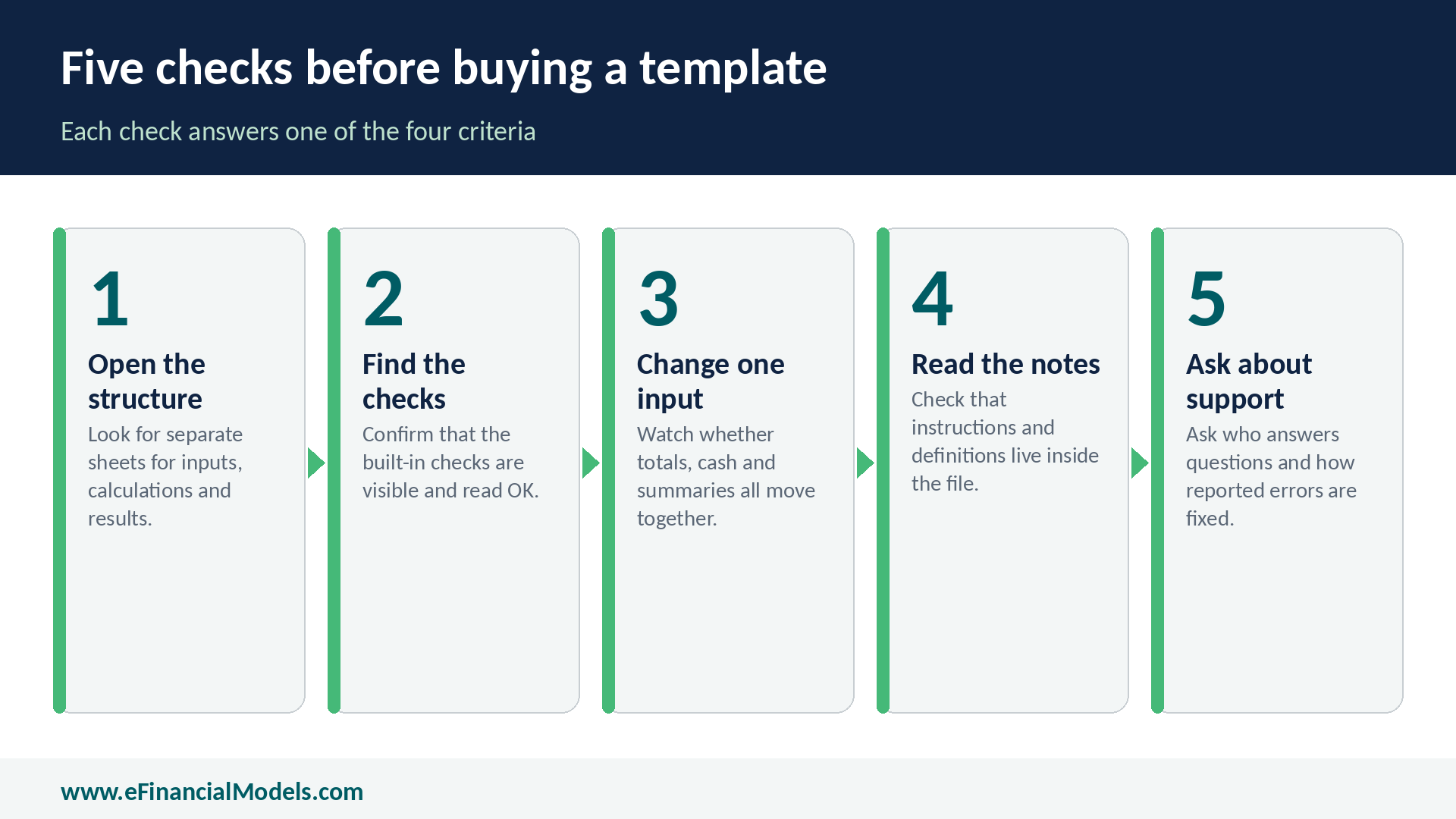
A five-step test a first-time founder can run on any template before paying for it.
First, open the structure and look for separate sheets for inputs, calculations and results. Second, find the checks and confirm that they read OK. Third, change one input and see whether every statement moves. Fourth, read the documentation inside the file. Fifth, ask the seller who answers questions after the sale and how errors are fixed. A template that fails one or two checks may be fixable, so the seller should be asked to correct or explain the gaps, while one that fails most of them is usually closer to generic than professional.
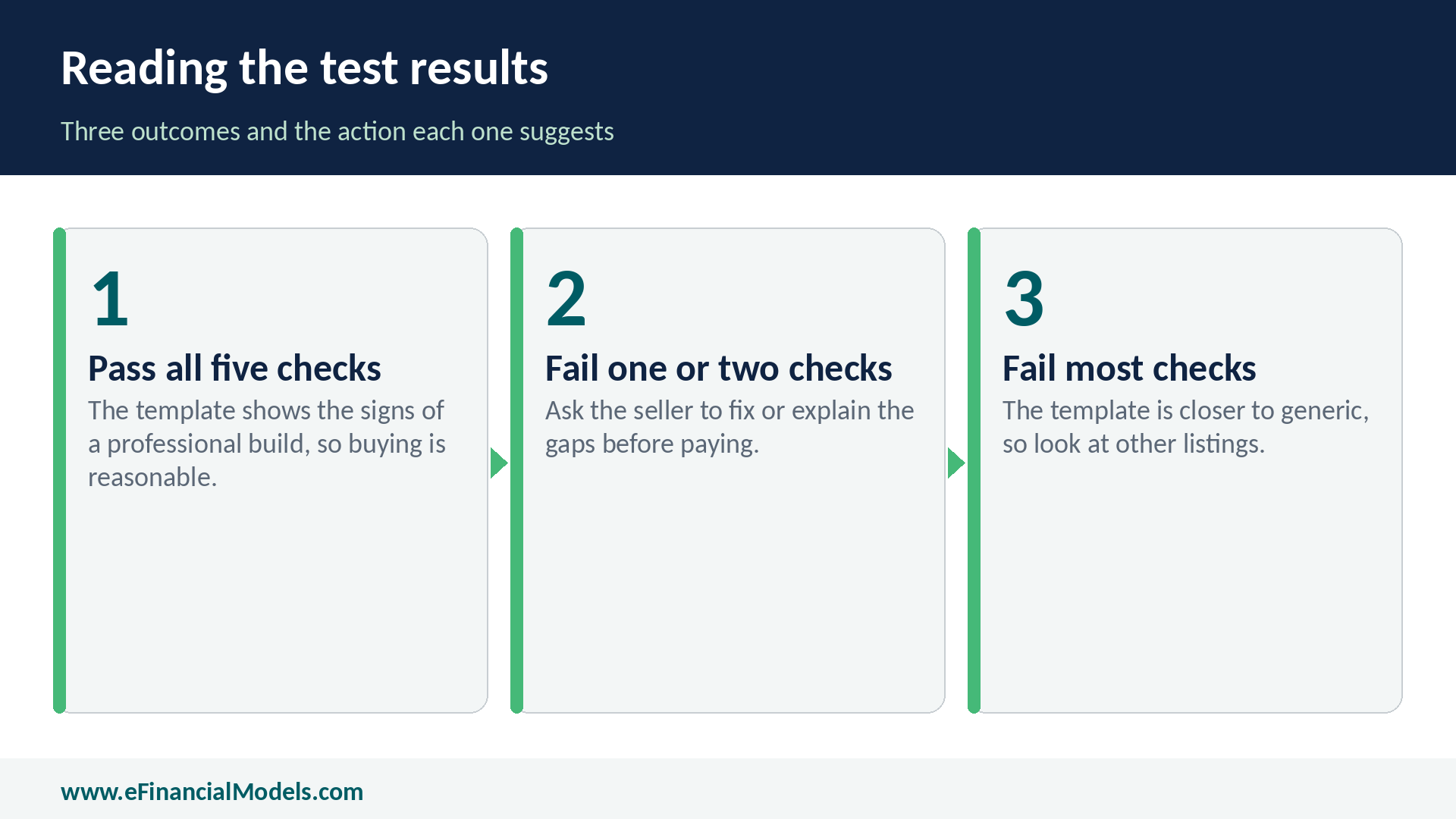
How to read the results of the five-step test and decide whether to buy, ask for fixes or look elsewhere.
Conclusion
Professional-grade templates earn the label through depth, tested accuracy, safe customization and real support, and a founder can verify each of them before paying. Buyers who want a starting point can open the Simple Fundraising Model from eFinancialModels, an Excel template that holds three-statement projections for 5 years and a sources and uses of funds schedule. The same five checks apply to that file as to any other template before a founder pays.
Frequently Asked Questions
Is a more expensive financial model template always better?
Price is a weak signal on its own. A higher price can reflect more build time, review and support, but it can also reflect branding alone, so the safer approach is to look at what the money buys. Ask whether the file contains visible checks, whether the inputs are separated from the formulas, and whether the seller states a fix policy in writing.
How much modelling skill does a founder need to evaluate a template?
Very little is needed for the first pass. A founder should be able to open the workbook, follow the sheet names, change one input and see whether the totals respond. These steps test structure rather than formula writing. Where a template uses finance terms the founder does not know, the documentation should define them, and a missing glossary is itself a warning about the quality of the rest.
Can a generic template be upgraded into a professional one?
Sometimes, but as a general judgement rather than a measured figure, the effort is often greater than buying the right file. Upgrading means adding input controls, checks, documentation and a consistent structure, and each addition must be tested against the existing formulas. If the founder lacks the time, a modeller can be hired for that work. When the template hides numbers inside formulas or mixes inputs and calculations, rebuilding from a better structure is usually quicker than repairing the original.
What should a founder ask a seller before buying?
Four questions cover most of the risk: who built and reviewed the model, what checks it contains, how customers report errors and what the seller does after a report. Written answers matter more than verbal ones, because they can be compared across sellers. A seller who answers clearly and quickly has already shown a sample of the support that follows the purchase, which is useful evidence for a buyer with little time.
Do lenders and investors care which template a founder used?
Readers care about the numbers and whether they hold up under questions, not about the template’s brand. A model that is clearly structured, internally consistent and documented makes questions easier to answer, while a model with unexplained numbers invites doubt about the whole plan. The template is a tool for reaching a credible forecast, and the founder remains responsible for the assumptions in it, however polished the file looks.