0 ITEMS

AI vs. Expert Financial Models: How to Spot the Difference

An expert-built financial model can be traced, tested and explained cell by cell, while an unchecked AI-generated one can look equally polished and still hide broken formulas. A first-time founder can test whether a model is sound with five short checks that need no coding skill, and can ask for proof of authorship separately.
Key Takeaways
- Polish proves nothing: a clean layout and confident labels appear in expert, AI-generated and template-mill models alike, so test the formulas instead.
- Human-built spreadsheets carry errors too, so the real question is whether anyone independent has tested the model.
- Benchmark studies show AI tools make frequent mistakes on finance and spreadsheet tasks, so every AI-generated formula needs an independent check.
- Five checks expose common problems: trace the totals, recompute one number, stress the inputs, hunt plugs, and ask for documentation.
- Credentials and logo walls are claims, so ask for a named reviewer, an unlocked sample model and references that can be called.
A Trustworthy Model Lets a Stranger Trace Every Number Back to a Visible Input
The label on a model (expert, AI or template) matters less than whether a stranger can audit it. A model passes when each total can be followed to the inputs that feed it, each assumption is written down, and a check cell confirms the model balances. The table below compares three typical sources on the three points founders care about most.
| What to compare | Expert-built model | Unchecked AI-generated model | Template-mill model |
|---|---|---|---|
| Customization depth | Structure follows the business: its revenue drivers, cost behavior and funding plan | Follows the prompt; depth depends on how much detail the prompt supplied | Fixed layout; the business is squeezed into the template |
| Error exposure | Lower once an independent reviewer has tested it, but never zero | Unknown until tested; formulas can look right and be wrong | Unknown until tested; one template error is copied to every buyer |
| Auditability | Assumptions, change log and reviewer named | Often no record of why a formula was chosen | Formulas may be locked or undocumented |
The expert column assumes a file that has been reviewed, while the other two describe files nobody has yet tested; the checks below apply equally to all three.
People Build Spreadsheets with Errors Too, So Independent Review Matters More Than the Label
Expert-built does not mean error-free. Raymond Panko’s review of spreadsheet error research lists six studies, published from 1995 to 2001, that intensively inspected 85 operational spreadsheets, and collectively, these studies found errors in 94% of the spreadsheets studied. That result shows how often human-built workbooks hide mistakes, so founders should read it as a case for testing every model, whoever made it.
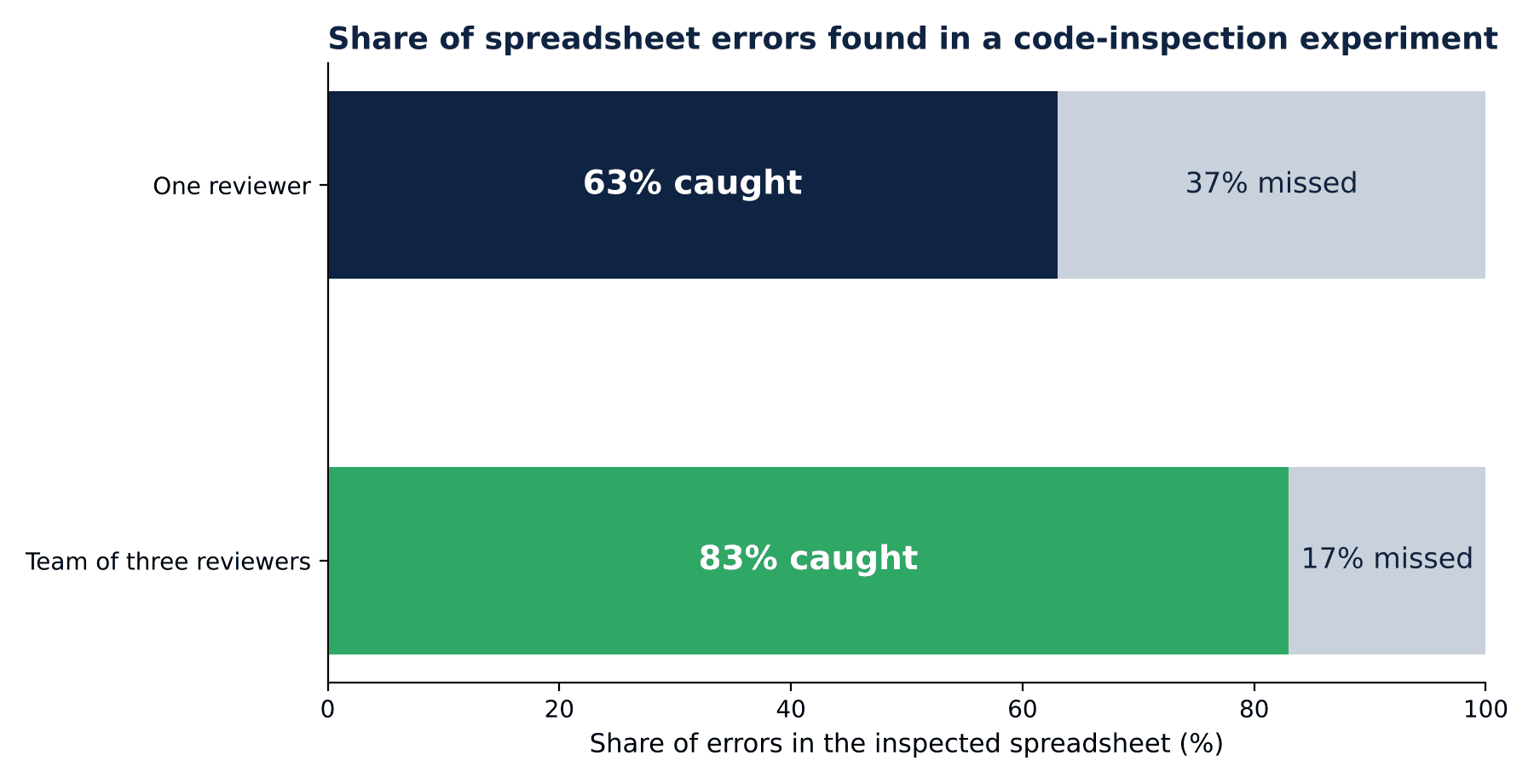
The same review shows how much a second pair of eyes helps, describing a code-inspection experiment in which individual reviewers caught 63% of the errors in the spreadsheet they examined, and teams of three averaged 83%.
AI Tools Fail Finance and Spreadsheet Tasks Often Enough That Every Formula Needs a Check
AI-generated formulas deserve the same inspection, because current evidence shows frequent mistakes on finance tasks. The FinanceBench study below measures finance question answering rather than formula writing, so it works as an indirect signal, while a second benchmark tests spreadsheet work directly. Large language models (LLMs), such as the Generative Pre-trained Transformer (GPT) family from OpenAI, are software trained on text to predict and produce language, which is why they can write a confident formula without computing anything.
The 2023 FinanceBench study tested that confidence on company-filing questions and found that GPT-4-Turbo used with a retrieval system incorrectly answered or refused to answer 81% of questions in a sample of 150 cases. A retrieval system is a search step that fetches source passages for the model to read before it answers.
SpreadsheetBench 2, a 2026 benchmark of 321 multi-sheet business workbook tasks given to eight frontier large language models, reports that the best model achieves 34.89% overall task accuracy, and debugging accuracy is as low as 12.00%.
AI still works as a fast first draft, but its formulas need a human check before money or investors depend on them.
Five Checks a First-Time Founder Can Run Without Reading Code
Each check takes minutes; run all five on any model, whoever built it.
- Trace the totals. Click a headline number, such as annual revenue, and use Excel’s trace precedents tool to see which cells feed it. A total that skips a month or points at a typed-in number is a red flag.
- Recompute one number by hand. Pick one figure, rebuild it on a calculator from the inputs, and compare. A single mismatch means the model deserves a full review.
- Stress the inputs. Set sales to zero, then double the price. Costs that never move, or profit that rises when sales fall to zero, point to broken links.
- Hunt for plugs. A plug is a typed-in number used to force a total to match. Search formulas for numbers embedded inside them, and look for a check cell that proves assets equal liabilities plus equity.
- Ask for the paper trail. A credible modeler can supply an assumptions list, a change log and the name of whoever reviewed the file. An AI-generated model can have the same trail if the founder writes it down while verifying.
Worked Example: One Dropped Cell Shifts a Four-Month Total by 40 Percent
This illustrative example shows why check two matters. Assume amounts in US dollars and a startup whose monthly revenue is 10,000 in month 1, 20,000 in month 2, 30,000 in month 3 and 40,000 in month 4. The table shows each month and the running total, which adds that month to every earlier one.
| Month | Revenue | Running total |
|---|---|---|
| 1 | 10,000 | 10,000 |
| 2 | 20,000 | 30,000 |
| 3 | 30,000 | 60,000 |
| 4 | 40,000 | 100,000 |
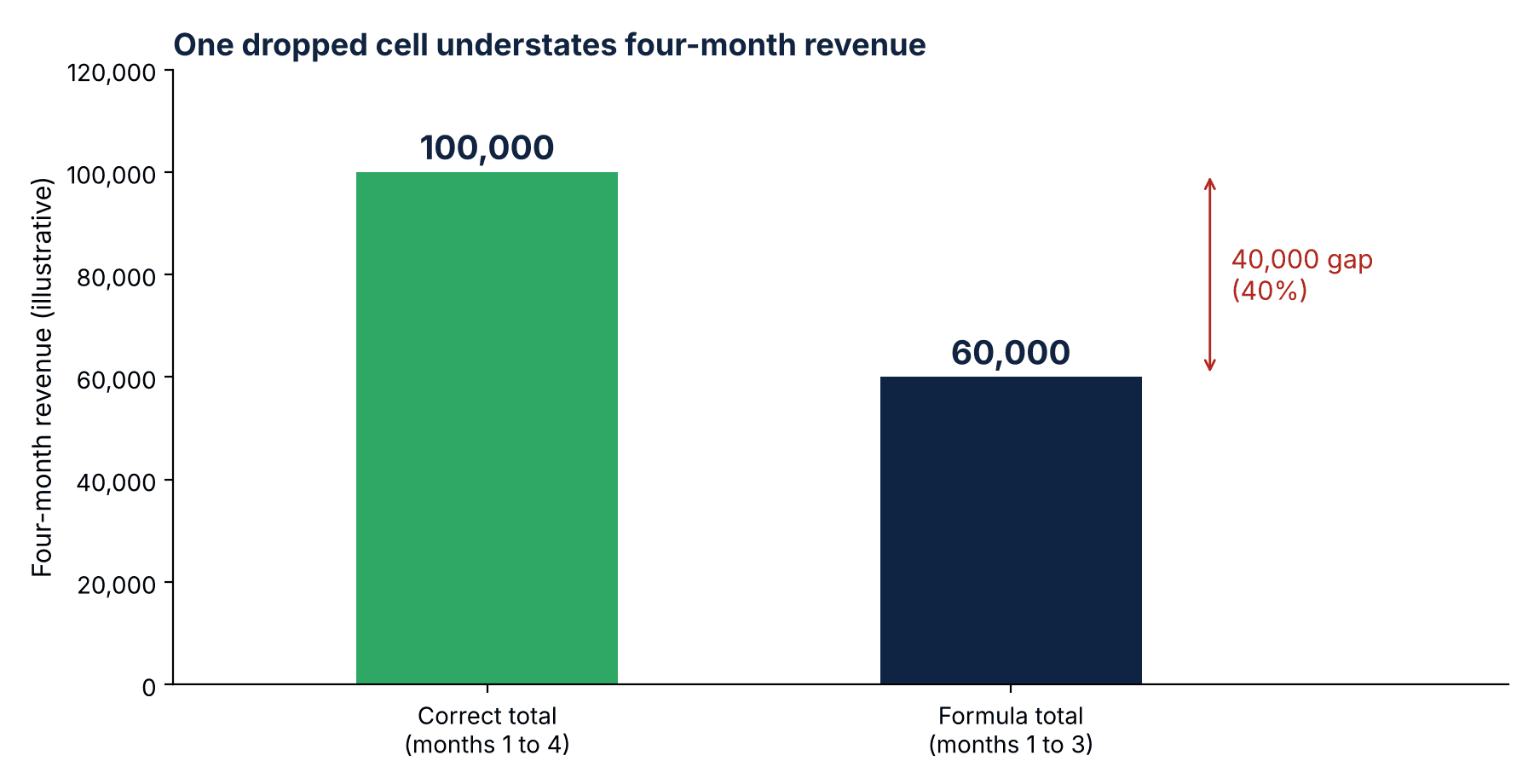
The correct four-month total is the month 4 running total, 100,000.
Now assume an AI-written formula covers only the first three monthly cells because its range stops one cell short, a slip a hand check is designed to catch. It returns 10,000 + 20,000 + 30,000 = 60,000 and leaves out the month 4 amount of 40,000. The model understates revenue by 40,000, which is 40,000 ÷ 100,000 = 40 percent of the correct total. The hand check catches it at once, because adding the four monthly amounts on a calculator gives 100,000, which disagrees with the 60,000 on the sheet.
Spreadsheet formulas fail quietly, which is why verification beats inspection by eye.
Credentials and Logo Walls Are Claims, So Ask for Proof
Founders often meet expert biographies and client-logo badges when choosing a modeler. A badge saying a firm is trusted by large companies proves nothing about the file in hand, and a biography cannot be checked without a name and a reference.
Four requests separate real expertise from decoration. Ask for a named person who will stand behind the model. Ask for a sample model with unlocked formulas, so the five checks above can be run before buying. Ask for two references whose contact details can be confirmed. Ask what happens when an error surfaces after delivery. A modeler who answers all four with specifics is behaving like an expert, whatever the model’s origin. The same four questions apply to a ready-made file, such as the Excel templates in the General Excel Financial Models collection or the templates in the Startup Financial Models collection at eFinancialModels, and the five checks work on any of them.
Frequently Asked Questions
Can AI build a financial model a founder can trust?
AI can draft the structure and many formulas quickly, and some drafts are sound. Trust comes from what happens next. A founder or an independent reviewer has to run the traceability, recomputation and stress checks, write down the assumptions, and fix every mismatch. A model verified this way deserves the same confidence as a verified human-built one, and an unverified draft deserves less than either.
What is the quickest way to check an AI-generated formula?
Recompute its result by hand using a different route. If the formula adds a year of monthly revenue, multiply the average month by twelve and compare. If it computes a growth rate, rebuild it from the first and last values on a calculator. Two independent routes that agree give strong evidence the formula works, and a disagreement shows exactly where to look.
How does a template-mill model differ from an expert model?
A template mill sells one fixed layout to many buyers and rarely adapts it to a specific business. The formulas may be perfectly correct, yet the structure can omit the cost behavior or funding terms that matter for a particular company. An expert modeler starts from the business, builds the drivers it needs, and documents the choices. Ask the seller how much of the file can be changed without breaking it.
Should a founder pay for an expert if AI is cheaper?
A wrong model can cost more than a review. Investors, lenders and partners rely on the numbers, and a hidden error damages credibility when it surfaces late. A sensible split uses AI for speed and pays an expert to test, document and sign off the final file, especially before fundraising or a loan application. A review fee is known in advance, while the price of a flawed forecast can appear later as a failed negotiation or a missed cash shortfall.
What documents should come with a model that will go to investors?
Investors usually expect a clear assumptions page, a statement of what each tab does, a log of changes, and a check cell proving the model balances. A named author or reviewer helps too, because it lets an investor ask questions of a person. These documents also make later updates safer, since whoever edits the model next can see why each formula exists.
Conclusion
An expert-built model and an AI-generated one are told apart by testing, not by looks: trace the totals, recompute one number, stress the inputs, hunt for plugs, and ask for the paper trail. Founders who want a modeler whose work can be inspected before they commit can browse the Custom Financial Modeling Services listing at eFinancialModels, where the listing tells buyers to contact the financial modeler before ordering, a natural moment to ask the four questions above.