0 ITEMS

Build vs Buy vs Hire: Financial Modeling ROI Guide

For most financial modeling decisions, the right answer isn’t the cheapest option or the fastest one — it’s the one that delivers the highest value per dollar of total cost, including the hours you’ll never get back.
Key Takeaways
- A junior analyst building a DCF model from scratch typically spends 120+ hours, translating to $6,000 or more in fully-loaded labor cost at a $50/hour blended rate.
- A professional template from a reputable source costs $150 to $500 and requires 8 to 12 hours of customization, cutting time-to-deployment by roughly 90%.
- Hiring a financial modeling consultant runs $5,000 to $25,000 depending on complexity, with delivery timelines of 2 to 4 weeks.
- The “build” option only beats buying on ROI when the model requires genuinely proprietary logic that no template can replicate.
- A hybrid approach — buying a professional template and adding a 2-hour expert review — covers 80% of business modeling needs at under $1,000 total.
- The single most common decision mistake is underestimating build time by a factor of 3 to 5, turning a “free” internal project into the most expensive option.
- Regulatory, audit, or investor-facing models almost always justify either buying a professionally structured template or hiring an expert.
The Real Cost of Each Approach: Beyond Sticker Price
The sticker price of any financial modeling approach covers only a fraction of its true cost. You must account for labor time, revision cycles, error risk, opportunity cost, and ongoing maintenance to make a fair comparison.
Here’s what most teams miss: the opportunity cost of a senior finance professional spending 40 hours building a budget model is not zero. According to the U.S. Bureau of Labor Statistics, the median annual wage for financial analysts in 2023 was $99,890 (U.S. Bureau of Labor Statistics), which works out to roughly $48 per hour. Add benefits and overhead at a standard 1.3x multiplier and the fully-loaded rate reaches approximately $62 per hour. A 120-hour build project therefore costs $7,440 in labor alone, before a single revision.
Error risk compounds this further. A study published in the European Spreadsheet Risks Interest Group’s annual conference found that roughly 88% of spreadsheets contain errors (EuSpRIG), and models built under time pressure by non-specialists carry the highest defect rates. A single formula error in a fundraising model or acquisition analysis can cost multiples of the original build investment in rework, credibility damage, or a mispriced deal.
Maintenance is the third hidden cost. A model built once rarely stays static. Budget models need quarterly updates. Projection models need assumption refreshes. A model with no documentation or version control — common in self-built projects — can take 3 to 5 hours to update safely each cycle, versus 30 minutes for a well-structured template with labeled input cells. Excel supports up to 64 levels of nested functions (Microsoft), meaning poorly structured self-built models that rely on deeply nested formulas are especially prone to the kind of cascading errors that make maintenance cycles so costly.
Build It Yourself: When Internal Development Makes Strategic Sense
Building a financial model internally makes strategic sense in exactly one scenario: when the model’s logic is genuinely proprietary and no external solution can replicate it.
Examples where building is the right call include a SaaS company modeling a novel usage-based pricing algorithm with 12 interdependent variables, a private equity firm building a fund-level waterfall with bespoke carry structures, or a manufacturer modeling a production constraint optimization that feeds directly into ERP outputs. In each case, the model IS the competitive advantage. Buying a template would require so much structural reworking that you’d effectively be building from scratch anyway.
Outside of these scenarios, the “build” decision is often driven by what organizational psychologists call the “not invented here” bias — a preference for internal solutions that feels like quality control but is actually a form of sunk-cost reasoning. Teams that have always built their own models tend to underestimate how much time they spend doing it. According to research from the Association for Financial Professionals, finance teams spend an average of 75% of their time on data gathering and model maintenance rather than analysis (Association for Financial Professionals), which means buying a pre-built, professionally structured template directly attacks that ratio.
If you do build, plan for these time benchmarks by model type and builder experience:
- Simple 3-statement budget model: 20 to 40 hours (junior analyst), 8 to 15 hours (senior analyst)
- Standard DCF valuation: 40 to 80 hours (junior), 15 to 30 hours (senior)
- LBO model: 80 to 150 hours (junior), 30 to 60 hours (senior)
- Integrated M&A merger model: 120 to 200+ hours (junior), 50 to 90 hours (senior)
These ranges assume no major revisions. Real projects average 2 to 3 revision cycles, adding 30% to 50% to total hours.
Buy a Template: The Speed and Quality Middle Path
Buying a professionally built financial model template is the right choice for roughly 80% of standard modeling needs, and it’s the option most teams systematically undervalue.
A quality template from a source like eFinancialModels — built by former investment bankers and vetted across thousands of use cases — delivers three things a self-built model rarely does: a proven structure, built-in error checks, and documentation that survives staff turnover. The financial modeling templates available through professional marketplaces cover everything from three-statement models to LBO structures to startup financial models. A single Excel workbook can contain up to 1,048,576 rows and 16,384 columns (Microsoft), which means professional templates can encode extraordinarily detailed model architectures without hitting platform constraints — a structural advantage that self-built models rarely exploit fully.
Here’s the math on a standard DCF template purchase:
- Template cost: $299
- Customization time: 10 hours at $62/hour fully-loaded = $620
- Total cost: $919
- Time to deployment: 1 to 2 business days
- Versus building from scratch: $7,440 labor + 3 to 4 weeks
The template option delivers a 87% cost reduction and a 90% time reduction for a model that meets institutional quality standards from day one. For 5-year financial projections or startup financial models, the ROI case is even stronger because these model types follow well-established structures that professional templates already encode correctly.
The one risk with buying is purchasing the wrong tier. A $49 basic template designed for a sole proprietor will not serve a Series B fundraise. Match template complexity to use case: investor-facing models need scenario toggles, sensitivity tables, and clean output dashboards. Internal budget models can use simpler structures.
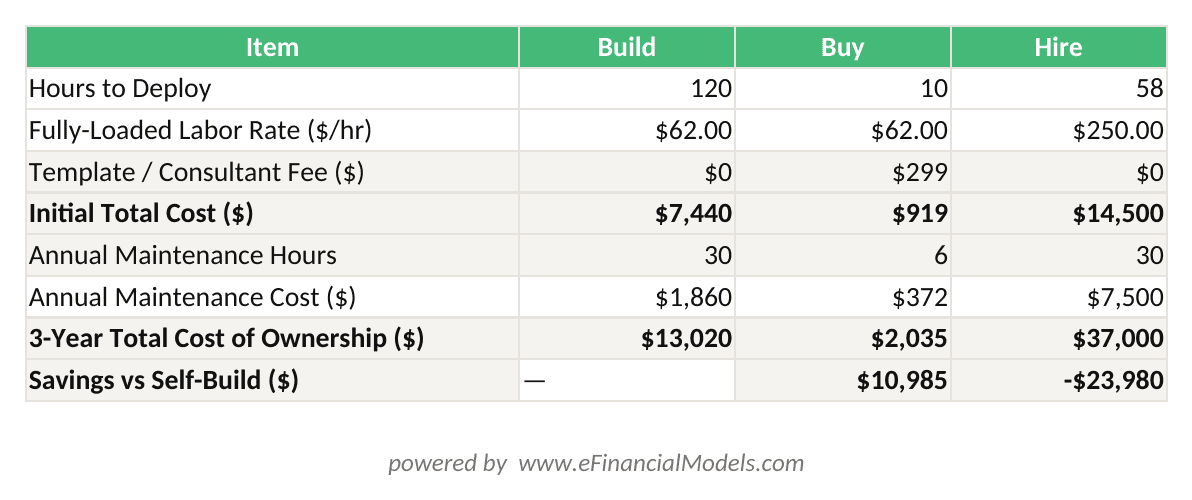
Template approach delivers $6,521 in savings versus self-build and $13,581 versus consultant on a single standard model.
Hire an Expert: Scenarios That Justify Premium Investment
Hiring a financial modeling consultant or boutique advisory firm is the right call when the stakes are high enough that model quality directly affects a financial outcome, and when internal capability genuinely cannot close the gap in the available time.
Specific scenarios that justify the $5,000 to $25,000 investment include:
- Complex M&A merger models with purchase price allocation, goodwill, and deferred tax adjustments
- Restructuring or distressed debt models requiring covenant analysis and waterfall distributions
- Litigation support models that must withstand expert witness scrutiny
- Regulatory capital models for financial institutions subject to Basel III or DFAST requirements
- Project finance models for infrastructure deals with complex debt sculpting
Freelance financial modeling rates on platforms like Toptal and Upwork range from $75 to $250 per hour for verified finance professionals, with boutique advisory firms billing $150 to $400 per hour for senior modelers. A mid-complexity LBO model at 60 consultant hours therefore costs $9,000 to $24,000 — consistent with the $5,000 to $25,000 range cited in the briefing. For context, the U.S. Bureau of Labor Statistics projects employment of financial analysts to grow 9 percent from 2023 to 2033 (U.S. Bureau of Labor Statistics), faster than the average for all occupations, which means consultant availability and rates are likely to tighten further — making the buy-template-first approach even more cost-efficient over time.
The key qualifier: hiring only beats buying when the model’s complexity genuinely exceeds what a professional template can provide as a starting point. Even for complex deals, many consultants start from a template and customize — which means you’re paying consultant rates for work a template could have seeded at a fraction of the cost. The hybrid approach (covered below) captures this insight.
Decision Matrix: Mapping Your Situation to the Right Solution
Use this matrix to score your situation across 7 criteria. The option with the most checkmarks is your starting point.
| Criterion | Build | Buy | Hire |
|---|---|---|---|
| Timeline | 3+ weeks available | 1-3 days needed | 2-4 weeks, budget available |
| Complexity | Proprietary logic | Standard structure | Complex/bespoke |
| Internal skill | Senior modeler on team | Any finance user | Skill gap exists |
| Budget | <$500 labor cost | $150-$500 budget | $5K-$25K approved |
| Customization | Deep structural changes | Input-level changes | Full custom build |
| Maintenance | Internal ownership | Template updates | Ongoing retainer |
| Audit/investor use | Internal only | Investor-ready template | Litigation/regulatory |
If you checked “Buy” on 4 or more criteria, a professional template is your optimal path. If you checked “Hire” on timeline, complexity, and audit requirements simultaneously, the consultant route is justified. “Build” only wins when you checked it on complexity AND internal skill AND have 3+ weeks available.
ROI Case Studies: Three Companies, Three Different Choices
These three scenarios illustrate how the decision plays out with real numbers.
Case 1: Series A SaaS Startup — Buy
A 12-person SaaS company needed a 5-year financial projection model for a $3M fundraise. The CFO estimated 100 hours to build from scratch at a $75/hour opportunity cost = $7,500. Instead, they purchased a SaaS-specific financial projections template for $349 and spent 12 hours customizing it ($900 in labor). Total cost: $1,249. Time to investor-ready output: 2 days. The model passed investor due diligence without revision requests.
Case 2: Mid-Market PE Firm — Hire
A private equity firm needed an LBO model for a $45M acquisition with a complex management equity rollover and ratchet structure. No template covered the ratchet mechanics. They hired a boutique modeling firm for $14,500 (58 hours at $250/hour). The model supported a successful close and was reused for two follow-on add-ons, reducing the effective per-use cost to $4,833. Hiring was correct because the proprietary structure genuinely required expert construction.
Case 3: Corporate FP&A Team — Build (Correctly)
A manufacturing company’s FP&A team needed a production capacity model that integrated directly with their SAP data feeds using a custom API logic layer. No template could replicate the integration architecture. A senior analyst spent 90 hours building it ($5,580 in labor). The model runs weekly with zero external dependency and has saved an estimated 8 hours per week in manual reporting — a payback period of 11 weeks.
The Hybrid Approach: Combining Templates with Expert Review
The hybrid model — buying a professional template and adding a targeted expert review — is best practice for high-stakes scenarios where you need both speed and quality assurance.
Here’s how it works in practice: purchase a professionally built template ($150 to $500), customize it for your specific inputs and assumptions (8 to 12 hours), then engage a senior financial modeler for a 2 to 4 hour review session ($300 to $800 at freelance rates). Total cost: $600 to $1,300. Total time: 3 to 5 business days.
This approach delivers 90% of the quality of a full consultant engagement at 10% to 15% of the cost. It works because the template handles structural integrity — formula logic, error checks, output formatting — while the expert review focuses exclusively on assumption validation and deal-specific adjustments. For investor-facing models, board presentations, or bank covenant compliance models, this hybrid is the optimal risk-adjusted choice.
Common Decision Traps and How to Avoid Them
Three mistakes account for the majority of poor build/buy/hire decisions in practice.
Trap 1: Underestimating build time by 3 to 5 times. Teams consistently estimate model builds at 20 to 30 hours and deliver at 80 to 120 hours. The fix: add a 3x multiplier to any internal time estimate for a model you haven’t built before, then compare that adjusted number against template cost.
Trap 2: Buying the wrong template tier. A $49 basic template will not serve a Series B investor. A $499 enterprise template is overkill for a simple departmental budget. The fix: match template complexity to the model’s audience. Investor-facing and lender-facing models need scenario analysis, sensitivity tables, and clean dashboards. Internal models can use simpler structures.
Trap 3: Over-hiring for simple needs. Paying a consultant $8,000 for a standard three-statement model that a $299 template covers is a common mistake in organizations that lack a template procurement process. The fix: maintain a library of pre-vetted financial model templates so that standard requests never escalate to consultant engagements by default.
Trap 4: Ignoring the “not invented here” bias. Finance teams that have always built their own models often resist templates on quality grounds without actually benchmarking the comparison. The fix: run a side-by-side audit of one self-built model against a comparable professional template. In most cases, the template wins on structure, documentation, and error-check coverage.
Frequently Asked Questions
How long does it actually take to build a financial model from scratch?
Build time depends heavily on model complexity and the builder’s experience level. A junior analyst building a standard DCF model from scratch typically needs 40 to 80 hours, while a senior analyst with a strong template library can complete the same model in 15 to 30 hours. An LBO model runs 80 to 150 hours for a junior builder and 30 to 60 hours for a senior one. These estimates assume one revision cycle. Real projects average 2 to 3 revision cycles, adding 30% to 50% to total hours. At a fully-loaded labor rate of $62 per hour (based on the BLS median financial analyst wage of $99,890 plus a 1.3x benefits multiplier), a 120-hour build costs $7,440 before any revisions.
What’s the minimum budget for a professional financial modeling consultant?
Freelance financial modeling professionals on verified platforms typically charge $75 to $150 per hour for standard work, with senior modelers and boutique advisory firms billing $150 to $400 per hour. A minimum engagement for a simple model runs 15 to 20 hours, putting the floor at roughly $1,500 to $3,000. Complex models — LBOs, M&A merger models, project finance — run 50 to 90 consultant hours, translating to $7,500 to $36,000 at mid-range rates. For most standard business models (three-statement, DCF, budget), the consultant option is hard to justify against a $150 to $500 professional template unless the model requires genuinely bespoke logic.
When should a startup use a template versus hiring a consultant for fundraising models?
For pre-seed and seed rounds, a professional template customized to your business model is almost always sufficient. Investors at these stages focus on assumptions and unit economics, not model architecture. For Series A and B rounds, a high-quality template with a 2-hour expert review covers 90% of cases. Hiring a consultant makes sense for Series C and beyond, when institutional investors conduct detailed model audits, or when the model needs to integrate with complex cap table structures, convertible note waterfalls, or multi-entity consolidations. The startup financial model templates available from professional sources are specifically designed to meet early-stage investor expectations.
How do I know if a financial model template is high enough quality for investor use?
A professional-grade investor-ready template should include: a dedicated assumptions input sheet with clearly labeled drivers, a fully integrated three-statement model (income statement, balance sheet, cash flow statement), at least one sensitivity analysis table, a scenario toggle (base, upside, downside), and output charts formatted for presentation. It should also include error-check cells that flag circular references or broken links. Templates built by former investment bankers and reviewed by multiple finance professionals are the benchmark. Avoid templates that hardcode assumptions directly into formula cells, lack documentation, or use inconsistent formatting — these are signs of amateur construction that will fail investor scrutiny.
What’s the total cost of ownership for a financial model over 3 years?
Total cost of ownership (TCO) covers initial build or purchase cost, customization time, and ongoing maintenance. For a self-built model: $7,440 initial build + $1,860 per year in maintenance (30 quarterly update cycles at 1 hour each at $62/hour) = $13,020 over 3 years. For a professional template: $919 initial (template + customization) + $372 per year in maintenance (6 hours annually at $62/hour) = $2,035 over 3 years. For a consultant-built model: $14,500 initial + $1,860 per year in maintenance = $20,080 over 3 years, unless the consultant provides a maintenance retainer. The template option delivers the lowest 3-year TCO for standard models by a factor of 6 to 10 versus self-build.
Can I use a template for a complex LBO or M&A model?
Yes, with important caveats. A professional LBO template covers standard deal structures: debt tranches, amortization schedules, returns analysis, and management equity. It handles 70% to 80% of typical LBO scenarios. Where templates fall short: bespoke management equity ratchets, complex earn-out structures, multi-currency consolidations, and deals with unusual regulatory capital requirements. For these cases, the hybrid approach works well: start with a professional LBO template, use it as the structural foundation, and engage a consultant for 10 to 20 hours of bespoke additions rather than a full build. This cuts consultant cost by 60% to 70% versus starting from scratch.
How do I avoid model errors when building internally?
The most effective error-prevention practices for internally built models are: separate input cells from formula cells (never hardcode assumptions inside formulas), use a single source of truth for each assumption (one input cell referenced everywhere, not repeated entries), build in error-check rows that flag when balance sheets don’t balance or cash flows don’t reconcile, and conduct a peer review before any external use. According to EuSpRIG research, roughly 88% of spreadsheets contain errors (EuSpRIG), and the majority are introduced during the build phase rather than the update phase. Professional templates eliminate most structural error risk by encoding these best practices from the start.
Conclusion
The build vs buy vs hire decision is not a cost comparison — it’s a resource allocation decision with a clear ROI framework. For 80% of standard financial modeling needs, buying a professional template and spending 8 to 12 hours customizing it delivers the best combination of speed, quality, and cost. Building from scratch only wins when the model requires genuinely proprietary logic. Hiring a consultant is justified when complexity and stakes both exceed what a template can handle.
I recommend starting with eFinancialModels’ library of professional financial model templates — built by former investment bankers, vetted by thousands of finance professionals, and deployable the same day — as the optimal starting point for any standard modeling need. For complex or high-stakes scenarios, use a template as the foundation and add targeted expert review to close the gap at a fraction of full consultant cost.