
0 ITEMS

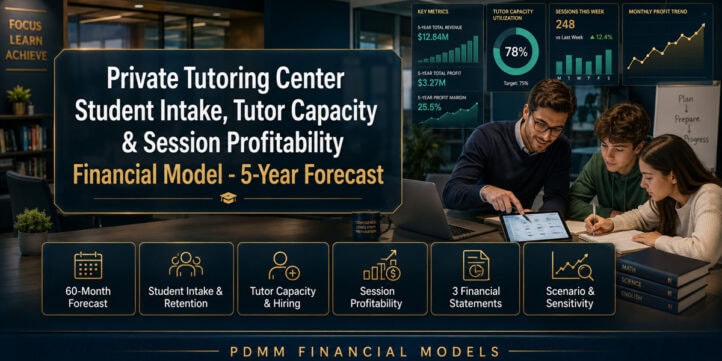
Private Tutoring Center Student Intake, Tutor Capacity & Session Profitability Financial Model – 5-Year Forecast
🎓 Private Tutoring Center Financial & Operating Model – 5-Year Forecast Running a tutoring business is not only an enrollment problem. A center can attract more students and still underperform if tutor capacity is poorly scheduled, group classes are underfilled, package pricing leaks margin, cancellations are unmanaged, or cash is tied up in the wrong places. This Excel model is designed to connect those operating decisions directly to financial performance.


🎓 Private Tutoring Center Financial & Operating Model – 5-Year Forecast
Running a tutoring business is not only an enrollment problem. A center can attract more students and still underperform if tutor capacity is poorly scheduled, group classes are underfilled, package pricing leaks margin, cancellations are unmanaged, or cash is tied up in the wrong places. This Excel model is designed to connect those operating decisions directly to financial performance.
The workbook provides a 60-month operating forecast with 5-year financial statements for a private tutoring center, after-school academy, subject tutoring business, test-prep provider, or independent tutor scaling into a larger operation. It combines student acquisition, cohort retention, session demand, tutor-hour capacity, hiring, service mix, pricing, deferred revenue, working capital, debt, profitability, cash flow, break-even, scenario analysis, sensitivity analysis, management KPIs, and automated integrity checks in one integrated decision system.
🎯 What the model helps you decide
Use the model to answer practical questions such as:
- How many active students can the current tutor base support?
- When should additional tutors be hired?
- Is one-to-one, small-group, or online tutoring producing the best contribution economics?
- How much can pricing change before demand or margin becomes unattractive?
- How much revenue is being lost through cancellations, refunds, or unused capacity?
- What student volume is required to break even?
- How sensitive is Year 5 EBITDA margin to price, tutor utilization, retention, and wage inflation?
- How much cash is generated or required as the business grows?
- What happens to revenue and EBITDA under Downside, Base, and Upside operating cases?
🧭 Model workflow
The workbook is built as a linked operating-to-financial model. Start by selecting a scenario and updating the centralized assumptions. The student funnel converts leads into trials and enrollments. Active students then roll forward through churn and reactivation. Student demand is translated into requested, billable, and delivered sessions, which then drive tutor-hour requirements.
Tutor capacity is calculated from available teaching hours, utilization targets, peak-time availability, group occupancy, and trigger-based hiring. Pricing and service-mix assumptions convert sessions into revenue, while tutor compensation creates direct delivery cost and contribution margin. Operating costs, working capital, deferred revenue, capital expenditure, debt service, tax, and funding logic then flow into the integrated profit and loss statement, balance sheet, and cash flow statement.
✏️ Centralized editable inputs
The assumptions area includes editable sample inputs for:
- Forecast start date, opening students, lapsed students, leads, cash, equity, debt, interest rate, debt term, and minimum cash
- Lead growth, trial conversion, enrollment conversion, churn, reactivation, sessions per student, price growth, wage inflation, group occupancy, cancellation rate, and marketing efficiency
- One-to-one in-person, small-group, and online tutoring service mix
- Starting prices, tutor hourly costs, and students per tutor hour
- Subscription, prepaid-package, and pay-as-you-go billing mix
- Package discount, cancellation refund rate, make-up rate, receivable days, payable days, and prepaid months
- Tutor availability, peak-hour share, hiring target utilization, capacity alert threshold, admin payroll, and payroll burden
- Rent, utilities, software, marketing, insurance, other operating expenses, inflation, capex, depreciation life, and tax rate
- Monthly demand seasonality
- Subject mix and pricing/cost multipliers for Mathematics, English / Language Arts, Science, and Test Preparation
- Grade-level mix and pricing/cost multipliers for Elementary, Middle School, High School, and Exam / Admissions Prep
Blue-font hardcodes are intended for user editing, while formulas and linked cells preserve model traceability.
⚙️ Operating and calculation engines
The model contains dedicated schedules for:
- Lead-to-trial-to-enrollment conversion
- Active-student and lapsed-student roll-forwards
- 12-month cohort retention analysis
- Requested, refunded, make-up, billable, and delivered student sessions
- One-to-one, small-group, and online tutor-hour requirements
- Total and peak-hour tutor utilization
- Hiring triggers, required tutor counts, new hires, capacity headroom, and revenue per tutor
- Subject and grade-level pricing differentiation
- Service-line pricing and customer billing mix
- Revenue by service and payment type
- Accounts receivable, deferred revenue, cash collections, and prepaid unused-session roll-forward
- Tutor labor, payroll burden, contribution margin, and revenue / contribution per tutor hour
- Fixed operating expenses, marketing, capex, cumulative capex, and depreciation
- Accounts payable, debt amortization, interest, principal repayment, and ending debt
- Cash tax using cumulative taxable income and loss carryforward logic
- Minimum-cash funding protection and equity injection logic where required
📊 Workbook coverage
The 23-sheet workbook includes:
- Cover & Navigation
- Executive Dashboard
- Scenario Control
- Centralized Assumptions
- Student Acquisition & Enrollment
- Cohorts & Retention
- Sessions & Scheduling
- Tutor Capacity & Hiring
- Pricing & Service Mix
- Revenue & Deferred Revenue
- Tutor Costs & Contribution Margin
- Operating Expenses & Capex
- Working Capital & Funding
- 5-Year Profit & Loss
- 5-Year Balance Sheet
- Monthly Cash Flow & Funding
- Break-Even Analysis
- Scenario Comparison
- Dedicated Exact Scenario Engine
- Sensitivity Analysis
- KPI & Operational Charts
- Audit & Integrity Checks
- Instructions & Methodology
📈 Scenarios and sensitivities
A central selector switches the live model between Downside, Base, and Upside assumptions. A separate exact 60-month scenario engine also calculates all three cases independently, allowing the scenario-comparison page to remain stable while the live model is changed.
The sensitivity section includes two Year 5 EBITDA-margin matrices:
- Price × tutor-utilization sensitivity
- Student-retention × tutor-wage-inflation sensitivity
These matrices help management see which commercial and staffing levers have the greatest effect on profitability.
📌 Dashboard and management KPIs
The Executive Dashboard provides decision-ready KPI cards and native Excel charts covering revenue, EBITDA margin, active students, tutor count, cash, contribution margin, CAC, LTV / CAC, student growth, tutor utilization, service revenue mix, and liquidity.
The KPI scorecard expands this analysis across the five-year horizon with metrics including:
- Revenue, EBITDA, and net income
- Average active students and year-end tutors
- Average tutor utilization and peak-hour utilization
- Ending cash and equity funding required
- Revenue by one-to-one, small-group, and online tutoring
- Average CAC per new student
- Contribution margin
- Revenue per tutor hour
- Student lifetime value
- LTV / CAC
- CAC payback
- Average students per tutor
✅ Practical use cases
- Business planning: translate a tutoring-center growth plan into a complete operating and financial forecast.
- Five-year forecasting: project student activity, tutor staffing, revenue, margins, statements, and cash over 60 monthly periods.
- Profitability management: compare contribution economics across one-to-one, small-group, online, subject, and grade-level offerings.
- Cash-flow planning: evaluate working capital, deferred revenue, capex, debt service, cash reserves, and potential equity funding needs.
- Pricing decisions: test session prices, package discounts, payment mix, subject premiums, and grade-level pricing effects.
- Scenario planning: compare exact Downside, Base, and Upside revenue and EBITDA paths.
- Sensitivity analysis: stress Year 5 EBITDA margin against pricing, tutor utilization, retention, and tutor wage inflation.
- Capacity planning: determine tutor-hour requirements, utilization, hiring needs, peak-hour pressure, and capacity headroom.
- Break-even planning: calculate required billable sessions, active students, tutor hours, and utilization at break-even.
- Marketing economics: connect marketing spend, lead conversion, CAC, student LTV, LTV / CAC, and CAC payback.
- Subscription and prepaid-package management: track billing mix, deferred revenue, purchased sessions, delivered sessions, and unused-session balances.
- Management reporting: use the executive dashboard, KPI scorecard, financial statements, and integrity checks for recurring internal review.
👥 Intended users
This model is designed for independent tutors scaling beyond solo practice, private tutoring and tuition-center owners, after-school learning centers, subject-specific academies, test-preparation providers, operators evaluating staffing and pricing decisions, and consultants preparing financial plans for tutoring businesses.
📦 Delivered files
The premium package includes the editable client-ready Excel workbook, a full 23-sheet PDF preview with one worksheet per page, and a curated set of buyer-facing PNG screenshots. The audited workbook also includes 37 automated integrity checks, with the supplied Base sample case returning 37 passes and 0 fails.
The workbook uses fictional sample assumptions so every formula, chart, scenario, sensitivity, KPI, and financial statement is populated and immediately demonstrable. Replace the blue-font inputs with business-specific assumptions to adapt the model to a real tutoring operation.
Similar ProductsOther customers were also interested in...



 eFinancialModels
Electric Vehicle (EV) Charging Station Financial M...
With this comprehensive 5- or 10-year monthly tool, investors can assess the viability of setting up... Read more

Financial Model for Mobile App | Mobile App Busine...
The Mobile App Financial Plan Template in Excel allows you to develop financial projections when lau... Read more

 HenrySheykin
Food Truck Financial Model Excel Template
The Food Truck Financial Model helps entrepreneurs, founders, business owners, consultants, and anal... Read more

Green Hydrogen Production from Wind Energy Financi...
The Green Hydrogen from Wind Financial Model aims to comprehensively forecast a horizon of 40 years ... Read more

Simple Mutual Non-Disclosure Agreement Template
Protect your business secrets with ease using our Simple Mutual Non-Disclosure Agreement Template. S... Read more

Solar Energy Financial Model
The Solar Energy Financial Model Spreadsheet Template in Excel assists you in preparing a sophistica... Read more

 Peter Graf
The Customer-Centric Financial Model for Restauran...
Starting a restaurant without a financial plan is like driving a car blindfolded. You wouldn´t do i... Read more
You must log in to submit a review.