
0 ITEMS

Auto Repair Shop Acquisition & SBA Underwriting Financial Model (Effective Labor Rate, Bay Capacity, DSCR)
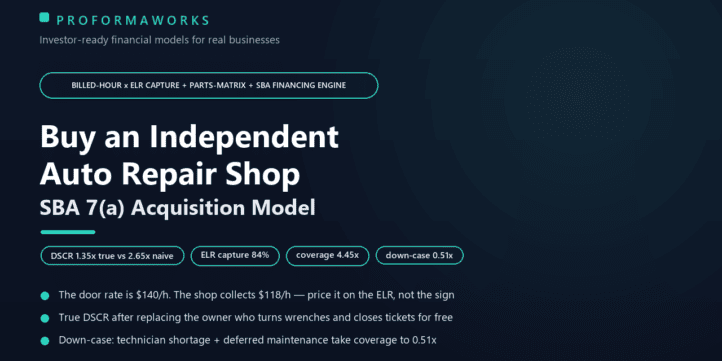
Underwrite the acquisition of a single independent auto repair shop the way an SBA 7(a) lender will: labor revenue built bottom-up from bays, technicians and billed hours at the effective labor rate the shop actually captures ($118.02 against a $140 door rate), a parts matrix priced separately, an owner-technician replacement, and a DSCR gate. The door-rate pro-forma price ($773,469) is printed next to the real one ($589,059): a $184,410 overpay avoided. 11 sheets, Excel + Google Sheets, 140 automated checks.
| Car Services, Financial Model, Retail, Service Businesses |
| Break-Even, Business Plans, Business Valuation, Cash Flow Projections, Debt Service Coverage, Excel, Financial Model, Loans, Pro-Forma |


The sign on the wall says $140 an hour. The bank funds $118. That gap is $184,410 of purchase price.
This is an acquisition-underwriting model for an independent auto repair shop financed with an SBA 7(a) loan — not a startup or operating forecast. It is built for the searcher, the ETA buyer or the first-time owner-operator who must prove to a lender that the shop services its debt.
The engine. Labor revenue is manufactured from physical capacity rather than typed in: 4 technicians × 8,000 available hours × 63.6% overall utilization (productivity × efficiency) = 5,085 billed hours, priced at the effective labor rate. Parts run off a parts-to-labor ratio at their own matrix margin, with comebacks and warranty as an explicit line. The result is cross-checked two independent ways: 2,400 repair orders at a $525 average repair order, and 2.12 hours per RO.
The number that decides the deal. A shop’s posted door rate is not what it collects. Discounts, giveaway diagnostics, comebacks and unbilled hours drag $140 down to $118.02 — an 84.3% capture. Underwrite at the sign and you overstate labor revenue by $111,870, which at a 60% labor margin drops roughly $67,000 straight onto SDE. Price that at 2.75× and the shop “costs” $773,469 instead of $589,059. The model prints both prices side by side.
The add-back the seller’s sheet skips. In most independent shops the owner is the A-technician on hard diagnostics or the service advisor who closes the estimates. A buyer who will not stand in that bay must hire it ($75,000), and must reserve for lifts, alignment racks and scan tools ($18,000/yr). Deduct both and the true DSCR is 1.35× against the 2.65× a broker’s add-back sheet implies. The gap is the owner’s own labor.
An honest down-case. In this business revenue is a technician’s hour, and the pipeline fills roughly 71% of technician demand (TechForce: about 20,780 needed a year). Car count −8% plus a 4% rate discount to hold volume drives DSCR to 0.51×, far below the 1.25× SBA program floor. Losing one of four technicians removes 25% of billed hours.
What is inside. An 11-sheet Excel workbook (Google Sheets compatible — no macros, no add-ins, no external links), 5-year projections, every assumption editable and highlighted; a 23-page PDF guide with sources; the ELR bridge, the gross-profit stack, the SDE add-back bridge, the SBA 7(a) capital stack with a full-standby vs amortizing seller-note toggle, a real amortisation schedule, the DSCR gate, labor-gross-profit coverage (4.45×), debt yield, the break-even effective labor rate ($115.39/h), cash-on-cash and a 5-year equity multiple (leverage-amplified — flagged). Three shop profiles reload the whole engine: Tire-and-Service Volume (2.40×), General Repair (2.75×), Euro/Import Specialist (3.25×). The tire shop books a bigger top line on a thinner SDE margin, because tires are pass-through: read the shop on the gross profit, not the revenue.
Honest by design. SDE is held at 17.0% and Adjusted EBITDA at 9.6% — deliberately below the “15-20% net” of trade blogs, because that is what remains once the owner is paid for and the equipment is reserved. The down-case is not a recession back-test (no auto-repair series supports one) but two defensible mechanisms, and the model says so. Comeback rate and technician productivity are user inputs with guidance bands, not invented benchmarks; the 1.25× floor cited is a standard SBA 7(a) program benchmark, not an industry rule. There is no IRR by design: on a single small deal it is hostage to the exit multiple. Benchmarks referenced from PartsTech, Ratchet+Wrench, BizBuySell and TechForce. Educational planning tool — not financial, lending or legal advice.
Similar ProductsOther customers were also interested in...



 eFinancialModels
Electric Vehicle (EV) Charging Station Financial M...
With this comprehensive 5- or 10-year monthly tool, investors can assess the viability of setting up... Read more

Financial Model for Mobile App | Mobile App Busine...
The Mobile App Financial Plan Template in Excel allows you to develop financial projections when lau... Read more

 HenrySheykin
Food Truck Financial Model Excel Template
The Food Truck Financial Model helps entrepreneurs, founders, business owners, consultants, and anal... Read more

Green Hydrogen Production from Wind Energy Financi...
The Green Hydrogen from Wind Financial Model aims to comprehensively forecast a horizon of 40 years ... Read more

Simple Mutual Non-Disclosure Agreement Template
Protect your business secrets with ease using our Simple Mutual Non-Disclosure Agreement Template. S... Read more

Solar Energy Financial Model
The Solar Energy Financial Model Spreadsheet Template in Excel assists you in preparing a sophistica... Read more

 Peter Graf
The Customer-Centric Financial Model for Restauran...
Starting a restaurant without a financial plan is like driving a car blindfolded. You wouldn´t do i... Read more
You must log in to submit a review.