
0 ITEMS

Accounting / Bookkeeping / Tax Firm Acquisition & SBA Underwriting Financial Model
A 5-year, SBA-lender-ready model for buying an independent accounting / bookkeeping / tax firm. It reads the book on collected (realized) fees, not the standard-rate schedule; splits recurring CAAS from seasonal tax prep; replaces the owner-producer; and prints the true DSCR next to the broker’s naive one, with a transfer-attrition down-case.
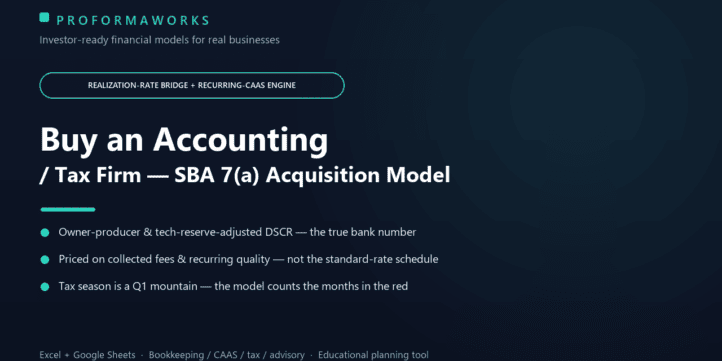


Most accounting-firm templates are startup or operating forecasts, and most brokers headline the standard-rate fee schedule and anchor on 1x gross fees. But accountants write work down: you collect a realization rate, not the rack rate, and the seller is usually the top biller whose clients may not all stay after the sale. This 5-year, SBA-lender-ready model reads an independent accounting / bookkeeping / tax firm the way a disciplined buyer and a bank do.
Realization-rate bridge and revenue-quality engine. Four service lines (recurring compliance / CAAS, annual tax prep, non-recurring advisory, attest), each quoted at a standard fee, written down by its realization rate to net collected fees, then at its own gross margin. The blended realization (about 89%) is the honesty number: a book quoted at standard rates overstates by about 11%. The recurring-CAAS share (about 45%) and the renewable-book share (about 88%), not the top line, decide the multiple.
The summer cash trough, counted. A tax practice collects most fees in a roughly 14-week Q1 spike while the SBA loan amortises over all twelve months. The model spreads revenue across the calendar and counts the months where collections do not cover the bank: four in a tax-season practice, zero in a year-round CAAS firm. Size the working-capital line to the real seasonality.
The honesty a broker’s sheet skips. It reads the book on collected fees, pays a market-rate producer to replace the owner-biller, and books an explicit technology and transition reserve. So the true DSCR (1.43x) sits next to the naive broker DSCR (2.88x); the gap is the producer salary and the reserve. The recurring-vs-lumpy carve-out re-rates the non-recurring advisory work.
The down-case that matters. The sector’s number-one risk is client attrition on transfer. If post-sale retention lands at the profession’s 75-80% average instead of 90%, plus AI and fee compression, DSCR drops to 0.66x, well below the 1.25x floor, and the earnout clawback trips. The 4.5x renewable-book coverage is the cushion.
SBA 7(a) capital stack with buyer equity, a seller note (full-standby vs amortizing lever), the DSCR gate, a goodwill $500k valuation-trigger flag, and a 5-year cash-on-cash and equity multiple. No IRR is printed, deliberately.
Inside: ten Excel sheets (every calculation a formula, Google-Sheets-safe, no macros), a 25-page PDF guide, three firm profiles (Solo Tax-Practice / Balanced Compliance Firm / CAAS-Advisory Forward), and a sourced benchmarks sheet. Educational planning tool, not financial, legal, tax or investment advice.
Similar ProductsOther customers were also interested in...



 eFinancialModels
Electric Vehicle (EV) Charging Station Financial M...
With this comprehensive 5- or 10-year monthly tool, investors can assess the viability of setting up... Read more

Financial Model for Mobile App | Mobile App Busine...
The Mobile App Financial Plan Template in Excel allows you to develop financial projections when lau... Read more

 HenrySheykin
Food Truck Financial Model Excel Template
The Food Truck Financial Model helps entrepreneurs, founders, business owners, consultants, and anal... Read more

Green Hydrogen Production from Wind Energy Financi...
The Green Hydrogen from Wind Financial Model aims to comprehensively forecast a horizon of 40 years ... Read more

Simple Mutual Non-Disclosure Agreement Template
Protect your business secrets with ease using our Simple Mutual Non-Disclosure Agreement Template. S... Read more

Solar Energy Financial Model
The Solar Energy Financial Model Spreadsheet Template in Excel assists you in preparing a sophistica... Read more

 Peter Graf
The Customer-Centric Financial Model for Restauran...
Starting a restaurant without a financial plan is like driving a car blindfolded. You wouldn´t do i... Read more
You must log in to submit a review.