0 ITEMS

Risk-Adjusted Valuation: How to Value a Business to Buy

A buyer values a small business by normalising the seller’s earnings, applying a market multiple, and then lowering the price for owner dependency, customer concentration and illiquidity. This guide walks through each step with a hypothetical target, where 300,000 USD of earnings becomes a risk-adjusted value of 562,500 USD.
Key Takeaways
- Normalised earnings, not the seller’s reported profit, are the base of every small business valuation.
- In US third-quarter 2026 data, smaller deals sold at lower multiples, so buyers should test asking prices against closed sales.
- Owner dependency and customer concentration belong in the required return, and each risk should be priced only once.
- An illiquidity discount reflects a thin buyer pool and a slow exit, and it should be tested rather than assumed.
- In the worked example, risk adjustments cut a hypothetical base value of 750,000 USD by 25% to 562,500 USD.
A buyer starts with normalised earnings, not reported profit
Normalised earnings are the profit a new owner can expect once items that will not continue are removed. In small deals the usual measure is seller’s discretionary earnings (SDE), which is pre-tax profit plus one owner’s total pay and benefits, with interest, depreciation, amortisation and one-off items added back. Where a hired manager will run the business, earnings before interest, tax, depreciation and amortisation (EBITDA) is cleaner, because a market-rate salary is deducted first.
The buyer rebuilds three years of results, adds back personal costs, removes one-off income and, on the EBITDA path, charges a fair wage for the work the owner does. Tax returns, bank statements and the books should agree, and a structured financial due diligence review is where any gap surfaces.
Market multiples set the base value, and small deals sit low
A multiple turns normalised earnings into a starting price. A multiple is the price paid divided by earnings, and a buyer who demands a higher return pays a lower multiple.
Size changes the multiple. Reporting on third-quarter 2026 data from BizBuySell, a US marketplace for business sales, on closed United States transactions, Small Business Trends said the average cash-flow multiple was 3.73 for larger transactions, versus 2.30 for smaller ones.
These averages cross sectors, so they anchor a range and do not set a price. The buyer narrows it with sales of similar businesses. Adjustments for the target’s own weaknesses then move the price within that range, and ready business valuation models can organise the comparison.
Risk adjustments turn a market value into a buyer’s price
Small-business risks reduce value either through a higher required return or through a discount, and each risk should be priced once.
Owner dependency. This is the share of customers, know-how and supplier relationships that sit with the seller personally. When the owner leaves, earnings can leave too.
The buyer prices it once. On an EBITDA basis, a market salary for a replacement manager is deducted from earnings and a premium on the required return covers the transition risk. On an SDE basis the owner’s labour stays in earnings, so only the premium applies. Pricing the same risk in both places double counts it.
Customer concentration. One customer that supplies a large share of revenue can end the contract after the sale. The buyer reads the contract, checks renewal dates and adds a premium for any customer above a chosen share of revenue, a threshold that is a judgment call.
Illiquidity. This means the buyer cannot sell the business quickly or cheaply, because few people can finance and run a small company. Valuers measure it with a discount for lack of marketability (DLOM), a percentage cut to value. A valuation reference updated in January 2024 reports that studies of restricted stock, which is listed-company stock that cannot be freely sold for a set period, typically find discounts of 20% to 50%.
Those studies cover shares of listed companies. A buyer of a whole small business should therefore treat the range as an outer limit and test smaller discounts. Multiples from closed private sales already carry the typical small-deal illiquidity, so the explicit discount covers only what the target adds beyond that, such as a niche buyer pool or a hard-to-finance structure. It is applied last, after the rate adjustments.
When outcomes are uncertain, risk-adjusted net present value, which weights each scenario by its probability to give the value today of future cash flows, offers a cross-check.
Worked example: from 300,000 of earnings to 562,500
The hypothetical target has normalised SDE of 300,000 USD and will be run by its buyer as owner-operator. The example uses an assumed multiple of 2.5 times SDE, set near the 2.30 small-deal average above, and a buyer should always confirm which earnings measure a quoted multiple uses. Assume a base capitalisation rate (the earnings yield on the price paid) of 40%, which means paying 2.5 times earnings. Assume an owner dependency premium of 5 percentage points, a customer concentration premium of 3 points (assuming the largest customer supplies 30% of revenue) and an extra illiquidity discount of 10% for a niche buyer pool, set deliberately below the 20% to 50% restricted-stock range because the buyer acquires control of the whole business and typical illiquidity is already in the multiple. Growth is assumed to be zero, so the capitalisation rate equals the required return. Every input is an assumption chosen for illustration.
| Step | Capitalisation rate | Value (USD) | Change (USD) |
|---|---|---|---|
| Base value | 40% | 750,000 | n/a |
| Add owner dependency premium | 45% | 666,667 | -83,333 |
| Add customer concentration premium | 48% | 625,000 | -41,667 |
| Apply 10% extra illiquidity discount | 48% | 562,500 | -62,500 |
Each value is earnings divided by the rate, rounded to the nearest dollar: 300,000 / 0.40 = 750,000, 300,000 / 0.45 = 666,667 and 300,000 / 0.48 = 625,000. The 10% discount then gives 625,000 x 0.90 = 562,500, which is 25% below the base value.
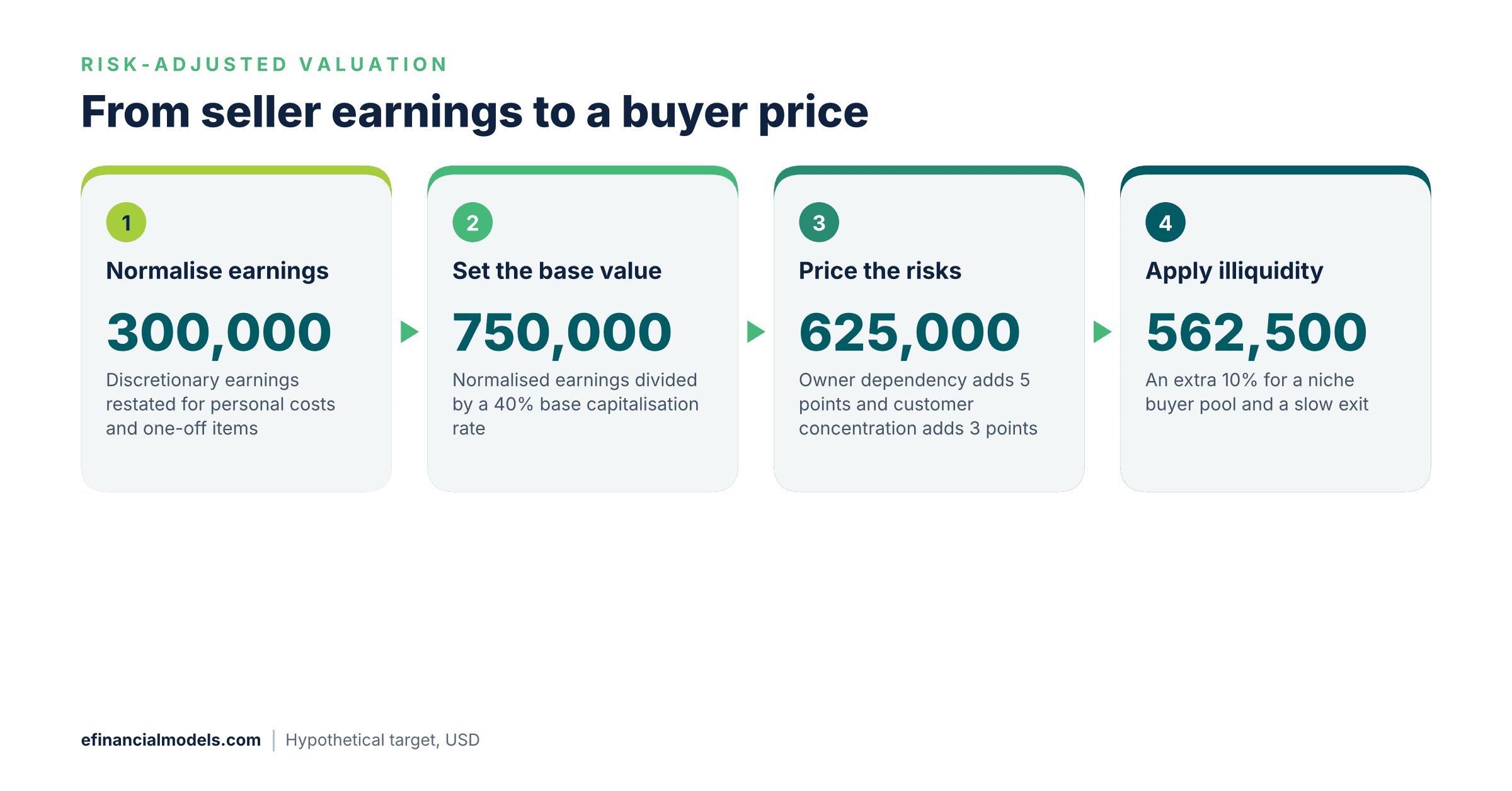
The worked example as a four-step workflow in USD, from seller earnings to a buyer price. Source: eFinancialModels Analysis
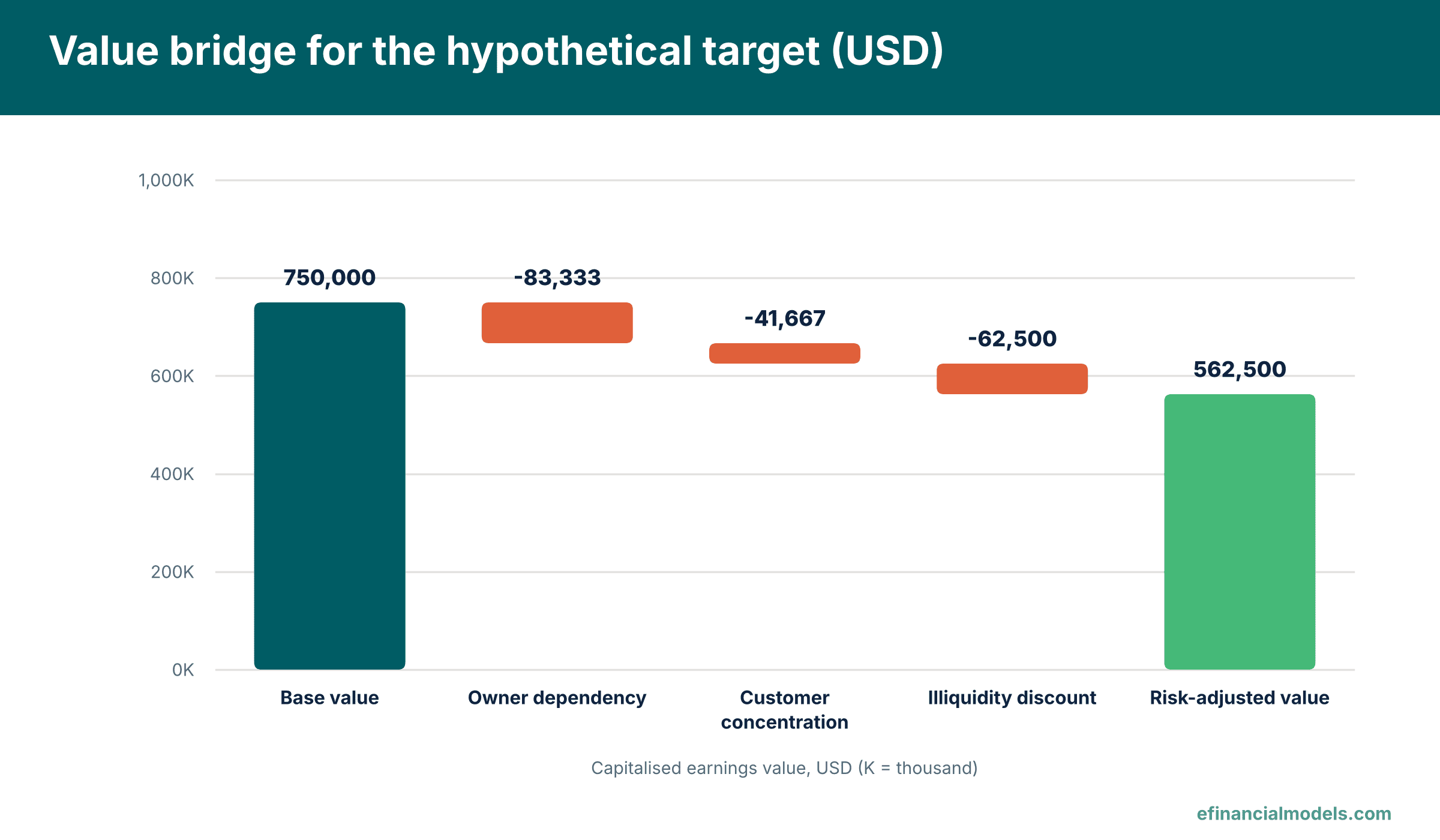
Owner dependency removes the most value, followed by illiquidity and customer concentration, in the hypothetical example. Source: eFinancialModels Analysis
The result is a ceiling for the offer, not the offer itself. If the seller commits to a 12-month transition and the owner premium falls from 5 points to 3, the rate becomes 46% and the final value rises to 586,957.
Varying the extra illiquidity discount between 5% and 15% moves the final value between 593,750 and 531,250 (625,000 x 0.95 and 625,000 x 0.85), so the central case of 562,500 sits inside a range of 531,250 to 593,750.
Set a price range and a walk-away number
The risk-adjusted value is the walk-away price, and the sensitivity range is not a negotiating range. In the example, an opening offer of 531,250 leaves 31,250 of room below the central ceiling of 562,500, and the buyer never pays above that ceiling.
This guide covers capitalised earnings and multiples for small private businesses, and the data and lender rules cited are for the United States. Forecast-based and asset-based methods suit larger or asset-heavy targets and are outside its scope, so a valuation adviser should be consulted for them. A family-business successor buying from relatives should use the same arm’s-length earnings and a market salary for the successor, because a price set on sentiment misleads lenders and co-owners.
Documentation then decides whether the price holds. Earnings that the books cannot support, a lease that ends soon or a key employee who is not under contract each justify moving the rate or pausing the deal.
Frequently Asked Questions
Should a buyer use SDE or EBITDA for a small business?
The choice depends on who will run the business after closing. If the buyer will work in it full time, the buyer takes the owner’s pay as part of the return, and SDE already adds that pay back, so SDE fits. If the buyer will hire a manager, EBITDA after that manager’s salary is the right base. The multiple must match the measure: applying an EBITDA multiple to SDE overstates value, because SDE has no manager cost deducted.
How large should the illiquidity discount be for a whole business?
There is no fixed answer, so a buyer should test a band rather than pick one number. Start from the exit: how many realistic buyers exist, how long a sale would take and what financing they would need. Showing the price at a low, middle and high discount makes the sensitivity visible before negotiation. The 10% used in the worked example is one point in that band, chosen for a business with a niche buyer pool.
How do lender rules affect what a buyer can pay?
Financing sets a practical limit on price: a 10% equity injection on a purchase of 562,500, the example’s ceiling, would be 56,250 before other project costs. The Small Business Administration (SBA) states that the maximum loan amount for a 7(a) loan is $5 million.
A 2026 law-firm briefing from Starfield and Smith says that under Standard Operating Procedure (SOP) 50 10 8.1, which takes effect for all SBA loans approved on or after October 1, 2026, the equity injection requirement for an initial acquisition is 10% of total project costs plus additional uses of proceeds in the loan.
How should a buyer treat an earn-out or a seller note?
Both shift risk back to the seller. An earn-out is a payment that depends on later results, and a seller note is a loan from the seller repaid over time. Neither costs the full headline amount today. The buyer discounts each at a rate reflecting its risk and compares the total with the ceiling. Tying the earn-out to retained customers directly answers concentration risk.
What return should a search-fund buyer expect?
A searcher raising capital for a first acquisition should treat published returns as context and not as a required rate. The Stanford Graduate School of Business reports in its 2026 search fund study that the US and Canadian search funds it tracks generated an aggregate internal rate of return (IRR), which is the annualised return on invested money, of 33.9% as of December 31, 2025. That is a pooled historical result across funds, so it should inform the investor conversation without replacing a deal-specific rate.
Conclusion
A defensible price for a small business comes from normalised earnings, a market-based starting multiple, and explicit adjustments for owner dependency, customer concentration and illiquidity, each priced once. Buyers who want an independent number before making an offer can request the eFinancialModels Business Valuation Service, which delivers a valuation model and report built on capitalised earnings, comparables and precedent transactions.