0 ITEMS

How Much Does a Custom Financial Model Cost in 2026?

A custom financial model costs from about USD 1,800 for a startup model to about USD 48,750 for a mergers and acquisitions model in this guide’s illustrative estimator, which prices build hours only at Standard complexity, while vendors publish fixed-price tiers from USD 750 in 2026. Model type, complexity, deadline and consultant tier drive the price, and a written scope is what makes a quote accurate.
Key Takeaways
- Vendor prices published in 2026 start at USD 750 for an entry tier and at USD 3,000 for a 3-statement model.
- In the illustrative estimator, a startup model costs USD 3,000 to USD 5,200 at a boutique firm, with a USD 4,100 mid estimate.
- Complexity, purpose, industry, deliverable depth, timeline and consultant experience are the six factors that move a quote the most.
- Hourly billing suits open scope, a fixed fee suits a written scope, and a detailed scope document makes competing quotes comparable.
- Maintenance is a separate cost, and the estimator below prices the build only.
A custom financial model costs from under USD 1,000 to tens of thousands of dollars
Published vendor prices start at USD 750 for an entry-level fixed-price tier and at USD 3,000 for a standard 3-statement model. Waveup states that its engagements start at USD 3,000 for a standard 3-statement model (Waveup, 2026). A 3-statement model links the income statement, balance sheet and cash flow statement so that a change in one flows through all three.
Business Plan Firm lists fixed prices of USD 750, USD 1,250 and USD 1,950 across its three tiers, updated 30 October 2026 (Business Plan Firm, 2026). Both sources are vendors publishing their own prices rather than independent surveys, and the pages do not name a country. They price packaged work, whereas the estimator below prices a consultant’s hours at stated rates, so the two sets of figures differ. A packaged tier of USD 750 to USD 1,950 can suit a simple startup forecast with standard outputs, while the boutique range of USD 3,000 to USD 5,200 applies when a consultant builds to a custom scope.
The illustrative estimator in this guide produces a wider spread because it prices complexity. At Standard complexity, its five model types range from USD 1,800 for a startup model at the lowest freelancer rate to USD 48,750 for a mergers and acquisitions (M&A) due-diligence model at the highest top-tier rate.
Six factors determine the price of a custom financial model
Each factor changes the hours a consultant must spend, and hours multiplied by an hourly rate produce the quote.
- Model complexity. An integrated model, where every statement and schedule feeds the others, takes more build and review time than a one-sheet forecast.
- Purpose. Fundraising, project finance, acquisition and valuation models need different checks, and an investor-facing model faces more scrutiny. Fundraising models for early companies sit in the eFinancialModels Startup Financial Models collection.
- Industry requirements. Real estate, software and manufacturing models each need sector-specific revenue and cost logic, which adds specialist time.
- Deliverable depth. A spreadsheet alone costs less than one with written documentation, a user guide and training.
- Timeline and urgency. Compressed deadlines add hours, and the estimator applies a 1.25x multiplier to rush work as an illustrative assumption.
- Consultant experience and location. Rates rise with seniority and differ by market.
Pay data gives context, not an input to the estimator. The U.S. Bureau of Labor Statistics (BLS) reports a median hourly wage of USD 47.80 for management analysts in May 2023 (BLS, 2023) and a median annual wage of USD 101,860 in May 2025 (BLS, 2025), and it projects employment of management analysts to grow 10 percent from 2025 to 2035 (BLS, 2025 to 2035 outlook) and of financial analysts 7 percent over the same period (BLS, financial analysts). These are employee wages for one occupation, and they exclude the overhead and unbilled time that a consultant’s rate must cover. The estimator’s rates are separate illustrative assumptions.
Worked example: cost estimator results for five model types
The estimator multiplies build hours by an hourly rate. Every input is an illustrative planning assumption, not a market statistic. Base build hours are 20 for a startup model, 36 for an integrated 3-statement model, 45 for a valuation model, 75 for a project finance model and 150 for an M&A due-diligence model. Hourly rates are USD 75 to USD 125 for a freelancer, USD 125 to USD 200 for a boutique firm and USD 200 to USD 250 for a top-tier firm. Complexity multipliers are 0.75x for Basic, 1.00x for Standard and 1.50x for Advanced, and the rush multiplier is 1.25x. Review and documentation overhead adds 20% of labour cost, and the high case adds a further 10% contingency.
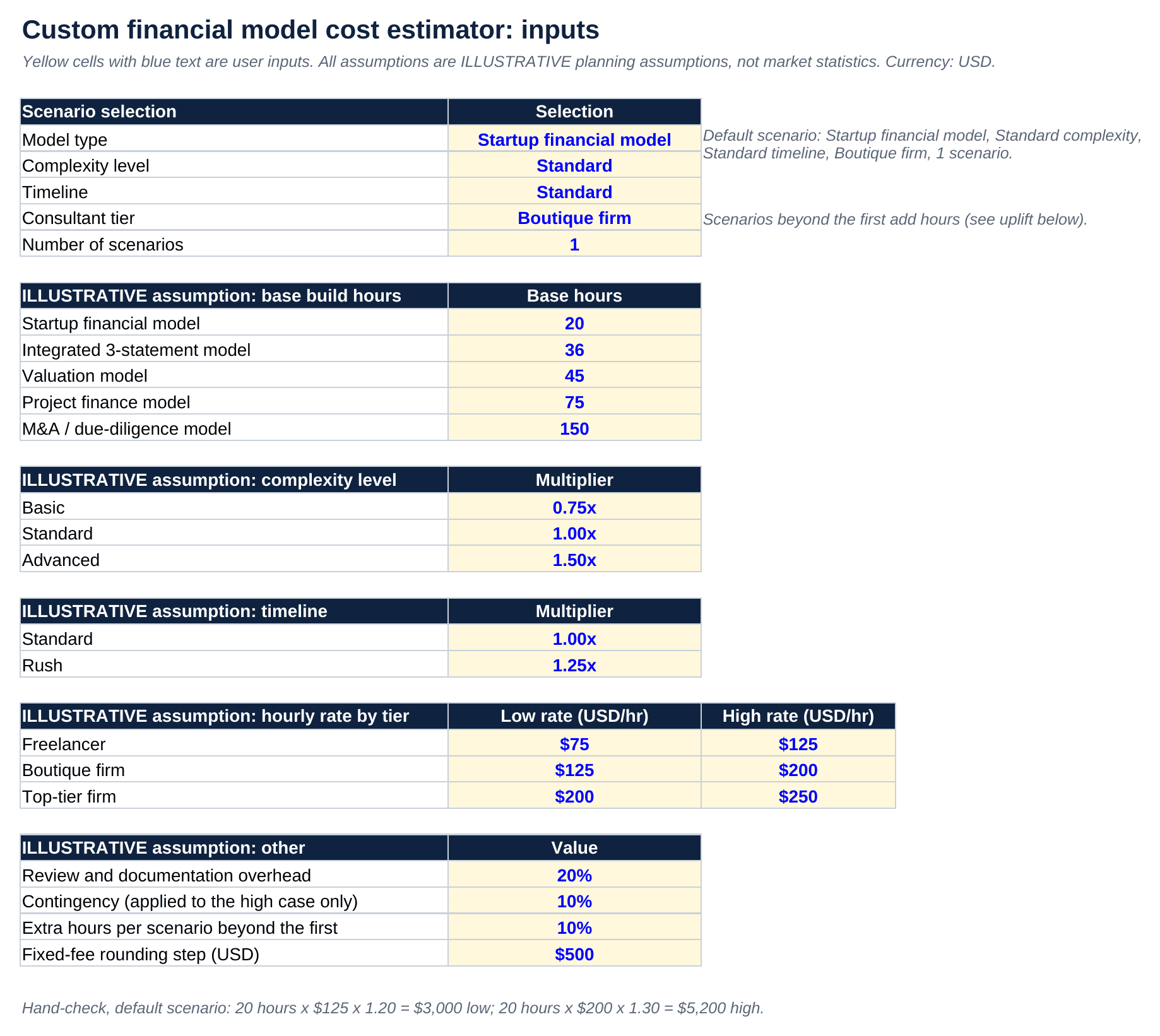
The inputs sheet holds every illustrative assumption in yellow cells that a reader can change.
Assume the default scenario: a startup model, Standard complexity, a Standard timeline, one scenario and a boutique firm. Hours are 20. Low case: 20 hours x USD 125 = USD 2,500 of labour, plus 20% review and documentation overhead (USD 500), gives USD 3,000. High case: 20 hours x USD 200 = USD 4,000 of labour, plus 20% review and documentation overhead and 10% contingency (30% in all, USD 1,200), gives USD 5,200. The mid estimate is their average, USD 4,100. Rounded to the nearest USD 500, the fixed-fee equivalent is USD 4,000, an implied USD 200 per hour.
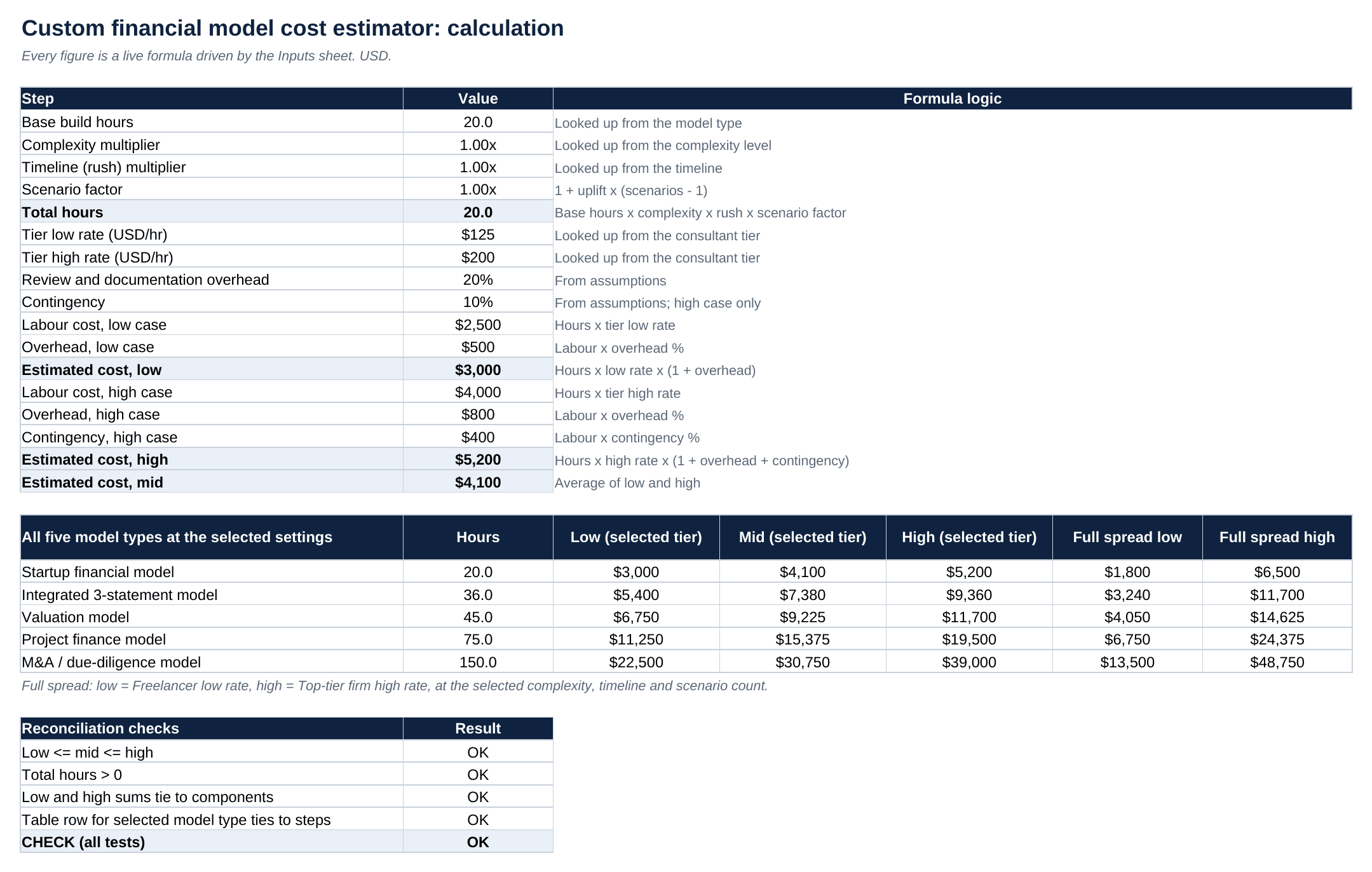
The calculation sheet turns the selected inputs into hours and a low, mid and high cost.
The same calculation applied to all five model types, at Standard complexity and a Standard timeline, gives the illustrative results below. The full spread runs from the freelancer low rate to the top-tier high rate.
| Model type | Hours | Boutique low | Boutique mid | Boutique high | Full spread |
|---|---|---|---|---|---|
| Startup | 20 | USD 3,000 | USD 4,100 | USD 5,200 | USD 1,800 to 6,500 |
| Integrated 3-statement | 36 | USD 5,400 | USD 7,380 | USD 9,360 | USD 3,240 to 11,700 |
| Valuation | 45 | USD 6,750 | USD 9,225 | USD 11,700 | USD 4,050 to 14,625 |
| Project finance | 75 | USD 11,250 | USD 15,375 | USD 19,500 | USD 6,750 to 24,375 |
| M&A due diligence | 150 | USD 22,500 | USD 30,750 | USD 39,000 | USD 13,500 to 48,750 |
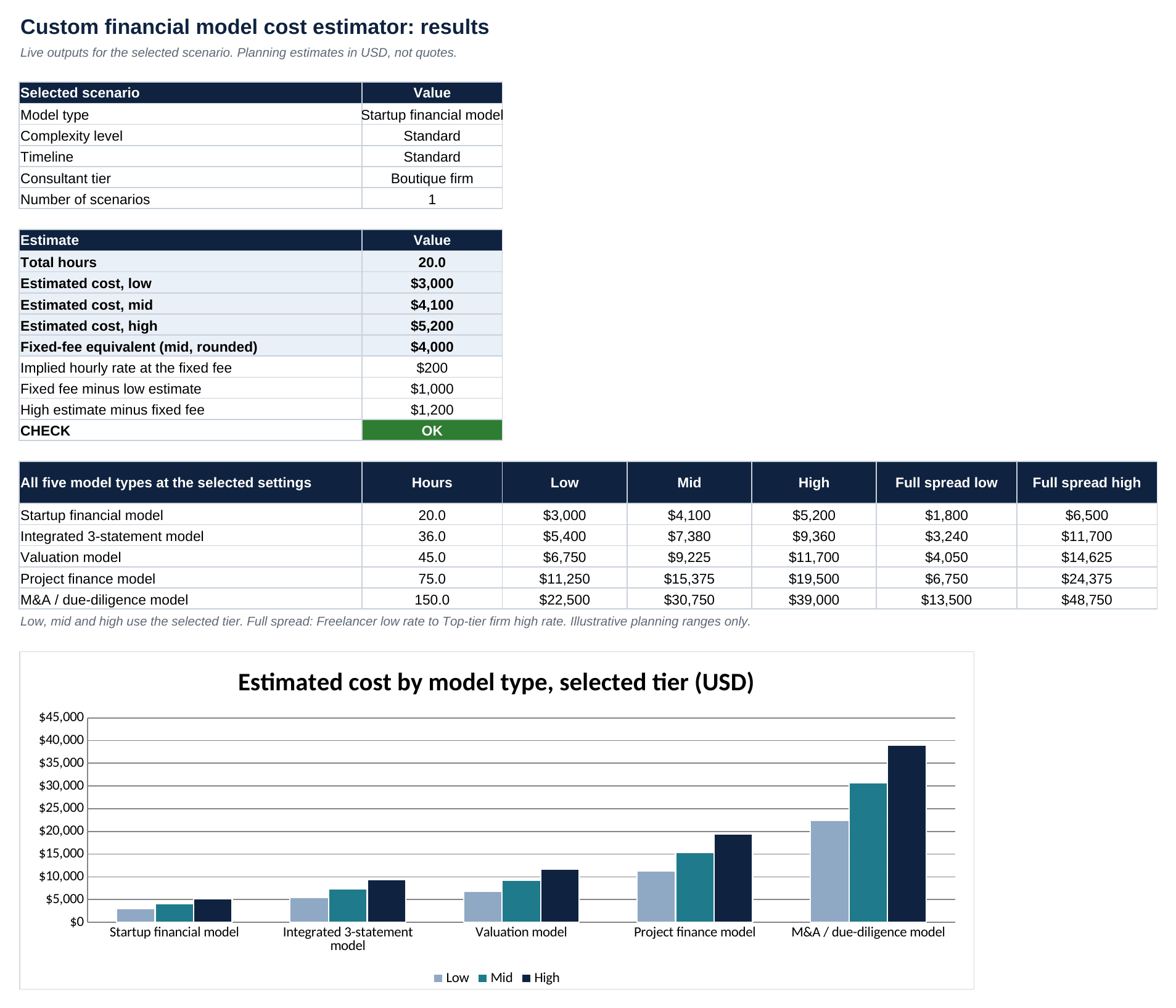
The results sheet compares all five model types and confirms that the check cell reads OK.
A reader can replace the assumptions with the terms of a real quote to test whether it is reasonable.
Hourly billing suits open scope, and fixed fees suit defined scope
| Pricing model | Pros | Cons | Best for |
|---|---|---|---|
| Hourly | Pays only for hours used | Total cost is unknown at the start | Changing requirements |
| Fixed fee | Locks scope and cost | Changes need a written change order | Clear, documented outputs |
Rate data differs widely by source. ZipRecruiter reports an average of USD 47.71 an hour for freelance financial modeling in the United States in September 2026, with most workers earning USD 24.28 to USD 61.78 (ZipRecruiter, 2026). A goLance guide puts freelance financial analysts at USD 35 to USD 300 an hour worldwide in 2026 (goLance, 2026). The first figure is worker pay and the second a vendor guide, so neither equals what a boutique firm bills.
The choice follows the scope. A founder who can write down outputs, inputs and deadlines should ask for a fixed fee, and a founder still deciding what to model should pay hourly with a cap.
Five steps produce an accurate quote
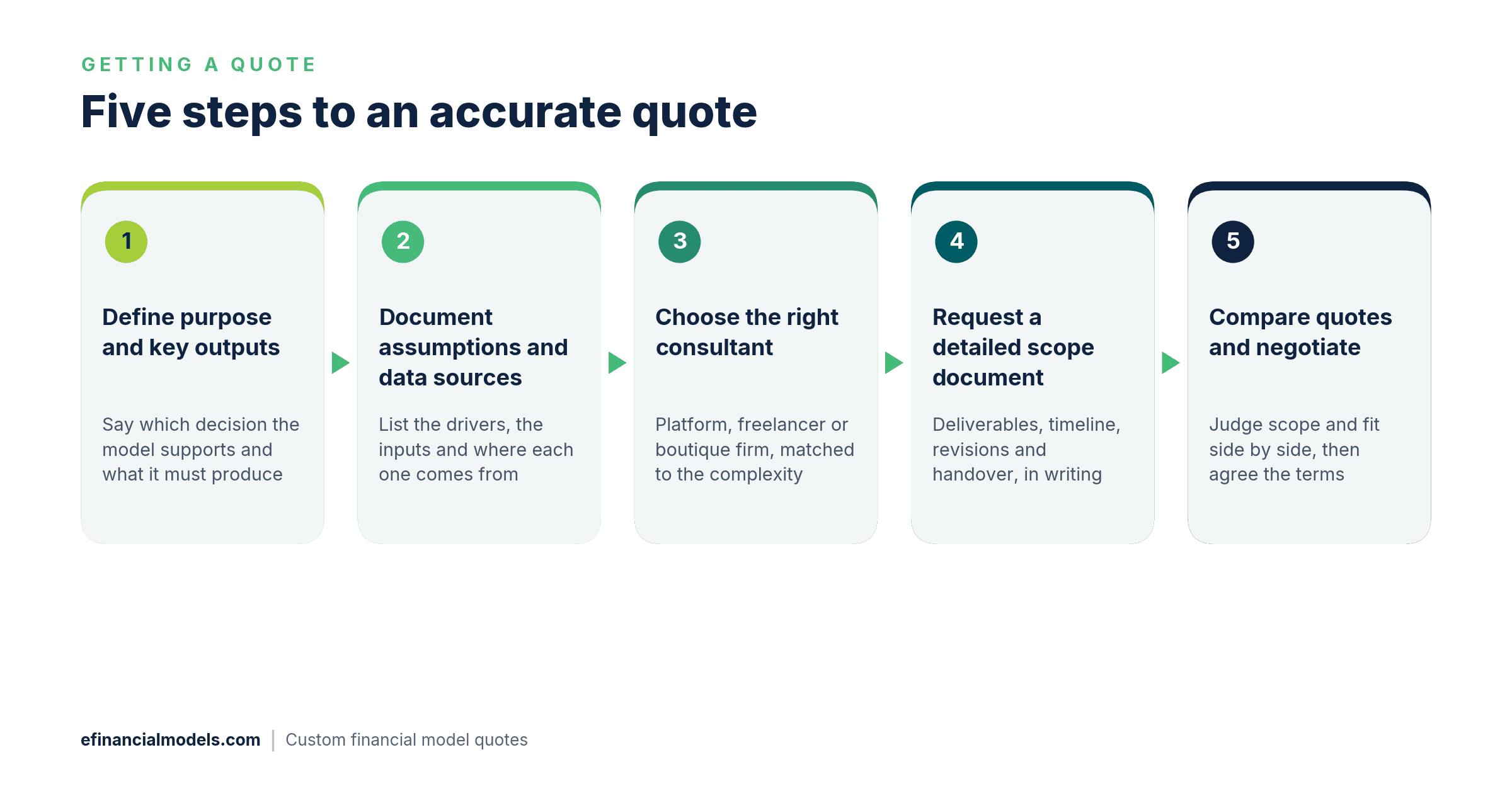
A clear brief and a written scope make quotes easier to compare like for like.
- Define the purpose and key outputs. State who will read the model and which decisions it must support.
- Document assumptions and data sources. List growth, pricing, cost and funding inputs, and where each came from.
- Choose the consultant. Compare a marketplace freelancer, an independent specialist and a boutique firm on sample work.
- Request a scope document. It should list deliverables, revisions, timeline and what is excluded.
- Compare quotes and negotiate. Match each quote against the same scope, then trade price for timeline or deliverables.
Five budgeting mistakes inflate the final bill
- Underestimating complexity. Extra scenarios and entities add hours, and scope creep follows.
- Choosing the cheapest quote without vetting quality. Ask for sample models before signing.
- Ignoring maintenance. A 2026 Knex guide lists USD 500 to USD 2,000 a month for model updates (Knex, 2026).
- Leaving the deliverable format open. Excel file, PDF report and interactive dashboard are priced differently.
- Overlooking tax and regulatory assumptions. They change cash flow, so they belong in the scope.
Templates, Excel tools and a hiring checklist help control cost
A template reduces build hours when a standard layout is enough. The eFinancialModels Three Statement Model collection offers ready structures to adapt.
Excel tools let a founder test a model before paying for rework. Solver is an Excel add-in for what-if analysis (Microsoft Support, 2026), and Microsoft also lists Scenarios, Goal Seek and Data Tables (Microsoft Support, 2026). Sensitivity analysis is a test that changes one input at a time to show how the result moves, and these tools run it.
Ten questions to ask before hiring a financial modeler surface scope gaps before they become change orders:
- Which similar models have been built?
- Can sample work be shown?
- Who owns the file and formulas?
- What does the scope document include?
- How many revisions are included?
- How are scope changes priced?
- What documentation is delivered?
- How is the model tested?
- What support follows delivery?
- What are the timeline and payment terms?
Build it yourself for simple internal models and hire for investor-facing ones
Building suits simple models for internal use, an owner with strong Excel skills and a tight budget. Hiring suits complex models, investor-facing work, tight deadlines and gaps in expertise. As a rule, a model that investors will inspect, or that is due within days, goes to a consultant, and an internal forecast that its owner can audit stays in-house.
Frequently Asked Questions
How long does it take to build a custom financial model?
Duration follows scope. Business Plan Firm states that the first version arrives in 3 to 7 days on every tier (Business Plan Firm, 2026). Larger models need longer, and the estimator treats a compressed deadline as 25% more hours. A realistic plan adds time for the buyer’s own review and data collection, because late inputs delay delivery more often than the build itself.
Can a template replace a custom model?
A template replaces a custom build when the business fits a standard structure, such as a basic forecast with common revenue and cost lines. It falls short when the model needs unusual revenue logic, several legal entities or investor-specific outputs. Many founders start from a template, then pay a consultant only to adapt the parts that do not fit, which narrows the scope and the invoice.
What should a buyer look for in a financial modeling consultant?
A buyer should look for relevant sample models, transparent formulas, a clear scope document and a named person responsible for revisions. References from founders who raised money or closed a deal with the consultant’s work carry more weight than credentials alone. A consultant who asks detailed questions about purpose and assumptions before quoting usually delivers a model that survives investor questions.
How does a model stay accurate over time?
A model stays accurate when someone owns it. That owner updates actuals, reviews assumptions each quarter and logs every change. Vendors price this work separately: one 2026 guide lists USD 500 to USD 2,000 a month for ongoing updates (Knex, 2026). A founder with Excel skills can handle updates in-house if the original builder provides documentation, a change log and a short handover session, which also protects the model when staff leave.
What is the difference between a $5,000 model and a $50,000 model?
The gap is mostly hours. In the illustrative estimator, a startup model needs 20 build hours and an M&A due-diligence model 150, so the larger job takes more than seven times the labour before rates differ. Extra entities, scenarios, integrations, documentation and review layers add the rest. A higher price also buys a consultant whose work withstands outside scrutiny from lenders and acquirers.
Conclusion
A custom financial model costs what its scope demands: model type, complexity, deadline, deliverables and consultant tier set the hours, and hours set the price. Founders who want a starting structure before paying a consultant can adapt the eFinancialModels Free Three Statement Financial Model, then use the Custom Financial Modeling Services collection to compare consultants.