0 ITEMS

Replacement Income: Your Real Quit Number Is 1.4x Salary

Most founders planning to go full-time on their product compare their product revenue to their salary and call it close enough. That math is wrong, and it costs people their savings.
Key Takeaways
- Your true replacement income is 1.25x to 1.4x your base salary once you add employer-paid benefits, payroll taxes, and 401(k) match you’ll lose.
- Self-employment tax runs 15.3% on net earnings, versus roughly 7.65% you paid as a W2 employee, adding thousands to your annual tax bill.
- You need 6 to 18 months of full personal expenses saved as runway before quitting, depending on your risk profile.
- Revenue must hold at your target level for at least 3 to 6 consecutive months before you treat it as stable enough to quit on.
- A conservative quit threshold requires product revenue to cover 100% of your replacement income number for 6 months straight, with 12 months of runway saved.
- Staged exits (part-time, consulting retainer, phased notice) reduce financial risk more than a hard quit date.
- The 4 most common miscalculations are: underestimating expenses, ignoring churn, skipping growth reinvestment, and forgetting quarterly estimated tax payments.
Why Your Salary Is Not Your Real Replacement Number
Your salary is the floor, not the ceiling, of what your product must earn before you quit. The moment you leave employment, you absorb costs your employer was quietly paying on your behalf.
The Bureau of Labor Statistics reports that employer costs for employee compensation average roughly 30% on top of wages and salaries for private-sector workers. That 30% includes health insurance contributions, retirement plan matches, payroll taxes, and other benefits. For a founder earning $80,000 per year, that means your employer is spending closer to $104,000 to keep you. When you quit, you must replace all of it.
Here is what disappears from your financial life on day one of self-employment:
- Employer-paid health insurance premiums
- Employer 401(k) match (commonly 3% to 6% of salary)
- Employer share of FICA payroll taxes (7.65% of wages)
- Paid time off, sick leave, and disability coverage
- Life insurance and any group benefits
None of these show up in your salary figure. All of them show up in your monthly expenses the moment you go solo.
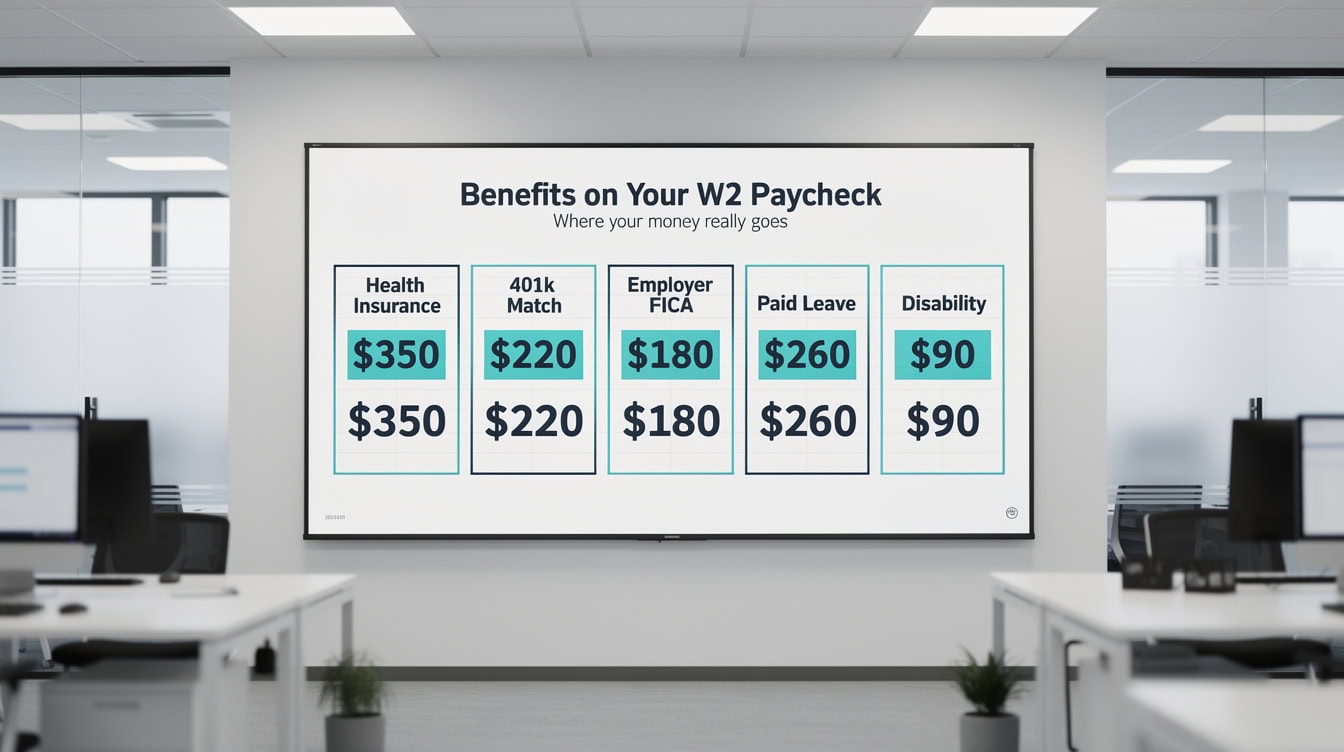
Employer-paid benefits add an average of 30% on top of wages, per BLS data, making them a critical input in any replacement income calculation.
Calculating Your True Cost of Employment: The 1.4x Rule
Your replacement income target equals your base salary multiplied by a benefits multiplier, typically 1.25x to 1.4x depending on your situation. Here is how to build the exact number.
Step 1: Start with your gross salary.
Example: $80,000 per year.
Step 2: Add the employer health insurance contribution.
The Kaiser Family Foundation’s 2023 Employer Health Benefits Survey found that employers contribute an average of $7,034 per year for single coverage and $20,576 per year for family coverage. Use your actual plan cost if you know it.
Step 3: Add the 401(k) match.
Vanguard’s 2023 How America Saves report found that 51% of plans use a dollar-for-dollar match up to 4% of salary. On $80,000, a 4% match equals $3,200 per year.
Step 4: Add the employer FICA share.
Your employer pays 7.65% of your wages in Social Security and Medicare taxes. On $80,000, that is $6,120 per year.
Step 5: Sum the total.
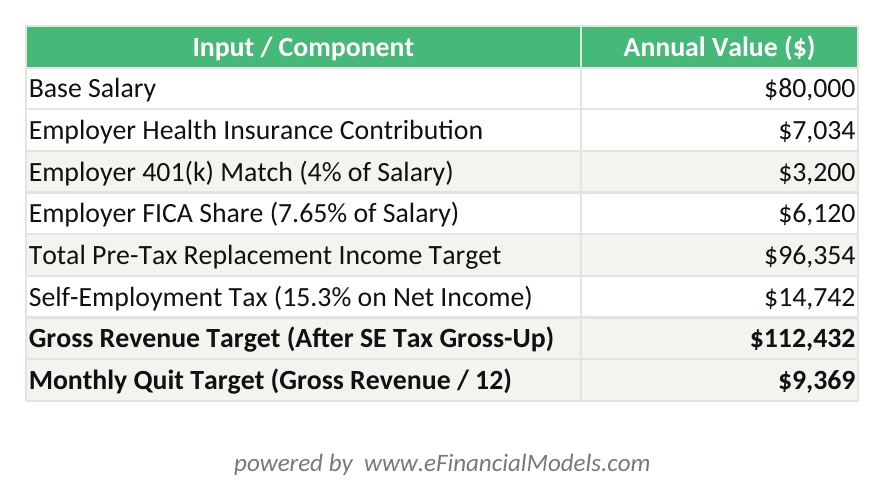
Replacement Income Calculator: enter your salary and benefits in the yellow cells to generate your personal monthly quit target.
Here is the math for an $80,000 salary with single health coverage:
- Base salary: $80,000
- Employer health contribution: $7,034
- 401(k) match at 4%: $3,200
- Employer FICA: $6,120
- Total replacement income target: $96,354 per year, or $8,030 per month
That is a 1.20x multiplier in this example. Add paid leave value and any disability or life insurance and you land squarely in the 1.25x to 1.4x range. Your product must generate at least $8,030 per month in net income, not gross revenue, before this math works.
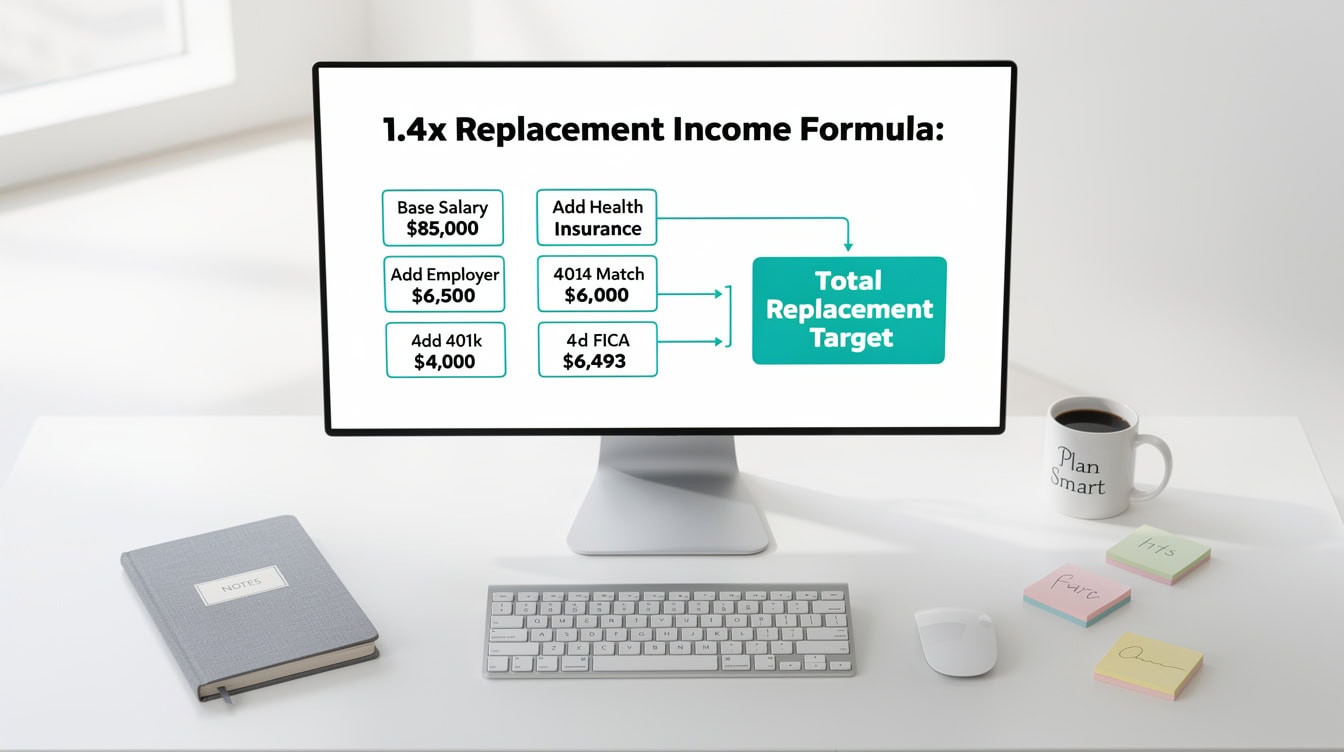
The 1.4x rule applied to an $80,000 salary produces a monthly replacement income target of approximately $8,030 before self-employment tax.
The Stability Test: Is Your Product Revenue Real or a Spike?
A single strong revenue month is not a signal to quit. Revenue stability, defined as consistent monthly income at or above your target for multiple consecutive months, is the only reliable signal.
For SaaS and subscription products, median monthly churn rates run between 3% and 8% for early-stage companies according to research aggregated by OpenView Partners. At 5% monthly churn, a product generating $10,000 MRR (Monthly Recurring Revenue, meaning the predictable revenue earned each month from active subscriptions) loses $500 in existing customers every month and must replace that before growing. A spike month driven by a Product Hunt launch or a viral post does not count toward your stability threshold.
Apply this 3-part stability test before treating any revenue figure as your baseline:
- Consistency: Revenue at or above your target for 3 consecutive months minimum (6 months for conservative profiles).
- Source diversity: No single customer represents more than 20% of revenue. Concentration risk means one cancellation breaks your income.
- Trend direction: Month-over-month growth is flat or positive. Declining MRR during your evaluation window is a hard stop.
If your product passes all three tests, you have a real revenue baseline. If it fails any one of them, you are not ready to quit.

A single strong revenue month does not qualify as a stable baseline. Three to six consecutive months at or above your target is the minimum stability test.
How Much Runway You Actually Need Before Quitting
Runway, in this context, means the number of months you can cover all personal living expenses from savings alone, assuming zero product revenue. You need this buffer because product revenue is never perfectly smooth, especially in the first 12 months of full-time operation.
Financial planners generally recommend the following runway targets by risk profile:
| Risk Profile | Runway Needed | Revenue Threshold | Dependents Assumed |
|---|---|---|---|
| Conservative | 12-18 months | 6 months at target | Yes |
| Moderate | 6-12 months | 3 months at target | Optional |
| Aggressive | 3-6 months | 1 month at target | No |
To calculate your runway in dollars: multiply your total monthly personal expenses (not just rent, but food, transport, subscriptions, insurance, debt payments, and discretionary spending) by your target runway months.
Example: $5,000 per month in expenses, conservative profile, 12 months runway = $60,000 in liquid savings required before quitting.
This savings figure must be separate from your business operating capital. Mixing personal runway with business cash is one of the fastest ways to force a bad decision under pressure.

At $5,000 per month in expenses, a conservative founder needs $60,000 to $90,000 in liquid savings before quitting, separate from business capital.
The Self-Employment Tax Surprise: How It Changes Your Math
W2 employees pay 7.65% of wages in FICA taxes (Social Security at 6.2% and Medicare at 1.45%). Their employer pays a matching 7.65%. Self-employed founders pay both halves: the full 15.3% on net self-employment income, per the IRS. This is called self-employment tax. The Social Security portion of this tax applies to the first $160,200 of net earnings. Meaning high-earning founders face this ceiling but most solo product builders will owe the full 15.3% on every dollar of net income.
On $96,354 of net self-employment income, the self-employment tax alone equals $14,742 per year, or $1,228 per month. You can deduct half of that amount from your gross income when calculating federal income tax, which softens the blow slightly, but the cash outflow is real and immediate.
You also lose W2 withholding. As a self-employed person, you must make quarterly estimated tax payments to the IRS (due in April, June, September, and January) or face underpayment penalties. Missing these payments is one of the most common first-year mistakes founders make.
Adjusted replacement income target after self-employment tax on the $80,000 example:
- Pre-tax replacement income needed: $96,354
- Self-employment tax: $14,742
- Adjusted gross revenue target: approximately $111,096 per year, or $9,258 per month
That is the gross revenue your product must generate, before your own income tax, to net what you were earning as an employee.
Risk Profiles: Conservative vs. Aggressive Quit Thresholds
Your personal quit threshold depends on factors beyond the math. Two founders with identical revenue and savings may have very different right answers based on their circumstances.
Key variables that push your threshold higher (more conservative):
- Dependents (children, aging parents, a partner not working)
- High fixed expenses (mortgage, car payments, student loans)
- Industry where re-entry after a gap is difficult (law, medicine, finance, government)
- Health conditions requiring reliable insurance
- Age above 45, where re-employment timelines lengthen
Key variables that allow a lower threshold (more aggressive):
- Dual-income household where a partner covers baseline expenses
- Low fixed expenses or no dependents
- Industry with high demand and easy re-entry (software engineering, consulting, marketing)
- Product in a high-growth market with strong retention data
- Existing consulting clients who can provide bridge income
The Federal Reserve’s 2023 Report on the Economic Well-Being of U.S. Households found that 37% of adults could not cover a $400 emergency expense from savings alone. If you are in that group, an aggressive quit threshold is not a strategy, it is a gamble.

Risk profile is personal: dependents, fixed expenses, and industry re-entry difficulty all push your required quit threshold higher.
The Replacement Income Calculator: Find Your Quit Number
Your quit number is a single monthly revenue figure your product must consistently generate before leaving employment. Here is the framework to calculate it.
Inputs you need:
- Current gross annual salary
- Employer health insurance contribution (check your benefits portal or HR)
- Employer 401(k) match percentage and cap
- Total monthly personal expenses (use 3 months of actual bank statements)
- Current product MRR or average monthly revenue (last 3 months)
- Liquid savings available for runway
- Risk profile (conservative, moderate, or aggressive)
Calculation sequence:
- Replacement income base = Salary x 1.3 (blended multiplier for benefits + FICA)
- Add self-employment tax gross-up: divide result by 0.857 (accounts for 15.3% SE tax)
- Divide by 12 for monthly target
- Compare to current MRR
- Calculate months of runway from savings divided by monthly expenses
- Apply stability test (3 or 6 months of consistent revenue)
Quit Readiness Score: Score 1 point for each condition met: (a) MRR exceeds monthly target, (b) MRR has held for 3+ months, (c) runway exceeds your profile minimum, (d) no single customer exceeds 20% of revenue, (e) MRR trend is flat or growing. A score of 4 or 5 means you are ready. A score of 3 or below means you stay.

Score 4 or 5 out of 5 on the Quit Readiness Score before treating any quit date as financially sound.
Transition Strategies: How to Bridge Without Burning Bridges
A hard quit date is rarely the optimal path. Staged exits reduce financial risk and preserve professional relationships.
Option 1: Part-time employment. Negotiate a reduced schedule (3 days per week) with your current employer. You keep partial salary and benefits while freeing 2 days for your product. Many employers accept this for high-value employees rather than lose them entirely.
Option 2: Consulting retainer. Offer your employer a 3 to 6 month consulting arrangement post-departure. You bill at a day rate (typically 1.5x to 2x your daily salary equivalent), cover your own taxes, and maintain income while your product revenue ramps.
Option 3: Phased notice. Give 60 to 90 days notice instead of the standard 2 weeks. Use the extended period to complete key projects, maintain goodwill, and keep your income stream intact longer.
Option 4: Moonlighting threshold. Set a specific MRR trigger (for example, $6,000 per month for 3 consecutive months) as your automatic quit signal. Remove the emotional decision entirely by committing to the number in advance.

Staged exits reduce financial risk by maintaining partial income during the transition period, giving product revenue time to stabilize.
The Most Common Miscalculations Founders Make
Four specific errors cause most premature quits and financial crises.
Mistake 1: Using gross revenue instead of net income.
If your product generates $8,000 per month in revenue but costs $3,000 to operate (hosting, tools, contractors, ads), your net income is $5,000. Compare net income to your replacement target, not gross revenue.
Mistake 2: Ignoring customer churn in the revenue baseline.
A product with $10,000 MRR and 8% monthly churn loses $800 in existing customers every month. If you are not replacing that churn with new customers, your real forward revenue is declining. Project 3-month forward MRR using your actual churn rate before setting your baseline.
Mistake 3: Forgetting growth reinvestment.
Once you go full-time, you will want to invest in marketing, tooling, and possibly contractors to grow. If 100% of your product net income goes to personal expenses, you have no growth capital. Build a reinvestment budget of at least 20% to 30% of net revenue into your replacement income calculation.
Mistake 4: Skipping quarterly estimated taxes.
The IRS charges an underpayment penalty when you owe more than $1,000 at year-end and did not make quarterly payments. Set aside 25% to 30% of every product payment into a separate tax account from day one.

Comparing gross revenue to net salary is the single most common error: it can make a financially dangerous quit look safe on paper.
When to Stay: Scenarios Where Keeping Your Job Is the Right Move
Quitting is not the only path to building a successful product. Staying employed while building is a legitimate, often superior strategy in specific circumstances.
Stay if your product revenue has not cleared your replacement income target for 3 consecutive months. One good month is not a trend.
Stay if your runway savings are below 6 months of expenses. A market downturn, a platform change, or a single large customer cancellation can cut revenue by 40% overnight.
Stay if your product is in a market with long sales cycles (enterprise SaaS, B2B services) where revenue is lumpy and unpredictable by nature. Lumpy revenue requires more runway, not less.
Stay if your employer offers equity, pension, or vesting benefits that cliff within 12 months. Leaving 3 months before a 4-year cliff vests is a $40,000 to $200,000 mistake depending on your grant size.
The eCommerce Financial Model Excel Template and the SaaS Financial Model Excel Template both include revenue projection and scenario planning tools that help you model exactly when your product crosses your quit threshold, without guessing.
For founders building physical or manufactured products, the Product Manufacturing Business Model provides a cost structure framework that feeds directly into your replacement income calculation.
Frequently Asked Questions
What is the minimum MRR I need before quitting my job?
There is no universal minimum, but the math gives you a personal floor. Take your gross annual salary, multiply by 1.3 to account for lost benefits and employer FICA contributions, then divide by 0.857 to gross up for self-employment tax, then divide by 12 for a monthly figure. On a $70,000 salary, that calculation produces: $70,000 x 1.3 = $91,000, divided by 0.857 = $106,184 per year, divided by 12 = $8,849 per month in net product income. Your MRR must clear that number for at least 3 consecutive months before you treat it as a real baseline. If you have dependents or a mortgage, add a 20% buffer on top.
How do I calculate the value of my employer health insurance?
Check your benefits portal or ask HR for the employer contribution amount, not the total premium. The Kaiser Family Foundation’s 2023 Employer Health Benefits Survey found employers contribute an average of $7,034 per year for single coverage and $20,576 per year for family coverage. If you cannot get the exact figure, use $587 per month for single and $1,715 per month for family as planning estimates. When you go self-employed, you can purchase coverage through the ACA marketplace or a professional association, but expect to pay the full premium yourself, which often runs $400 to $700 per month for a healthy individual in their 30s.
What counts as stable product revenue for the purposes of this calculation?
Stable revenue means your product has generated net income at or above your monthly replacement target for at least 3 consecutive months, with no single customer representing more than 20% of that revenue, and with a flat or positive month-over-month trend. One-time spikes from a launch, a press mention, or a seasonal event do not count. For SaaS products, look at your net MRR (new MRR plus expansion MRR minus churned MRR) rather than gross new sales. A product with $8,000 gross new MRR but $3,000 in churn has a net MRR of $5,000, which is the number that matters for your quit calculation.
How does self-employment tax actually work compared to W2 withholding?
As a W2 employee, you pay 7.65% of your wages in FICA taxes (6.2% Social Security plus 1.45% Medicare) and your employer pays a matching 7.65%. When you become self-employed, you pay both halves: the full 15.3% on net self-employment income, per IRS Schedule SE. You can deduct half of the self-employment tax (the employer-equivalent portion) from your gross income when calculating federal income tax, which reduces your taxable income but does not eliminate the cash outflow. On $100,000 of net self-employment income, the SE tax alone is $15,300 per year, or $1,275 per month, before any federal or state income tax.
What is a realistic runway target for a solo founder with no dependents?
For a solo founder with no dependents, low fixed expenses, and a product in a market with easy re-entry (such as software or digital services), a moderate profile applies: 6 to 12 months of full personal expenses in liquid savings. If your monthly expenses are $4,000, that means $24,000 to $48,000 in savings before quitting. The aggressive profile (3 to 6 months) is defensible only if you have a dual-income household or a consulting retainer lined up that covers at least 50% of your expenses. Never count your product revenue as part of your runway calculation; runway is savings only, because product revenue can drop to zero in a bad month.
Should I include my spouse’s income in the replacement income calculation?
Yes, a working spouse materially changes your quit threshold. If your spouse earns enough to cover household fixed expenses (rent or mortgage, utilities, groceries, minimum debt payments), your personal replacement income target drops to covering only your discretionary expenses and your share of variable costs. In that scenario, a moderate or even aggressive quit profile may be appropriate. However, build in a stress test: what happens if your spouse loses their job 6 months after you quit? Your plan should survive that scenario with at least 3 months of combined runway remaining.
What is the biggest financial mistake founders make when going full-time on their product?
The single most common and most damaging mistake is comparing gross product revenue to net salary without accounting for taxes, benefits, or business operating costs. A founder earning $6,000 per month in product revenue who quits a $60,000 salary job ($5,000 per month) believes they are ahead. In reality, after self-employment tax ($918 per month at 15.3%), lost health insurance ($587 per month), lost 401(k) match ($200 per month), and product operating costs ($1,500 per month), their net personal income is $2,795 per month, which is 44% below their previous take-home pay. Run the full calculation before making any decision.
Conclusion
The decision to go full-time on your product is a financial engineering problem, not a leap of faith. Your quit number is specific, calculable, and testable against real revenue data. The framework here gives you the inputs, the multipliers, and the stability tests to answer the question with math instead of hope.
I recommend downloading the Price Volume Mix Charts and Analysis template from eFinancialModels to model your product revenue scenarios and stress-test your replacement income number across conservative, moderate, and aggressive growth assumptions before you hand in your notice.