0 ITEMS

How Much Funding to Raise: A Runway and Burn Rate Guide
A founder should raise the cash that planned burn will consume before the next milestone, plus a runway reserve and a contingency, minus the cash already in the bank. In the worked example below, built on hypothetical figures and an assumed pre-money valuation, that rule produces a raise of USD 1,650 thousand that sells 29.2% of the company.
Key Takeaways
- Size the raise as planned net burn to the next milestone, plus a runway reserve and a contingency, less cash on hand.
- Net burn is cash spent minus cash collected, and runway is cash divided by monthly net burn; unpaid invoices do not count as cash.
- Open a raise with 12 to 18 months of cash left; US startups with USD 1 million-plus seeds wait over two years for a Series A.
- In the worked example, the base case needs USD 1,650 thousand for 29.2% of the company; slower collections lift it to USD 2,250 thousand.
- A bigger raise buys safety but costs ownership; the right size is the smallest amount that still funds the milestone, the reserve and the contingency.
Raise the cash needed to reach the next milestone, plus a reserve
The amount to raise equals the cash the business will consume before its next milestone, plus a reserve for raising again, plus a cushion for forecast error, minus the cash already held. A milestone is the achievement that lets the next raise happen on better terms, such as a revenue target or the first profitable month. The reserve is the runway a company wants left when it reaches the milestone, because fundraising takes months. The contingency is a percentage added to planned burn to absorb slippage. Planned burn is the sum of monthly net burn from today to the milestone.
Investor guidance points to a similar total horizon. CRV (a venture capital firm) says a round should fund 18 to 24 months of post-close runway that carries the company to a specific milestone, and First Round Review (a publication of a venture investor) calls 12 to 18 months of runway a common rule of thumb, with 24 to 36 months in tighter fundraising markets. A plan of 18 months plus a six-month reserve covers 24 months, which matches the top of CRV’s 18 to 24 month range. Monthly cash plans are the base of this method, and eFinancialModels lists templates for them in its cash flow projections collection.
Net burn, not gross burn, sets the runway
Runway is the number of months a company can operate before its cash runs out, and it equals cash on hand divided by monthly net burn. Gross burn is total monthly cash spending. Net burn is the cash a company loses each month after revenue, and counting cash collected instead of invoices raised keeps the figure honest. A company with fast bookings and slow collections burns faster than its income statement suggests, because an unpaid invoice pays no salaries.
Burn also moves as hiring and sales change, so the runway should be recalculated each month from actual bank balances and a rolling forecast.
Start raising early, because funding rounds are spaced far apart
CRV advises opening a raise with 12 to 18 months of runway left, well before cash drops under six months. The gap shows how far ahead a plan has to look: in the US, the time between a seed round (a company’s first outside equity round) of USD 1 million or more and a Series A (the next, larger equity round) now stretches beyond two years, according to Crunchbase News in 2026. Outside funding is common among smaller employers too. In the Federal Reserve Banks’ 2026 Report on Employer Firms, based on a non-random US survey fielded in 2025, 60% of the surveyed firms applied for financing in the prior 12 months, and 56% of those seeking financing wanted it for operating expenses.
Round sizes vary widely. A May 2026 Crunchbase News analysis put the median US seed round of the previous year at around USD 3 million and the median Series A deal at USD 15 million, but those medians describe venture-backed deals and are not a target. A raise sized from the company’s own burn can sit well below them.
Worked example: sizing a raise for a hypothetical company
All figures below are hypothetical assumptions in USD thousand, and each funding-need step in the table is rounded to one decimal before the next. The company holds cash of 600.0, spends 180.0 a month in cash and collects 90.0, so net burn is 90.0 and runway at today’s burn is 6.67 months (600.0 divided by 90.0). The assumed plan runs 18 months to the milestone, with costs growing 2% a month and collections 4% a month. The reserve is six months of milestone-month burn, the contingency is 15%, and the pre-money valuation, the value of the company before the new money, is assumed at 4,000.0. Post-money valuation is the pre-money value plus the new cash.
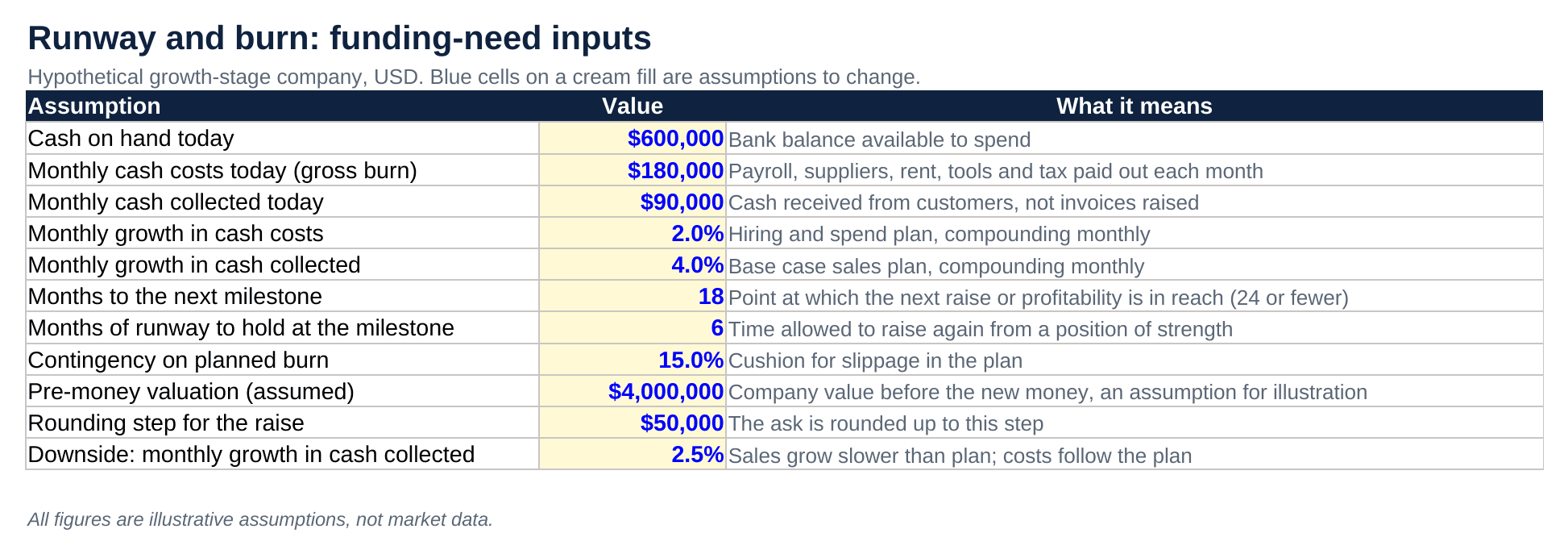
Inputs sheet of the worked example: each blue cell on a cream fill is an assumption that can be changed. Source: eFinancialModels Analysis
In month 18, costs reach 252.0 (180.0 x 1.02 to the power of 17) and collections 175.3 (90.0 x 1.04 to the power of 17), so net burn falls from 90.0 to 76.7. Added up and rounded to one decimal, the 18 months consume 1,546.1. With no raise, cash left after month 6 is 61.5 and the balance turns negative at -27.3 in month 7, a little later than the flat-burn figure because planned collections grow, so the raise must close before month 7. The example company is already late against the 12 to 18 month guidance above, and it assumes the money arrives in time.
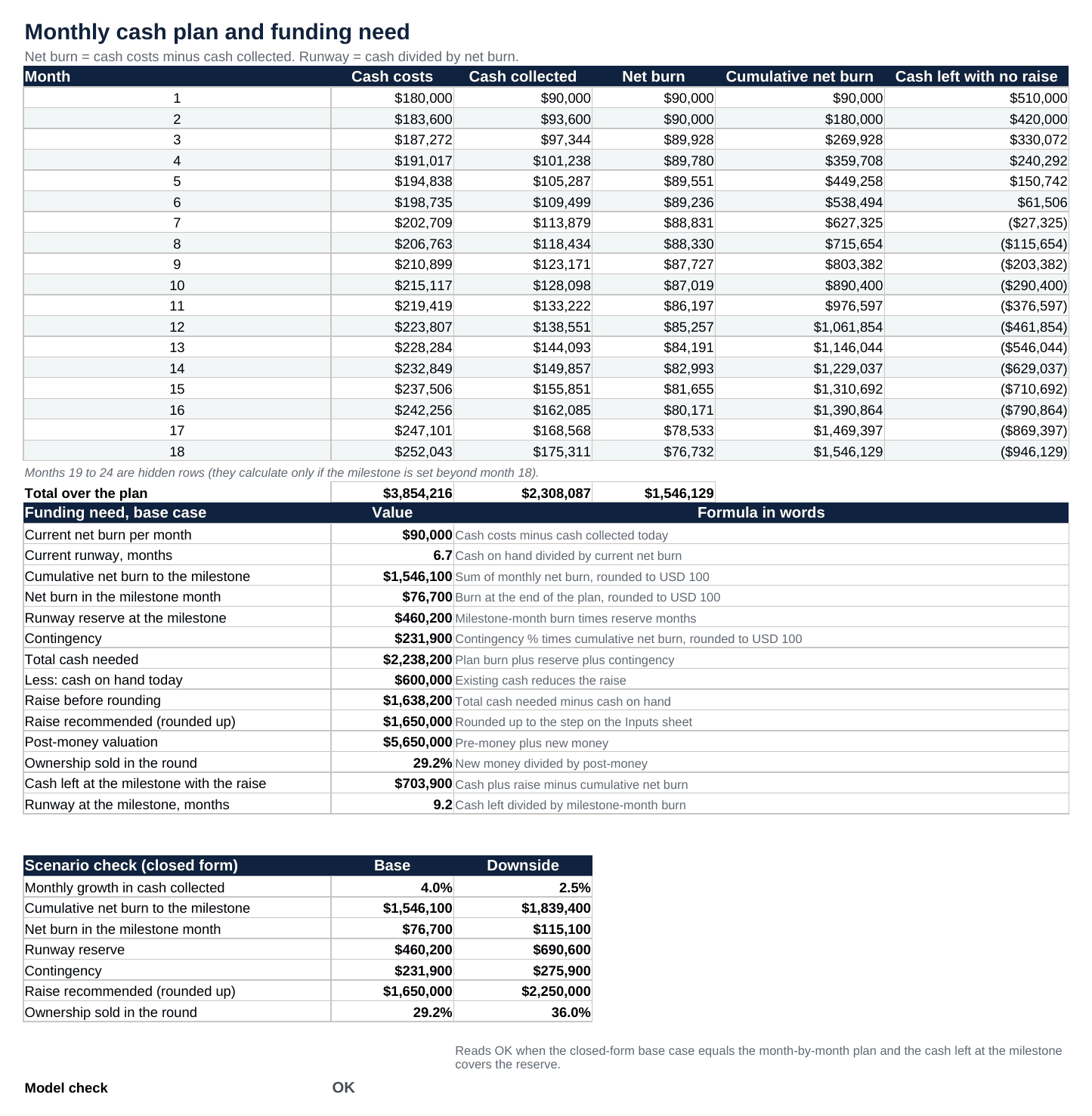
Calculation sheet: the monthly cash plan, the funding need and the downside scenario in one flow. Source: eFinancialModels Analysis
| Step | Calculation | USD thousand |
|---|---|---|
| Cash costs over 18 months | 180.0 x (1.02 to the power of 18, minus 1) / 0.02 | 3,854.2 |
| Cash collected over 18 months | 90.0 x (1.04 to the power of 18, minus 1) / 0.04 | 2,308.1 |
| Net burn to the milestone | 3,854.2 – 2,308.1 | 1,546.1 |
| Runway reserve | 6 months x 76.7 | 460.2 |
| Contingency | 15% x 1,546.1 | 231.9 |
| Total cash needed | 1,546.1 + 460.2 + 231.9 | 2,238.2 |
| Raise before rounding | 2,238.2 – 600.0 cash on hand | 1,638.2 |
| Raise, rounded up to the next 50.0 | 1,650.0 | |
| Post-money valuation | 4,000.0 + 1,650.0 | 5,650.0 |
The share sold equals the 1,650.0 raised divided by the post-money valuation of 5,650.0, or 29.2%. Reserve and contingency together add 692.1 (460.2 + 231.9) to planned burn. With the raise, cash at the milestone is 703.9 (600.0 + 1,650.0 – 1,546.1), which gives a runway of 9.18 months at the milestone (703.9 divided by that month’s net burn of 76.7), the same cash-divided-by-monthly-net-burn method used for the 6.67 months today.
In the downside scenario, collections grow 2.5% a month instead of 4%. Cumulative burn rises to 1,839.4, the reserve to 690.6 (6 x 115.1), the contingency to 275.9 (15% x 1,839.4) and the total need to 2,805.9. The raise becomes 2,250.0 and sells 36.0% (2,250.0 divided by 6,250.0). The downside holds the pre-money valuation at 4,000.0 as a simplification, although weaker collections would usually lower it.
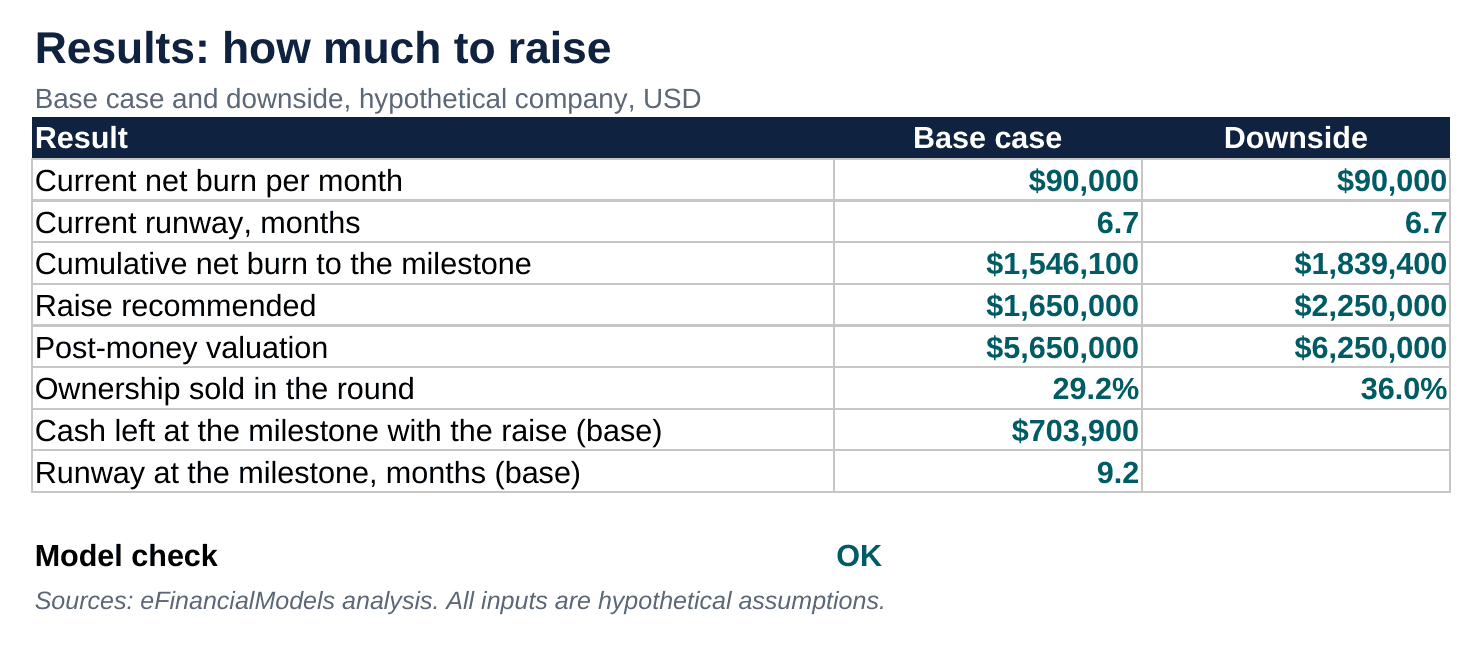
Results sheet: the recommended raise and ownership sold in the base case and the downside. Source: eFinancialModels Analysis
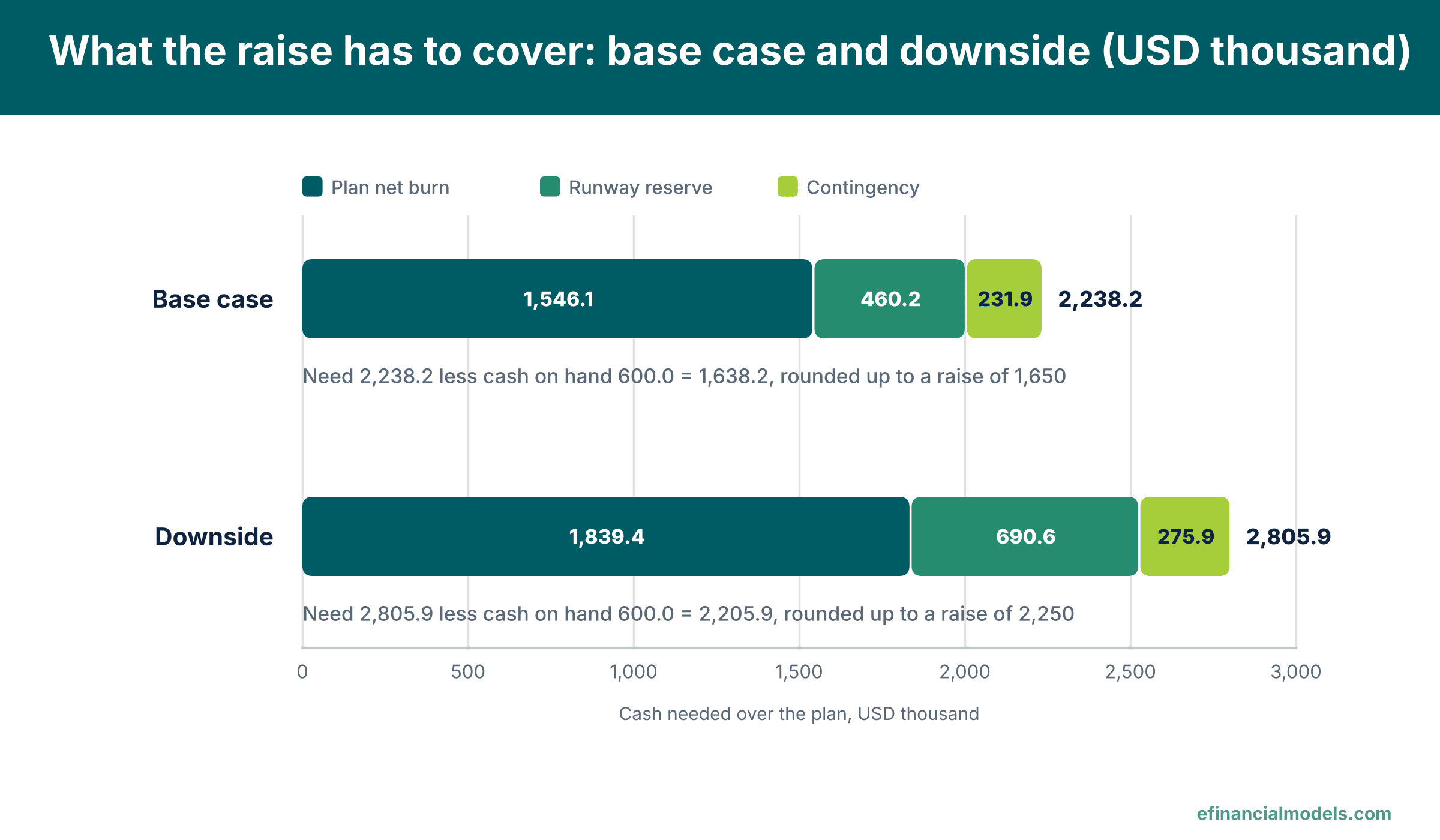
What the raise has to cover in the base case and the downside, drawn from the worked example results in USD thousand. Source: eFinancialModels Analysis
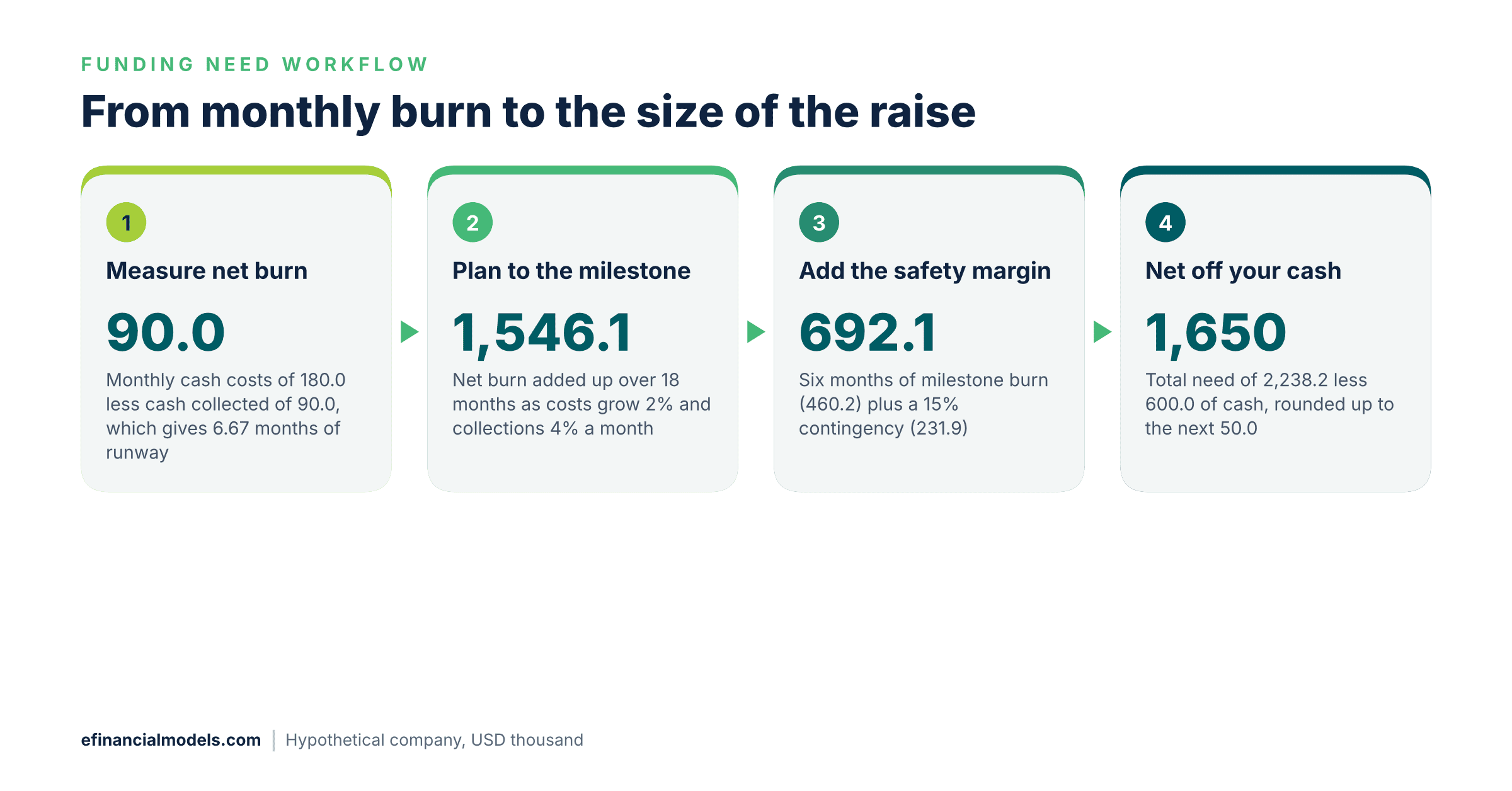
The worked example as a four-step workflow, from net burn to the rounded raise, in USD thousand. Source: eFinancialModels Analysis
Check the raise against dilution before committing
Dilution is the share of the company that existing owners give up, and it equals the new money divided by the post-money valuation. The raise should be the smallest amount that funds the milestone, the reserve and the contingency. Each extra month of reserve adds one more month of milestone burn, 76.7 in the example, and each extra dollar raised at the same valuation is ownership given up. A raise that is too small forces a new round before the milestone, usually on weaker terms. Tranches tied to milestones, or equity paired with debt repaid from cash flow, are illustrative options that can narrow that trade-off and that the worked example does not model.
Frequently Asked Questions
What cash counts when calculating runway?
Only cash the business can freely spend counts. Bank balances qualify, but restricted deposits, customer prepayments that may need refunding, and tax or payroll bills falling due should be subtracted first. Overdue receivables belong in the forecast only when they are collected. A runway built from a truthful opening balance and a cash-based forecast protects a founder from the common error of treating invoices raised as money in hand.
Should a founder raise debt instead of equity?
Debt avoids selling ownership but adds repayments that raise gross burn, so it suits businesses with predictable collections or recurring contracts. Equity carries no repayment but means permanent dilution. A lender usually asks for the same forecast an equity investor wants, so building the monthly burn schedule first helps either route. Mixed structures work when a modest loan covers a known cost, such as equipment, and equity covers uncertain growth spending. Loan sizing and covenants fall outside this method, so a lender or accountant should be consulted.
How often should the funding need be recalculated?
Every month, after the books close, using actual collections and actual spending. Replace the first forecast month with the actual result, extend the plan by one month, and recompute the runway and the raise. Setting trigger levels in advance, such as cutting costs or opening a raise when runway falls under a chosen number of months, keeps the response from waiting for a crisis.
What if investors offer more money than the plan needs?
Extra cash extends runway but costs ownership at the same valuation, so the founder should ask what the additional money would buy. If it funds a defined opportunity, such as a second product or market, add it to the model as a separate line with its own milestone. If it only adds comfort, a smaller round, or a second tranche at a later and higher valuation, may keep more of the company.
Conclusion
A defensible raise comes from a monthly cash plan, an explicit reserve and a dilution check. Founders who want to test how a larger or smaller round changes ownership can start with the eFinancialModels Simple Cap Table Template, which models pre-money and post-money ownership, and browse the fundraising and startup financial model collections for full forecasting templates.