0 ITEMS

Financial Model Cost: Templates at $100 vs. Custom at $50K
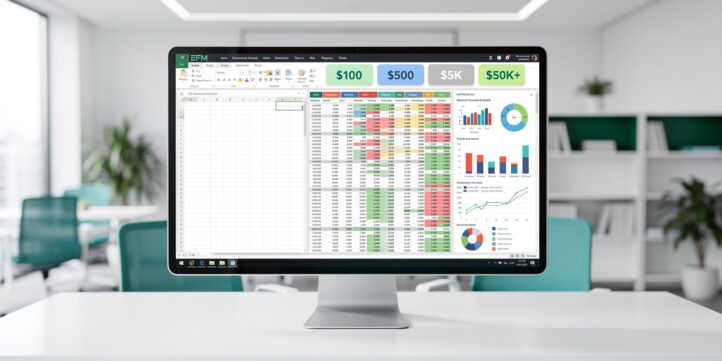
The gap between a $150 template and a $40,000 custom build is real, and choosing the wrong option wastes either money or time.
Key Takeaways
- Pre-built financial model templates cost $100–$500 depending on model type, covering 3-statement models, DCF, SaaS, LBO, and industry-specific builds.
- Custom financial model development runs $5,000–$10,000 for basic builds, $10,000–$25,000 for mid-complexity, and $25,000–$50,000+ for enterprise-grade models.
- The 7 key cost drivers in custom builds are: number of revenue streams, scenario count, department granularity, software integrations, documentation, training, and ongoing support.
- Hidden costs in templates include 10–40 hours of customization labor at your internal rate, plus annual maintenance; hidden costs in custom builds include scope creep and revision cycles averaging 3–5 rounds.
- A hybrid approach, starting with a $200–$500 template and adding 5–10 hours of hourly consulting at $150–$300/hour, covers most early-stage and Series A fundraising needs for under $5,000 total.
- Founders raising a seed or Series A round typically need a model that takes 20–60 hours to build from scratch; a quality template cuts that to 5–15 hours of customization.
- Red flags at any price point include no version history, no formula documentation, and no scenario toggle, regardless of whether the model is a template or a custom build.
Understanding Financial Model Pricing: The Full Cost Spectrum
Financial model pricing spans five distinct tiers, from free Excel downloads to six-figure enterprise builds, and the right tier depends on your use case, not your budget alone. A founder using a model for internal planning has fundamentally different needs than a CFO preparing a board package for a $50M Series B.
Here is the full spectrum at a glance:
| Tier | Price Range | Best For |
|---|---|---|
| Free / DIY | $0 | Simple cash flow, personal use |
| Template | $100–$500 | Startups, standard models |
| Template + Consulting | $1,000–$5,000 | Early fundraising, light customization |
| Custom Basic | $5,000–$10,000 | Seed/Series A, single-entity |
| Custom Mid | $10,000–$25,000 | Multi-stream, board reporting |
| Custom Enterprise | $25,000–$50,000+ | M&A, multi-entity, API integration |
Each tier reflects a different combination of time, expertise, and deliverable scope. The sections below break down what you actually get at each level.

Six pricing tiers cover every financial modeling need from pre-revenue startups to enterprise M&A transactions.
DIY Template Pricing: What $100–$500 Buys You
Pre-built financial model templates in the $100–$500 range cover the most common business model types and deliver a working, formula-driven Excel file you can populate with your own numbers. The price reflects the complexity of the underlying logic, not just the number of tabs.
Here is what you can expect at each price point within the template tier:
- $100–$150: Basic 3-statement models (income statement, balance sheet, cash flow statement linked together), simple startup cash flow projections, or single-product P&L templates. These suit pre-revenue businesses or founders who need a clean structure to fill in.
- $150–$250: Industry-specific templates for restaurants, e-commerce, or service businesses. These include revenue build-up logic, cost of goods sold (COGS) breakdowns, and 3–5 year projections.
- $250–$400: SaaS financial models with monthly recurring revenue (MRR) and annual recurring revenue (ARR) drivers, churn assumptions, customer cohort tracking, and unit economics (CAC and LTV). A SaaS financial model template at this price point typically includes 5–7 revenue scenarios.
- $400–$500: Discounted cash flow (DCF) models, leveraged buyout (LBO) models, or real estate pro forma templates. These require more financial sophistication from the user because the logic is more complex.
The $100–$500 range does not typically include custom branding, integration with your accounting software, or dedicated support beyond a user guide.
Template price reflects model type complexity: a basic 3-statement model costs $150 while a DCF or LBO template runs $400–$500.
What Drives Template Price Variance
Template price variance comes down to 4 factors: model type complexity, number of built-in scenarios, industry specificity, and the quality of documentation included. A generic 3-statement model requires less build time from the template creator than a SaaS cohort model with 6 revenue drivers and a sensitivity table.
Specifically:
- Model type: A DCF model (which discounts future cash flows back to present value using a discount rate) requires more interconnected logic than a simple P&L. More logic means more build time, which means higher price.
- Scenario count: Templates with 3 or more built-in scenarios (base, upside, downside) cost more than single-scenario models because the scenario toggle mechanism requires additional formula architecture.
- Industry specificity: A restaurant model with covers-per-table and average check size drivers costs more than a generic service business template because the revenue logic is custom to that industry.
- Documentation quality: Templates that include a user guide, assumption explanation, and formula audit trail cost more but save you hours of reverse-engineering.
You can browse financial model templates by type to compare what each price point delivers before purchasing.
Four variables determine where a template lands in the $100–$500 range; documentation quality alone can shift price by $100.
Custom Build Pricing Tiers: $5K to $50K+ Explained
Custom financial model development pricing reflects the scope of work, the seniority of the modeler, and the number of revision cycles included in the engagement. Most consultants price custom builds using one of three models: fixed-price, hourly, or value-based.
Basic Custom Build: $5,000–$10,000
A basic custom build at this tier typically delivers a single-entity, 3-statement integrated model with 2–3 revenue streams, 3 scenarios, and one round of revisions. The modeler builds the structure from scratch to match your specific business logic rather than adapting a template. Deliverables usually include the Excel file, a 1-page assumption summary, and a 1-hour walkthrough call.
This tier suits seed-stage startups preparing for investor conversations, small businesses building their first annual budget, or founders who need a model that reflects a non-standard revenue structure.
Mid-Complexity Custom Build: $10,000–$25,000
Mid-complexity builds add department-level cost modeling, 4–6 revenue streams, headcount planning, and 3–5 revision cycles. The modeler typically spends 60–120 hours on the engagement. This tier often includes a sensitivity analysis table (a grid showing how the output changes when you vary 2 key inputs simultaneously) and a dashboard for board presentation.
According to the Association of Chartered Certified Accountants, financial modeling engagements at this complexity level require a modeler with 5+ years of experience to avoid structural errors that compound across a 5-year projection.
Enterprise Custom Build: $25,000–$50,000+
Enterprise builds cover multi-entity consolidation (combining financials from 2+ legal entities into one model), API integrations with accounting software like QuickBooks or NetSuite, Monte Carlo simulation (a technique that runs thousands of random scenarios to show a probability distribution of outcomes), and full documentation packages. These engagements run 150–300+ hours and include dedicated project management, training sessions, and ongoing support agreements.
M&A transaction models, private equity portfolio models, and board-level reporting tools for companies with $10M+ in revenue typically fall into this tier. You can explore DCF and valuation models to understand the structural complexity that enterprise builds must replicate and extend.
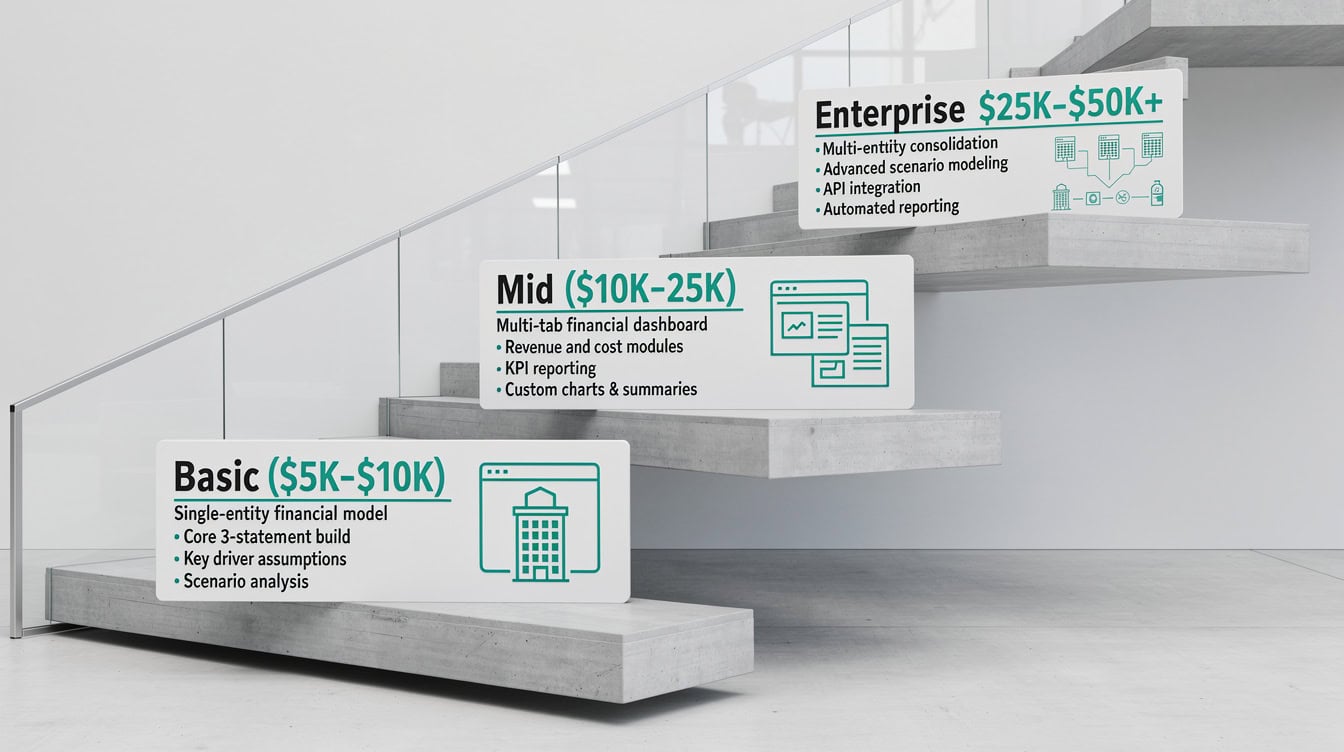
Custom build tiers reflect scope: basic builds deliver a single-entity model; enterprise builds add multi-entity consolidation and live data integrations.
The 7 Key Cost Drivers in Custom Financial Model Development
Custom model pricing is not arbitrary. Seven specific factors determine where your project lands within a pricing tier, and understanding them lets you scope your engagement more precisely.
- Number of revenue streams: Each distinct revenue line (subscription, services, hardware, licensing) requires its own driver logic. Adding a third revenue stream to a two-stream model can add 15–20 hours of build time.
- Scenario count and complexity: Three scenarios with a toggle switch add less time than 5 scenarios with interdependent assumptions. Monte Carlo simulation adds 20–40 hours on its own.
- Department granularity: A model that tracks headcount, salaries, and benefits by department (Sales, Engineering, G&A) requires a headcount module that can add $2,000–$5,000 to the project cost.
- Software integrations: Connecting the model to a live data feed from QuickBooks, Xero, or a CRM system requires API work that typically adds $3,000–$8,000 and a separate technical resource.
- Documentation and audit trail: A fully documented model with formula notes, assumption rationale, and a model map costs 20–30% more than an undocumented build but is essential for investor due diligence.
- Training: A 2-hour training session for your finance team adds $500–$1,500 but dramatically reduces the risk of the model being misused after delivery.
- Ongoing support: Monthly retainer agreements for model updates (new actuals, revised forecasts) typically run $500–$2,000/month depending on frequency and complexity.

Each of the 7 cost drivers can add $500–$8,000 to a custom build; API integrations and Monte Carlo simulation are the largest single add-ons.
Hidden Costs: What Budget Buyers Often Overlook
Both templates and custom builds carry costs that don’t appear in the headline price. Ignoring them leads to budget overruns and frustration.
Hidden Costs in Templates
- Customization labor: Adapting a template to your business takes 10–40 hours depending on your Excel skill level. At an internal rate of $75–$150/hour for a finance manager, that’s $750–$6,000 in labor cost that never appears on the invoice.
- Learning curve: If you’re not fluent in Excel, you’ll spend additional time understanding the model’s structure before you can modify it. This is especially true for DCF and LBO templates.
- Maintenance: Financial models need updating as your business changes. Plan for 5–10 hours per quarter to update assumptions, add new revenue lines, or fix broken formulas after a structural change.
- Version control: Without a disciplined file-naming system, teams end up with 6 versions of “Model_FINAL_v3_REVISED.xlsx” and no clear record of which assumptions are current.
Hidden Costs in Custom Builds
- Scope creep: The most common budget killer in custom builds. Adding a new revenue stream mid-project, requesting a new output tab, or changing the model’s time horizon after build has started can add $2,000–$10,000 to the final invoice.
- Revision cycles: Most fixed-price engagements include 2–3 revision rounds. Additional rounds typically cost $150–$300/hour. Projects with unclear initial requirements average 5–7 revision cycles.
- Consultant availability: A senior financial modeler with a strong track record is often booked 4–8 weeks out. If you need a model in 2 weeks for a fundraising deadline, you’ll pay a rush premium of 20–40%.
- Handover risk: If the consultant who built your model leaves or becomes unavailable, an undocumented model becomes very expensive to maintain or modify.

Hidden costs in templates (customization labor, maintenance) often match or exceed the purchase price within 12 months.
Total Cost of Ownership: 12-Month Comparison
The true cost of a financial model is not the purchase price. It’s the total cost of ownership (TCO) over the period you use it, including initial cost, customization labor, maintenance, and any upgrades.
Here is a worked example comparing three common scenarios over 12 months:
Scenario A: Template Only (Early-Stage Startup)
- Template purchase: $250
- Customization labor: 20 hours at $100/hour internal rate = $2,000
- Quarterly maintenance: 4 quarters x 6 hours x $100/hour = $2,400
- Total 12-month TCO: $4,650
Scenario B: Template + Consulting (Series A Fundraising)
- Template purchase: $350
- Consulting for customization: 8 hours at $200/hour = $1,600
- Quarterly maintenance (internal): 4 quarters x 4 hours x $100/hour = $1,600
- Total 12-month TCO: $3,550
Scenario C: Custom Build (Series B, Board Reporting)
- Custom build: $18,000
- Internal maintenance: 4 quarters x 8 hours x $150/hour = $4,800
- Monthly support retainer: 12 months x $1,000 = $12,000
- Total 12-month TCO: $34,800
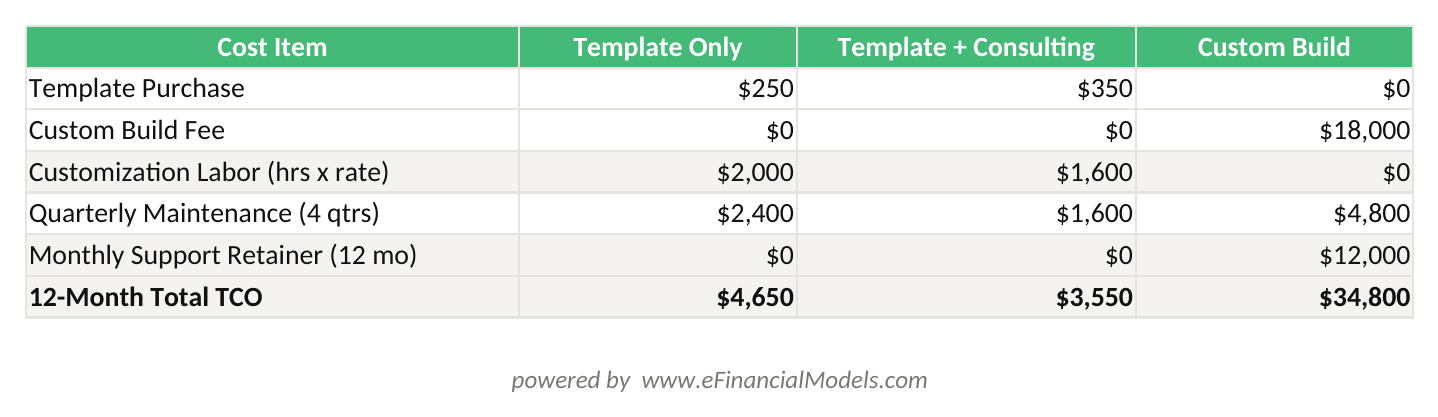
TCO = Purchase + Customization Labor + Quarterly Maintenance + Support Retainer. The hybrid approach delivers the lowest 12-month cost for fundraising use cases.
The math shows that Scenario B (hybrid) delivers the best value for fundraising use cases. Scenario C is only justified when the model drives decisions at a scale where a $34,800 investment is immaterial relative to the capital being raised or deployed. For financial projections used in investor decks, the hybrid approach covers 80% of use cases.
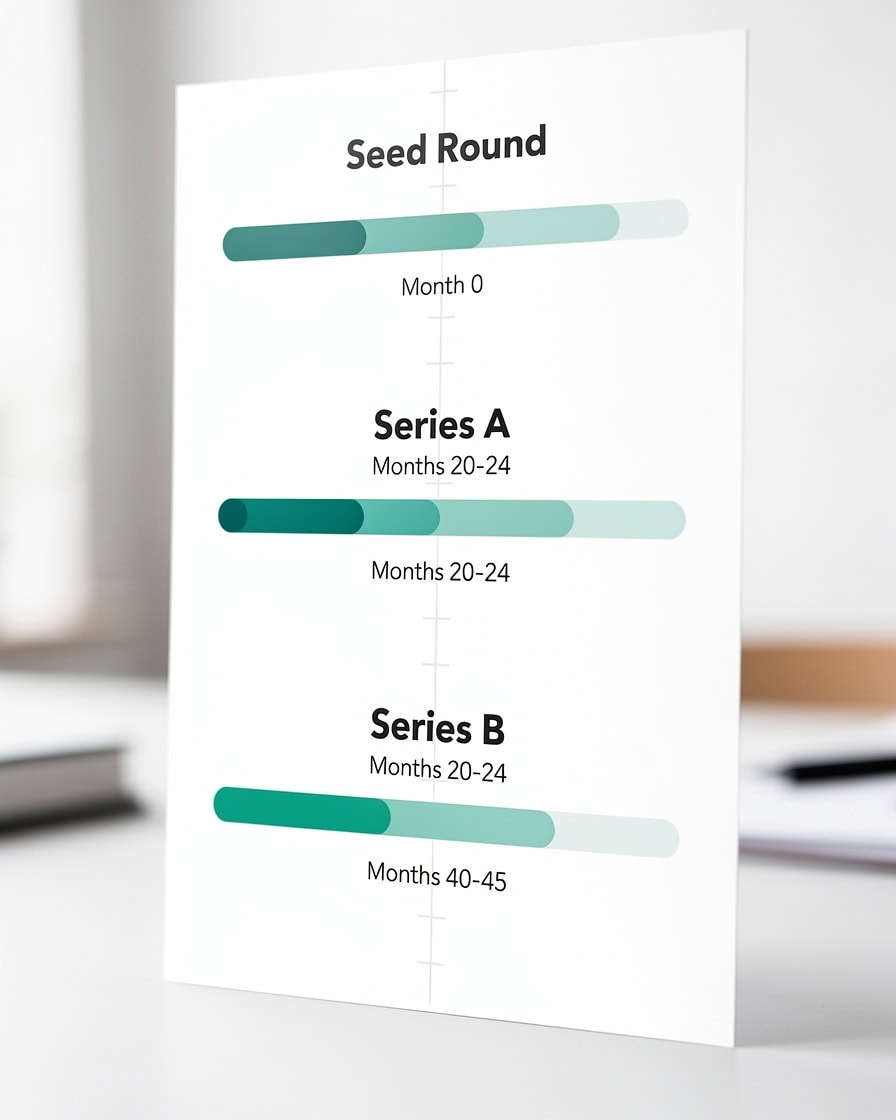
The hybrid template-plus-consulting approach delivers the lowest 12-month TCO for fundraising use cases at $3,550 versus $34,800 for a full custom build.
Decision Framework: Template vs. Custom for Your Situation
The right choice depends on 4 factors: your business stage, the model’s audience, the complexity of your revenue model, and your internal Excel capability. Use this matrix to guide your decision.
| Situation | Recommended Approach | Estimated Cost |
|---|---|---|
| Pre-revenue startup, internal planning | Template | $100–$300 |
| Seed fundraising, standard SaaS model | Template + light consulting | $500–$2,000 |
| Series A, investor-ready model | Template + consulting | $2,000–$5,000 |
| Series B+, board reporting | Custom mid-tier | $10,000–$25,000 |
| M&A, multi-entity, complex revenue | Custom enterprise | $25,000–$50,000+ |
| PE/VC portfolio modeling | Custom enterprise + retainer | $50,000+ |
Templates suffice when your business model maps cleanly to a standard industry type, your audience is internal (not external investors or acquirers), and you have at least one person on your team comfortable with Excel. Custom builds justify their cost when the model will be scrutinized by sophisticated investors, when your revenue model has 4+ distinct streams, or when the model needs to connect to live data sources.
For startup financial models specifically, the template-plus-consulting hybrid covers the vast majority of seed and Series A fundraising scenarios.
Business stage is the primary decision variable: templates work through Series A; custom builds become necessary at Series B and beyond.
The Hybrid Approach: Starting Small and Scaling Up
The hybrid approach, buying a quality template and then engaging a consultant for targeted modifications, delivers the best cost-to-value ratio for most small and mid-market businesses. You pay for the structural work once (via the template) and pay a consultant only for the custom logic your specific business requires.
A typical hybrid engagement looks like this:
- Purchase a relevant template ($200–$400)
- Spend 5–10 hours adapting the basic assumptions to your business
- Engage a financial modeling consultant for 5–10 hours at $150–$300/hour to build any custom revenue logic, add a scenario toggle, or create a board-ready output dashboard
- Total cost: $1,500–$4,400, with a model that reflects your actual business
Consultant hourly rates for financial model modification (as opposed to full custom builds) typically run $150–$250/hour for a mid-level modeler and $250–$400/hour for a senior modeler or CFA charterholder. Fixed-price engagements for targeted modifications (adding one revenue stream, building a sensitivity table) typically run $500–$2,000 per module.
According to the Bureau of Labor Statistics, the median annual wage for financial analysts in the United States was $99,890 in 2023 (Bureau of Labor Statistics), which implies an internal hourly cost of approximately $48/hour fully loaded, making the case for outsourcing complex modeling work to specialists rather than building in-house.
Quality Indicators and Red Flags at Each Price Point
Not all templates are worth $150, and not all custom builds are worth $25,000. Here is how to assess quality before you commit.
Green Flags
- Scenario toggle: A working scenario switch (base/upside/downside) that changes outputs across all tabs simultaneously. This is a sign of professional model architecture.
- Error checks: A dedicated tab or row that flags circular references, negative cash balances, or balance sheet imbalances. According to a study published in the European Spreadsheet Risks Interest Group (EuSpRIG) proceedings, 88% of spreadsheets contain errors (EuSpRIG), making error-check mechanisms essential.
- Formula consistency: Formulas in the same row should follow the same logic. Hardcoded numbers (numbers typed directly into cells rather than referenced from an assumption input) scattered through the model are a red flag.
- Documentation: A user guide, assumption log, or formula map. Without documentation, you’re inheriting someone else’s logic with no way to audit it.
- Version history: A changelog tab showing what was modified and when.
Red Flags
- No sample output: A template or custom build that doesn’t include a sample populated with dummy data is harder to evaluate before purchase.
- Circular references without iteration settings: Circular references (where a formula refers back to itself) are sometimes intentional in financial models but must be handled correctly. An unresolved circular reference breaks the model.
- Price without scope: A custom build quote with no written scope of work is a setup for scope creep disputes.
- No revision policy: A consultant who doesn’t specify how many revision rounds are included will charge you for every change request.
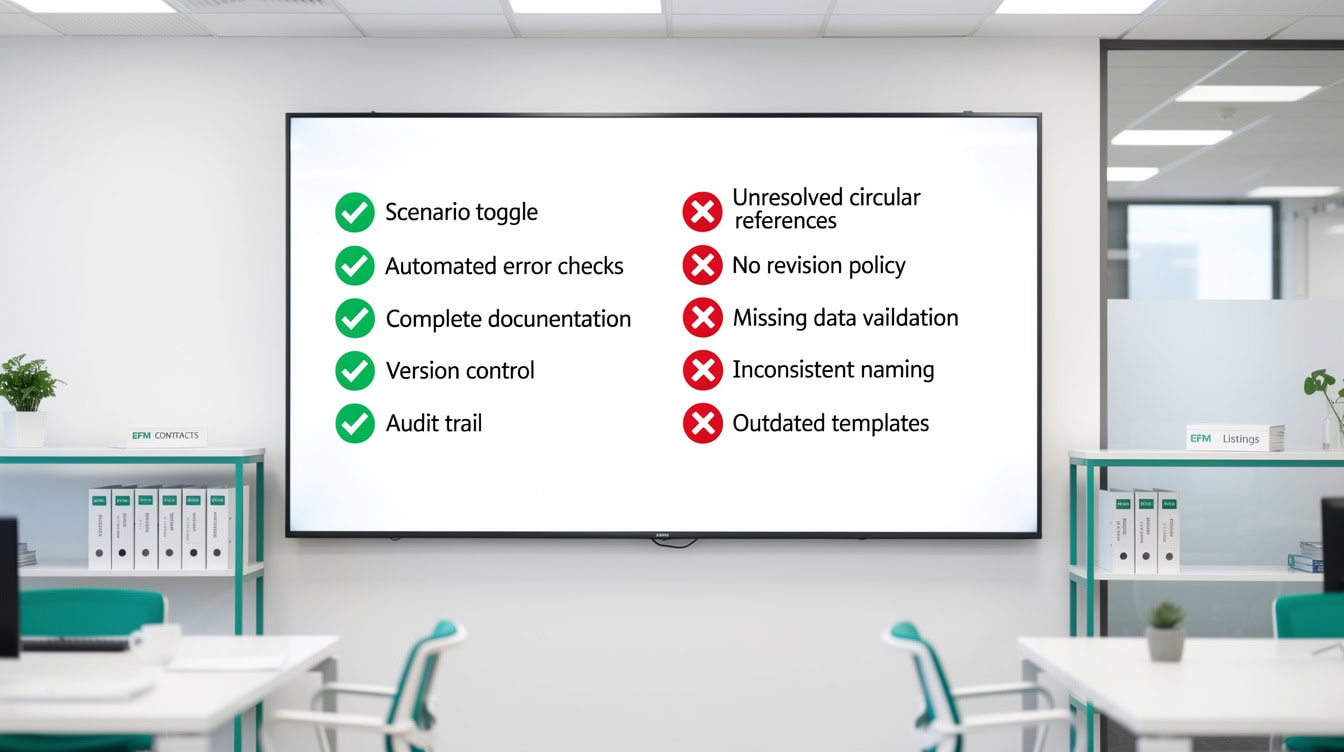
A scenario toggle and error-check tab are the two fastest quality signals to evaluate in any financial model, template or custom.
Frequently Asked Questions
How much does it cost to have a financial model built from scratch?
A custom financial model built from scratch costs $5,000–$10,000 for a basic single-entity model, $10,000–$25,000 for a mid-complexity build with multiple revenue streams and board-ready outputs, and $25,000–$50,000+ for enterprise models with multi-entity consolidation, API integrations, or Monte Carlo simulation. These ranges assume a fixed-price engagement with a professional financial modeler. Hourly rates for custom builds run $150–$400/hour depending on seniority, so a 60-hour mid-complexity project at $250/hour totals $15,000 before any documentation or training add-ons. Rush timelines (under 2 weeks) typically add a 20–40% premium.
Can I use a template for investor fundraising?
Yes, a quality template works for seed and Series A fundraising in most cases, especially if your business model is a standard SaaS, e-commerce, or service business. The key is ensuring the template’s revenue logic matches your actual business drivers. If your model has 3+ distinct revenue streams, non-standard pricing mechanics, or complex unit economics, a template-plus-consulting hybrid (total cost $1,500–$4,000) will produce a more credible investor-ready output than a template alone. Sophisticated Series B investors and institutional VCs often expect custom models with scenario analysis and sensitivity tables.
What is the difference between a 3-statement model and a DCF model?
A 3-statement model (also called an integrated financial model) links three core financial statements: the income statement (revenue and expenses), the balance sheet (assets, liabilities, equity), and the cash flow statement (cash in and out). It shows how your business performs over time. A DCF model (discounted cash flow model) takes the cash flows from a 3-statement model and discounts them back to today’s value using a discount rate, producing an estimate of what the business is worth today. Most investor-grade models include both: the 3-statement model as the operating foundation and the DCF as the valuation output. Templates for 3-statement models start at $100–$150; DCF templates start at $300–$500.
How long does it take to customize a financial model template?
Customizing a template takes 10–40 hours depending on your Excel proficiency and how closely the template matches your business. A finance manager comfortable with Excel can adapt a SaaS template to their specific pricing tiers and churn assumptions in 10–15 hours. A founder with limited Excel experience may need 30–40 hours for the same task, or should consider hiring a consultant for 5–8 hours at $150–$250/hour to do the customization. The most time-consuming parts are adapting the revenue build-up logic, adding new cost lines, and verifying that all formulas still balance after changes.
What should a custom financial model contract include?
A custom financial model contract should specify: the exact deliverables (number of tabs, model type, output format), the number of revision rounds included (typically 2–3 for fixed-price engagements), the timeline with milestone dates, the payment schedule (commonly 50% upfront, 50% on delivery), the ownership of the final file (you should own it outright), and the consultant’s policy on ongoing support after delivery. Contracts that lack a written scope of work or revision limit are the primary cause of scope creep disputes, which can add $2,000–$10,000 to the final cost of a mid-complexity build.
Is it worth building a financial model in Excel myself?
Building a financial model in Excel yourself is worth it if you have strong Excel skills, 40–80 hours available, and a relatively simple business model. The Bureau of Labor Statistics reports that financial analysts earn a median of $99,890 annually (Bureau of Labor Statistics), which translates to roughly $48/hour. At that internal rate, 60 hours of DIY model building costs your business $2,880 in opportunity cost, often more than a quality template. For complex models (multi-entity, fundraising, M&A), DIY builds carry significant error risk: the EuSpRIG research cited above found that 88% of spreadsheets contain errors (EuSpRIG), and a flawed model shown to investors can damage credibility.
What is the middle market option between templates and full custom builds?
The middle market ($1,000–$5,000) is the hybrid approach: purchase a quality template ($200–$500) and engage a financial modeling consultant for targeted modifications at an hourly rate of $150–$300/hour. A typical hybrid engagement covers 5–10 hours of consulting, adding custom revenue logic, a scenario toggle, or a board-ready dashboard to an existing template. This approach delivers 80–90% of the value of a custom build at 20–30% of the cost, making it the best-value option for early-stage companies, Series A fundraising, and businesses with moderately complex revenue models. You can explore free and low-cost financial model templates as a starting point before deciding how much customization you need.
Conclusion
The right financial model investment is the one that matches your use case, not the most expensive option available. Templates at $100–$500 solve 80% of early-stage and internal planning needs. The hybrid approach at $1,500–$5,000 covers most fundraising scenarios. Custom builds at $10,000–$50,000+ are justified when the model drives high-stakes decisions at scale.
I recommend starting with a curated template from the EFM financial model template library to benchmark what a professional model structure looks like before committing to a custom build. If your requirements exceed what a template covers, you’ll have a much clearer scope to bring to a consultant, which means a tighter quote and fewer revision cycles.