
0 ITEMS

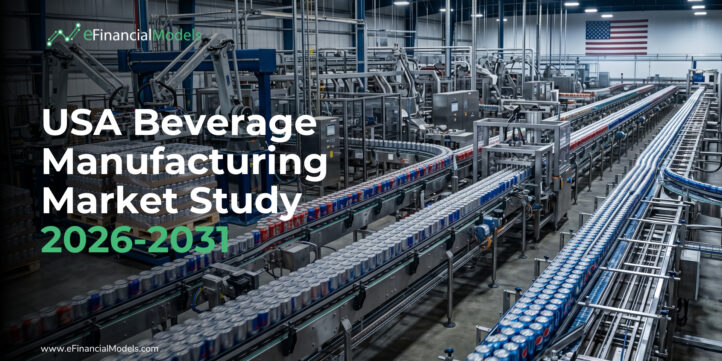
USA Beverage Manufacturing Market Study 2026-2031
Complete integrated outlook on US beverage manufacturing — CSD (11.9 bn gallons, $46.2 bn producer revenue), bottled water (16.4 bn gallons, $50.5 bn retail), craft beer (23.1 M barrels, $28.8 bn retail), and RTD ($10-13 bn). Bear/Base/Bull scenarios to 2031, top operators, aluminum tariff and GLP-1 sensitivity tables, EPR and SSB tax overlays. PDF + Excel verification workbook included.
| Distillery, F&B (Food & Beverages), Financial Model |
| Financial Modeling, Financial Planning, Free Financial Model Templates, Market Studies, PDF |


A 30-40 page integrated outlook on the United States’ four largest beverage manufacturing industries — carbonated soft drinks, bottled water, craft beer, and ready-to-drink (RTD) alcohol — with EFM-branded charts, named-operator competitive landscape, and scenario forecasts to 2031.
The complete 2026-2031 outlook on the four US beverage industries that matter to investors.
US Liquid Refreshment Beverage volume reached 36.4 billion gallons in 2024 at $255.3 billion retail — but the headline masks four very different stories. Carbonated soft drinks face GLP-1 demand destruction and seven-city soda tax expansion. Bottled water has a new number one operator after the Primo Brands merger. Craft beer just posted its first net-decline year since 2005. RTD is the only structural growth pocket, with spirits-based RTD volume compounding at 33% through 2025.
This study integrates all four sub-segments in a single analytical lens — backed by Beverage Marketing Corporation, IBISWorld, the Brewers Association, IWSR, Beverage-Digest, Primo Brands SEC filings, IBWA, and the Beer Institute — with explicit Bear, Base, and Bull scenarios to 2031.
Built for strategic investors, beverage corporate development teams, financial modelers, and operators.
Key findings
- CSD: US carbonated soft drink volume reached 11.9 billion gallons in 2024 with $46.2 billion producer revenue (IBISWorld 2025). Coca-Cola holds 40% volume share, PepsiCo 27%, Keurig Dr Pepper 24.5%, with all others at 8.5%. GLP-1 demand destruction is the structural risk: AlixPartners and Virginia Tech research shows ~29% reduction in alcohol-drinking frequency among adult GLP-1 users, with directional read-across to CSD.
- Bottled water: Volume reached 16.4 billion gallons (+2.9%) at $50.5 billion retail and $28.2 billion wholesale, with per-capita consumption at 47.3 gallons. The Primo Brands merger (closed November 8, 2024) created the new number-one US bottled water operator by revenue — FY2024 combined net sales $6.81 billion, Q1 FY2025 net sales $1.8 billion (+35.3%).
- Craft beer: Production fell 3.9% in 2024 to 23.1 million barrels, with 9,796 active craft breweries (430 opens, 529 closures — the first net-decline year since 2005). Retail value held at $28.8-28.9 billion (+3%) on premium pricing. Total US beer shipments fell 3.4% (-5.2 million barrels). The Beer Serves America report puts US beer’s total economic output at $470.96 billion supporting 2.42 million jobs and $58 billion in taxes.
- RTD: US RTD value is estimated at $10-13 billion at retail in 2024 with +2% volume growth. Spirits-based RTD volume compounded at 33% through 2025 (IWSR), with High Noon controlling more than 65% of the spirits-based hard seltzer category. The federal excise tax parity debate (BEVERAGES Act / RTD Modernization Act) is the next regulatory pivot.
- Aluminum tariffs are the cross-segment cost shock: Section 232 aluminum tariffs moved from 25% (February 10, 2025) to 50% (June 3, 2025), translating to roughly $0.01-0.025 per can at 25% and $0.02-0.05 per can at 50%. Every aluminum-can-packaged sub-segment — CSD, bottled water sparkling, RTD, craft beer — absorbs the pass-through.
- State-level regulatory overlay: Seven states (Maine, Oregon, Colorado, California, Minnesota, Maryland, Washington) have Extended Producer Responsibility (EPR) for packaging laws operationalizing through 2025-2027; ten states maintain active bottle bills; seven cities levy sugar-sweetened beverage excise taxes (Boulder, DC, Philadelphia, Seattle, Berkeley, Oakland, Albany CA, San Francisco). The cost overlay materially differs by state.
Three scenarios with explicit senior-analyst probabilities — Bear 25%, Base 55%, Bull 20%.
What’s inside
- Market study (PDF): Executive Summary, fourteen body sections, three appendices including pricing-model assumptions and the GLP-1 sensitivity table
- EFM-branded charts rendered to 1500 px PNGs, embedded inline in the .docx
Audience
This study is designed for three reader audiences, weighted as follows:
- Tier 1 — Strategic investors and corporate strategists (primary, ~60% of analytical weight). Private equity (Stripes, Castanea, Encore, L Catterton), public-equity analysts covering KO, PEP, KDP, BUD, TAP, STZ, SAM, and beverage corporate-development teams at Coca-Cola, PepsiCo, KDP, Anheuser-Busch InBev, Molson Coors, Constellation, Diageo North America, and Mark Anthony. Coverage: M&A pulse, unit economics, scenario sensitivity, brand-portfolio choices, capex composition.
- Tier 2 — Financial modelers (secondary, ~25% of analytical weight). Independent modelers, business-school students, M&A advisory shops building beverage-company DCFs and operating models. Coverage: methodology, assumption tables, comparable-company benchmarks, sensitivity ranges.
- Tier 3 — Operators and co-packers (tertiary, ~15% of analytical weight). Existing beverage manufacturers, contract bottlers (Refresco, Niagara contract lines), beverage industry consultants. Coverage: capacity utilization, supply-chain bottlenecks, regulatory readiness.
Download the full study
Pair with the Beverage Manufacturing Startup Financial Model, Liquor Distillery Financial Plan Template, Tequila Distillery Financial Model, Brandy Distillery Business Plan, and Cider Distillery Financial Model. Browse all Food and Beverage Manufacturing Templates on EFM.
Similar ProductsOther customers were also interested in...



 eFinancialModels
Electric Vehicle (EV) Charging Station Financial M...
With this comprehensive 5- or 10-year monthly tool, investors can assess the viability of setting up... Read more

Financial Model for Mobile App | Mobile App Busine...
The Mobile App Financial Plan Template in Excel allows you to develop financial projections when lau... Read more

 HenrySheykin
Food Truck Financial Model Excel Template
The Food Truck Financial Model helps entrepreneurs, founders, business owners, consultants, and anal... Read more

Green Hydrogen Production from Wind Energy Financi...
The Green Hydrogen from Wind Financial Model aims to comprehensively forecast a horizon of 40 years ... Read more

Simple Mutual Non-Disclosure Agreement Template
Protect your business secrets with ease using our Simple Mutual Non-Disclosure Agreement Template. S... Read more

Solar Energy Financial Model
The Solar Energy Financial Model Spreadsheet Template in Excel assists you in preparing a sophistica... Read more

 Peter Graf
The Customer-Centric Financial Model for Restauran...
Starting a restaurant without a financial plan is like driving a car blindfolded. You wouldn´t do i... Read more
You must log in to submit a review.