0 ITEMS

The Risks of AI Financial Models: What CFOs Need to Know

AI-generated financial models carry a real risk because they can look finished while holding wrong formulas, so every AI-built formula needs an independent check before anyone relies on it. Published tests, from spreadsheet audits to benchmark studies, show why that check separates an expert-built model from a merely plausible one.
Key Takeaways
- AI can write formulas that look correct and are wrong, so a polished layout is never evidence that a model works.
- Audits of real spreadsheets found errors in most files studied, so human-built models need checking too, not only AI-built ones.
- Benchmarks of AI on spreadsheet and filing tasks show high failure rates, and one found debugging accuracy very low.
- Finance leaders and CFOs surveyed in 2026 report limited trust and call human oversight critical, so AI-assisted models should have a named reviewer.
- Four checks, trace, break, recompute and stress, let a first-time founder test any model, whoever or whatever built it.
Why can an AI-built financial model look right and still be wrong?
An AI-built model can look right because large language models (LLMs), the text-prediction systems behind chatbots and spreadsheet assistants, produce formulas that read well, not formulas that have been run against the numbers. The US National Institute of Standards and Technology (NIST) names the effect in its generative AI risk profile, where “confabulation” refers to systems that “generate and confidently present erroneous or false content”, according to NIST AI 600-1 (2024).
CFOs face this risk first, and a first-time founder who acts as the company’s own finance lead faces it too. For that founder, the danger is that a wrong cell reference or a number typed over a formula does not announce itself. The output cell shows a clean figure, the layout looks professional, and the mistake travels into the investor deck. A visible error gets fixed; a confident wrong answer gets trusted.
How often do AI models fail on finance and spreadsheet tasks?
Measured failure rates are high enough to justify checking every result. In FinanceBench, a 2023 benchmark of questions about public-company filings, OpenAI’s generative pre-trained transformer (GPT) model known as GPT-4 Turbo, used with a retrieval system, which looks up passages in the filings before answering, “incorrectly answered or refused to answer 81% of questions”, according to the FinanceBench paper (2023). That result predates newer models, so it shows the kind of failure that occurs, not today’s rate for any one product.
A second, more recent benchmark tests spreadsheet work directly. A 2026 benchmark of end-to-end business spreadsheet workflows reported that “the best model achieves 34.89% overall task accuracy, and debugging accuracy is as low as 12.00%”, in the SpreadsheetBench 2 paper (2026). Debugging is the skill a founder needs when a number looks wrong, and the authors reported accuracy on it as low as 12.00%.
Are human-built spreadsheets any safer?
Not by default, and that matters for the buyer’s question. Raymond Panko, a spreadsheet-risk researcher, collected audits of real spreadsheets and wrote that “Collectively, these studies found errors in 94% of the spreadsheets studied”, in his review of spreadsheet errors (2015). In laboratory experiments where people built spreadsheets, “The average across these studies is a cell error rate of 3.9%”, from the same review.
The review is older than most sources here, and the 3.9%, the share of cells containing a mistake, comes from experiments, not from live business files, so it supports a general caution and not a precise error rate. The point is narrower: an expert-built model is not a model without mistakes. It is a model built so that mistakes can be found.
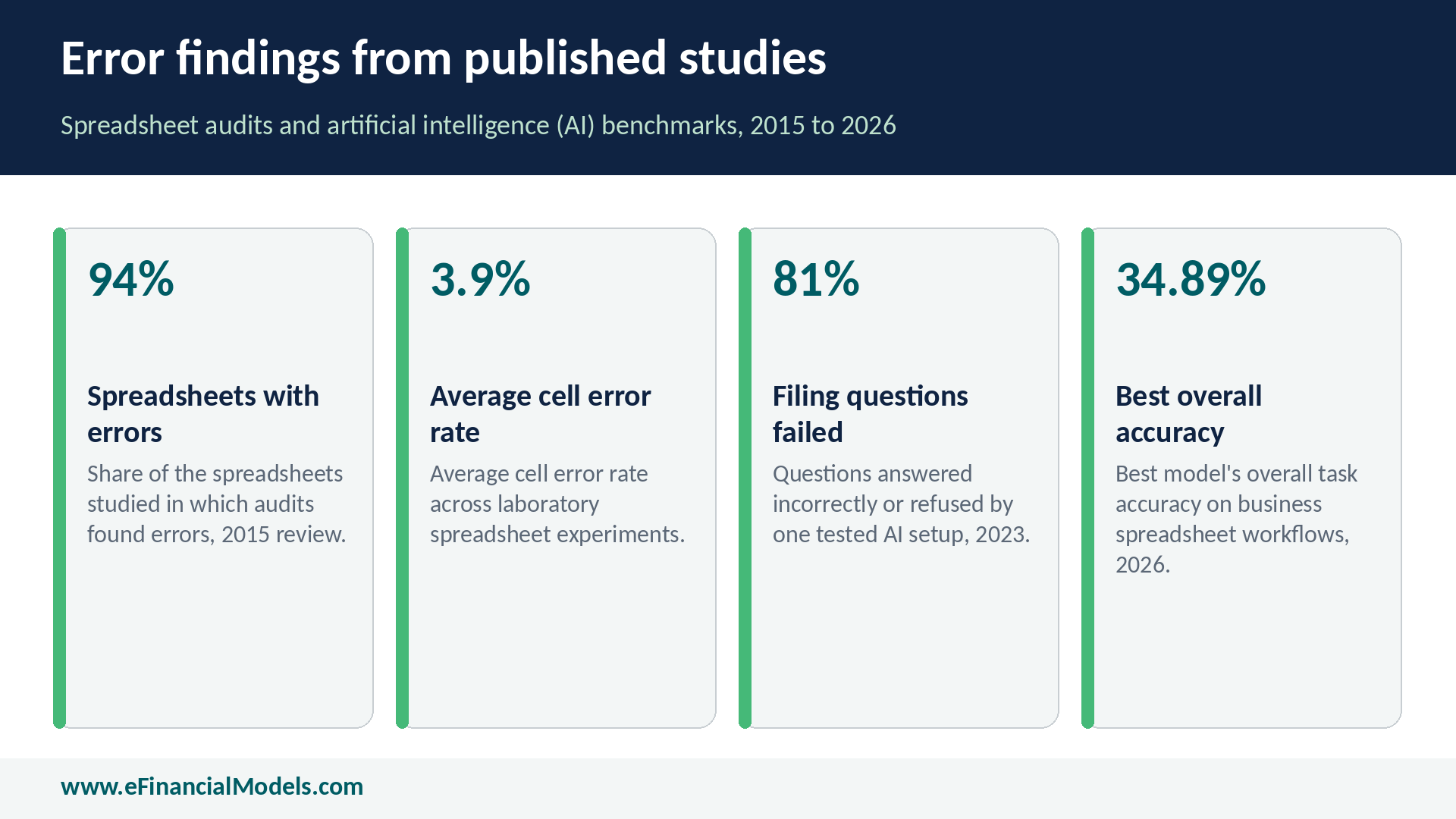
Four published findings on spreadsheet and AI error rates, from a 2015 review, a 2023 benchmark and a 2026 benchmark.
How can a founder tell an expert-built model from an AI-generated or template-mill file?
The reliable tells are structural, not visual, because a polished layout is easy to copy. An expert-built model separates inputs from calculations, labels every unit, repeats the same formula across a row, and ships with checks that flag problems, such as a balance check showing whether the balance sheet balances in every period. It also documents its assumptions and names who reviewed it.
An AI-generated or template-mill file, meaning one mass-produced from a generic layout with little testing, tends to show the opposite signs: typed-over numbers inside formulas, no checks tab, assumptions scattered across sheets, and no one who can walk through a single formula on request. A useful test is to ask the seller to trace one output back to its inputs in under a minute. An expert can do it. A file that was never understood by its maker cannot.
A well-built three-statement model, which links the income statement, balance sheet and cash flow statement, makes this easier because every result has a visible route back to its inputs. Running scenario analysis, meaning best, base and worst cases on the same file, then shows whether the outputs react sensibly.
What do finance leaders say about trusting AI output?
Finance leaders themselves are cautious. KPMG, the audit and advisory firm, reported in its 2026 survey of senior finance leaders that, under “Top concerns as AI scales”, “48% cite the accuracy of AI-generated outputs”, in its finance leaders survey article (2026).
A smaller poll points the same way. CFO Dive reported a poll of 100 US mid-market chief financial officers (CFOs), commissioned by a software vendor, in which “Only 14% of CFOs completely trust artificial intelligence technology to deliver accurate accounting data on its own” and 97% said human oversight is critical for data accuracy, in its report on the study (2026). The same report says “Most respondents (86%) said their finance team had encountered at least one instance of inaccurate or ‘hallucinated’ data while using AI.” The sample is small and vendor-commissioned, so it is an indicator, not a measurement of the whole market.
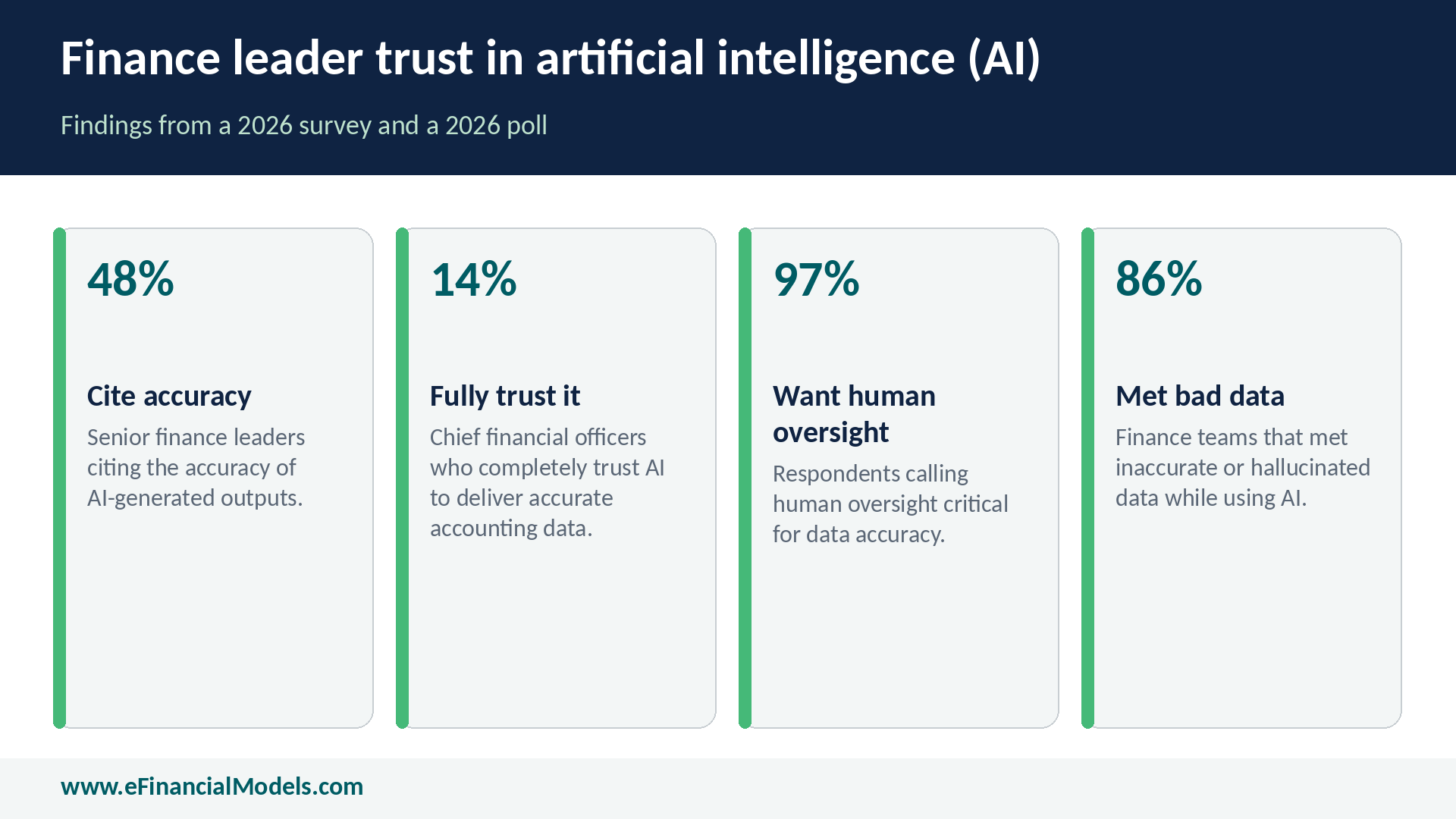
Survey findings from a 2026 finance leader survey and a 2026 poll of mid-market chief financial officers.
What four checks verify an AI-generated formula?
Four short checks are designed to expose common faults without advanced skill, and they work on any model whoever built it. They are best done on a copy of the file, starting with the cells that feed the headline result.
- Trace: click into the key output and follow each reference back to an input, confirming that no step is a typed-over number.
- Break: change one input, such as a price, and confirm that every dependent result moves in the expected direction.
- Recompute: rebuild one period by hand, or in a fresh sheet, and compare it with the model’s figure.
- Stress: enter extreme values, such as zero sales or a negative growth rate, and confirm that totals still reconcile and the balance check holds.
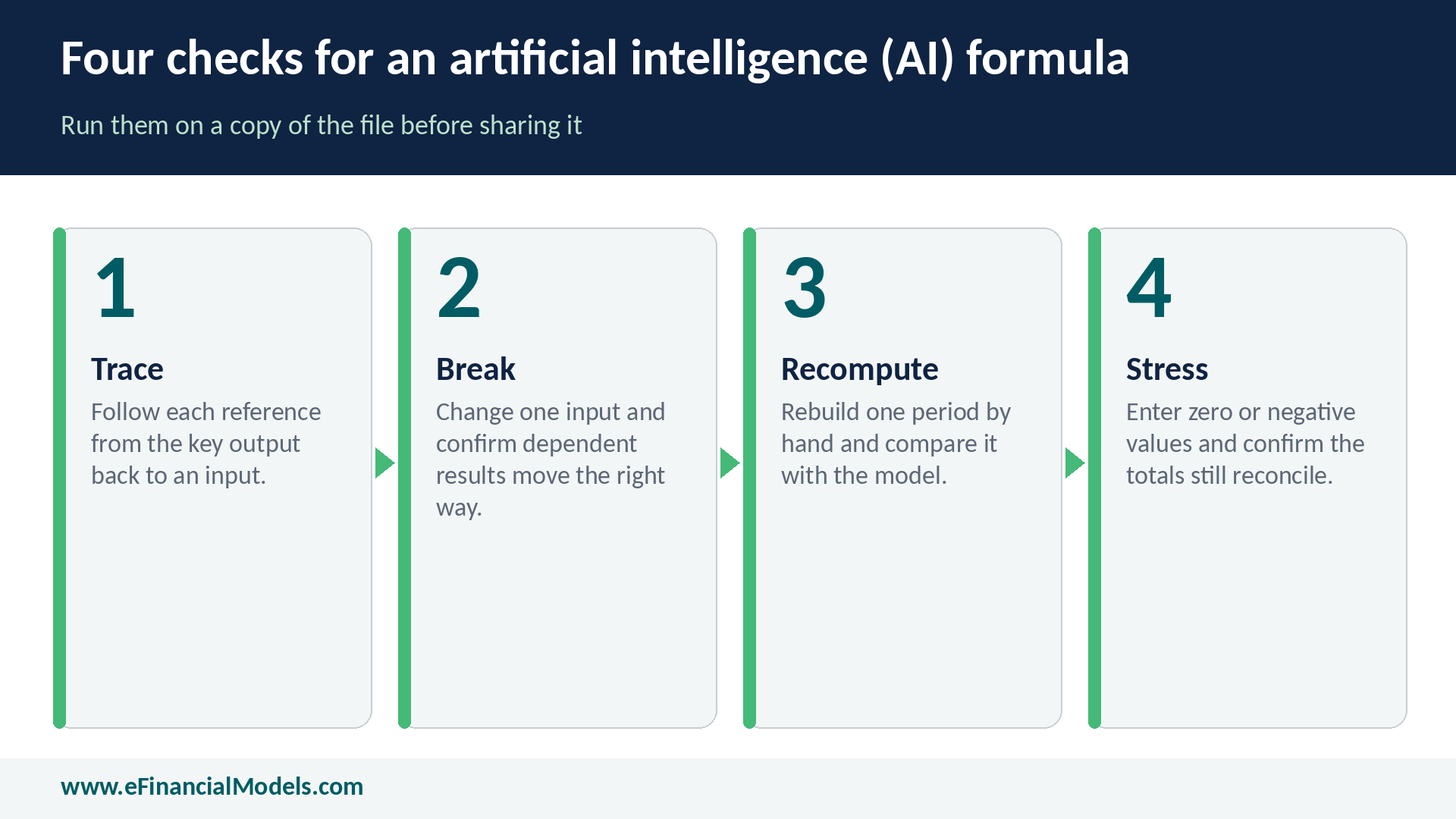
A four-step check sequence that any founder can run on a copy of an AI-built or purchased model.
Asking the same AI to confirm its own formula is not one of the checks, because the confirmation comes from the same system that produced the error. A founder can also browse the financial modeling collection to compare listings before choosing a file.
Conclusion
AI makes models faster to produce and no safer to trust, so the founder’s job is to verify, not to admire the layout. Founders who build a subscription software forecast can start from the SaaS Business Financial Model from eFinancialModels and apply the four checks above before sharing any model with anyone.
Frequently Asked Questions
Can AI still be used to help build a financial model?
Yes, as a drafting assistant and not as the final author. AI can suggest a structure, draft a formula or explain an unfamiliar function, which saves time on blank-page work. The risk starts when its output is pasted in and accepted unseen. A sound workflow treats every AI suggestion as a proposal, runs the four checks on the result, and records who reviewed it, so speed gains do not quietly turn into hidden errors.
What counts as an independent check on an AI-written formula?
An independent check reaches the answer by a different route. Hand arithmetic on one period, a pocket calculator, a second tool opened on the same inputs, and a colleague reading the file all qualify. A test dataset with a known answer, such as last year’s actual results, is stronger still, because the model must reproduce a number that already exists. Asking the same chatbot to confirm itself is a repeat, not a check.
Does buying a ready-made template remove the risk?
No. A template puts formula quality in its author’s hands, while the buyer still carries the consequences and owns the inputs and the fit to the business. A file sold in bulk may never have been tested against unusual cases such as zero sales or a missing year. Buyers should look for a seller who explains the logic, shows the checks, and answers questions about specific cells, because that behavior signals real modeling experience.
Who should review a model before investors see it?
A person who did not build it. Fresh eyes catch assumptions the builder no longer notices, and an outside reader tests whether the file can be understood without the builder present. For a first-time founder, that reviewer can be an experienced adviser, an accountant, or a paid specialist. Whoever it is, the review should end with a short written note listing what was checked and what was changed.
What should a written review note of a model contain?
A useful review note is short and specific. It names the reviewer and the date, lists which outputs were traced to inputs, records the inputs that were changed during testing and what moved, and states every fix that was made. It also lists open questions the builder still has to answer. Investors and lenders read such a note as evidence that someone other than the builder looked, which a polished layout cannot supply.