0 ITEMS

What Investors Want to See in a Startup Financial Model

Investors want a financial model that shows how the business makes money, backs each assumption with a reason, and keeps margins, retention and cash use in plain view. A public example, Buffer’s 2014 funding round, shows the headline figures a founder can publish and an investor can trace, and published research on spreadsheet errors shows why a model needs a second reader.
Key Takeaways
- Investors read a model as evidence of how the founders think, so clear drivers and stated assumptions matter more than a long spreadsheet.
- Unit economics should rest on gross profit, with retention shown by cohort, as Andreessen Horowitz guidance and one of its partners describe.
- Buffer’s public 2014 round shows the headline figures a founder can publish and an investor can trace: round size, valuation, revenue run rate and paying customers.
- Every model should be reviewed by a second person before it goes to investors, because spreadsheet errors are common.
- A short checklist of five items covers drivers, unit economics, retention, cash use and review before the first investor meeting.
What do investors check first in a startup financial model?
The first job of a model is to explain the business, because investors weigh the team’s reasoning before the arithmetic. The survey evidence ranks deal factors rather than model checks, so this is an inference from it. In a survey of institutional venture capital investors, 47% of firms named the management team as the most important factor, according to a Harvard Law School Forum summary of the study, posted on 20 August 2019. The same 2019 summary reports that 20% of respondents do not forecast cash flows when they invest and that 9% use no quantitative deal evaluation metric. The National Bureau of Economic Research digest (2016) describes the sample as 885 institutional venture capital investors.
Attention data points the same way. DocSend, a document-sharing platform owned by Dropbox, released data showing that venture capital investors spent 40% more time on seed stage team slides, and 30% more time on pre-seed team slides, in 2024 compared to the previous year, according to a 2024 Dropbox DocSend report release.
These figures have one practical implication. Investors do not all build a forecast of their own, so the founders’ model works as evidence of how the founders think: which drivers move revenue, which costs follow, and how long the cash lasts. A model that cannot explain itself cannot support the team’s story. The survey covers institutional venture capital investors only, and angels or lenders may weigh things differently.
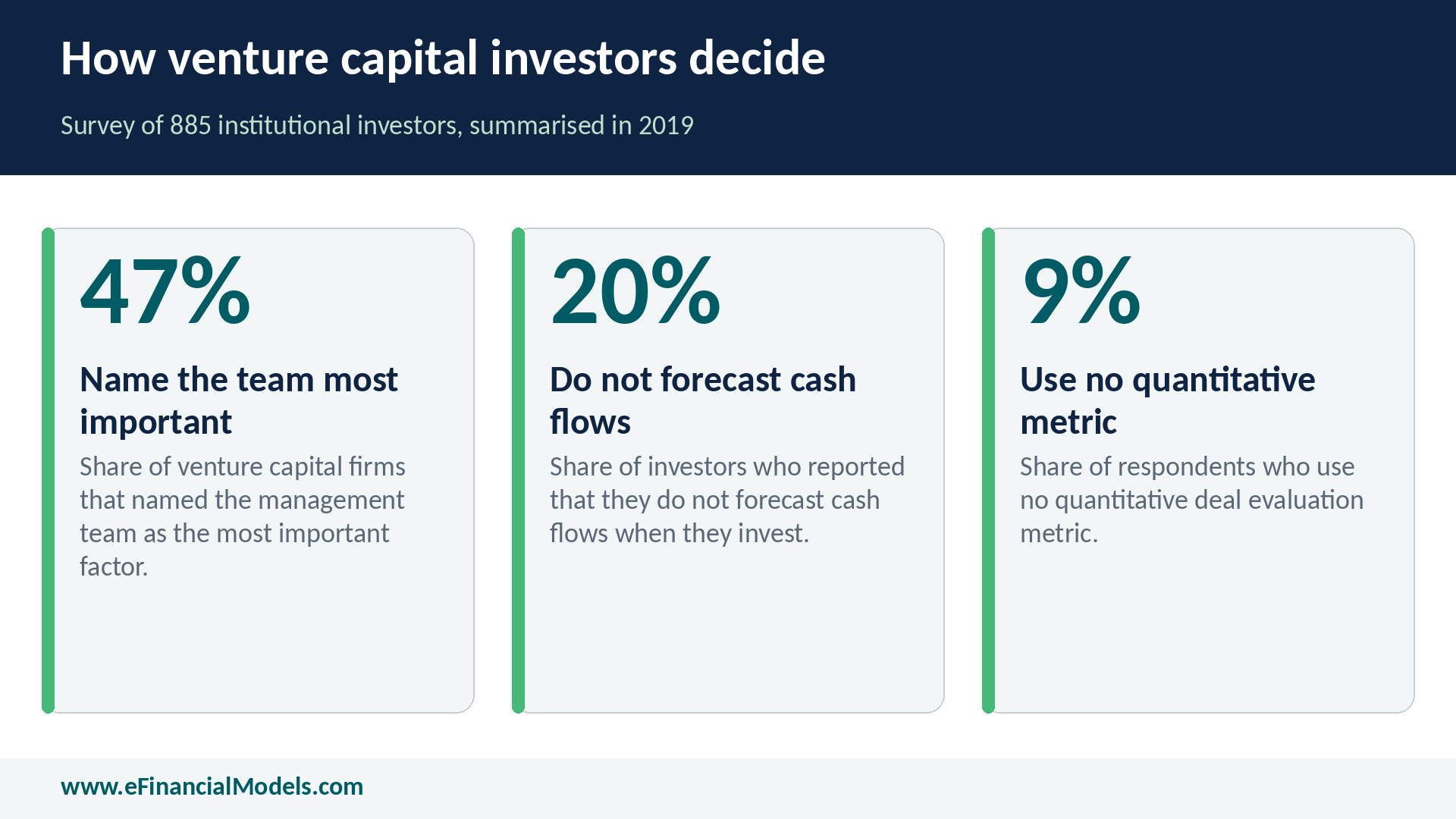
Findings from the survey of institutional venture capital investors, as summarised by the Harvard Law School Forum in 2019.
Which numbers do investors expect to see?
Andreessen Horowitz partners point to unit economics built on gross profit, retention shown by cohort, and a clear view of cash use. Customer lifetime value (LTV) is the value a customer is expected to generate over the relationship, and customer acquisition cost (CAC) is what it costs to win that customer. On the ratio of the two, David George of Andreessen Horowitz says in the firm’s 2020 discussion of the financial numbers: “The LTV to CAC metric that I like to look at on the LTV side is gross profit, not revenue.”
On retention, the firm’s 16 startup metrics guide (2015) states that investors want to see engagement, ideally expressed as cohort retention on metrics that matter for that business. A cohort is a group of customers who joined in the same period, so a cohort table shows whether later customers stay as long as earlier ones.
Net revenue retention, the share of a customer group’s earlier revenue that remains after cancellations, downgrades and expansion, is a natural companion figure, because it shows whether existing customers grow or shrink in value. On cash, Jeff Jordan of Andreessen Horowitz says the most important early balance sheet metric is how much capital the company has deployed, so a model should show spending against the milestones it buys.
How should a model present its assumptions?
A model should keep every assumption in one labelled place, each with its source or reasoning, so an investor can change one input and watch the result move. Startup founders can see how such layouts look in the startup financial models collection. Assumptions are the starting numbers a forecast depends on, such as the monthly growth rate, the price per customer and the share of customers who cancel. Hard-coded numbers buried inside formulas hide those choices, and a reader who cannot find a choice cannot test it.
With the inputs separate, a founder can show a base case and a downside case side by side, and the investor can see whether margins and retention improve or worsen as the company grows.
Worked example: what did Buffer’s public 2014 round show?
Buffer, the social media scheduling company, published its funding terms on its own blog on 27 October 2014, in a post on the valuation and term sheet. The post gives a $3.5m raise at a valuation of $60m post-money, or $56.5m pre-money. It reports annual recurring revenue (ARR), the yearly value of subscriptions, of $4.6m, around $385k a month, and 28k paying customers. A later update on the same page says the full $3.5m was committed, with due diligence still to be finished with the lead investor, Collaborative Fund.
In this example, the stated figures are consistent: the post-money valuation is the pre-money valuation plus the round ($56.5m plus $3.5m equals $60m).
These are the figures an investor can trace without a model: price, round size, revenue run rate and customer count. A full model adds the forecast on top, and the same recomputation habit applies to it.
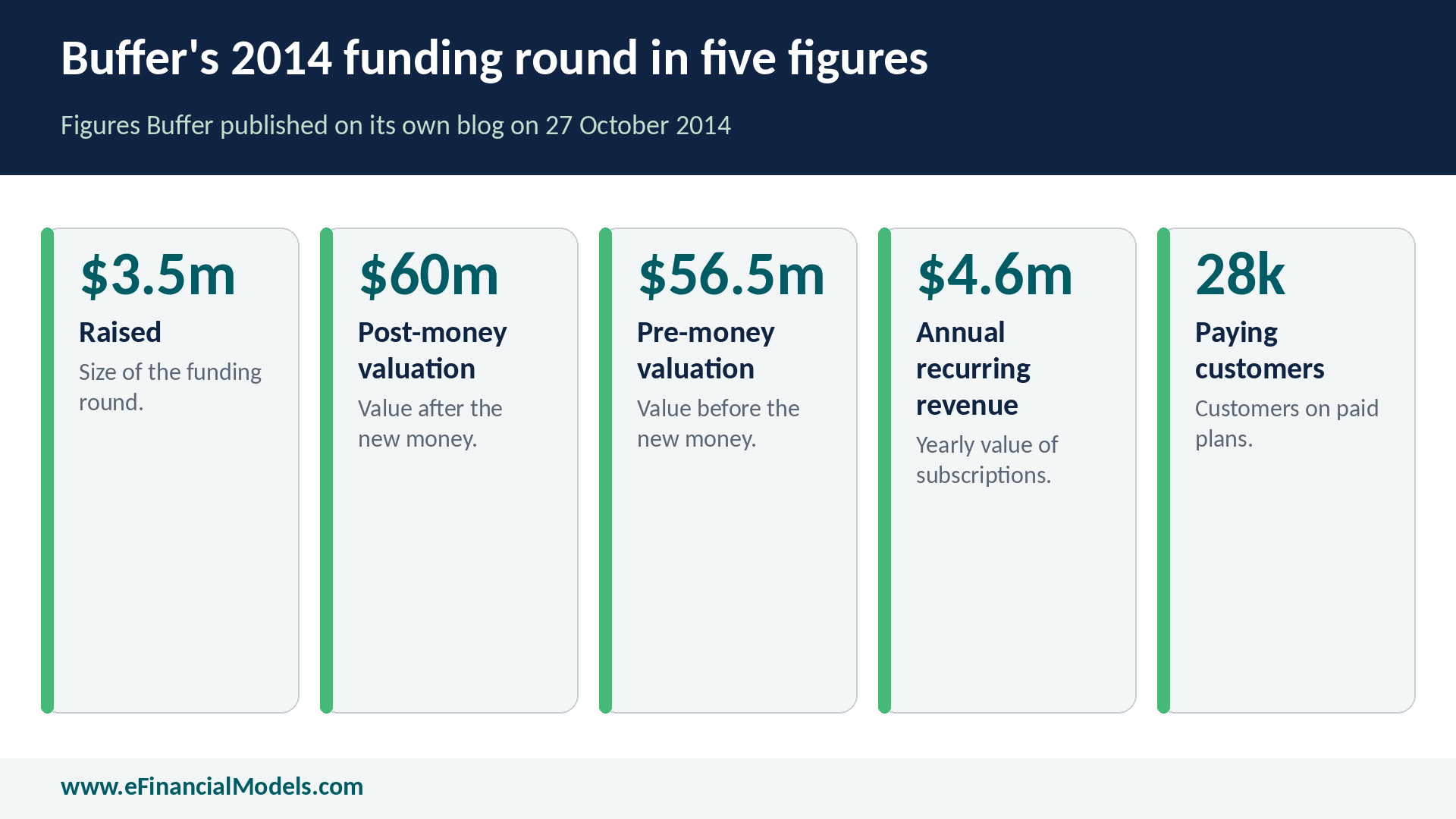
The figures Buffer published for its 2014 round, redrawn as a stat grid from the company’s own funding post.
How do reviewers validate a model before investors rely on it?
Reviewers validate a model by recomputing it independently, because spreadsheet errors are common. A paper by Raymond Panko, available on arXiv, reports that fifteen years of research studies concluded unanimously that spreadsheet errors are both common and non-trivial.
Investors run their own checks too. Buffer’s post says due diligence with the lead investor was still to be finished, and, as general advice, a founder who has already had a second person recompute the model meets such checks with fewer surprises.
What should an investor-ready model checklist contain?
An investor-ready model needs five items, and each one maps to a question investors ask. The list targets an early-stage raise from institutional investors. Lenders look at different numbers: in the Federal Reserve’s 2025 Small Business Credit Survey report, firms that were denied all or some of the financing they applied for were more likely in 2024 than in 2021 to say they were denied because they already had too much debt (41% in 2024 versus 22% in 2021). Angels and later rounds may also weigh items differently, so the lead investor or an adviser can confirm what applies. The fundraising model collection at eFinancialModels shows how such files are usually laid out.
- Drivers: the few inputs that move revenue, each labelled and sourced.
- Unit economics: lifetime value to acquisition cost on gross profit, not revenue.
- Retention: cohort tables, with net revenue retention shown.
- Cash use: monthly spending against the milestones it buys.
- Review: a second person has recomputed one period by hand.
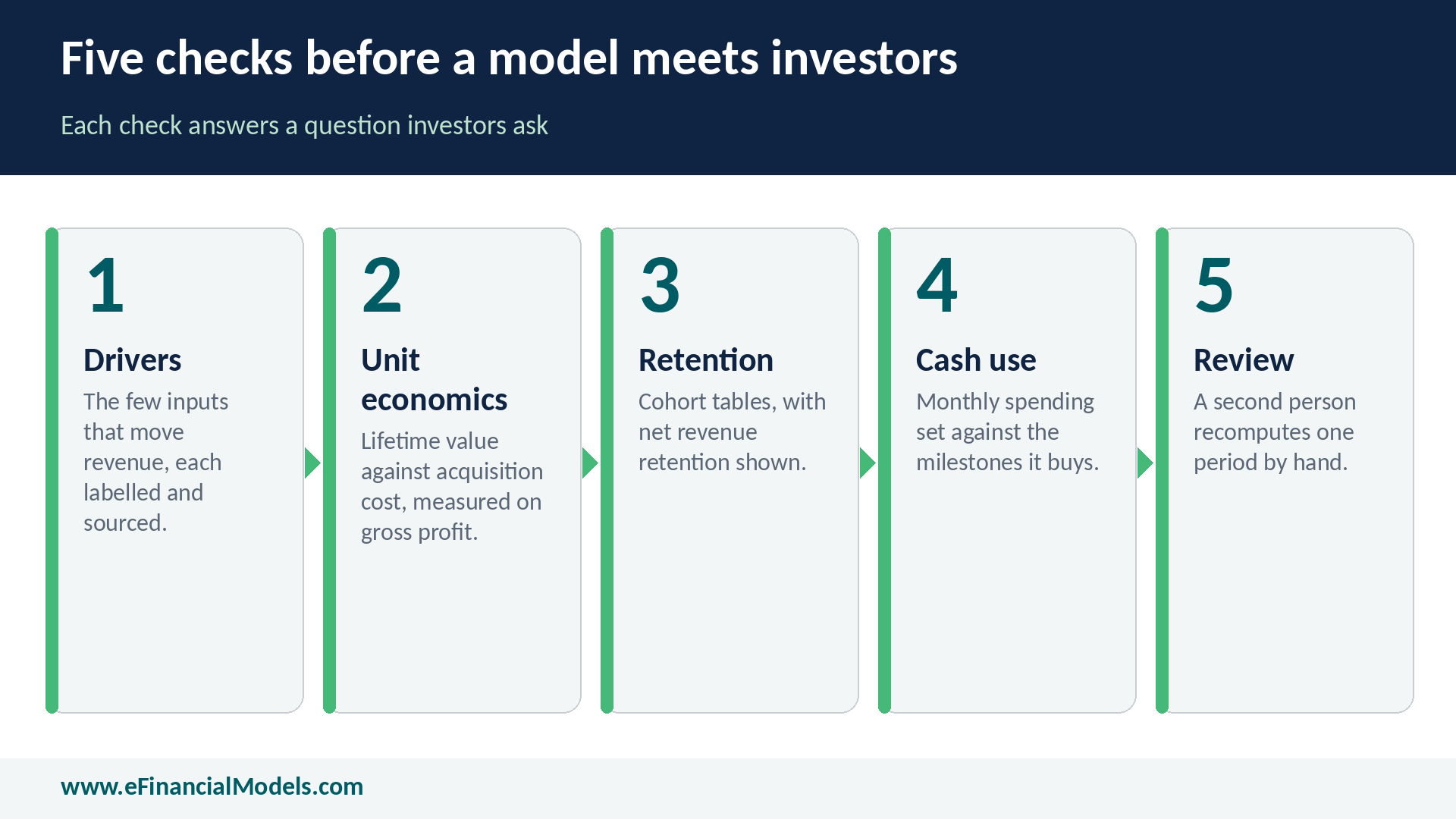
A five-step checklist for preparing a startup financial model for investor review.
Conclusion
Investors want a model that explains itself: sourced assumptions, gross-profit unit economics, retention by cohort, cash use tied to milestones and a review by a second person. Founders preparing a round can start from the Simple Fundraising Model from eFinancialModels, replace its inputs with the company’s own numbers, and have a second person recompute the result before the first meeting.
Frequently Asked Questions
Should a startup model include a downside case?
Yes. A downside case is a version of the forecast in which growth is slower or costs run higher than planned, and it shows how long the cash would last if the plan slips. Investors usually ask what happens when the main assumption is wrong, so having the answer ready signals preparation. The downside should change a small number of named inputs, such as customer growth or cancellations, so the difference between cases is easy to explain.
Does an early-stage company need a full three-statement model?
Not always, because the right depth depends on the stage. A three-statement model links the income statement, balance sheet and cash flow statement, and it suits a company with inventory, debt or large capital spending. A company at the earliest stage can often start with a driver-based view of revenue, costs and monthly cash balance, then add the linked statements when a lender or later-stage investor asks for them.
Who should review a model before an investor sees it?
A person who did not build the file. An accountant, an experienced modeller or a finance-literate adviser can recompute one period by hand, check that totals add up and test whether changing an input moves the outputs sensibly. The builder tends to read the file as intended rather than as written, so the second reader finds the slips that the builder cannot see and can note what remains unclear.
What makes investors lose trust in a model?
Trust drops when a number cannot be explained. Typical triggers include a growth rate with no reasoning, revenue and cash used as if they were the same thing, totals typed over formulas, and forecasts that never reconcile to actual results. A model does not need to be right about the future, but it does need to be internally consistent and transparent about which numbers are facts and which are guesses.
How should founders explain assumptions in the meeting?
Lead with the three or four inputs that move the result most and say where each came from: past results, a customer interview, a supplier quote or a published benchmark. Then show how the outcome changes if the input is wrong. Investors tend to respond well to a founder who knows which assumption is weakest and has a plan to test it, since that shows the model is a working tool rather than a pitch decoration.