0 ITEMS

Model Review Checklist Template for Investor-Ready Models

Yes, a founder can have an expert review a financial model before investors see it, and the five-stage checklist below makes that review focused. Running the checklist first and hiring help where the stakes justify it is consistent with the ICAEW Financial Modelling Code (copyright 2024), which calls for peer review or professional audit when a model’s impact is particularly significant.
Key Takeaways
- An expert review before investor meetings is possible: founders should self-check with a five-stage checklist first, then hire help where the stakes justify it.
- The ICAEW Financial Modelling Code (copyright 2024) advises peer review or professional audit when a model’s impact is particularly significant.
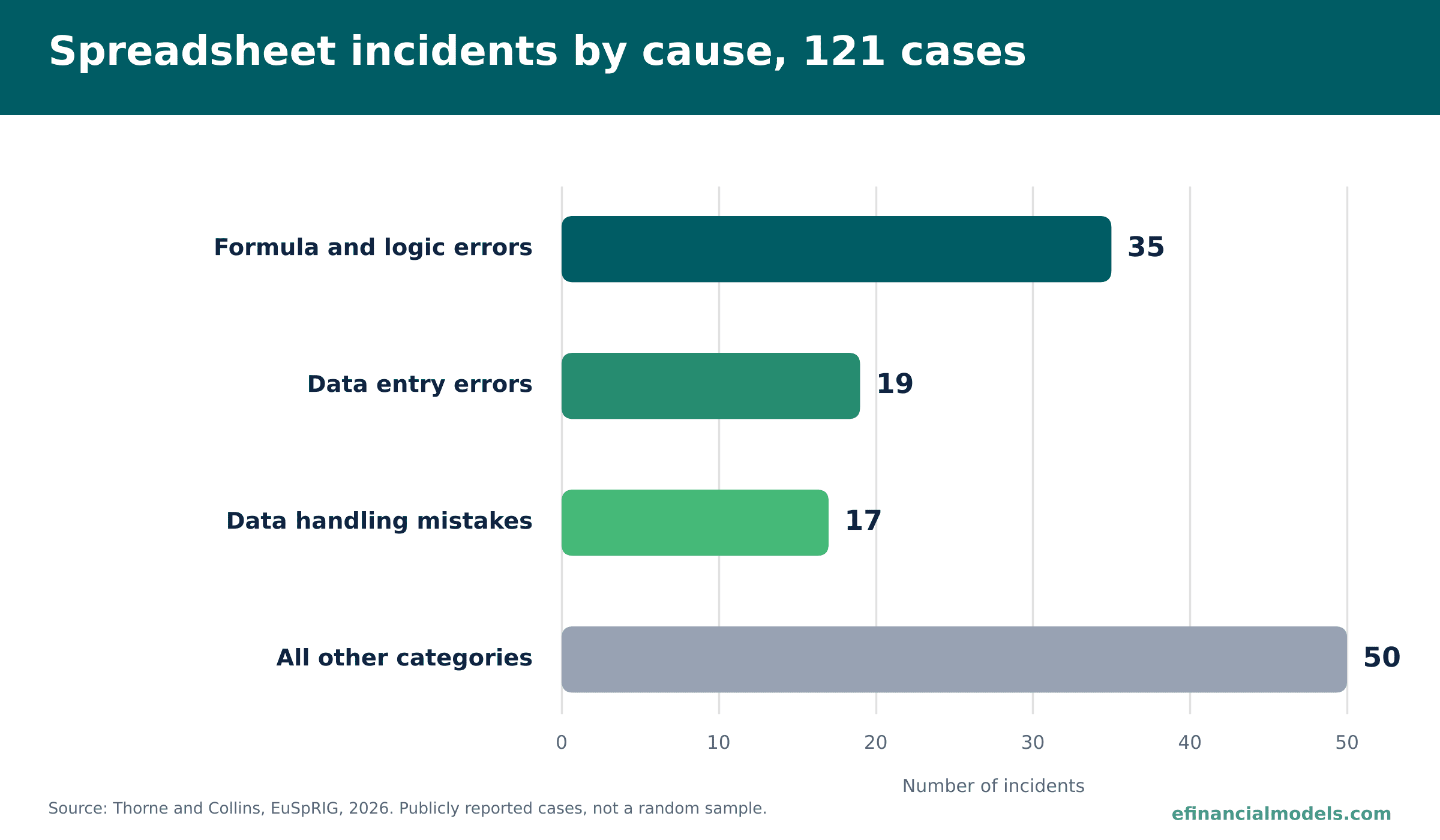
- Formula, data entry and data handling errors account for 71 of 121 mostly severe, publicly reported spreadsheet incidents (1995 to 2026) in a 2026 study.
- Numbers that disagree across tabs or with the deck undermine trust, so every deck number should tie to a named cell in the model.
- Hire a consultant when the model prices a round, has complex parts, was checked only by its author, or an investor requested a revision.
An Expert Can Review the Model Before Investors See It
The Institute of Chartered Accountants in England and Wales (ICAEW) publishes a Financial Modelling Code, copyrighted 2024, which says to operate a system of peer review, for example by a colleague or even a professional audit, if the model’s impact is particularly significant (ICAEW Financial Modelling Code, 2024).
ICAEW’s guide to reviewing a spreadsheet splits the work into five stages: initial, structural, data, analytical and detailed review (ICAEW guide to reviewing a spreadsheet, 2024). The checklist below keeps that order, so a founder can complete most items alone and hand the last item of Stage 5, independent expert review, to a professional.
Why Model Errors Reach Investors
The ICAEW guide notes that a commonly quoted statistic says as many as 90% of spreadsheets contain a mistake, a figure it attributes to research by Ray Panko of the University of Hawaii and others, and separately cites Panko’s research finding that self-review catches only 34% to 69% of errors (ICAEW guide to reviewing a spreadsheet, 2024). The guide gives no sample size, so the figures show direction, not a precise rate, and suggest that self-review alone misses many errors.
A 2026 paper by Simon Thorne and Angela Collins analysed 121 publicly reported spreadsheet incidents from 1995 to 2026, drawn from the archive of the European Spreadsheet Risks Interest Group (EuSpRIG) and a later expansion of it. Formula and logic errors account for 35 incidents, data entry errors for 19 and data handling mistakes for 17, together 71 of the 121 (Thorne and Collins, EuSpRIG proceedings, 2026). The authors describe the set as mostly severe, publicly reported cases, so it is not a representative sample of all models.
Investors also compare the model with the pitch deck and with itself, so a number that differs between tabs or from the deck is the first thing a reviewer should chase.
Model Review Checklist in Five Stages
Copy the items into a tracker with one row per check and columns for status, reviewer and note.
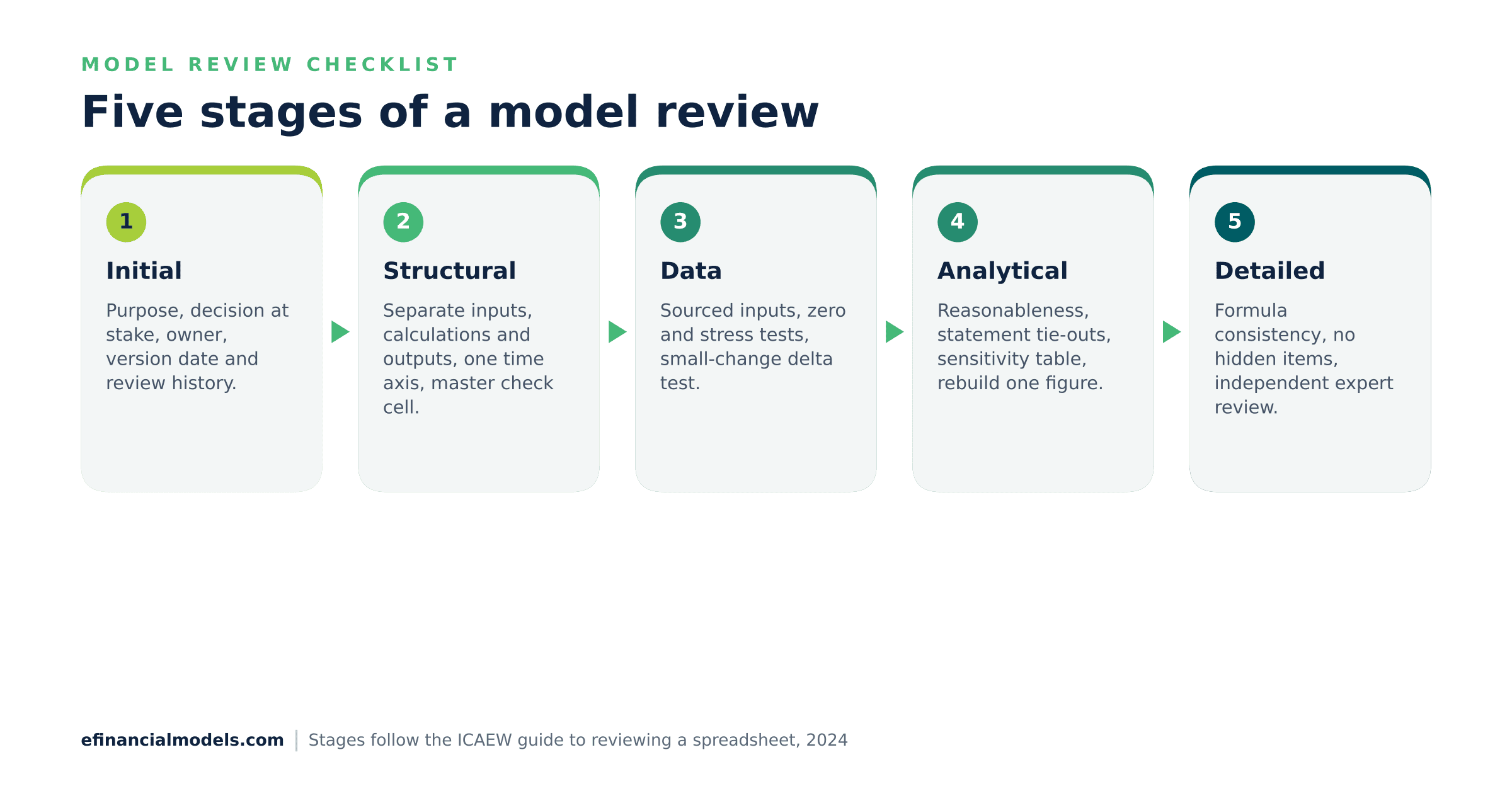
Stage 1: Initial review
- Purpose and risk: the cover sheet states which decision the model supports, such as a seed round of a stated size, plus the owner and the version date.
- Author and history: a note records who built the model and whether anyone has reviewed it before.
Stage 2: Structural review
- Layout: inputs, calculations and outputs sit on separate, labelled sheets, which follows the Structured principle of the FAST (Flexible, Appropriate, Structured, Transparent) Standard, a modelling standard published by the not-for-profit FAST Standard Organisation (FAST Standard Organisation).
- One time axis: every sheet uses the same columns for the same months.
- Checks and flags: a master check cell adds up every integrity test and reads OK or shows an alert, in line with the ICAEW principle to build in checks, controls and alerts from the outset.
Stage 3: Data review
- Sourced inputs: each input carries a source and a date, and typed numbers appear only on the inputs sheet.
- Zero and stress tests: set key inputs to zero, then to extreme values; outputs must react sensibly and the balance sheet must still balance.
- Delta test: change one input by a small amount and confirm the outputs move in the expected direction and by the expected size.
Stage 4: Analytical review
- Reasonableness: growth, margins and hiring plans compare with market evidence the founder can cite.
- Statement tie-outs: the balance sheet balances, closing cash on the cash flow statement equals cash on the balance sheet, and receivables, inventory and payables move sensibly with sales.
- Sensitivity analysis (a table that tests how outputs change when one input moves): eFinancialModels templates tagged Sensitivity Analysis show how such tables are laid out.
- Deck match: every headline number in the pitch deck ties to a named cell in the model, with the same value and period.
- Reperformance: rebuild one headline figure outside the model and compare.
Take runway, the number of months until cash runs out. Assume a startup holds USD 600,000 in cash and spends a constant USD 40,000 more cash than it receives each month. The independent rebuild is runway = cash divided by the monthly cash shortfall = 600,000 divided by 40,000 = 15 months. Suppose the model’s runway cell shows 18 months instead: the difference of 3 months (18 minus 15) points to a timing, sign or opening-balance error that needs tracing before any investor sees the number.
Stage 5: Detailed review
- Formula consistency: one formula per row across all months, no numbers typed inside formulas, no links to other files and no hidden rows or sheets.
- Independent expert review: an outside reviewer inspects the workbook and returns a ranked list of issues, each with its location and a suggested fix.
When to Hire a Financial-Modeling Consultant
Self-review has a ceiling, so outside help earns its fee in four situations. The model sets the price or size of a funding round. The model has complex parts such as several currencies, tax, debt schedules or an option pool. Nobody except the author has ever reviewed it. Or an investor has already asked for a revised version and a second miss would cost credibility.
A founder with a simple, early-stage model can skip the consultant: start from a template listed under Startup Financial Models, complete the checklist, fix the findings and ask an experienced peer to open the file cold and try to break it. Founders who prefer to hand the work over can compare the custom services listed under Custom Financial Modeling Services.
Reviewers include chartered accountants with modelling experience, independent model auditors and freelance modelers who did not build the model under review. Ask each for examples of past reviews and the standards they apply. When briefing the chosen reviewer, agree the scope in writing: which sheets are covered, whether the reviewer fixes issues or only reports them, how findings are ranked, and whether a re-test follows the fixes.
How the Checklist Aligns with ICAEW and FAST Guidance
The ICAEW code also asks model owners to test and review to reduce the risk of error and identify inefficiencies, which the data, analytical and detailed stages put into practice. The FAST Standard adds the four design principles named above. The edition linked from the FAST Standard Organisation site is 02c, dated July 2019, so the checklist treats it as design guidance and takes review practice from the 2024 ICAEW documents.
Frequently Asked Questions
How much does an independent financial model review cost?
Price depends on scope, so no single figure fits every model. The main drivers are the number of sheets, how many scenarios and currencies the workbook handles, whether the reviewer only reports or also corrects, and how quickly the founder needs the answer. Ask each candidate for a fixed fee against a written scope, and compare what each quote includes before comparing the totals.
How long does a model review take, and what comes back?
Turnaround varies with the size of the workbook and the reviewer’s availability, so confirm the date before agreeing a fee. A useful review returns an issue log that gives each finding a severity, a sheet and cell reference and a recommended fix. Ask the reviewer to re-test the corrected version, and agree that up front, because investor meetings leave little room for a second round.
Can a founder review the model alone?
A first pass is worth doing, and the checklist is built for it. Self-review remains weak because the author reads the formulas as intended rather than as written, and the same assumptions that shaped the model shape the check. Treat the founder’s pass as clearing the obvious faults, then give a colleague or paid reviewer the cleaned file to find what the author cannot see.
What should a founder send to a reviewer?
Send one locked version of the file with the version date, a short note on the decision the model supports, and the list of assumptions with their sources. Include the pitch deck so the reviewer can confirm that headline numbers match. Mention known weak spots and earlier review history, because that history tells the reviewer where to spend the limited hours of a short engagement.
Does a completed review guarantee investors will trust the numbers?
No. A review tests mechanics and reasonableness, meaning that formulas work, totals tie and results behave sensibly when inputs change. It cannot prove that the forecast will happen, because investors still judge the assumptions, the market and the team for themselves. What a review removes is the avoidable damage of an error that an investor finds first, so the model is judged on its ideas rather than its slips.
Conclusion
A founder can get an expert review before investors see the model: run the five-stage checklist, fix what it finds, and bring in a consultant for what the author cannot judge alone. A founder who wants a practice file for the statement tie-outs can open the eFinancialModels Free Three Statement Financial Model and run the checklist against it.