0 ITEMS

Balance Sheet Won’t Balance? Find and Fix the Gap in 6 Steps

A balance sheet that does not balance has a traceable cause: timing mismatches, formula errors and keying errors open a gap, while classification slips leave the sheet balanced but wrong. Six reconciliation steps, starting with cash and retained earnings, isolate each source of the gap until the difference reaches zero.
Key Takeaways
- A balance sheet balances only when assets equal liabilities plus equity, so any gap means one side of an entry was missed or altered.
- Timing, formula and entry errors open gaps, while classification errors leave a balanced but wrong sheet, so the symptom points toward the cause.
- Reconcile cash, retained earnings, fixed assets, payables, accruals and debt in that order, because each reconciliation isolates one possible error.
- A gap can stack several errors, so fix the largest roll-forward break first and re-test before drawing conclusions.
- Never plug the difference; build a visible balance check row into every model so errors surface the day they appear.
Every Entry Has Two Sides, So a Gap Means One Side Went Missing
A balance sheet lists a company’s assets, liabilities and ownership equity as of a specific date, and equity must equal assets minus liabilities, which is the same equality as assets equal liabilities plus equity. Double-entry bookkeeping enters every transaction in at least two accounts so that total debits equal total credits, which makes that equality hold by construction. A difference therefore signals one of three things: a posting that hit only one side, a number altered after posting, or a link in a spreadsheet model that broke.
Balancing is a necessary check, not proof of accuracy. Matching debit and credit totals are only a partial check on whether each transaction was recorded correctly, which is why a sheet can balance while an expense sits in the wrong account, a long-term loan appears as current, or two mistakes cancel each other. Background reading: balance sheets and double-entry bookkeeping.
Spreadsheet-built models make such errors common. A 2024 literature review led by Prof. Pak-Lok Poon, reported by Phys.org, found that 94% of spreadsheets used in business decision-making contain errors.
Common Causes Matrix: Timing, Classification and Formula Errors
The matrix groups the usual suspects by family. Only errors that change one side without the other create a gap; the rest leave the sheet balanced but misleading.
| Cause family | Typical example | Breaks the balance? | Where to look | Fix |
|---|---|---|---|---|
| Timing | Expense booked in March, matching liability posted in April | Yes, until both sides post | Cut-off schedule, accrual roll-forward | Post both sides in one period |
| Timing | Cash flow statement closes on a different period column than the balance sheet | Yes | Opening and closing column links | Align every period reference |
| Classification | Loan repayment booked as an expense instead of reducing debt | No, but profit and debt are misstated | Debt schedule against the ledger | Reclassify the entry |
| Formula | Depreciation added to fixed assets instead of subtracted | Yes, by twice the amount | Fixed asset roll-forward | Correct the sign |
| Formula | Typed number pasted over a linked formula | Yes | Constants inside formula rows | Restore the link |
| Entry | Digits transposed on one side of an entry, for example 57,200 keyed as 52,700 | Yes, by a multiple of nine, when only one side is keyed that way | Subledger against ledger | Correct the entry |
| Currency | Foreign subsidiary translated, but the translation difference never reaches equity | Yes | Equity line for translation differences | Post the difference to equity |
Timing errors have a structural source in accrual accounting, which records revenue and expenses when they are earned or incurred rather than when cash moves (see the Wikipedia entry on accruals for background). An expense accrued on the income statement without its matching liability on the balance sheet is exactly the one-sided posting that opens a gap.
Foreign currency deserves a separate check. A consolidation that translates a foreign subsidiary but never posts the translation difference to equity leaves a gap in every period.
Reconciliation Workflow: Six Steps From Gap to Zero
The workflow moves from the cheapest diagnostic to the most detailed reconciliation, and each step either explains part of the gap or proves an area clean.
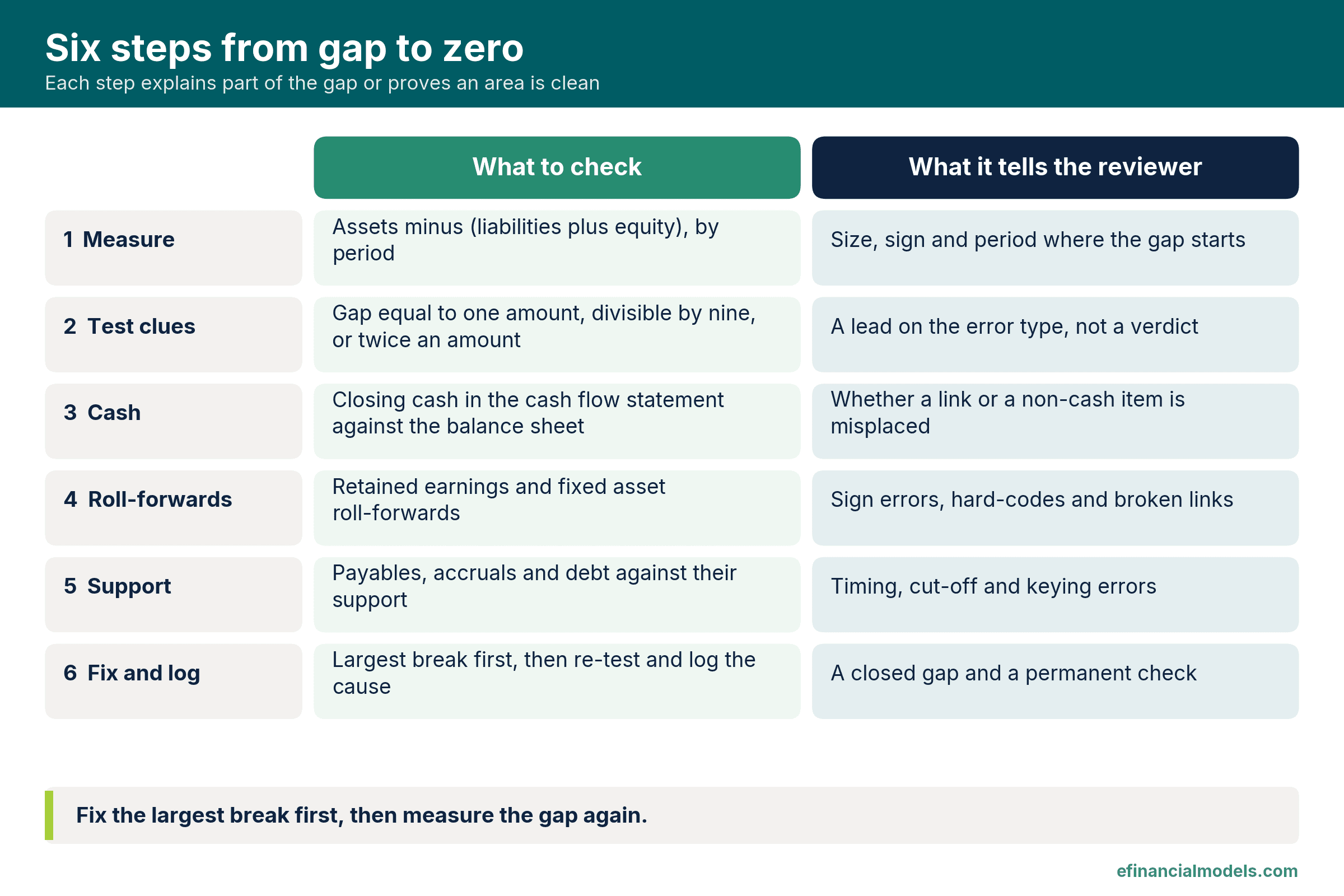
Each step either explains part of the gap or proves that an area is clean.
- Freeze and measure the gap. Lock the period, then record the gap as total assets minus (liabilities plus equity). Note whether it appears in every period and scenario or in only one.
- Test the difference for clues. A gap equal to a single posted amount suggests a one-sided entry, a gap divisible by nine suggests transposed digits, and a gap equal to twice an amount suggests a flipped sign. These tests work for one error; stacked errors blur them, so treat a clue as a lead and not a verdict.
- Reconcile cash. Closing cash in the cash flow statement must equal cash on the balance sheet. The cash flow statement groups cash movements into operating, investing and financing activities, so a cash break means a non-cash item in net income was not added back, or a link is missing.
- Roll forward retained earnings and fixed assets. Opening retained earnings plus net income minus dividends must equal closing retained earnings. Opening fixed assets plus additions minus depreciation and disposals must equal closing fixed assets. In multi-currency models, also confirm that translation differences reach the equity line.
- Tie payables, accruals and debt to their support. Compare each balance with the invoice list, the accrual schedule and the loan statement. This step catches the timing and entry errors that the roll-forwards cannot see.
- Fix, re-test and document. Correct the largest break first, recalculate, and measure the gap again. Record the cause, entry and approver, then add a permanent check.
Worked Example: Splitting a 12,600 Gap Into Three Errors
In this example, all amounts are illustrative US dollar figures for one month-end. The booked balance sheet shows total assets of 1,255,600, total liabilities of 780,000 and equity of 463,000, so liabilities plus equity equal 780,000 + 463,000 = 1,243,000. The gap, total assets minus (liabilities plus equity), is 1,255,600 – 1,243,000 = 12,600.
| Line | As booked | Corrected |
|---|---|---|
| Fixed assets | 682,800 | 677,200 |
| Other assets | 572,800 | 572,800 |
| Total assets | 1,255,600 | 1,250,000 |
| Payables | 52,700 | 57,200 |
| Accrued expenses | 0 | 2,500 |
| Other liabilities | 727,300 | 727,300 |
| Total liabilities | 780,000 | 787,000 |
| Equity | 463,000 | 463,000 |
| Liabilities plus equity | 1,243,000 | 1,250,000 |
| Gap (total assets minus (liabilities plus equity)) | 12,600 | 0 |
Clue tests mislead on stacked errors: 12,600 happens to divide by nine, yet only one of the three errors is a transposition. The fixed asset roll-forward and the step 5 tie-outs separate the three errors:
- Fixed assets (step 4). The opening balance is 600,000, additions are 80,000 and the month’s depreciation is 2,800. The correct closing balance is 600,000 + 80,000 – 2,800 = 677,200, but the model computes 600,000 + 80,000 + 2,800 = 682,800 because depreciation was added. The sign error overstates assets by 682,800 – 677,200 = 5,600.
- Payables (step 5). The invoice list totals 57,200, and the expense side was posted correctly at 57,200, but the balance sheet payable was keyed as 52,700, a transposition worth 4,500.
- Accruals (step 5). A 2,500 accrued expense reached the income statement but not the balance sheet, a timing error worth 2,500.
The three breaks sum to 5,600 + 4,500 + 2,500 = 12,600. Correcting assets to 1,255,600 – 5,600 = 1,250,000 and liabilities to 780,000 + 4,500 + 2,500 = 787,000 gives liabilities plus equity of 787,000 + 463,000 = 1,250,000, so the gap closes exactly.
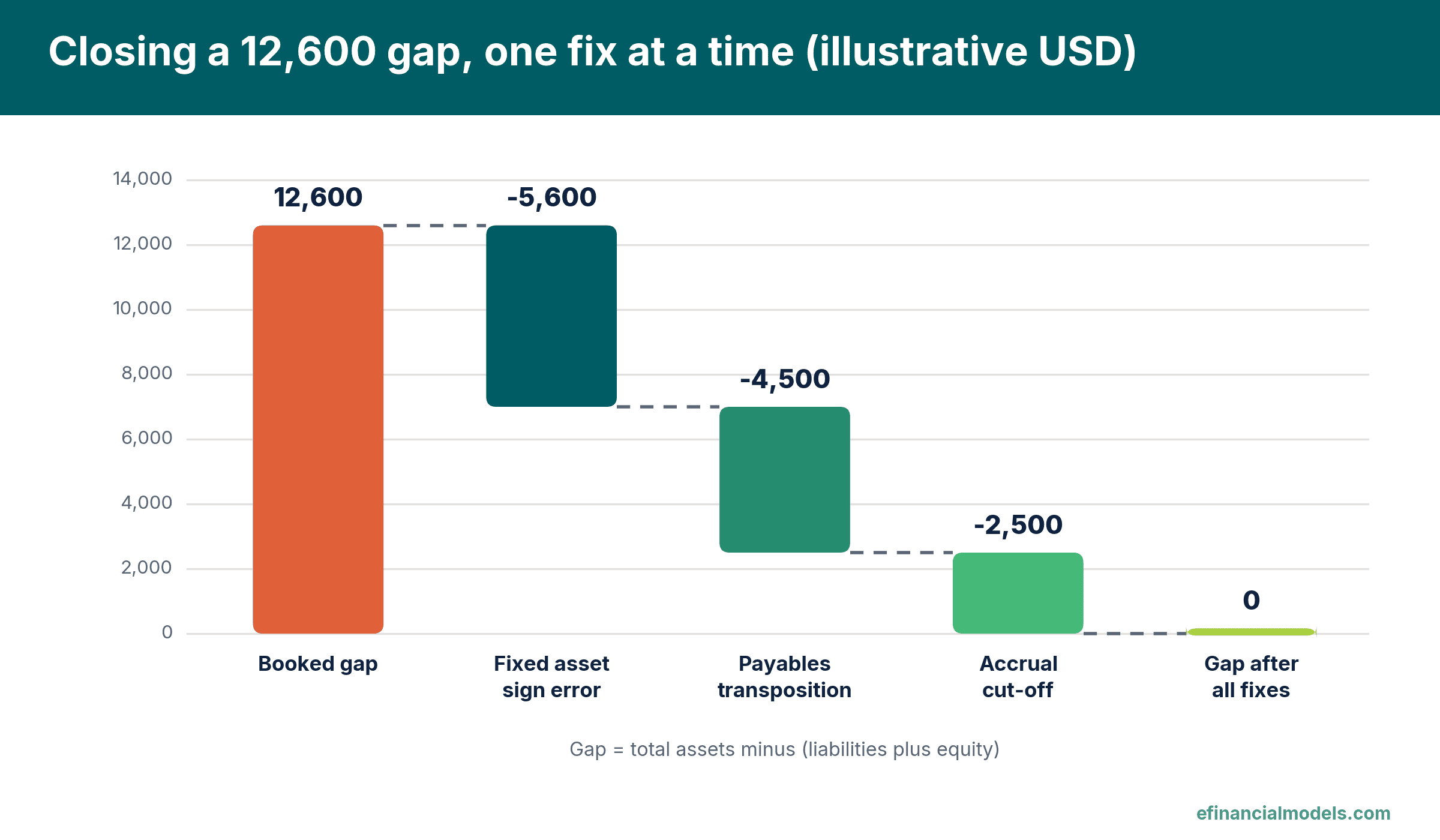
Built from the worked example’s own figures: 5,600 plus 4,500 plus 2,500 equals 12,600.
Who Does What: Founder, Controller and Student
A first-time founder using accounting software rarely has a software-made gap, because ledgers enforce double entry. The gap usually comes from a spreadsheet model, a manual journal or an opening balance keyed by hand, so the founder should compare balances with bank statements and invoices first. If the gap survives all six steps, the bookkeeper or external accountant should review before any report goes to a lender or investor, and tax treatment belongs with a tax adviser.
A controller treats an unexplained difference as a close-process failure: the reconciliation note, correcting entry and approval belong in the close file, and a difference still open at sign-off is a question for the auditor.
A Master of Science (MSc) finance student building a three-statement model meets the same errors as broken links, sign errors and circular interest, so the balance check row comes first, not last. A gap that survives all six steps goes to the course tutor or supervisor with the reconciliation log attached.
Build the Check Into the Model So the Gap Cannot Hide
A check row calculates total assets minus (liabilities plus equity) for every period and flags any value outside a tolerance. Roll-forwards sit on their own rows, inputs sit apart from formulas, and no plug cell absorbs differences. Models built on a linked three statement model structure make the checks easier because net income, cash and retained earnings already connect. Related collections: financial statements and accounting.
Undetected errors can reach published statements. Accounting Today, reporting on the Ideagen Audit Analytics Financial Restatements report, says corporate restatements fell by almost a fifth (18%) in 2025, to 391, the second-lowest count in the past 20 years.
Conclusion
A gap in the balance sheet is a signal, not a mystery. Measure it, test it, reconcile cash, retained earnings, fixed assets, payables and debt in turn, and fix the largest break first. Readers who want a linked structure with the statements already connected can start with the Free Three Statement Financial Model from eFinancialModels and apply the six steps to their own numbers.
Frequently Asked Questions
Can a balance sheet balance and still contain errors?
Yes. Equality only tests arithmetic. Mistakes that move both sides by the same amount pass the check: a repair cost capitalised as equipment, a customer deposit recognised as revenue, or two errors of equal size and opposite direction. Reviewers therefore pair the balance check with ratio reasonableness, comparisons with prior periods and subledger tie-outs, because those tests expose misstatements that the equation cannot see.
Is a suspense account or plug cell ever acceptable?
A plug converts a visible error into a hidden one. In live bookkeeping, a temporary suspense account can be acceptable when it has a named owner, a written reason and a clearing deadline inside the close. In a forecast model, a plug cell is never acceptable, because every later period inherits it and reviewers can no longer tell genuine cash from the correction.
What tolerance should the check row allow?
When amounts are stored to the cent, the tolerance should be no more than one cent. Larger differences deserve investigation. Display rounding is the usual culprit for tiny gaps, so round only in the presentation layer and keep full precision in every underlying calculation. A tolerance wider than the rounding noise lets real errors of a few currency units pass unnoticed.
Why does the model balance in one scenario but break in another?
Scenario switches often skip a link, pasted values override formulas for one case, and circular interest calculations misbehave when iteration is off. Run the check row under every scenario, find the first period where it turns non-zero, and trace the cells that differ between the working and failing cases. The break normally sits in the first cell whose value stops following its formula.
When should a founder involve an accountant or an auditor?
Escalate when the gap survives all six steps, when the numbers support a loan, investor report or tax filing, or when the difference involves foreign currency, consolidation or equity transactions. Unexplained differences should not be filed or presented. The accountant resolves the books, the tax adviser handles filing consequences, and the auditor needs the reconciliation notes if the difference touched a closed period.