0 ITEMS

Financial Modeling Services for Startups: Raise-Ready in 7 Days

Fundraising is already the hardest thing a founder does — a weak financial model shouldn’t be the reason a VC passes before the second meeting.
Key Takeaways
- 90% of startup pitch decks that reach a VC’s desk are rejected, and financial model quality is among the top 3 reasons cited by investors, according to DocSend pitch deck research.
- EFM delivers seed-stage financial models in 5–7 business days and Series A models in 10–14 business days — faster than any in-house hire.
- Pricing starts at $1,500 for pre-seed models and scales to $4,500–$8,000 for Series A packages with full diligence support.
- An investor-ready model includes 5 non-negotiable components: a 3-statement model, cap table integration, unit economics, scenario analysis, and a valuation framework.
- Hardcoded numbers, broken formula links, and missing sensitivity analysis are the 3 model errors most likely to kill a deal in diligence.
- EFM has supported 40+ startups through successful fundraising rounds across SaaS, fintech, consumer, and deep tech sectors.
- Ongoing model maintenance after your first close keeps actuals tracking clean and your next round preparation on schedule.
Why Investors Reject 90% of Financial Models Before Reading Them
Most investor rejections tied to financial models happen in the first 60 seconds of review — not because the numbers are wrong, but because the model signals amateur construction. According to DocSend, the average VC spends just 2 minutes and 42 seconds reviewing a pitch deck, and financial slides receive disproportionate scrutiny because they reveal how a founder thinks about their business.
Source: DocSend Pitch Deck Research
A model full of hardcoded numbers (values typed directly into cells rather than driven by formulas linked to assumptions) tells an investor the founder can’t stress-test their own projections.
The Kauffman Foundation reports that fewer than 1 in 4 venture-backed startups successfully raise a second round, and preparation quality — including financial model rigor — is a consistent differentiator between those that do and those that don’t.
CB Insights analyzed 111 startup post-mortems and found that running out of cash was the second most common cause of failure, which traces directly back to inadequate financial planning and modeling.
Investors know this. They use your model to assess whether you know it too.
The three fastest rejection triggers are:
- Revenue projections with no bottom-up logic (just a percentage of a large market)
- Missing sensitivity analysis (a tool that shows how outcomes change when key assumptions shift)
- A cap table that doesn’t reconcile with the funding ask

Hardcoded numbers, broken links, and unsupported hockey-stick projections are the three fastest rejection triggers in investor model review.
What Makes a Financial Model ‘Investor-Ready’ vs. ‘Founder-Built’
An investor-ready financial model is fully formula-driven, assumption-transparent, and built to answer follow-up questions without a rebuild. A founder-built model is typically the opposite: it tells a story but can’t survive a single diligence question like “what happens to your runway if CAC increases 30%?”
The structural difference comes down to architecture. Professional models separate inputs (your assumptions), calculations (your formulas), and outputs (your projections) into distinct layers. This means an investor’s analyst can change one assumption and watch every output update instantly. Founder-built models often collapse under that kind of interrogation because numbers are hardcoded across dozens of cells with no traceable logic.
Here’s the practical test: if you can’t answer “where does that $2.4M revenue figure come from, cell by cell?” in under 30 seconds, your model isn’t investor-ready.

Professional model architecture separates inputs, calculations, and outputs — making every assumption traceable and every output stress-testable.
Core Components Every Startup Financial Model Must Include
Every investor-ready startup financial model needs 5 core components, each serving a specific function in the fundraising conversation.
1. Three-Statement Model
The 3-statement model (income statement, balance sheet, and cash flow statement) is the backbone of any financial model. These three statements must link dynamically — meaning a change in revenue on the income statement automatically flows through to cash on the balance sheet. Investors use the cash flow statement to verify your burn rate and runway claims. You can explore financial model templates to see how professional 3-statement structures are built.
2. Cap Table Integration
A cap table (capitalization table) tracks who owns what percentage of your company, including founders, employees with options, and existing investors. Your model must show how the current raise changes ownership percentages and what that means for future dilution. Mismatches between your cap table and your funding ask are an immediate red flag.
3. Unit Economics
Unit economics are the per-customer or per-transaction revenue and cost metrics that prove your business model works at the individual level before it works at scale. The two most critical metrics are Customer Acquisition Cost (CAC, the total cost to acquire one customer) and Lifetime Value (LTV, the total revenue one customer generates). A healthy SaaS business typically targets an LTV:CAC ratio of 3:1 or higher.
Source: OpenView Partners SaaS Benchmarks
4. Scenario Analysis
Scenario analysis (also called sensitivity analysis) shows investors what happens to your projections under different conditions: a base case, a conservative case, and an optimistic case. This isn’t pessimism — it’s proof that you understand the levers in your business. Models without scenario analysis signal that the founder only believes their best-case outcome.
5. Valuation Framework
Your model should support at least two valuation methods: a revenue multiple approach (common for early-stage SaaS) and a discounted cash flow (DCF) analysis for later-stage companies. The valuation framework anchors your funding ask to a defensible number rather than a wish. For financial projections that feed directly into valuation, the assumptions must be traceable and benchmarked.

Every investor-ready startup model must include all 5 components — missing any one signals incomplete preparation to institutional investors.
Timeline Reality: From Kickoff to Pitch-Ready Model
EFM delivers models faster than any alternative — and speed matters when your fundraising window is open. Here’s the honest timeline comparison across your three options:
| Option | Delivery Time | Cost Range | Diligence-Ready |
|---|---|---|---|
| EFM Service | 5–14 days | $1,500–$8,000 | Yes |
| Freelancer | 3–6 weeks | $2,000–$15,000 | Varies |
| In-House Hire | 3–6 months | $80K–$150K/yr | Depends on hire |
| Fractional CFO | 4–8 weeks | $5,000–$20,000 | Often yes |
For seed-stage startups, EFM’s standard delivery is 5–7 business days from a completed intake call. Series A packages, which include full scenario modeling, investor Q&A preparation, and diligence documentation, deliver in 10–14 business days. Rush delivery (3–4 business days) is available for an additional fee when your fundraising timeline demands it.
The average venture fundraising process takes 6–12 months from first outreach to term sheet.
Source: National Venture Capital Association (NVCA)
Model preparation typically needs to be complete before you begin investor outreach — which means a 3-month delay waiting for an in-house hire to ramp up costs you a full fundraising cycle.

EFM delivers in 5–14 days versus 3–6 months for an in-house hire — a critical difference when your fundraising window is open.
Pricing That Aligns With Your Runway
EFM structures pricing around startup stage because a pre-seed founder and a Series A CEO have fundamentally different needs and budgets.
Pre-Seed / Bootstrap: Starting at $1,500
Includes a 3-statement model with 3-year projections, basic unit economics dashboard, and one scenario (base case). Designed for founders raising their first $250K–$1M from angels or accelerators. Delivery in 5 business days.
Seed Stage: $2,500–$4,000
Includes everything in the pre-seed package plus cap table integration, three-scenario analysis (base, bear, bull), monthly cash flow detail, and a KPI dashboard. Designed for rounds of $1M–$5M. Delivery in 7 business days. You can browse startup financial models for reference on what seed-stage models typically include.
Series A: $4,500–$8,000
Includes a full 5-year 3-statement model, cap table with option pool modeling, cohort-based unit economics, five-scenario sensitivity analysis, valuation framework (DCF + revenue multiple), investor Q&A preparation guide, and diligence data room support. Designed for rounds of $5M–$20M. Delivery in 10–14 business days.
All packages include one round of revisions and a 60-minute model walkthrough call where EFM explains every assumption to your team.
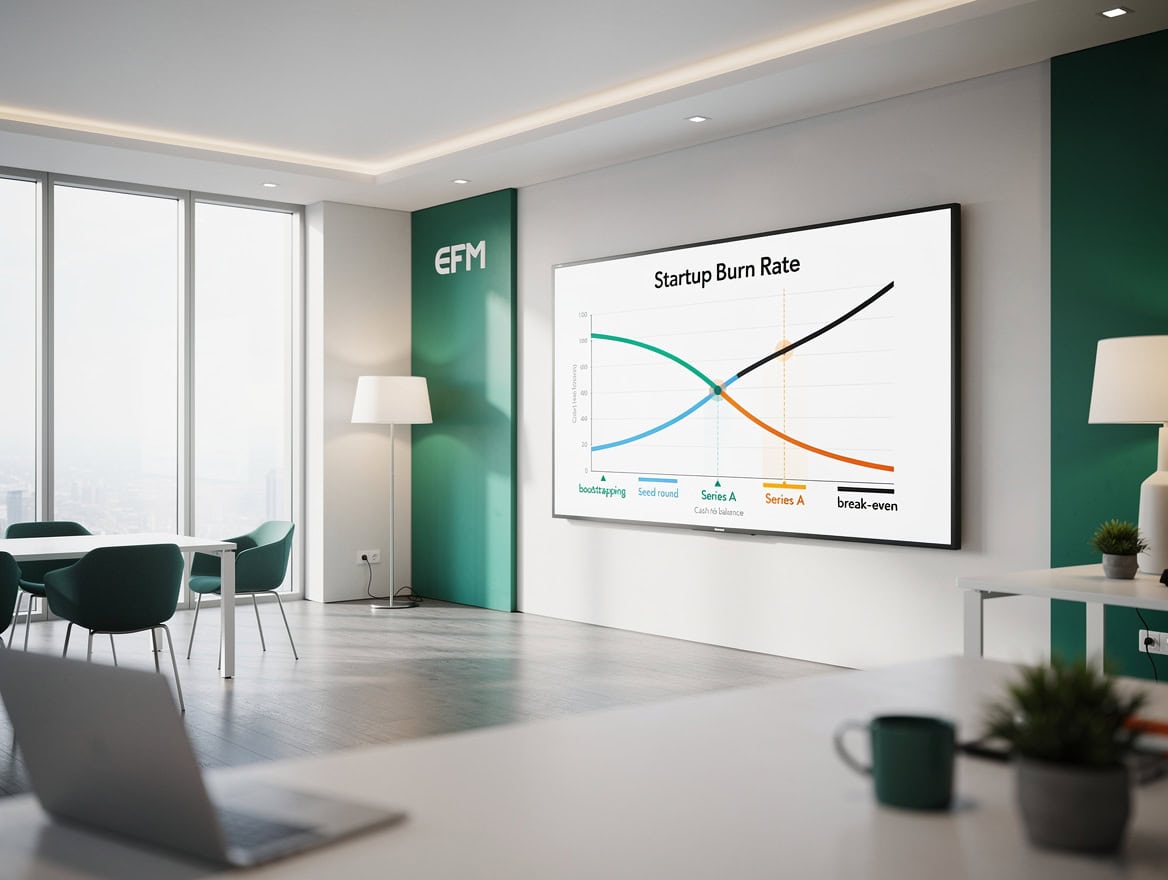
EFM’s stage-based pricing ensures pre-seed founders aren’t paying for Series A complexity they don’t need yet.
How EFM Models Withstand Investor Due Diligence
Due diligence is where most founder-built models fail. An investor’s analyst will open your model, change your churn assumption from 2% to 5%, and watch what happens. If the model breaks, throws errors, or produces nonsensical outputs, the deal stalls.
EFM builds every model with what we call diligence-ready architecture: fully dynamic formula chains, no hardcoded values in calculation cells, named ranges for every key assumption, and a dedicated assumptions tab that serves as the single source of truth. This means an investor can stress-test any variable without breaking the model.
The 4 most common model errors that kill deals in diligence:
- Hardcoded numbers in formula cells: Revenue of $2.4M typed directly into a cell instead of calculated from price × volume × conversion rate.
- Circular references: Formula loops that cause Excel to calculate incorrectly or display errors (a circular reference occurs when a formula refers back to its own cell, creating an infinite loop).
- Broken external links: Formulas that reference other files or sheets that aren’t included in the model package sent to investors.
- Unrealistic growth hockey sticks: Month 1 revenue of $10K growing to $10M by month 24 with no explanation of the sales motion that drives it.
EFM’s QA process includes a 47-point model audit before delivery, checking for all of the above plus formula consistency, unit reconciliation, and balance sheet integrity.
EFM’s QA audit checks 47 model integrity points before delivery — catching every error that would surface in investor due diligence.
Worked Example: Seed-Stage SaaS Unit Economics
Here’s the math behind a typical seed-stage SaaS unit economics model EFM builds:
Inputs:
- Monthly new customers: 50
- Average Contract Value (ACV): $12,000/year ($1,000/month)
- Monthly churn rate: 2%
- Sales and marketing spend: $30,000/month
- Average sales cycle: 45 days
Calculations:
- CAC = Sales and marketing spend / new customers = $30,000 / 50 = $600 per customer
- Average customer lifetime = 1 / churn rate = 1 / 0.02 = 50 months
- LTV = Monthly revenue per customer × lifetime = $1,000 × 50 = $50,000
- LTV:CAC ratio = $50,000 / $600 = 83:1 (exceptional for seed stage)
- CAC Payback Period = CAC / monthly revenue = $600 / $1,000 = 0.6 months
This model tells an investor: for every $600 spent acquiring a customer, the business recovers $50,000 over the customer’s lifetime, and recoups the acquisition cost in under one month. That’s the kind of unit economics story that accelerates term sheets.
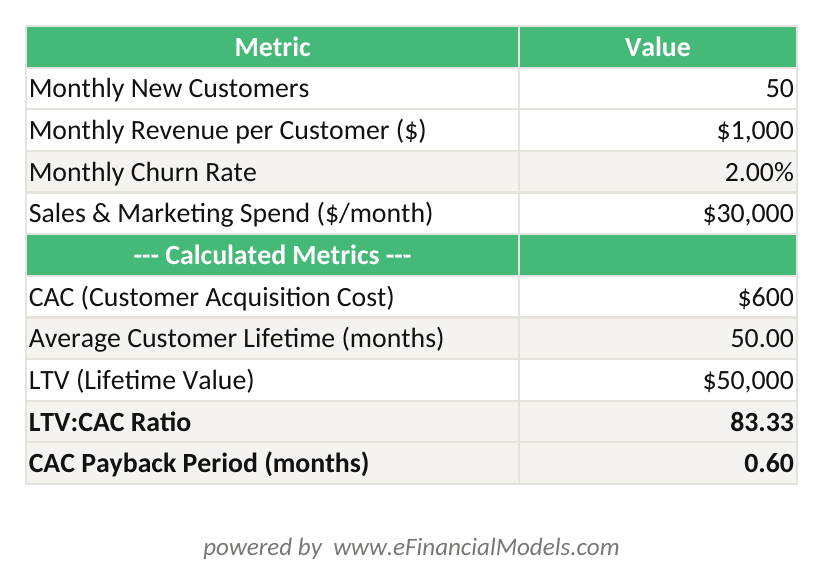
LTV:CAC = $50,000 / $600 = 83:1 | CAC Payback = $600 / $1,000 = 0.6 months — inputs match the worked example in the article body.

An LTV:CAC ratio of 83:1 with a 0.6-month payback period is the kind of unit economics story that accelerates term sheets.
Real Outcomes: Startups That Closed Rounds Using EFM Models
EFM has supported more than 40 startups through successful fundraising rounds, spanning SaaS, fintech, consumer marketplaces, and deep tech. Here are three anonymized examples:
Case 1: B2B SaaS, Seed Round ($2.2M)
A 6-person SaaS team came to EFM 3 weeks before their first investor meetings with a founder-built model that had 14 hardcoded revenue figures and no scenario analysis. EFM rebuilt the model in 6 business days. The founder closed a $2.2M seed round 8 weeks later. The lead investor specifically cited the model’s clarity on CAC payback as a deciding factor.
Case 2: Fintech, Series A ($8.5M)
A fintech startup needed a model that could survive a 90-day diligence process from a tier-1 VC. EFM delivered a full Series A package in 12 business days, including a cohort-based revenue model and a regulatory capital adequacy analysis. The round closed at $8.5M.
Case 3: Consumer Marketplace, Pre-Seed ($750K)
A two-person founding team needed their first investor-ready model for an accelerator application. EFM delivered a pre-seed package in 5 business days. The team was accepted into the accelerator and subsequently raised $750K from angel investors.

EFM has supported 40+ startups across SaaS, fintech, and consumer sectors through successful fundraising rounds.
Maintaining Your Model: From First Close to Growth Stage
Closing your round is the beginning of your model’s working life, not the end. Investors expect monthly or quarterly actuals-vs-budget reporting, and your board will ask why you’re 15% below revenue plan in month 3. A model that isn’t maintained becomes a liability.
EFM offers ongoing model maintenance packages starting at $500/month, which include:
- Monthly actuals integration (plugging real revenue, cost, and headcount data into your model)
- Variance analysis (explaining the gap between projected and actual performance)
- Rolling 12-month forecast updates
- Board reporting templates
- Next-round preparation updates when you’re 6–9 months from your next raise
For forecasting and KPI tracking after your close, a maintained model is also your best tool for managing burn multiple — the ratio of net burn to net new ARR — which has become a primary efficiency metric for Series B investors following the 2022–2023 funding contraction.
Working With EFM: The Collaboration Process
The EFM engagement process is designed to minimize founder time while maximizing model quality.
Step 1: Model Strategy Session (30 minutes, free)
EFM assesses your fundraising timeline, investor type (angel, seed VC, growth equity), and model requirements. You receive a fixed-price proposal and delivery timeline within 24 hours.
Step 2: Intake and Data Collection (1–2 hours, founder-led)
You complete a structured intake questionnaire covering your business model, pricing, customer acquisition channels, headcount plan, and historical financials (if any). EFM provides the template — you fill in what you know.
Step 3: Model Build (5–14 business days, EFM-led)
EFM builds your model, runs internal QA, and prepares a plain-English assumptions summary that explains every projection to a non-finance audience.
Step 4: Review and Revision (3–5 days)
You review the model, ask questions, and request one round of revisions included in your package price.
Step 5: Walkthrough Call (60 minutes)
EFM walks your team through every tab, every assumption, and every output so you can answer investor questions confidently without needing EFM on the call.
Frequently Asked Questions
How much does a startup financial model cost?
Startup financial model costs depend on your stage and complexity. EFM’s pre-seed packages start at $1,500 and include a 3-statement model with 3-year projections and basic unit economics. Seed-stage packages run $2,500–$4,000 and add cap table integration and three-scenario analysis. Series A packages range from $4,500–$8,000 and include full diligence support, cohort-based unit economics, and a valuation framework. For comparison, a fractional CFO typically charges $5,000–$20,000 for equivalent work, and an in-house financial modeling hire costs $80,000–$150,000 per year in salary alone. EFM’s fixed-price model means no billing surprises and a clear scope before work begins.
How long does it take to build an investor-ready financial model?
EFM delivers seed-stage models in 5–7 business days and Series A models in 10–14 business days from a completed intake call. Rush delivery in 3–4 business days is available for an additional fee. By comparison, hiring a freelancer typically takes 3–6 weeks (including sourcing, vetting, and onboarding time), and an in-house hire takes 3–6 months to recruit and ramp. Given that the average venture fundraising process takes 6–12 months according to NVCA data, starting your model build early is critical — but EFM’s turnaround means you can begin investor outreach within two weeks of engaging us.
What is a 3-statement financial model and why do investors require it?
A 3-statement financial model links three core financial statements: the income statement (revenue and expenses), the balance sheet (assets, liabilities, and equity), and the cash flow statement (actual cash movement). The three statements must connect dynamically — a change in revenue flows automatically through to cash and equity. Investors require this structure because it proves your projections are internally consistent. A standalone revenue projection without a linked balance sheet can’t show whether you’ll run out of cash before hitting your milestones. The cash flow statement is particularly critical because it reveals your true burn rate and runway, which are the numbers investors use to size your funding ask.
What are the biggest mistakes founders make in their financial models?
The 4 most damaging mistakes are: (1) hardcoded numbers in calculation cells, meaning revenue figures typed directly rather than calculated from price, volume, and conversion assumptions; (2) top-down market sizing for revenue projections (“we’ll capture 1% of a $10B market”) instead of bottom-up customer acquisition logic; (3) missing scenario analysis, which signals the founder hasn’t stress-tested their own assumptions; and (4) a cap table that doesn’t reconcile with the funding ask, creating confusion about post-money ownership. EFM’s 47-point QA audit catches all of these before delivery. Investors see hundreds of models per year — these errors are immediately recognizable and damage credibility beyond just the model itself.
Do I need a financial model before approaching investors?
Yes, for any raise above $250K, you need a financial model before your first investor meeting — not after. Most VCs request the model within 48 hours of an initial meeting, and some request it before agreeing to meet. Arriving without a model signals that you haven’t done the foundational work. For pre-seed raises under $250K from friends, family, or angel networks, a simplified model may suffice, but even at that stage, a clear unit economics story and 18-month cash flow projection are expected. EFM’s pre-seed package is specifically designed for founders at this earliest stage who need something credible without over-engineering.
Can EFM update my model after I close my round?
Yes. EFM offers ongoing model maintenance starting at $500 per month, which includes monthly actuals integration, variance analysis, rolling 12-month forecast updates, and board reporting templates. Maintaining your model post-close serves two purposes: it keeps your board informed with accurate actuals-vs-budget reporting, and it keeps your model current for your next fundraising round. Investors in your Series A or B will ask to see your historical actuals against your seed-stage projections — a well-maintained model that shows disciplined tracking is a significant credibility signal. Most founders who skip maintenance end up rebuilding from scratch 18 months later at significant cost and time.
How does EFM’s model integrate with my pitch deck?
EFM builds your financial model and then extracts the 4–6 key slides that belong in your pitch deck: the financial summary (3-year revenue, EBITDA, and cash), the unit economics dashboard (CAC, LTV, payback period), the use of funds waterfall (how you’ll deploy the capital you’re raising), and the funding ask with post-money valuation. These slides are formatted to match your deck’s design language and are built directly from the model — meaning every number in your deck traces back to a formula in your model. This eliminates the common problem of deck numbers that don’t match model numbers, which is an immediate credibility issue when an investor’s analyst cross-references both documents.
Build the Model That Closes the Round
Your financial model is the most scrutinized document in your fundraising process. It tells investors whether you understand your business, whether you’ve stress-tested your assumptions, and whether you can survive 90 days of diligence questions without rebuilding from scratch.
EFM delivers investor-ready models in 5–14 business days at fixed prices that align with your stage and runway. More than 40 startups have used EFM models to close rounds ranging from $750K pre-seed to $8.5M Series A.
I recommend booking a free 30-minute Model Strategy Session with EFM — you’ll leave with a clear scope, a fixed price, and a delivery date. Start with our startup financial models or explore our full financial model library to see the quality of work before you commit.