0 ITEMS

Financial Model Cost: $50 Template vs. $50K Custom Build

A financial model can cost anywhere from $50 to over $50,000 depending on who builds it, how complex it is, and how fast you need it.
Key Takeaways
- Pre-built financial model templates cost $50–$500 and take 1–3 days to customize, making them the fastest path to a working model.
- Managed consulting services range from $5,000 to $50,000+ and deliver a custom model in 2–8 weeks, suited to Series A+ fundraising or complex deal structures.
- In-house development carries a hidden cost of $80,000–$130,000 per year in analyst salary plus 4–12 weeks of build time before the model is investor-ready.
- A single modeling error can cost far more than the model itself: according to the European Spreadsheet Risks Interest Group, 88% of spreadsheets contain errors, and high-profile mistakes have wiped out hundreds of millions in value.
- The payback period on a $300 template is often measured in hours: one faster funding decision or one avoided consultant call recovers the cost immediately.
- Startup founders at seed stage almost always get better ROI from a quality template; Series A+ companies with complex cap tables or multi-entity structures benefit most from managed services.
- Total cost of ownership includes maintenance, scenario updates, audit readiness, and the opportunity cost of delayed decisions — not just the upfront price.
The Three Paths to Financial Model Acquisition
Every business that needs a financial model faces three realistic options: buy a pre-built template, hire a consultant or managed service, or build the model in-house. Each path has a distinct cost structure, time requirement, and risk profile. Understanding those differences before you commit saves both money and time.
Option 1: Pre-Built Templates
Templates are pre-structured Excel or Google Sheets models built for a specific industry or use case. You purchase the file, input your own assumptions, and customize the outputs. Platforms like eFinancialModels offer industry-specific financial model templates priced between $50 and $500 for most standard use cases. Excel supports up to 64 levels of nested functions, which means even highly complex conditional logic in a template can be accommodated within a single spreadsheet formula.
Option 2: Managed Financial Modeling Services
A managed service means hiring a financial modeling consultant or boutique firm to build a model from scratch for your specific business. The consultant handles structure, logic, and presentation. Fees typically run $5,000–$50,000+ depending on complexity, with senior consultants in major financial centers billing $200–$500 per hour according to Bureau of Labor Statistics occupational wage data for financial analysts and management consultants.
Option 3: In-House Development
In-house means assigning the work to an existing analyst or hiring one. The upfront cost looks like zero, but the true cost includes salary, benefits, opportunity cost, and the learning curve on complex model architecture.
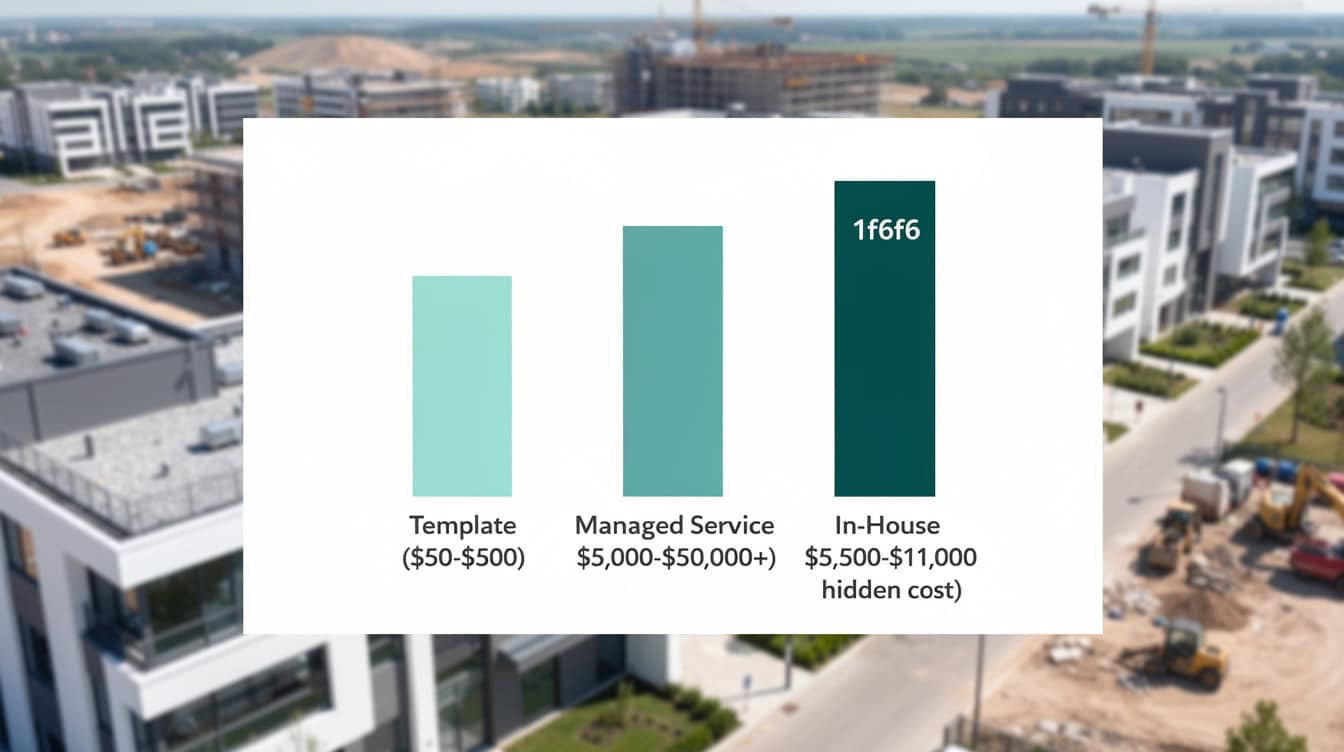
Upfront cost is only part of the story — in-house builds carry $5,500–$11,000 in hidden analyst time costs even before accounting for errors.
Pre-Built Templates: Cost Structure and Total Ownership
Templates deliver the lowest upfront cost and the fastest time-to-model, but they require the buyer to have enough financial literacy to customize them correctly. A SaaS startup template on eFinancialModels, for example, includes a three-statement model (income statement, balance sheet, and cash flow statement — the three core financial reports that every investor expects), a revenue build, and a KPI dashboard, all for under $200. Excel worksheets support up to 1,048,576 rows and 16,384 columns, giving even the most data-intensive financial models ample room to scale without hitting structural limits.
What drives template pricing:
- Complexity: a simple three-statement model costs $50–$150; a full LBO (leveraged buyout) model with debt waterfall and returns analysis runs $200–$500.
- Industry specificity: real estate development models with construction draw schedules and IRR waterfalls sit at the higher end.
- Included support: some templates include a 30-minute walkthrough call, which adds value but also adds cost.
Total cost of ownership for templates:
- Purchase price: $50–$500
- Customization time: 8–24 hours of analyst time at your internal hourly rate
- Ongoing maintenance: 2–4 hours per month to update actuals and refresh scenarios
- Audit readiness: templates from reputable providers include formula documentation, reducing audit time
For a founder spending 10 hours customizing a $200 template at an implied hourly value of $150, the all-in cost is roughly $1,700 — still a fraction of any consulting engagement.
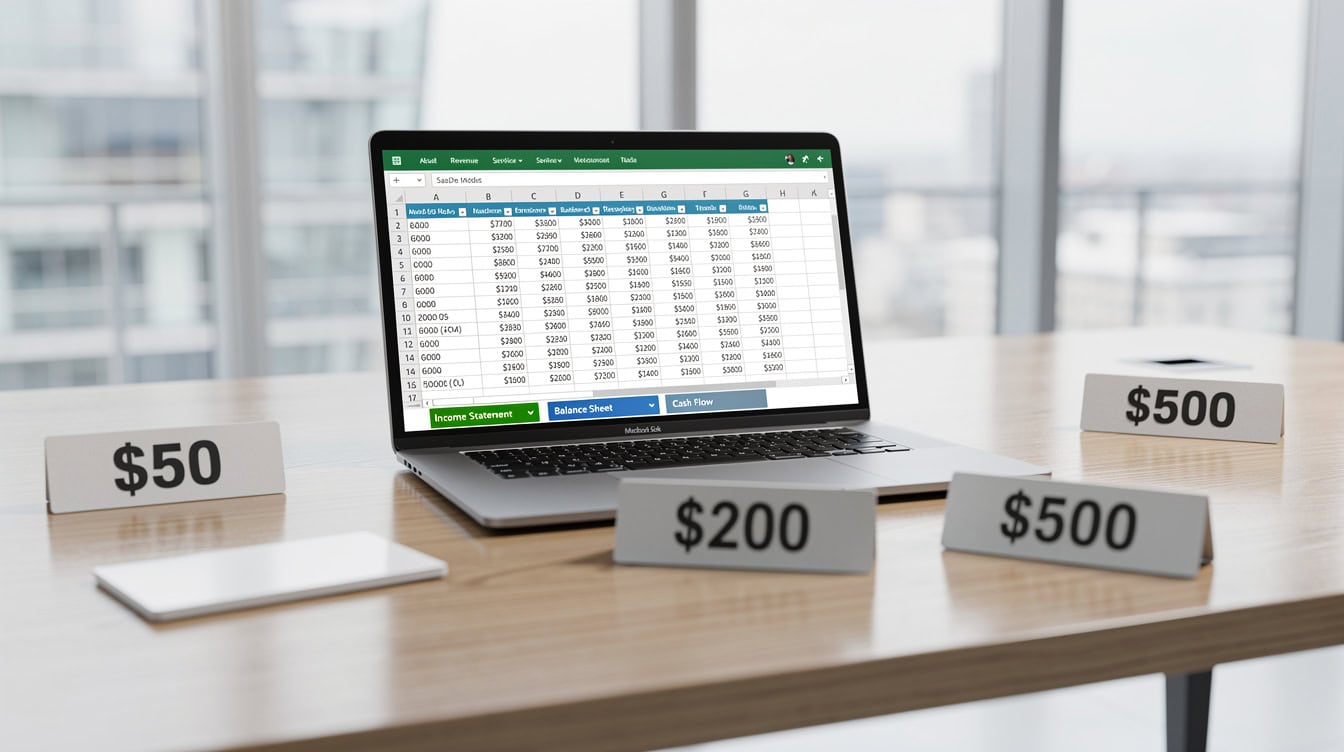
A SaaS three-statement template at $150–$200 includes revenue build, KPI dashboard, and scenario toggles — the same outputs a consultant would charge $8,000–$15,000 to build.
Managed Financial Modeling Services: What You’re Actually Paying For
Managed services cost more because you’re buying expertise, accountability, and time. A senior financial modeler with 10+ years of experience brings pattern recognition that a template cannot replicate: they know which assumptions investors will challenge, how to structure a cap table for a Series B, and how to build scenario toggles that survive due diligence.
Fee structures vary by engagement type:
- Fixed-fee project: $5,000–$15,000 for a standard three-statement model with 3-year projections
- Complex deal model (LBO, project finance, M&A): $15,000–$50,000+
- Fractional CFO with modeling included: $3,000–$10,000 per month
- Hourly consulting: $150–$500 per hour depending on seniority and geography
According to the U.S. Bureau of Labor Statistics, the median annual wage for financial analysts was $99,890 in 2023, which translates to roughly $48 per hour at a 40-hour week — but consulting firms apply a 3x–5x multiplier to cover overhead, profit, and expertise premium, pushing effective billing rates to $150–$250 per hour for mid-level consultants.
What the fee covers:
- Discovery and requirements scoping (5–10 hours)
- Model architecture and build (20–80 hours depending on complexity)
- Review cycles and revisions (5–15 hours)
- Presentation-ready output formatting
- Handover documentation and training

Managed service fees of $5,000–$50,000 cover discovery, architecture, build, revision cycles, and handover documentation — not just the Excel file.
In-House Development: The True Cost Beyond Salary
In-house development appears free but carries the highest hidden cost of the three options. The median salary for a financial analyst in the United States was $99,890 in 2023 according to the Bureau of Labor Statistics, and a mid-level FP&A (financial planning and analysis) professional capable of building a robust model earns $90,000–$130,000 annually including benefits.
Here’s the math for a single model build:
- Analyst fully-loaded cost: $110,000/year = $52.88/hour
- Hours to build a solid three-statement model from scratch: 80–160 hours
- Direct cost of build: $4,230–$8,460
- Opportunity cost (analyst not doing other work): add 20–30%
- Total in-house cost for one model: $5,500–$11,000
That figure assumes the analyst already knows how to build the model correctly. If they’re learning on the job, add another 40–80 hours of rework and review time. A single Excel workbook can contain up to 255 sheets, which means in-house analysts building multi-tab models with separate sheets for assumptions, outputs, and scenarios have substantial structural flexibility — but also more surface area for errors to hide across tabs.
The Association of Chartered Certified Accountants has documented that model errors in financial services cost firms significant remediation expense, reinforcing that expertise gaps are not free.

An in-house model build costs $5,500–$11,000 in analyst time alone — before accounting for rework from errors or the opportunity cost of redirected capacity.
Side-by-Side Comparison: Templates vs. Managed Services vs. In-House
The table below compares all three acquisition methods across the dimensions that matter most to a finance professional or founder making this decision.
| Dimension | Template | Managed Service | In-House Build |
|---|---|---|---|
| Upfront Cost | $50–$500 | $5,000–$50,000+ | $0 direct |
| True Total Cost | $500–$2,000 | $5,000–$55,000 | $5,500–$11,000+ |
| Build Time | 1–3 days | 2–8 weeks | 4–12 weeks |
| Expertise Needed | Intermediate Excel | Low (consultant handles) | Advanced Excel + finance |
| Customization | Moderate | Full | Full |
| Investor-Ready | Often yes | Yes | Depends on skill |
| Ongoing Maintenance | Self-managed | Billable add-on | Internal resource |
| Best For | Seed/early stage | Series A+, complex deals | Ongoing FP&A function |
| Risk of Error | Medium | Low | High if inexperienced |
| Speed to Decision | Fastest | Slowest | Slow |

Templates win on cost and speed; managed services win on accuracy for complex deals; in-house wins only when modeling volume justifies a dedicated hire.
Build Time and Speed-to-Decision Analysis
Speed matters most when you’re in an active fundraising process or facing a board deadline. Templates win on speed: a founder can download a startup financial model on Monday morning and have investor-ready projections by Wednesday afternoon.
Managed services require a scoping call, a proposal, a signed agreement, and then the build itself. A realistic timeline for a $15,000 engagement is 4–6 weeks from first contact to final delivery. For a Series A process where investor interest has a shelf life, that timeline can cost you a deal.
In-house builds take longest because the analyst must balance the modeling work against their existing responsibilities. A 120-hour model build spread across a normal workweek takes 3–4 weeks minimum, and that assumes no revision cycles from leadership.
Speed-to-decision benchmark: If a faster model helps you close a funding round 30 days sooner, and your monthly burn rate is $150,000, that acceleration is worth $150,000 in preserved runway — dwarfing the cost of any template or consulting engagement.
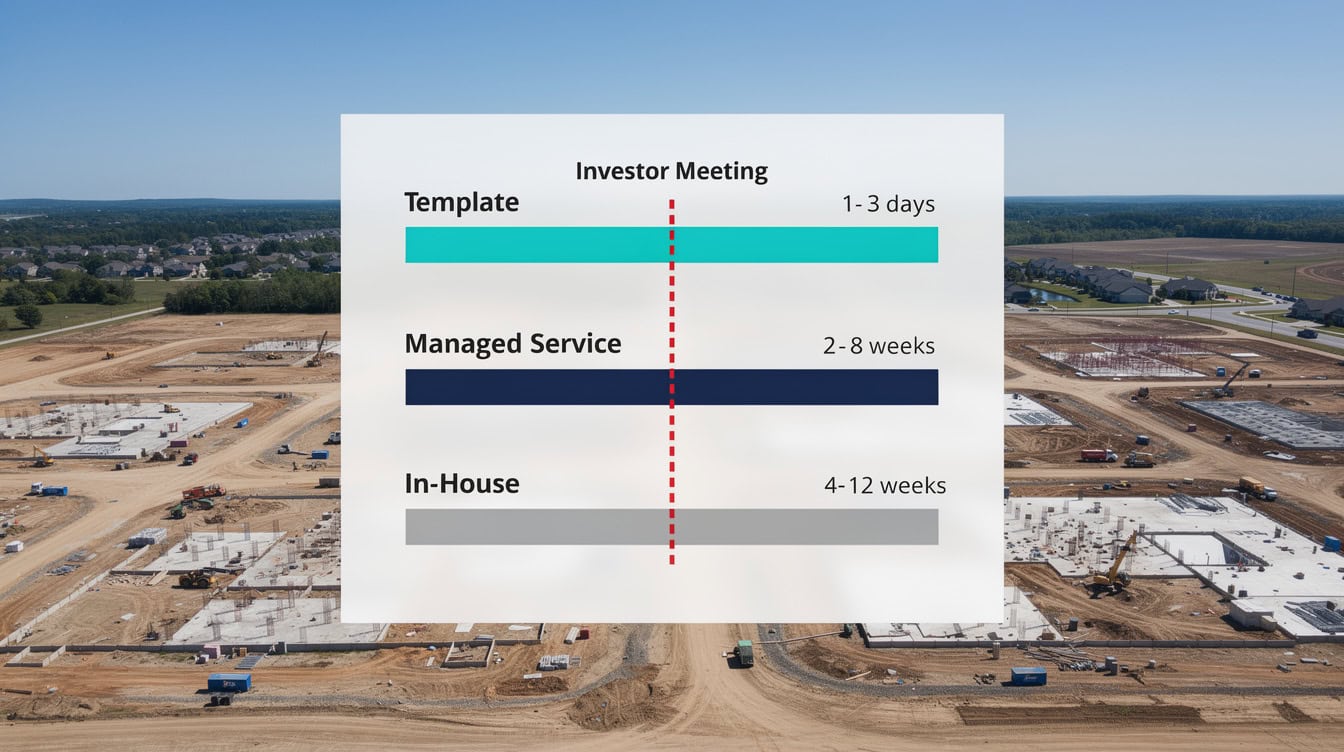
In an active fundraising process, a 6-week consulting timeline can cost you investor momentum — a template delivers the same core outputs in 3 days.
Expertise Requirements: Matching Skill Levels to Model Complexity
Not all financial models are equal in complexity, and not all buyers have equal modeling skills. Matching the right acquisition method to your actual skill level prevents the most common and costly mistake: buying a template you can’t customize correctly, or hiring a consultant for a model you could have built yourself.
Skill level definitions:
- Beginner: Can enter data into Excel, understands basic formulas (SUM, IF), has read a P&L but never built one.
- Intermediate: Comfortable with VLOOKUP, INDEX/MATCH, pivot tables, and basic financial statement structure. Can customize a template with guidance.
- Advanced: Builds dynamic models from scratch, understands circular references (a situation where a formula refers back to its own cell, common in interest calculations), uses array formulas, and can audit a model for errors.
- Expert: Builds LBO models, project finance waterfalls, and Monte Carlo simulations. Typically 5+ years of dedicated modeling experience.
| Model Type | Skill to Customize Template | Skill to Build In-House |
|---|---|---|
| 3-Statement Model | Intermediate | Advanced |
| SaaS Revenue Model | Intermediate | Advanced |
| Real Estate DCF | Advanced | Expert |
| LBO Model | Expert | Expert |
| Project Finance | Expert | Expert |
If your team sits at the intermediate level, a well-documented template from a provider like eFinancialModels gives you 80% of the value of a custom build at 5% of the cost. You can explore financial modeling resources to find models matched to your skill level.
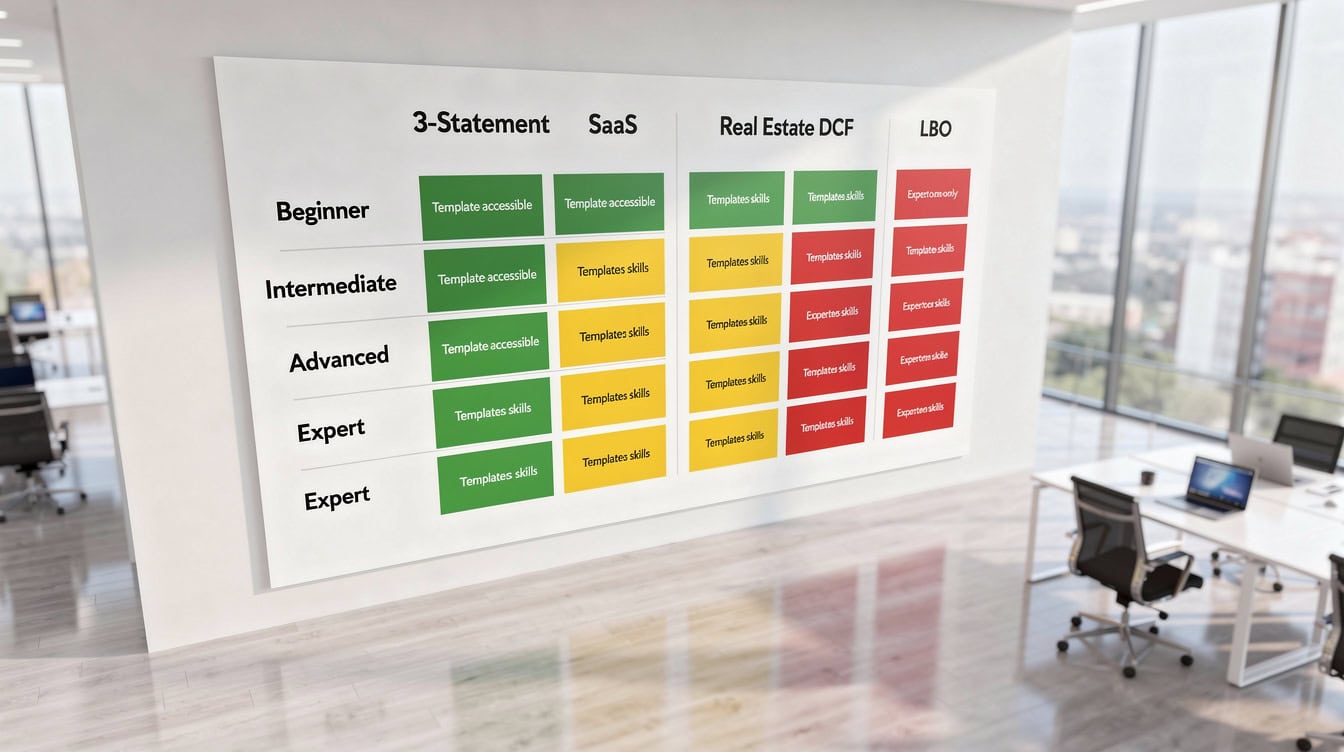
Intermediate Excel skills are sufficient to customize most SaaS and e-commerce templates — LBO and project finance models require expert-level modeling knowledge.
Calculating ROI: Framework for Measuring Model Value
ROI on a financial model is real but often invisible because the benefit shows up as a decision made faster, a mistake avoided, or capital raised at better terms. Here’s a concrete framework.
ROI Formula for a Financial Model:
ROI = (Value of Outcome Enabled by Model – Total Cost of Model) / Total Cost of Model
Worked Example: SaaS Startup Template
Scenario: A SaaS founder buys a $250 template, spends 16 hours customizing it (valued at $100/hour = $1,600 in time), and uses it to raise a $1.5M seed round.
- Total model cost: $250 + $1,600 = $1,850
- Capital raised: $1,500,000
- ROI: ($1,500,000 – $1,850) / $1,850 = 81,000%
Even if you conservatively attribute only 1% of the fundraising success to the model quality, that’s $15,000 in attributed value against a $1,850 cost — an 8x return.
Worked Example: Real Estate Managed Service
Scenario: A developer pays $20,000 for a custom project finance model on a $10M development. The model reveals that a 6-month construction delay makes the project IRR (internal rate of return — the annualized return that makes the project’s net present value equal to zero) fall below the 15% hurdle rate. The developer renegotiates the land price, saving $400,000.
- Total model cost: $20,000
- Value of insight: $400,000 in avoided loss
- ROI: ($400,000 – $20,000) / $20,000 = 1,900%
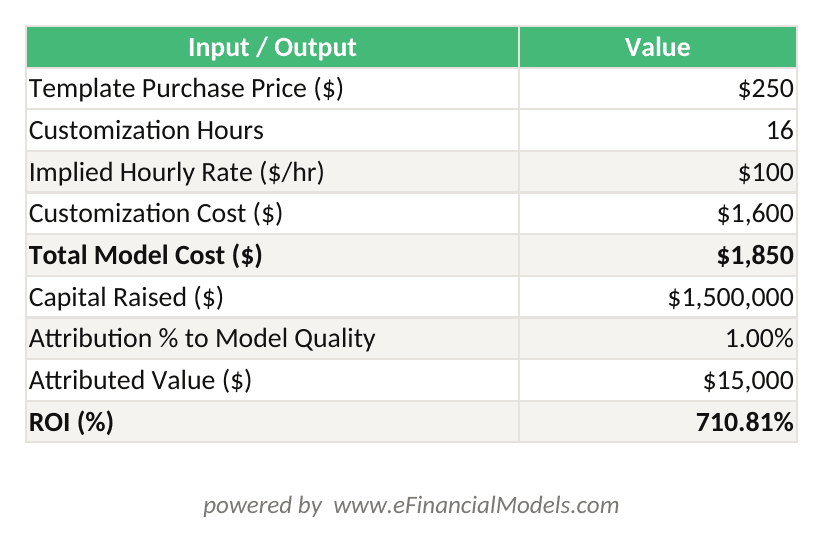
ROI = (Value of Outcome Enabled – Total Model Cost) / Total Model Cost. A $250 template plus 16 hours of customization yields an all-in cost of $1,850 against $1.5M raised.

ROI on financial models is rarely about the model cost — it’s about the quality of the decision the model enables.
Decision Matrix: Which Option Fits Your Situation
The right choice depends on your stage, complexity, and internal capability. Use this matrix to identify your path.
| Situation | Recommended Path | Reason |
|---|---|---|
| Pre-revenue startup, seed raise | Template | Speed and cost efficiency dominate |
| Series A with complex cap table | Managed service | Investor scrutiny requires custom logic |
| Standard SaaS or e-commerce model | Template | Industry templates cover 90% of use cases |
| Real estate development with JV waterfall | Managed service | Waterfall logic requires expert build |
| Ongoing FP&A for 50+ employee company | In-house | Volume of modeling justifies dedicated hire |
| M&A or LBO transaction | Managed service | Deal risk justifies expert cost |
| Manufacturing with complex COGS | Template + consultant review | Hybrid approach balances cost and accuracy |
For founders at the seed stage, startup financial model templates cover the vast majority of investor requirements. For companies building 5-year financial projections for a board or lender, a well-structured template with scenario tabs is usually sufficient.
Hidden Costs and Risk Factors in Each Approach
Every acquisition method carries risks that don’t appear in the headline price. Ignoring them leads to budget overruns and model failures at the worst possible moment.
Template risks:
- Incorrect customization: a formula error in a revenue driver can cascade through 40 linked cells without triggering an obvious error message. The European Spreadsheet Risks Interest Group estimates that 88% of spreadsheets contain errors, and most go undetected until a decision is already made.
- Over-reliance on defaults: templates are built for typical businesses; unusual revenue models or cost structures require significant restructuring that intermediate users may not execute correctly.
- Version control: multiple team members editing the same file without a clear version protocol creates conflicting models.
Managed service risks:
- Scope creep: a $10,000 engagement can reach $25,000 if requirements expand during the build. Always get a fixed-fee proposal with a defined change-order process.
- Handover failure: if the consultant doesn’t document the model logic, your team can’t maintain it after delivery. Require a model guide as a deliverable.
- Consultant quality variance: the financial modeling consulting market has no licensing requirement. Vet consultants by reviewing sample models and checking references.
In-house risks:
- Expertise gap: an analyst who has never built a three-statement model from scratch will make structural errors that are hard to detect and expensive to fix.
- Key-person dependency: if the analyst who built the model leaves, institutional knowledge of the model logic often leaves with them.
- Opportunity cost: every hour your analyst spends building a model is an hour not spent on analysis, reporting, or strategic support.
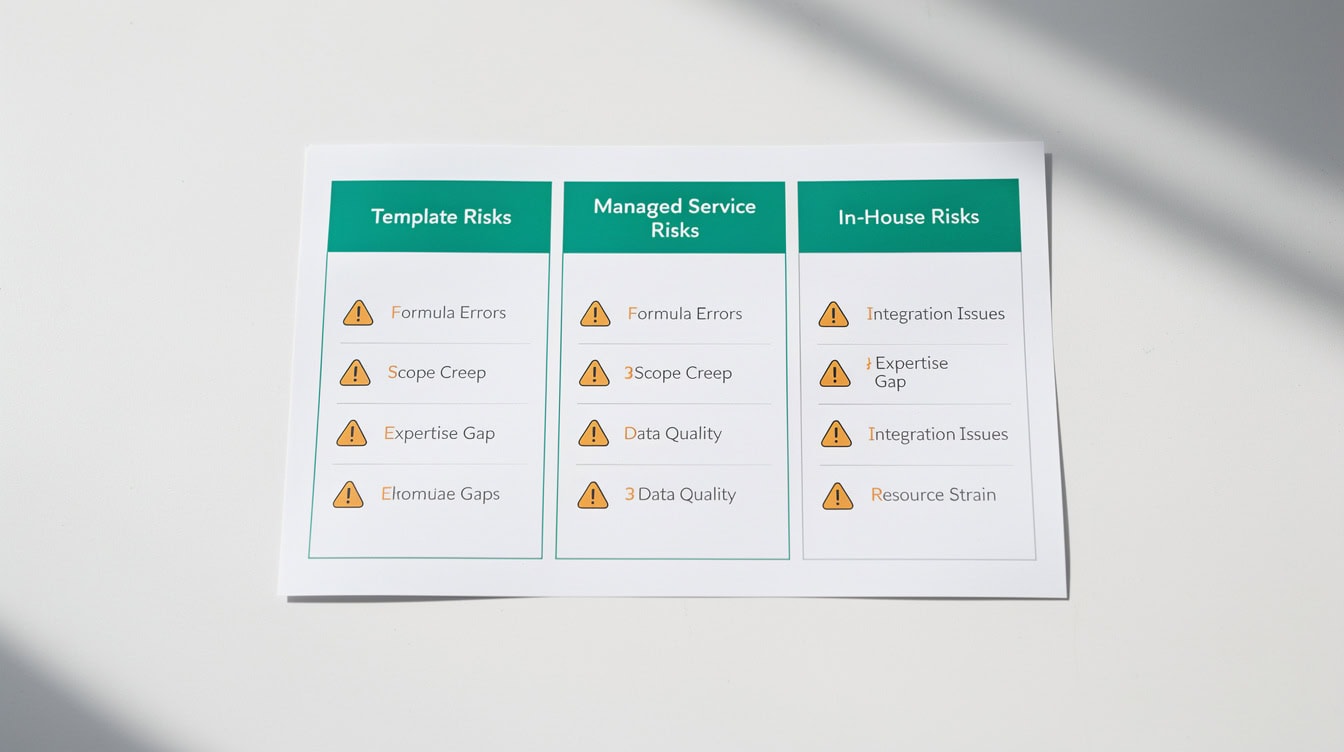
88% of spreadsheets contain errors according to the European Spreadsheet Risks Interest Group — template buyers and in-house builders both face this risk without expert review.
Frequently Asked Questions
How much does a basic financial model cost?
A basic three-statement financial model (income statement, balance sheet, and cash flow statement) costs $50–$200 as a pre-built template, or $5,000–$15,000 if built by a consultant. If you build it in-house, the direct cost is zero but the true cost in analyst time is $4,000–$8,000 based on 80–160 hours at a $52/hour fully-loaded rate for a mid-level analyst. For most early-stage founders, a $100–$200 template delivers 90% of the value at 2% of the consulting cost. The key variable is whether your business model fits a standard template structure — if it does, buy the template.
What’s the difference between a financial model template and a custom model?
A template is a pre-built Excel file structured for a specific industry or use case. You input your own numbers and adjust assumptions, but the formulas, layout, and logic are already built. A custom model is built from scratch for your specific business, with logic tailored to your exact revenue streams, cost structure, and reporting needs. Templates cover 80–90% of standard use cases. Custom models make sense when your business has unusual revenue mechanics, complex ownership structures like a joint venture waterfall, or when investor due diligence will scrutinize every formula. The cost difference is typically 20x to 100x.
How long does it take to build a financial model?
Build time depends heavily on complexity and who is doing the work. A template takes 1–3 days to customize for a standard business. A consultant building a custom model takes 2–8 weeks from kickoff to delivery, with the longest timelines on project finance or LBO models. An in-house analyst building from scratch typically needs 4–12 weeks, accounting for competing priorities and revision cycles. If you’re in an active fundraising process, template speed is a genuine competitive advantage: a founder who can share a model on day 3 of investor conversations moves faster than one waiting 6 weeks for a consultant delivery.
What expertise do I need to use a financial model template?
Most quality templates require intermediate Excel skills: comfort with formulas like VLOOKUP or INDEX/MATCH, the ability to trace formula dependencies, and a working understanding of how income statements, balance sheets, and cash flow statements connect. You don’t need to be a CFA or a modeling expert. What you do need is enough financial literacy to know whether your inputs are reasonable — a template can’t tell you if your 80% gross margin assumption is unrealistic for your industry. If you’re uncertain, a one-hour review call with a financial modeling consultant ($150–$300) is a cost-effective way to validate your work.
How do I calculate the ROI of a financial model?
ROI = (Value of Outcome Enabled – Total Model Cost) / Total Model Cost. The hard part is quantifying the outcome. For fundraising, attribute a percentage of capital raised to model quality (even 1% of a $1M raise = $10,000). For operational decisions, calculate the value of the insight the model provided: if a sensitivity analysis reveals that a price increase of $10 per unit improves EBITDA by $200,000 annually, and the model cost $500, the ROI is ($200,000 – $500) / $500 = 39,900%. For most businesses, the ROI on a quality financial model is not the question — the question is which acquisition method delivers that ROI most efficiently given your stage and complexity.
Are there ongoing costs after I buy or build a financial model?
Yes, and they’re often underestimated. A template requires 2–4 hours per month to update actuals, refresh forecasts, and add new scenario assumptions. At an internal rate of $50–$100/hour, that’s $1,200–$4,800 per year in ongoing maintenance cost. A custom model built by a consultant may require the consultant’s involvement for major updates, billed at their standard hourly rate of $150–$500. In-house models require the analyst’s ongoing time plus periodic audits to catch formula drift. Budget 15–20% of the original model cost per year for maintenance, regardless of which path you chose.
When should a startup use a managed financial modeling service instead of a template?
A startup should consider a managed service when any of these conditions apply: the fundraising round is Series A or later (where investor due diligence is more rigorous), the business model has non-standard revenue mechanics that templates don’t accommodate, the cap table includes complex instruments like SAFEs with MFN provisions or convertible notes with multiple tranches, or the model will be used in a transaction (M&A, debt financing) where errors carry legal or financial liability. For seed-stage companies raising under $2M on a standard equity round, a quality template from a provider like eFinancialModels covers investor expectations at a fraction of the consulting cost. You can browse financial model templates to find options matched to your industry and stage.
Conclusion
The right financial model acquisition strategy comes down to three variables: your budget, your timeline, and your model complexity. Templates win on cost and speed for standard use cases. Managed services win on accuracy and investor confidence for complex deals. In-house builds win only when you have ongoing, high-volume modeling needs that justify a dedicated hire.
I recommend starting with a pre-built financial model template from eFinancialModels — browse by industry, check the preview, and have a working model in your hands within 24 hours. If your situation is more complex, the template still gives you a structured starting point before you engage a consultant, saving you thousands in scoping time.