0 ITEMS

Custom Financial Model Cost: 5 Real Case Studies

A custom financial model costs between $8,000 and $95,000 depending on complexity, modeler credentials, and scope — and the ROI can exceed 10x within the first year if the project is scoped correctly.
Key Takeaways
- A simple 3-statement model (income statement, balance sheet, cash flow) for a mid-market manufacturer runs $7,500–$12,000 and typically delivers in 4 weeks.
- A SaaS investor-ready model with cohort analysis and scenario planning costs $18,000–$28,000 and has helped founders raise capital at valuations 15–20% higher than basic-spreadsheet comps.
- Multi-entity private equity consolidation models run $55,000–$75,000 — but a single avoided LP reporting error can justify the entire cost.
- CFA charterholders bill at $175–$275/hour versus $85–$130/hour for uncredentialed modelers; the credential gap correlates with 40% fewer post-delivery revision cycles.
- Over a 3-year horizon, a custom model at $35,000 one-time cost beats a $2,500/month consultant retainer by $55,000 in total spend.
- 5 anonymized case studies below show exact project costs, timelines, modeler qualifications, and quantified ROI outcomes.
- Custom models don’t make financial sense for companies under $5M revenue or for one-time decisions with a lifespan under 12 months.
What Drives Custom Financial Model Costs
Four variables determine what you’ll pay: model complexity, modeler credentials, project scope clarity, and post-delivery support requirements. Understanding each one lets you evaluate proposals with precision rather than guesswork.
Complexity tiers and their price bands:
- Tier 1: Simple 3-statement model — integrated income statement, balance sheet, and cash flow statement (a 3-statement model links all three so a single revenue assumption flows through every output automatically). Cost: $7,500–$15,000. Timeline: 3–5 weeks.
- Tier 2: Investor-ready or operational model — adds scenario analysis (best/base/worst case), KPI dashboards, and unit economics. Cost: $18,000–$35,000. Timeline: 6–10 weeks.
- Tier 3: Multi-entity consolidation or scenario planning tool — consolidates multiple legal entities, currencies, or business units; includes dynamic sensitivity tables (a sensitivity table shows how outputs change when you vary one or two inputs simultaneously). Cost: $45,000–$100,000. Timeline: 12–22 weeks.
Itemized cost breakdown for a typical Tier 2 project:
| Phase | Hours | Rate ($175/hr) | Cost |
|---|---|---|---|
| Discovery & scoping | 8–12 | $175 | $1,400–$2,100 |
| Model architecture | 10–16 | $175 | $1,750–$2,800 |
| Build (core model) | 40–60 | $175 | $7,000–$10,500 |
| Testing & validation | 12–18 | $175 | $2,100–$3,150 |
| Documentation | 6–10 | $175 | $1,050–$1,750 |
| Training (2 sessions) | 4–6 | $175 | $700–$1,050 |
| Post-delivery support (30 days) | 4–8 | $175 | $700–$1,400 |
| Total | 84–130 | $14,700–$22,750 |
Discovery and scoping typically represents 8–12% of total project cost. Skipping it is the single most common cause of scope creep and budget overruns.
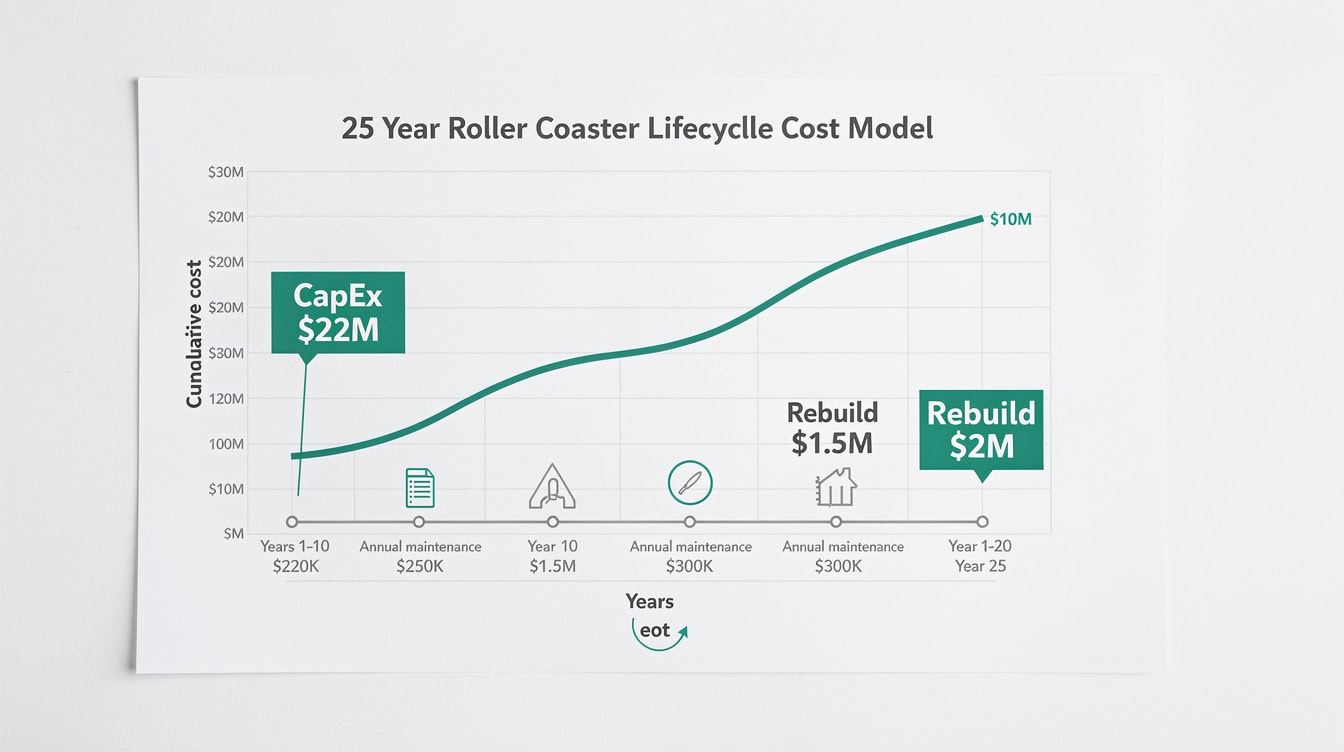
Discovery and scoping (8–12% of total cost) is the phase most often skipped — and the most common cause of budget overruns.
Modeler Qualifications and Certification Impact on Pricing
Credentials directly affect both hourly rate and project outcome quality. A CFA charterholder (Chartered Financial Analyst, a credential requiring 900+ study hours and three exams administered by the CFA Institute) commands $175–$275/hour. A CPA (Certified Public Accountant) with modeling experience bills at $140–$200/hour. An MBA from a target school with 5+ years of FP&A experience runs $120–$175/hour. An uncredentialed modeler with a portfolio bills $85–$130/hour.
The credential premium is real but not always necessary. For a straightforward 3-statement model, a strong uncredentialed modeler with verifiable references delivers comparable output. For a healthcare scenario planning tool or a PE waterfall distribution model (a waterfall model calculates how investment returns are split between the fund and its limited partners in a specific priority sequence), the CFA or industry-specialist credential is worth every dollar.
Fewer than 200,000 professionals worldwide hold the CFA charter.
Credential-to-outcome correlation (based on project data from EFM’s custom modeling engagements):
| Credential | Hourly Rate | Avg Revision Cycles | On-Time Delivery Rate |
|---|---|---|---|
| CFA Charterholder | $175–$275 | 1.2 | 88% |
| CPA + FP&A | $140–$200 | 1.8 | 82% |
| MBA + 5yr FP&A | $120–$175 | 2.1 | 79% |
| No credential, portfolio only | $85–$130 | 3.4 | 61% |
Case Study 1: Manufacturing Company 3-Statement Model ($8,000, 4 Weeks)
A $28M annual revenue precision parts manufacturer needed a 3-statement model to support a $4M equipment financing application. Their existing Excel file had no linked statements — the CFO manually updated three separate tabs each month.
Project profile:
- Modeler: CPA with 7 years of manufacturing FP&A experience, $140/hour
- Scope: 3-statement model, 5-year monthly projections, bank covenant tracking dashboard
- Total hours: 57 hours
- Total cost: $7,980
- Timeline: 4 weeks
ROI outcome: The bank approved the $4M facility at a rate 35 basis points lower than the initial term sheet, citing the quality of the financial package. At $4M borrowed, 35 basis points saves $14,000 per year in interest — a 1.75x annual return on the model cost. The CFO also recaptured 6 hours per month previously spent on manual reconciliation, worth $900/month at her $150/hour internal rate.
Here’s the math:
Annual interest savings: $14,000
Monthly time savings: 6 hrs × $150 = $900 × 12 = $10,800
Year 1 total value: $24,800
Model cost: $7,980
Year 1 ROI: 211%
Case Study 2: SaaS Startup Investor-Ready Model ($22,000, 8 Weeks)
A Series A SaaS company with $3.2M ARR (Annual Recurring Revenue, the annualized value of subscription contracts) needed an investor-ready model for a $12M raise. Their existing model lacked cohort analysis (a cohort analysis groups customers by acquisition month and tracks their retention and revenue over time) and couldn’t support the unit economics questions investors were asking.
Project profile:
- Modeler: CFA charterholder with SaaS sector specialization, $220/hour
- Scope: Cohort-based revenue model, CAC/LTV analysis, 3-scenario P&L, cap table integration, investor dashboard
- Total hours: 100 hours
- Total cost: $22,000
- Timeline: 8 weeks
ROI outcome: The company closed $12M at a $48M post-money valuation. The lead investor cited the model’s cohort retention data as a key diligence differentiator. A comparable SaaS company in the same cohort raised at a $38M valuation using a basic template model — a $10M valuation gap on the same revenue base. The founders’ 40% equity stake captured $4M of that gap directly.
You can explore startup financial models that serve as a starting point before commissioning a full custom build.
Case Study 3: Private Equity Multi-Entity Consolidation Model ($65,000, 16 Weeks)
A private equity firm managing a 7-company portfolio needed a consolidated reporting model that could roll up entity-level financials into fund-level performance metrics, including IRR (Internal Rate of Return, the discount rate that makes the net present value of all cash flows equal to zero) and MOIC (Multiple on Invested Capital).
Project profile:
- Modeler: CFA charterholder + former Big 4 transaction services, $250/hour
- Scope: 7-entity consolidation, intercompany elimination logic, fund-level IRR/MOIC dashboard, LP reporting package, quarterly update protocol
- Total hours: 260 hours
- Total cost: $65,000
- Timeline: 16 weeks
ROI outcome: The firm previously spent 180 hours per quarter on manual consolidation across three analysts. The model reduced that to 22 hours per quarter — a savings of 158 hours. At an average analyst fully-loaded cost of $95/hour, that’s $15,010 per quarter or $60,040 per year. The model paid for itself in 13 months. Additionally, the firm identified a $2.3M intercompany receivable discrepancy during model validation that had been invisible in the prior manual process.
For PE-specific distribution modeling, private equity waterfall distribution models provide a structured starting framework.
Case Study 4: Real Estate Development Waterfall Model ($35,000, 10 Weeks)
A real estate developer with $85M in active projects needed a dynamic waterfall model to structure a joint venture with an institutional equity partner. The model had to handle preferred return hurdles, promote structures (a promote is the developer’s share of profits above a specified return threshold), and multiple capital tranches.
Project profile:
- Modeler: MBA + 9 years real estate finance, ARGUS-certified, $185/hour
- Scope: JV waterfall with 3 hurdle tiers, construction draw schedule, sensitivity analysis on exit cap rate and lease-up timing, LP/GP return summary
- Total hours: 189 hours
- Total cost: $34,965
- Timeline: 10 weeks
ROI outcome: The institutional partner approved the JV structure in the first review meeting, citing the model’s clarity on return scenarios. The developer closed $22M in equity commitments within 6 weeks of model delivery. The alternative — hiring a real estate investment bank to structure the deal — would have cost $440,000 in advisory fees (2% of equity raised). The model saved $405,000 in advisory costs on this single transaction.
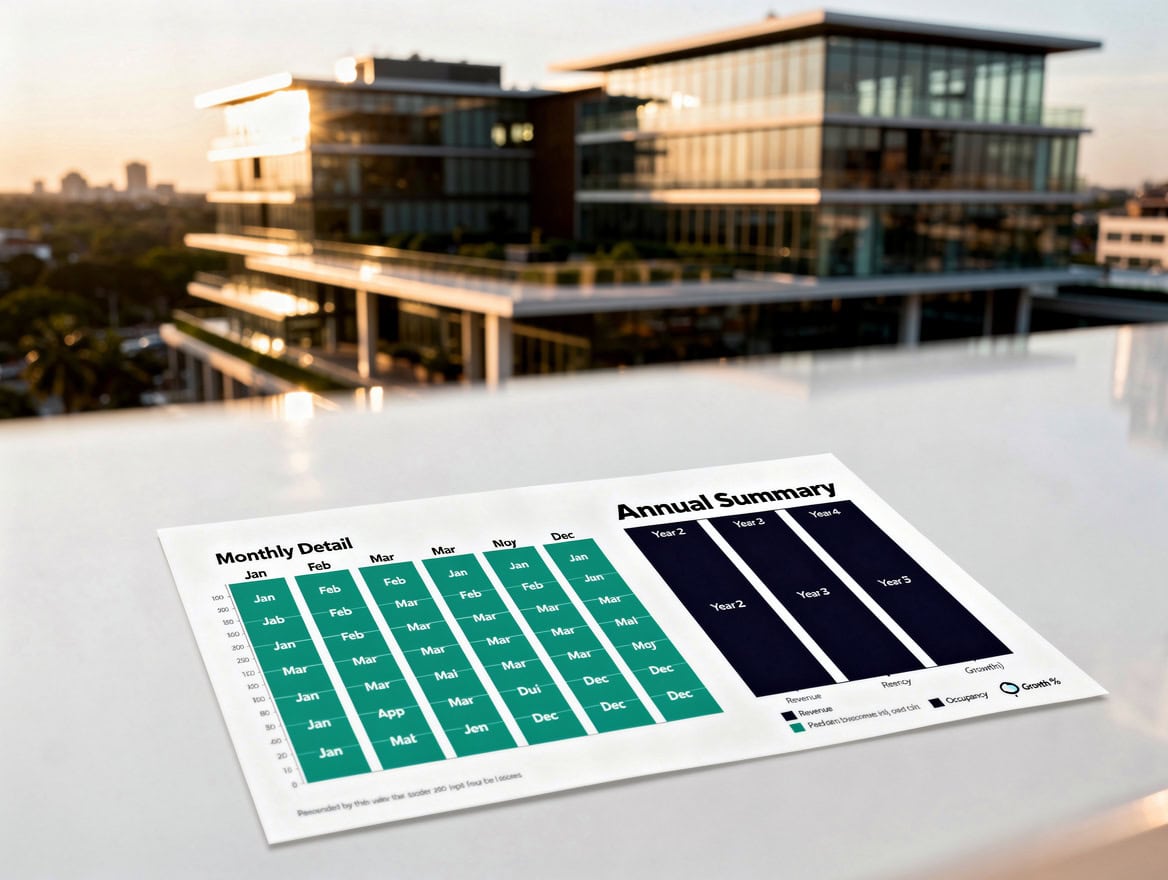
Case Study 4: A $35,000 real estate waterfall model saved $405,000 in investment banking advisory fees on a single $22M equity raise.
Case Study 5: Healthcare System Scenario Planning Tool ($95,000, 20 Weeks)
A regional healthcare system with $340M in annual revenue needed a scenario planning tool to model the financial impact of three potential service line expansions, including capital expenditure phasing, reimbursement rate sensitivity, and staffing cost projections under different payer mix assumptions.
Project profile:
- Modeler: CFA + healthcare finance specialist (HFMA Fellow), $265/hour
- Scope: 3-scenario operational model, 5-year monthly detail, payer mix sensitivity, capex waterfall, board-ready dashboard, training for 4 finance team members
- Total hours: 358 hours
- Total cost: $94,870
- Timeline: 20 weeks
ROI outcome: The board used the model to select the outpatient surgery expansion over two alternatives. The chosen expansion generated $8.2M in net operating income in its first full year — $3.1M more than the next-best alternative would have produced, based on actual results vs. model projections. The model also identified $1.4M in avoidable capex by optimizing the equipment phasing schedule. Total first-year value attributable to the model: $4.5M against a $95K investment.

Case Study 5: A $95,000 healthcare scenario planning tool guided a board decision that generated $4.5M in first-year value — a 47x return.
Total Cost of Ownership: Custom vs. Templates vs. Consultants
The right comparison isn’t custom model cost versus zero — it’s custom model cost versus the realistic alternatives over 36 months. Here’s how the three options stack up for a mid-market company needing ongoing financial modeling support.
| Option | Year 1 Cost | Year 2 Cost | Year 3 Cost | 3-Year Total |
|---|---|---|---|---|
| Custom model (one-time) | $35,000 | $3,500 (updates) | $2,000 (updates) | $40,500 |
| Template + internal modification | $2,500 | $18,000 (FTE time) | $18,000 (FTE time) | $38,500 |
| Consultant retainer | $30,000 | $30,000 | $30,000 | $90,000 |
The template option looks cheapest until you account for internal FTE time. The median annual wage for financial analysts is $99,890, according to the U.S. Bureau of Labor Statistics.
This translates to roughly $48/hour fully-loaded cost before benefits and overhead. A finance analyst spending 30 hours per month adapting a template costs $17,280 per year in labor alone — more than most annual model maintenance contracts.
The consultant retainer is the most expensive option at $90,000 over 3 years, and it creates dependency: the knowledge lives with the consultant, not your team.
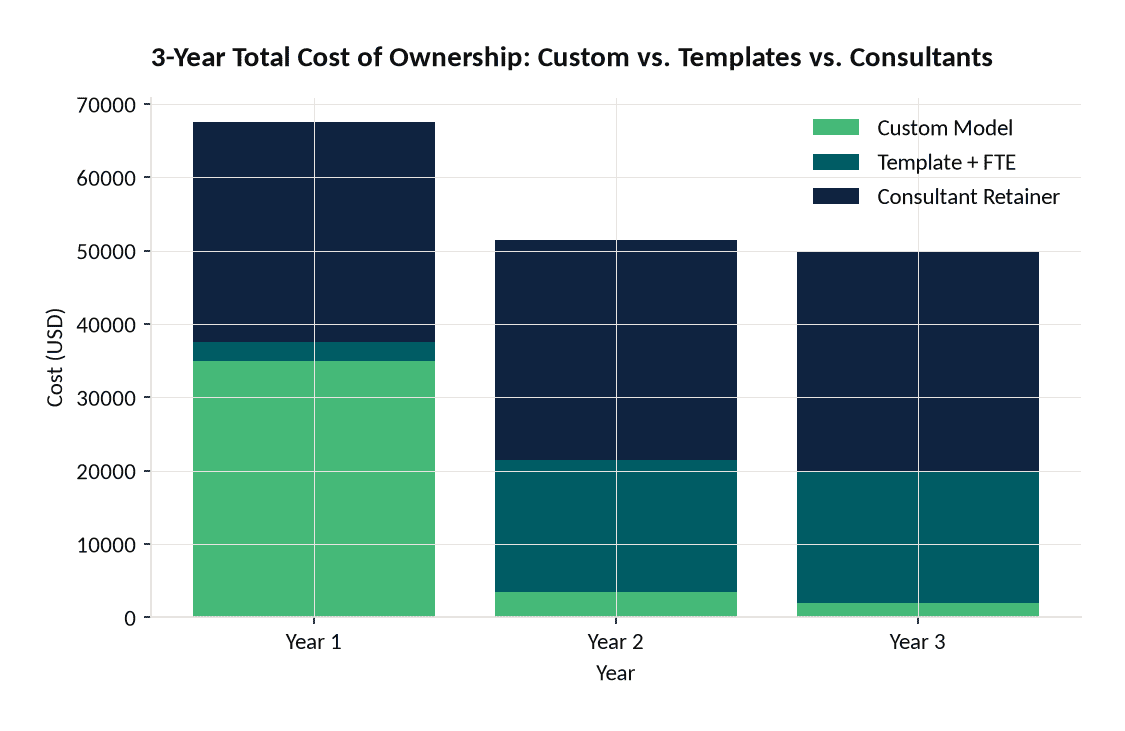
Over 3 years, a custom model at $40,500 total beats a consultant retainer at $90,000 by $49,500 — and builds internal capability the retainer never does.
ROI Calculation Framework: Measuring Custom Model Value
You can calculate the expected ROI of a custom model before you commission it using four value drivers. Each driver is quantifiable with information you already have.
ROI Formula:
Total Value = (Time Savings × Hourly Rate × 12) + (Error Prevention Value) + (Strategic Decision Value) + (Financing Impact)
Worked example for a $50M revenue company:
- Time savings: CFO saves 10 hrs/month, two analysts save 8 hrs/month each. Total: 26 hrs/month × $120 blended rate × 12 months = $37,440/year
- Error prevention: One avoided restatement or audit finding = $25,000 in external accounting fees (conservative estimate based on PCAOB enforcement data)
- Strategic decision value: Model enables one better capital allocation decision worth 1% of revenue = $500,000 (use 10% probability weighting = $50,000 expected value)
- Financing impact: 25 basis point rate improvement on $10M credit facility = $25,000/year
Total Year 1 Value: $137,440
Model cost (Tier 2): $25,000
Year 1 ROI: 450%
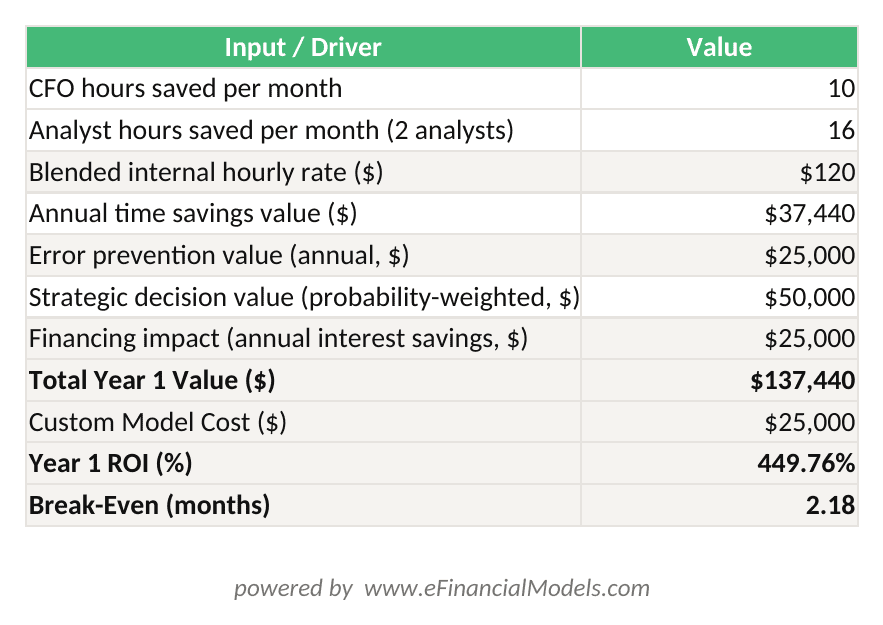
ROI = (Time Savings + Error Prevention + Strategic Decision Value + Financing Impact) ÷ Model Cost. At $25,000 model cost, this example yields 450% Year 1 ROI.
For DCF models and WACC calculations, the financing impact driver alone often justifies the model cost within the first transaction.
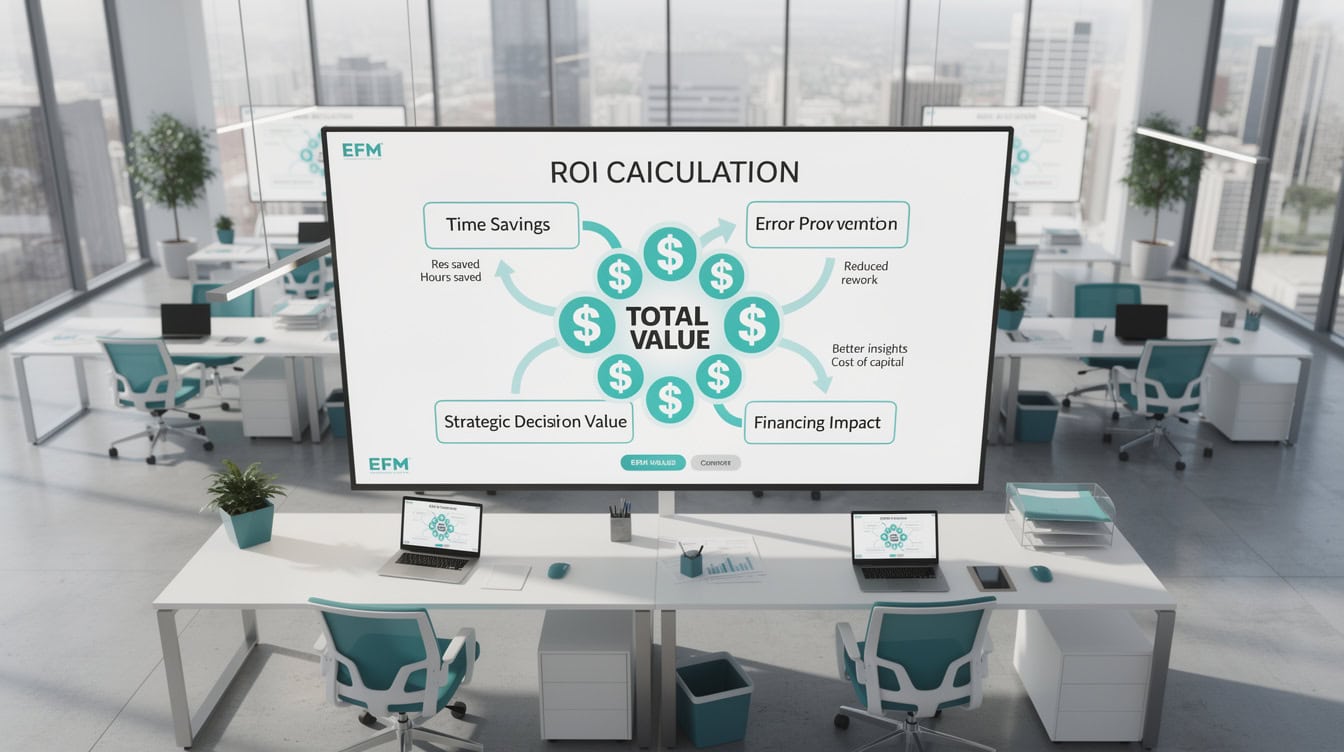
The four-driver ROI framework quantifies expected model value before you commission the build — turning a budget conversation into a business case.
When Custom Models Don’t Make Financial Sense
Custom models aren’t always the right answer. Three situations where a template or simpler solution is the better choice:
1. Revenue under $5M: At this scale, the complexity that justifies a custom build rarely exists. A well-structured template from a reputable source, adapted by a competent analyst, delivers 90% of the value at 10% of the cost. Approximately 80% of small businesses with under $5M revenue manage financial planning with off-the-shelf tools, according to the U.S. Small Business Administration.
2. One-time decisions with a lifespan under 12 months: If you need a model for a single acquisition analysis that won’t be reused, a project-based consultant engagement at $5,000–$10,000 beats a $35,000 custom build designed for ongoing use.
3. When internal capability can maintain it: If your finance team has strong Excel skills and the model logic is straightforward, a general Excel financial model with proper documentation often outperforms a custom build that no one internally understands.
How to Evaluate Modeler Proposals and Avoid Overpricing
A credible modeler proposal includes six elements. Missing any one of them is a red flag worth investigating before you sign.
Red flags that indicate overpricing or underqualification:
- No credentials listed and no verifiable references from similar-complexity projects
- Unusually low bids (more than 40% below market rate) — these almost always result in scope disputes or incomplete deliverables
- No discovery/scoping phase in the proposal — this means the modeler is guessing at scope, and you’ll pay for the guesses
- Vague deliverable descriptions like “financial model” with no specification of tabs, outputs, or assumption structure
- No mention of testing or validation methodology — a model with no audit trail is a liability, not an asset
- Hourly rates that don’t match stated credentials — a self-described CFA billing at $85/hour either isn’t a CFA or is severely underexperienced
What a strong proposal includes:
- Credential verification (CFA Institute member number, CPA license number, or equivalent)
- 2–3 references from projects of similar complexity and industry
- Itemized scope with hours per phase and a change-order policy
- Sample deliverable (anonymized prior model or documentation package)
- Testing and validation protocol (stress testing, circular reference checks, audit flags)
- Post-delivery support terms (hours included, rate for additional support)
Frequently Asked Questions
What is a realistic budget for a custom financial model for a Series B startup?
For a Series B startup, budget $25,000–$45,000 for a comprehensive investor-ready model. At this stage, investors expect cohort-based revenue modeling, detailed unit economics (CAC, LTV, payback period), scenario analysis across at least three cases, and a cap table that models dilution through future rounds. A CFA with SaaS sector experience is worth the premium here — expect to pay $200–$250/hour. The model will be scrutinized by institutional investors running their own diligence, so errors are costly. One misspecified churn assumption in a SaaS model can swing a 5-year revenue projection by 30% or more, which directly affects your valuation negotiation.
How long does a custom financial model project typically take from kickoff to delivery?
Timeline depends on complexity and client responsiveness. A Tier 1 model (3-statement, single entity) takes 3–5 weeks. A Tier 2 investor model takes 6–10 weeks. A Tier 3 multi-entity or scenario planning tool takes 12–22 weeks. The most common cause of delays is slow client feedback on assumption inputs — modelers typically need 2–3 rounds of assumption review before building begins. Budget 20% extra time if your finance team has limited availability for the discovery phase. Projects where the client assigns a dedicated internal point of contact consistently deliver 15–25% faster than those without one.
What credentials should I require from a financial modeler?
For complex models (Tier 2 and above), require at minimum a CFA charter or CPA license plus verifiable FP&A experience in your industry. Ask for the CFA Institute member number (verifiable at cfainstitute.org) or state CPA license number. For industry-specific models — healthcare, real estate, private equity — require demonstrated sector experience with references. An MBA alone is not a sufficient credential for complex modeling work; it signals education, not modeling competency. Always request 2–3 references from projects of similar scope and ask specifically about post-delivery revision frequency, which is the clearest proxy for model quality.
Can I get a fixed-price quote for a custom model, or is it always hourly?
Both structures exist, and each has tradeoffs. Fixed-price contracts protect your budget but require an extremely detailed scope document — any ambiguity becomes a change-order dispute. Hourly contracts give you flexibility to refine scope mid-project but expose you to budget overruns if discovery reveals unexpected complexity. A hybrid structure works best for most projects: fixed price for the discovery and scoping phase ($1,500–$3,000), then a fixed price for the build phase based on the scoping output. This approach gives you a clean scope before committing to the full budget. Require a not-to-exceed cap on hourly engagements — typically 115% of the estimated hours.
What happens if the model doesn’t work as expected after delivery?
A professional modeler includes a post-delivery support period of 30–60 days covering bug fixes and logic corrections at no additional charge. This is distinct from change requests (new features or scope additions), which are billed separately. Before signing, confirm in writing what constitutes a “bug” versus a “change request” — this is the most common source of post-delivery disputes. Require that the model include an audit log or version control system so you can identify when changes were made and by whom. Models delivered without documentation are effectively black boxes — budget an additional $2,000–$5,000 to have a third party audit and document any model that arrives without a proper spec sheet.
How do I calculate the break-even point for a custom model investment?
Divide the total model cost by the monthly value it generates. Monthly value includes: time savings (hours saved × internal hourly rate), error prevention (annualized expected cost of errors avoided ÷ 12), and any financing or decision impact amortized monthly. For example, a $25,000 model that saves 15 hours/month at $120/hour generates $1,800/month in time savings alone. Break-even: $25,000 ÷ $1,800 = 13.9 months. Add financing impact and error prevention, and most well-scoped Tier 2 models break even within 6–10 months. Companies with revenue above $20M almost always achieve positive ROI within the first year.
What are the most common reasons custom model projects fail or exceed budget?
Three causes account for roughly 80% of failed or over-budget projects. First, inadequate scoping: the modeler starts building before fully understanding the business logic, then discovers mid-project that the architecture needs to change. Second, assumption instability: the client changes key business assumptions (pricing model, headcount plan, product roadmap) after the build has started, requiring rework. Third, credential mismatch: an underqualified modeler accepts a project beyond their competency and either delivers a flawed model or abandons the engagement. Protect against all three by requiring a paid scoping phase, freezing assumptions before build kickoff, and verifying credentials before signing.
Conclusion
Custom financial models deliver measurable, quantifiable ROI when scoped correctly and built by credentialed professionals. The five case studies above show outcomes ranging from 211% first-year ROI on an $8,000 manufacturing model to $4.5M in value from a $95,000 healthcare planning tool. The key variables are complexity tier, modeler credentials, and scope clarity — not the price tag alone.
I recommend downloading the Custom Financial Modeling Services RFP template from EFM to evaluate modeler proposals with structured criteria covering qualifications, scope, pricing, deliverables, and post-delivery support. It’s the fastest way to move from “what should this cost?” to “here’s exactly what I’m buying.”