0 ITEMS

France Beverage Manufacturing: 3 Sub-Segments, 1 Sugar Tax
France’s beverage manufacturing sector enters 2026 as three industries sharing one regulatory squeeze: bottled water at roughly 11.5 billion liters of annual output, drinking dairy in structural decline, and soft drinks facing a redesigned sugar tax that will force reformulation across every major brand.
Key Takeaways
- Bottled water production sits at approximately 11.5 billion liters in 2025, with a 5.6 percent revenue CAGR projected through 2033 driven by premium and sparkling mix shift, not raw volume growth.
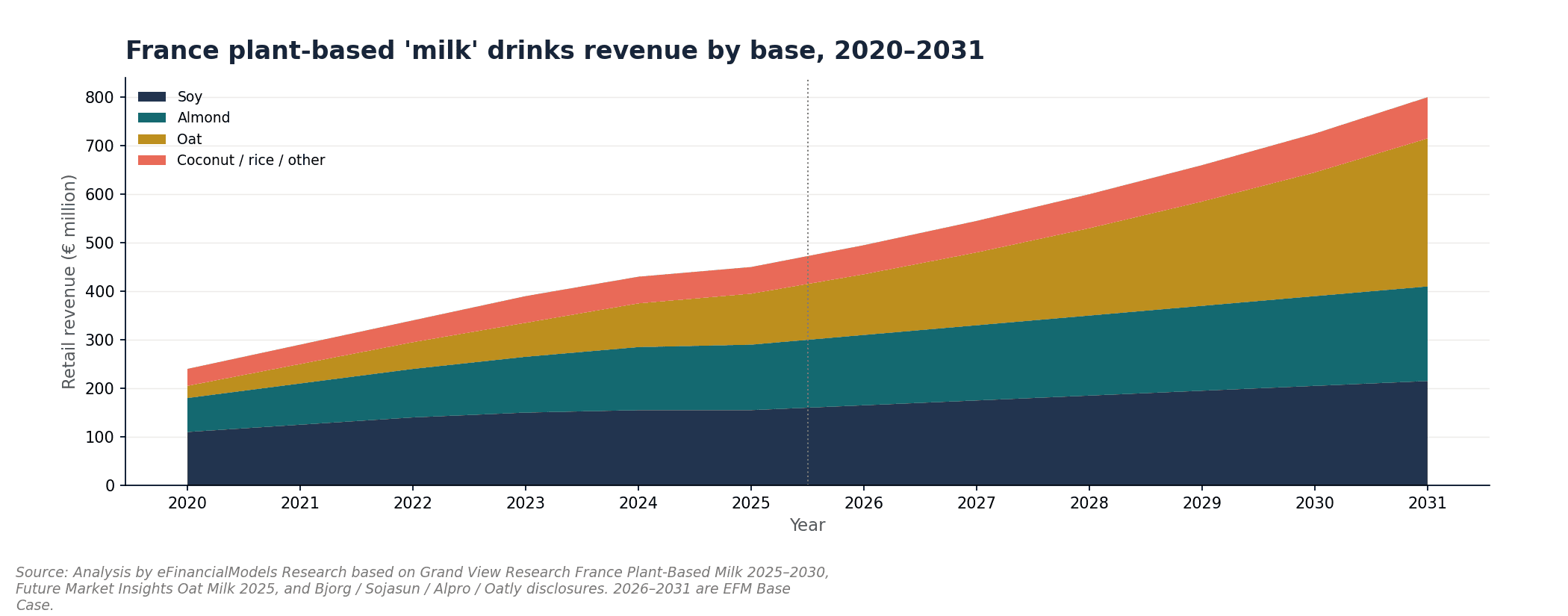
- Plant-based ‘milk’ drinks (soy, oat, almond) have grown to approximately 450 million euros at retail in 2025 and carry a 10.5 percent forecast CAGR through 2030, nearly doubling to 800 million euros in the Base Case by 2031.
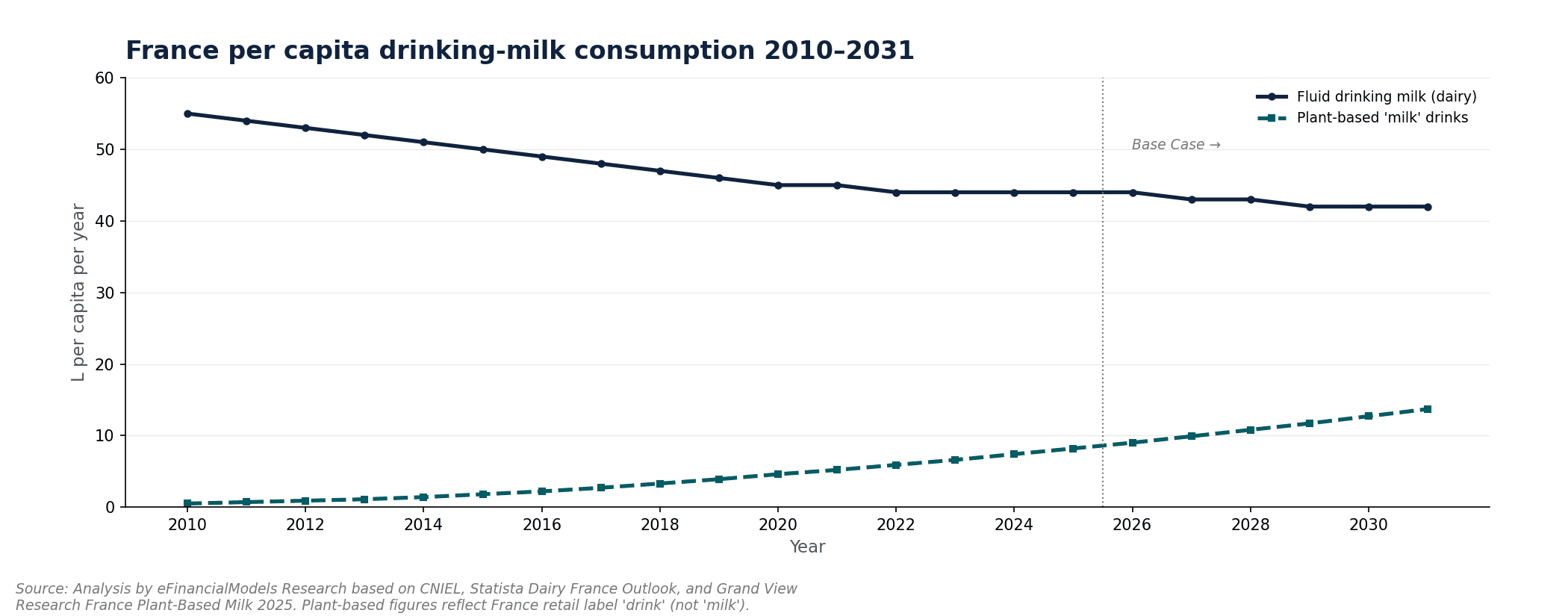
- Fluid drinking milk has declined from roughly 55 liters per capita in 2010 to about 44 liters in 2026, falling at approximately 2 percent per year through the late 2020s.
- The revised French sugar tax, effective 1 January 2026, creates a 30-plus cents per liter margin gap between high-sugar and low-sugar soft drink variants, forcing reformulation across the category.
- France’s top 3 grocery retailers (E.Leclerc, Carrefour, Intermarché) control approximately 63 percent of grocery share, giving them outsized pricing power over all three beverage sub-segments.
- EU Regulation 2025/40 (PPWR) mandates 30 percent recycled-content PET in beverage bottles by 2030, adding an estimated 50 to 200 million euros in capex per major water operator over the horizon.
- The Base Case (55 percent probability) projects aggregate sector retail revenue rising from 17.5 billion euros in 2025 to 20.5 billion euros by 2031, with average operating margins compressing slightly from 9.5 percent to 9.0 percent.
France Beverage Manufacturing: The 2026 Starting Point
France’s beverage manufacturing industry covers three distinct sub-segments under NACE codes 11.07 (manufacture of soft drinks and mineral waters) and 10.51 (operation of dairies). Each sub-segment enters 2026 with a different growth profile, a different competitive structure, and a different regulatory exposure.
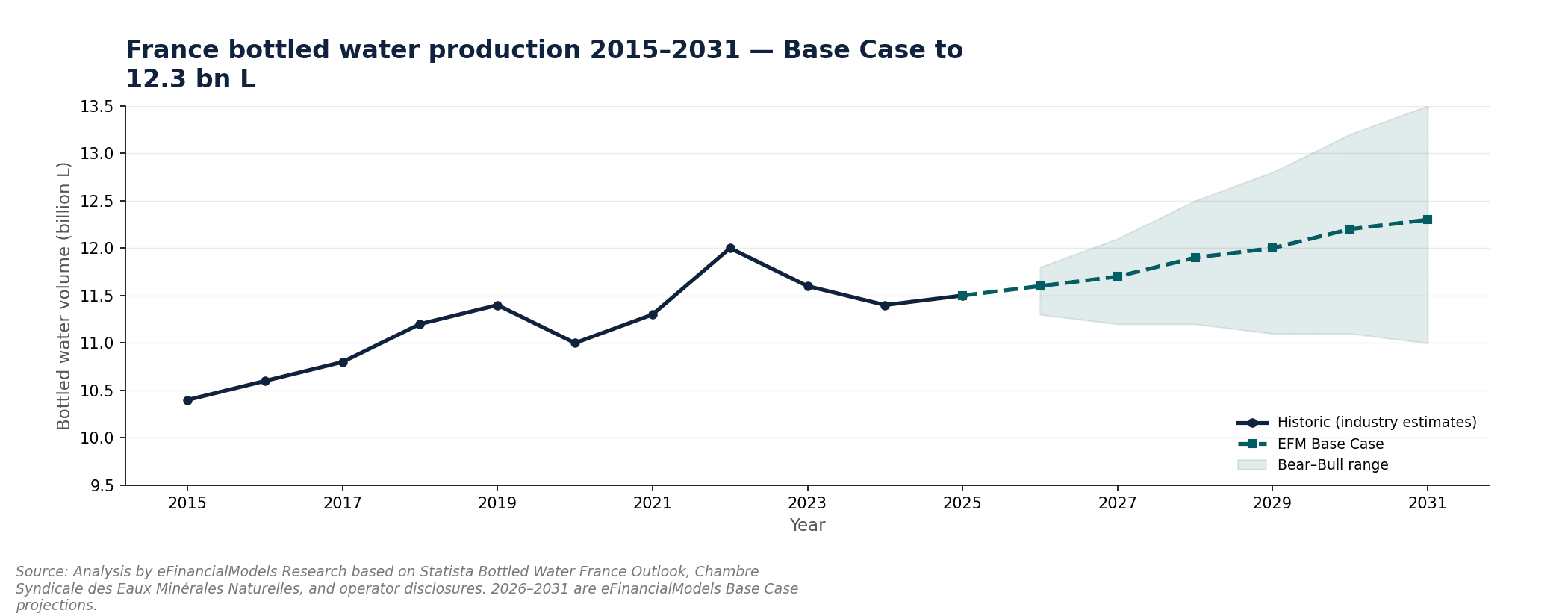
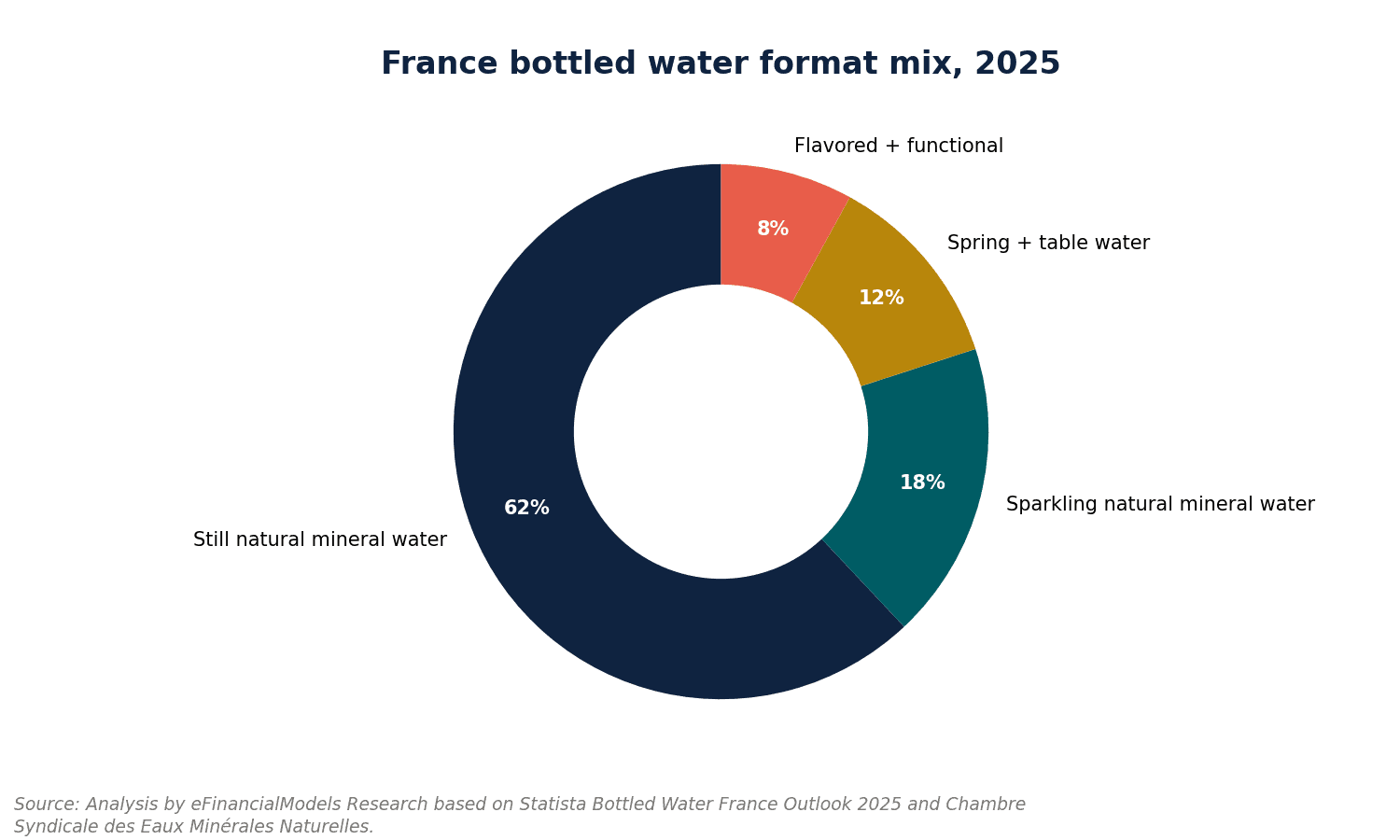
Bottled water is the volume anchor. French production sits at approximately 11.5 billion liters a year, with retail revenue near 2.67 billion euros in 2025 (eFinancialModels Research, based on Grand View Research France Bottled Water 2026-2033). Volume growth is a modest 1.1 percent in 2025, but revenue compounds faster because the mix is shifting toward sparkling and premium formats that carry higher per-liter prices.
Drinking dairy is a tale of two trends. Fluid milk has declined from roughly 55 liters per capita in 2010 to about 44 liters in 2026, a fall of roughly 20 percent over 16 years. Plant-based ‘milk’ drinks, meaning soy, oat, and almond-based beverages labeled as ‘drinks’ under EU regulatory convention, have grown from a niche to approximately 450 million euros at retail. The CNIEL (Center National Interprofessionnel de l’Économie Laitière), France’s national dairy industry body, tracks 740 dairy processing sites collecting 23 billion liters of raw milk from 44,242 farms (CNIEL).
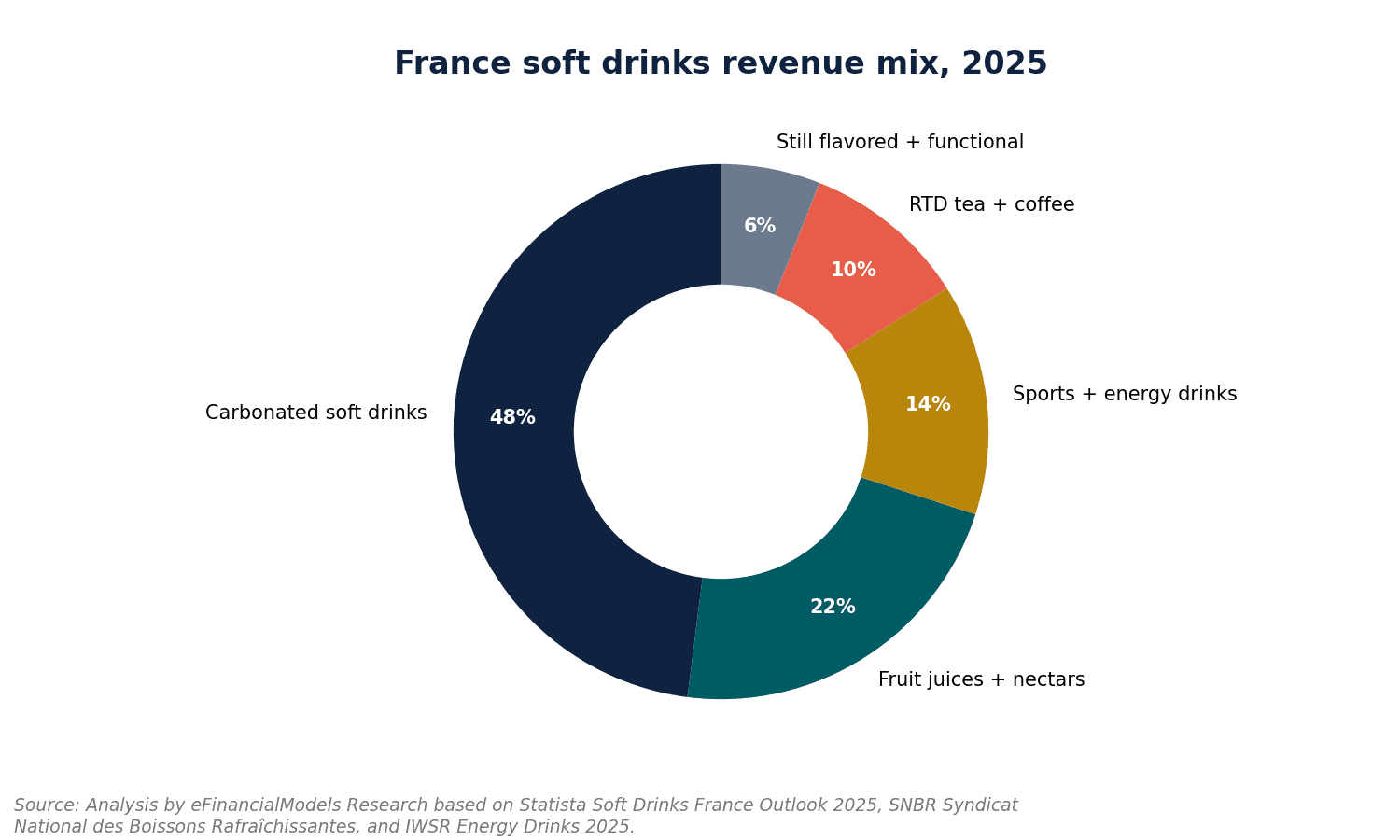
Soft drinks, defined under the SNBR (Syndicat National des Boissons Rafraîchissantes) scope to include carbonated soft drinks, still flavoured drinks, juices, nectars, RTD tea and coffee, sports drinks, and energy drinks, sit at approximately 8 to 10 billion euros at retail. Value growth runs ahead of volume as the revised two-tier sugar tax effective 1 January 2026 forces reformulation across the category.
The 2026 Sugar Tax: How the New Two-Tier Structure Works
The revised French sugar tax, formally the taxe sur les boissons sucrées under the Loi de financement de la sécurité sociale 2026, replaces the prior flat scale with a two-tier structure that creates sharply different economics depending on a product’s sugar content.
Here’s the math. Under the BOFIP TCA bareme effective 1 January 2026 (BOFIP):
- Beverages with up to 5 grams per liter of added sugar: 4.07 euros per hectolitre (roughly 0.04 euros per liter)
- Beverages with 5 to 8 grams per liter: 21.38 euros per hectolitre (roughly 0.21 euros per liter)
- Beverages above 8 grams per liter: approximately 35 cents per liter at factory exit
- A cumulative 3.50 euros per hectolitre sweetener tax applies when artificial sweeteners are also present
A regular full-sugar cola at 10 grams per liter of added sugar therefore faces approximately 35 cents per liter in fiscal cost. A reformulated version at 4 grams per liter faces only 4 cents per liter. That 31-cent-per-liter gap is the reformulation incentive. Monster Beverage has already reformulated its France core line with sucralose in response. Operators targeting sub-5 grams per liter on at least 60 percent of SKUs by 2027 can capture that margin gap before competitors do.
The sweetener tax adds a complication: products using acesulfame-K, sucralose, or aspartame to hit the low-sugar tier still face a cumulative 3.50 euros per hectolitre charge. Stevia and Reb-M (rebaudioside M, a high-purity steviol glycoside) avoid this if formulated without co-sweeteners, making natural-sweetener positioning the premium play.
Three Sub-Segments: Competitive Structure and Key Players
France’s beverage manufacturing competitive landscape is concentrated at the top in all three sub-segments, with a long tail of regional and cooperative operators below.
Bottled Water: Three Groups, One Volume Leader
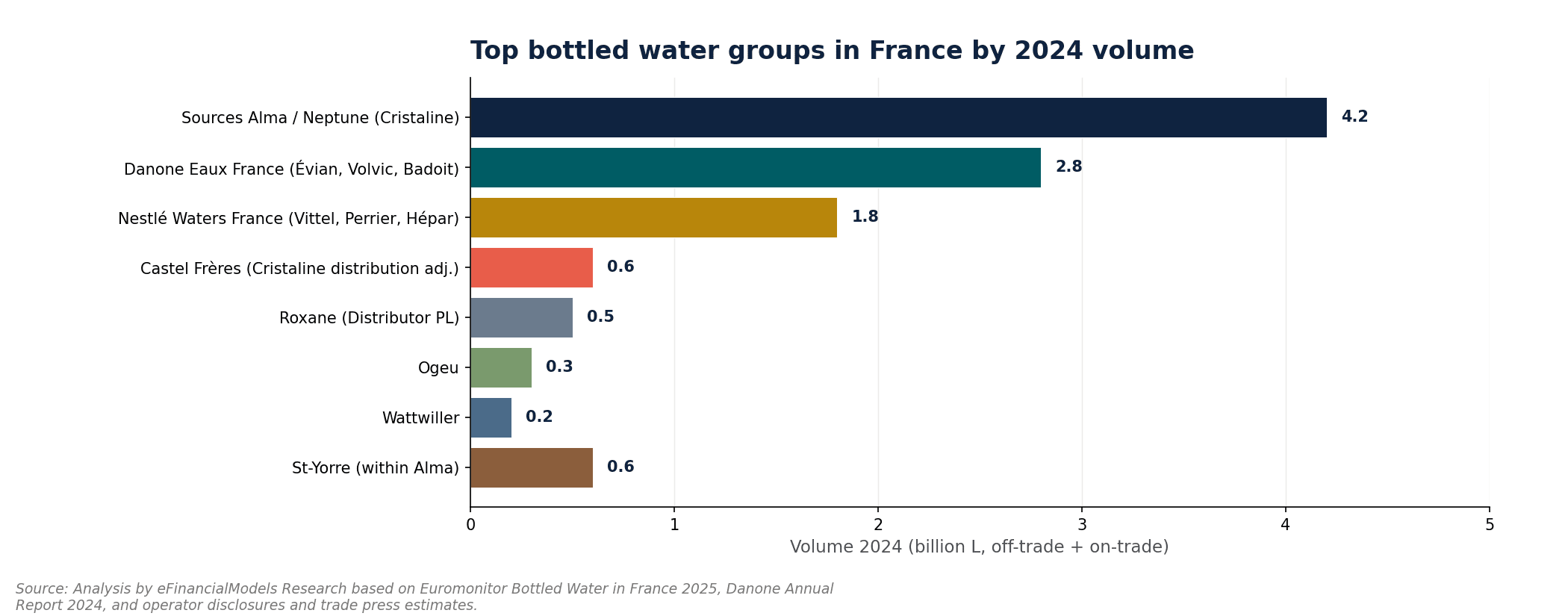
Three groups dominate French bottled water. Sources Alma (Neptune SA) operates Cristaline, Saint-Yorre, Vichy Célestins, Mont Roucous, and Rozana from over a dozen sources across France. Danone Eaux France operates Évian (Haute-Savoie), Volvic (Puy-de-Dôme), Badoit, and Salvetat. Nestlé Waters France operates Vittel and Hépar (Vosges), Perrier (Gard), and Contrex.
Cristaline is the off-trade volume leader: an estimated 60 percent of French adults report drinking it by self-reported awareness, compared with 22 percent for Évian, 19 percent for Perrier, and 17 percent for Vittel (eFinancialModels Research). But Évian and Perrier lead by branded retail value per liter, because premium and sparkling formats command a significant price premium over Cristaline’s low-cost positioning.
The Nestlé Waters France situation is a material risk. Nestlé closed two Hépar wells in 2023 after drought conditions in the Vosges. A January 2024 investigation by Mediapart and Le Monde revealed that Nestlé Waters France used industrial UV and activated-carbon filtration at Perrier and Vittel, methods prohibited for natural mineral water under EU Directive 2009/54/EC (EUR-Lex) and French law. The Perrier operating license at Vergèze is under pending ARS (Agence Régionale de Santé) review. Strategic divestment of lower-margin Nestlé water assets is a plausible scenario through 2026 to 2028.
Drinking Dairy: Cooperative Consolidation Under Pressure
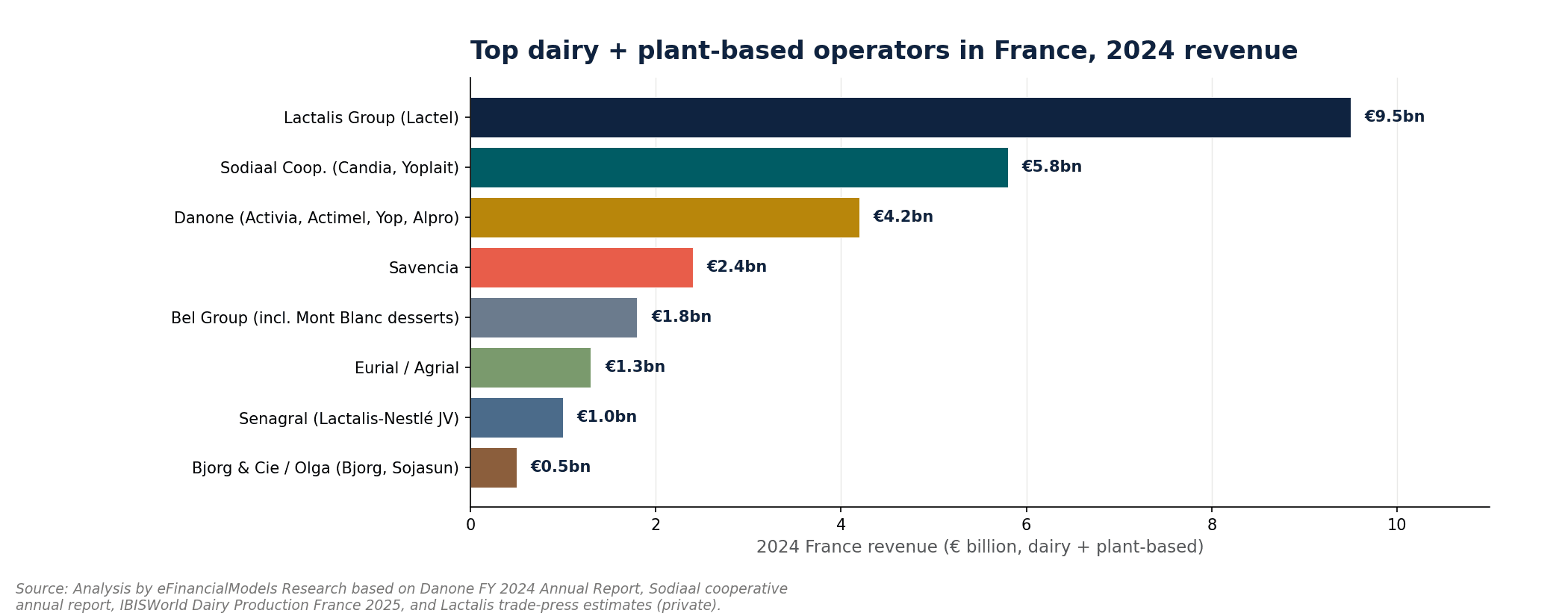
Lactalis (Lactel brand), Sodiaal cooperative (Candia brand), and Danone together hold 55 to 65 percent of fluid-milk processing capacity in France. Danone reported global revenue of 27.28 billion euros in 2025 (Danone). Sodiaal collects roughly 17 percent of France’s milk volume under a cooperative governance structure that provides farm-gate price stability under the EGalim framework (the Loi pour l’équilibre des relations commerciales agricoles, versions 1 through 4) but limits acquisition speed.
The plant-based pivot is the structural shift to watch. Danone converted a French dairy plant to oat-milk production in 2025, moving Alpro capacity into France. Olga / Ecotone Group (Bjorg, Sojasun brands) operates plant-based dedicated facilities and reported approximately 230 million euros of plant-based revenue across its France portfolio in 2025. Oatly is expanding French distribution and considering French production capacity through 2027. Lactalis and Sodiaal remain underweight in plant-based, creating an acquisition opportunity.
Soft Drinks: Three Multinationals, One Domestic Champion
Coca-Cola Europacific Partners (CCEP) France leads carbonated soft drinks with estimated 2024 France revenue of 2.9 billion euros, bottling from plants at Grigny, Castanet-Tolosan, Dunkerque, and Clamart. Suntory Orangina Schweppes Group France, the domestic champion with Orangina, Schweppes, Pulco, Oasis, and Champomy, reported estimated 2024 France revenue of 1.45 billion euros. PepsiCo France (Pepsi, 7Up, Lipton Ice Tea, Gatorade) sits at approximately 1.15 billion euros (eFinancialModels Research, based on Coca-Cola Europacific Partners Annual Report 2024 and Suntory Holdings Annual Report 2024 (Suntory)).
Energy drinks are led by Red Bull France at approximately 580 million euros and approximately 50 percent category share, with Monster Energy at approximately 22 percent. Red Bull imports finished product from Austria; Monster has reformulated its France line with sucralose ahead of the sugar-tax revision.
Supply-Side: Capacity, Capex, and the rPET Squeeze
France’s beverage manufacturing supply-side comprises approximately 500 to 600 production sites across the three sub-segments. Capacity utilisation runs at 75 to 90 percent, leaving moderate headroom for category growth without major greenfield investment. But two capex pressures are tightening the economics.
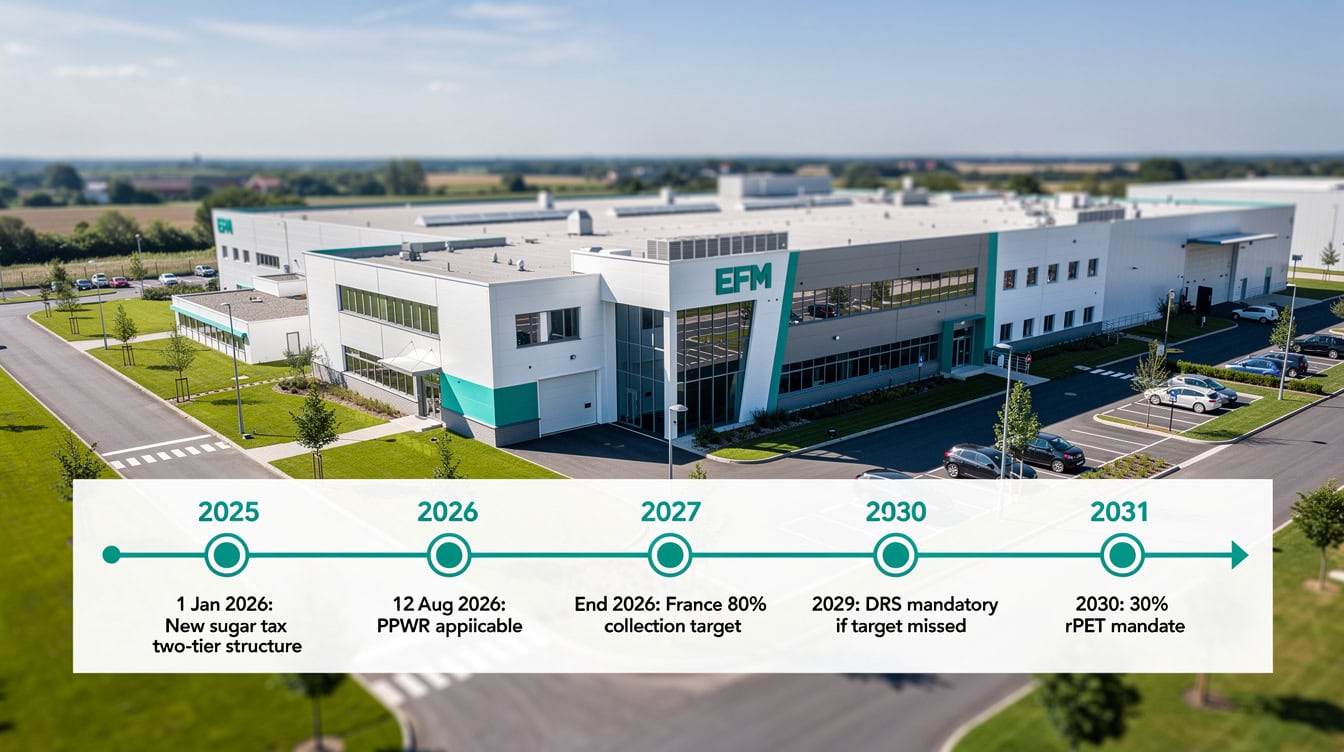
First, EU Regulation 2025/40 (the Packaging and Packaging Waste Regulation, PPWR), published 22 January 2025 and applicable from 12 August 2026, mandates 25 percent recycled-content PET (rPET) in beverage bottles from 2025, rising to 30 percent by 2030 (EUR-Lex PPWR). rPET currently trades at a 15 to 25 percent premium over virgin PET, at approximately 1,300 to 1,800 euros per tonne versus 1,100 to 1,400 euros per tonne for virgin resin. France faces a 45 percent rPET supply gap in 2025, meaning demand for recycled resin significantly exceeds domestic supply. Suppliers investing in mechanical and chemical rPET capacity now are positioned to capture that premium.
Second, source-protection capex for bottled water operators adds an estimated 50 to 200 million euros per operator over the 2026 to 2031 horizon. A modern PET bottling line for still water at 30,000 to 60,000 bottles per hour costs 12 to 18 million euros installed. A multi-format aseptic line capable of running plant-based milks alongside dairy or juice costs 25 to 40 million euros. Aluminium can lines cost 18 to 28 million euros and represent the structurally short capacity over 2023 to 2025 as energy-drink and RTD volume grew.
Co-pack utilisation has tightened from 75 to 80 percent in 2020 to 85 to 95 percent in 2024 as SKU proliferation (low-sugar variants, plant-based milk lines, premium juice formats) increased. Refresco, with French sites at Saint-Alban-les-Eaux and Vidauban, is the primary co-packer; new capacity is being added at the Saint-Alban site. France generated approximately 4.8 million tonnes of plastic packaging waste in a recent reference year, underscoring the scale of the recycling infrastructure challenge that underpins the rPET supply gap (European Environment Agency, Plastic packaging waste statistics).
Three Scenarios: Bear, Base, and Bull Cases to 2031
The Base Case (55 percent probability) projects bottled water rising to approximately 12.3 billion liters by 2031, drinking milk declining at 2 percent annually to about 2.8 billion liters, plant-based more than doubling to roughly 800 million euros at retail, and soft drinks compounding at low-single-digit volume growth as the sugar tax drives reformulation. Aggregate sector retail revenue rises from 17.5 billion euros in 2025 to 20.5 billion euros by 2031.
| Metric | 2025 Baseline | 2031 Base | 2031 Bear | 2031 Bull |
|---|---|---|---|---|
| Bottled water (bn L) | 11.5 | 12.3 | 10.5 | 13.5 |
| Drinking milk (bn L) | 2.95 | 2.80 | 2.70 | 3.00 |
| Plant-based (€m retail) | 450 | 800 | 600 | 980 |
| Soft drinks (bn L) | 6.8 | 7.4 | 6.0 | 7.7 |
| Sector revenue (€bn) | 17.5 | 20.5 | 16.5 | 23.0 |
| Avg operating margin | 9.5% | 9.0% | 7.5% | 11.0% |
The Bear Case (25 percent probability) reflects sharper milk decline, water constrained at 10.5 billion liters by rising water-rights litigation and PPWR compliance capex, and soft-drinks volume flat as the sugar-tax expansion squeezes margins. The Bull Case (20 percent probability) sees water benefitting from premium-PET differentiation, plant-based reaching 980 million euros on Oatly’s continental expansion, and soft drinks reformulating into low-tier categories at scale.
Demand Drivers: Demographics, Retail Concentration, and Channel Mix
Three structural forces shape demand across all three sub-segments through 2031.
France’s aging population, with a median age of 42.7 in 2025, drives down per-capita carbonated soft drink consumption while supporting bottled water and functional categories. Gen-Z’s reduced alcohol consumption and health orientation expands the market for low- and no-sugar reformulations, plant-based alternatives, and functional waters. Retailer concentration is the third force: E.Leclerc holds 23.5 to 24.9 percent of grocery share as of November 2025, Carrefour 21.8 percent, and Intermarché 18.1 percent, with the top three controlling approximately 63 percent of French grocery (eFinancialModels Research, based on Kantar Worldpanel / Numerator November 2025 data).
Private label (MDD, or Marque de Distributeur) penetration runs at 30 to 35 percent of bottled water volume, 25 to 30 percent of drinking milk, and 12 to 18 percent of soft drinks. Bottled water is most exposed: Castel-distributed and Roxane private-label brands give Leclerc, Carrefour, and Intermarché low-cost own-brand offerings that compete directly with Cristaline and the branded majors. France is the world’s largest per-capita consumer of bottled water in Europe, with consumption reaching approximately 141 liters per person per year (Statista), reinforcing why private-label competition in this sub-segment is so commercially significant.
Channel mix in 2025: off-trade (grocery, hypermarkets, supermarkets, discounters, convenience) accounts for approximately 75 to 80 percent of beverage manufacturing revenue; on-trade (restaurants, cafés, bars, hotels) for 15 to 20 percent; and out-of-home (vending, transport, sports venues) for 5 percent.
Common Pitfalls in Modeling France Beverage Manufacturing
Four modeling mistakes consistently distort financial projections for this sector.
Pitfall 1: Treating bottled water as a pure volume story. Revenue CAGR of 5.6 percent through 2033 runs well ahead of volume growth of 1.1 percent in 2025. Models that apply a single volume-growth rate to revenue will understate value creation from premium and sparkling mix shift. Fix: model volume and price per liter separately by format (still, sparkling, premium, private label).
Pitfall 2: Ignoring the rPET cost premium in packaging cost lines. rPET trades at a 15 to 25 percent premium over virgin PET today, and the PPWR mandate will push demand higher through 2030. Models using a flat PET cost assumption will understate input costs by 1 to 3 cents per liter for PET-heavy operators. Fix: build a separate rPET cost line with a Bear/Base/Bull range of 200 to 500 euros per tonne premium over virgin.
Pitfall 3: Applying a single sugar-tax rate to the entire soft drinks portfolio. The two-tier structure creates radically different economics by product. A full-sugar cola at 10 grams per liter faces approximately 35 cents per liter; a reformulated version at 4 grams per liter faces only 4 cents per liter. Fix: segment the portfolio by sugar content and apply the correct tier to each SKU.
Pitfall 4: Underestimating EGalim’s impact on dairy processor margins. The EGalim framework sets a farm-gate milk price floor that processors must pass through to farmers, but retailers resist passing the cost increase to consumers. The result is margin compression at the processor level. Fix: model farm-gate milk price (Base Case: 41.50 euros per 100 kg in 2025, rising to 42.00 euros by 2031) as a separate input with retailer pass-through sensitivity.
Regulatory Framework: PPWR, Sugar Tax, and EGalim
The 2026 to 2031 regulatory frame is dominated by three instruments that interact across sub-segments.
EU Regulation 2025/40 (PPWR), applicable from 12 August 2026, mandates 25 percent rPET content in beverage bottles from 2025 and 30 percent by 2030. It also mandates deposit return schemes (DRS, or consigne in French) by January 2029 unless member states achieve 80 percent separate collection by end-2026. France’s Loi AGEC (Loi n° 2020-105 du 10 février 2020, the anti-waste and circular economy law) sets a 77 percent separate collection target for 2025 (Legifrance). France’s current collection rate sits below that target, making a DRS likely by 2029 and adding logistics cost across all three sub-segments. The EU as a whole recycled only about 40 percent of plastic packaging in 2019 (European Environment Agency), illustrating how far member states including France must travel to meet the PPWR’s escalating recycled-content mandates.
The revised sugar tax (Loi de financement de la sécurité sociale 2026) is the most immediate margin lever for soft drinks operators. The EGalim framework (versions 1 through 4) governs farm-gate milk pricing and retailer-processor commercial relations for dairy, with EGalim 4 adding margin-floor provisions that increase processor input costs without guaranteed retailer pass-through.
Frequently Asked Questions
What is the current size of France’s bottled water market?
France’s bottled water market produces approximately 11.5 billion liters annually at the 2025 baseline, with retail revenue near 2.67 billion euros. Volume growth is modest at 1.1 percent in 2025, but revenue compounds at a projected 5.6 percent CAGR through 2033 because the mix is shifting toward sparkling and premium formats that carry higher per-liter prices. The three dominant operators are Sources Alma (Cristaline), Danone Eaux France (Évian, Volvic), and Nestlé Waters France (Vittel, Perrier). Cristaline leads by off-trade volume, with 60 percent of French adults reporting they drink it, while Évian and Perrier lead by branded retail value per liter.
How does the 2026 French sugar tax affect beverage manufacturers?
The revised taxe soda, effective 1 January 2026, replaces the prior flat scale with a two-tier structure. Beverages with up to 5 grams per liter of added sugar pay 4.07 euros per hectolitre (roughly 4 cents per liter). Beverages with 5 to 8 grams per liter pay 21.38 euros per hectolitre (roughly 21 cents per liter). Products above 8 grams per liter face approximately 35 cents per liter at factory exit. A cumulative 3.50 euros per hectolitre sweetener tax applies when artificial sweeteners are also present. The practical result is a 30-plus cents per liter margin gap between high-sugar and low-sugar variants, which is why Monster Beverage reformulated its France core line with sucralose before the tax took effect.
What is driving the decline in fluid milk consumption in France?
Fluid drinking milk consumption has fallen from roughly 55 liters per capita in 2010 to about 44 liters in 2026, a decline of approximately 20 percent over 16 years. The primary drivers are demographic (an aging population that shifts away from fluid milk toward functional and plant-based alternatives), dietary (reduced dairy consumption among younger cohorts), and competitive (plant-based ‘milk’ drinks growing at a 10.5 percent CAGR through 2030). The decline runs at approximately 2 percent per year through the late 2020s in the Base Case, reaching about 42 liters per capita by 2031. Plant-based milk growth offsets the revenue decline but not yet the volume decline, because plant-based drinks are priced at a significant premium to fluid milk.
Who are the main investors and M&A targets in France beverage manufacturing?
For strategic investors, three themes dominate the 2026 to 2031 horizon. First, Nestlé Waters France asset rationalisation: climate pressure on Vittel and Hépar sources, combined with the 2024 Perrier filtration scandal and pending ARS license reviews, creates a plausible path to divestment of one or more sites. Second, French dairy cooperative consolidation: Sodiaal’s EGalim 4 exposure creates conditions for partial brand divestments, with Candia drinking milk as the natural carve-out and Lactalis as the obvious consolidator. Third, plant-based platform M&A: Olga / Ecotone Group (Bjorg, Sojasun) carries approximately 230 million euros of plant-based revenue and growth-stage characteristics that make it a strategic target for Danone, Lactalis, Sodiaal, or international private equity firms including CVC, KKR, Bain Capital, and PAI.
What does the PPWR mean for beverage packaging costs in France?
EU Regulation 2025/40 (PPWR), applicable from 12 August 2026, mandates 25 percent recycled-content PET (rPET) in beverage bottles from 2025, rising to 30 percent by 2030. rPET currently trades at a 15 to 25 percent premium over virgin PET, at approximately 1,300 to 1,800 euros per tonne versus 1,100 to 1,400 euros per tonne for virgin resin. France faces a 45 percent rPET supply gap in 2025, meaning domestic recycled resin supply falls well short of demand. The PPWR also mandates deposit return schemes by January 2029 unless France achieves 80 percent separate collection by end-2026, adding logistics cost across all three sub-segments. Investors pricing French beverage assets should haircut earnings multiples for this regulatory and capex risk.
How concentrated is the French grocery retail market, and why does it matter for beverage manufacturers?
France’s grocery retail market is highly concentrated: E.Leclerc holds 23.5 to 24.9 percent of grocery share as of November 2025, Carrefour 21.8 percent, and Intermarché 18.1 percent, with the top three controlling approximately 63 percent of French grocery. This concentration gives retailers outsized pricing power over all three beverage sub-segments. Private label penetration runs at 30 to 35 percent of bottled water volume, 25 to 30 percent of drinking milk, and 12 to 18 percent of soft drinks. Bottled water is most exposed because Castel-distributed and Roxane private-label brands give the major retailers low-cost own-brand offerings that compete directly with Cristaline and the branded majors. Operators that invest in premium positioning and on-trade channel growth can partially offset this pressure.
What financial model should I use to analyze a French beverage manufacturing investment?
A robust financial model for France beverage manufacturing should include at least three scenario tracks (Bear, Base, Bull) with probability weightings, separate volume and price-per-liter assumptions by format and sub-segment, a dedicated rPET cost line with a 200 to 500 euros per tonne premium range over virgin PET, a sugar-tax tier assignment for each SKU in the soft drinks portfolio, and a farm-gate milk price input with EGalim pass-through sensitivity for dairy. The Base Case projects aggregate sector retail revenue rising from 17.5 billion euros in 2025 to 20.5 billion euros by 2031, with average operating margins compressing from 9.5 percent to 9.0 percent. A beverage manufacturing financial model template that incorporates these inputs will save significant build time versus starting from scratch.
Conclusion
France’s beverage manufacturing sector offers genuine growth opportunities through 2031, but the returns are not evenly distributed. Bottled water grows in value, not volume. Plant-based dairy is the highest-growth sub-segment at a 10.5 percent CAGR, but it requires platform investment that most incumbent dairy operators have not yet made. Soft drinks face a structural margin reset from the 2026 sugar tax, with operators that reformulate early capturing a 30-plus cents per liter advantage over those that wait.
The three risks that matter most are source closure or extraction limits at major mineral water springs (Critical severity), rPET supply shortage lifting unit costs by 1 to 3 cents per liter (High severity), and retailer private-label penetration squeezing branded-water and drinking-milk margins (Moderate severity). Operators that treat these as strategic vectors rather than external shocks will outperform through the horizon.
I recommend starting your analysis with the Beverage Manufacturing Start-Up Financial Model from eFinancialModels, which provides the three-scenario framework, sub-segment revenue build, and packaging cost structure you need to model the 2026 to 2031 horizon accurately. For broader manufacturing cost benchmarking, the Manufacturing Cost and Profit per Unit template and the Product Manufacturing Business Model are strong complements. If you are evaluating the full food and beverage investment landscape, the Food and Beverages financial model category covers adjacent sectors including dairy and soft drinks.