0 ITEMS

UAE Luxury Hotels: 80.7% Occupancy and What Comes Next
Dubai closed 2025 at record hotel performance for the third consecutive year, and the question for investors is no longer whether the UAE hospitality market grows — it is whether record rates can survive the heaviest luxury supply wave the market has ever seen.
Key Takeaways
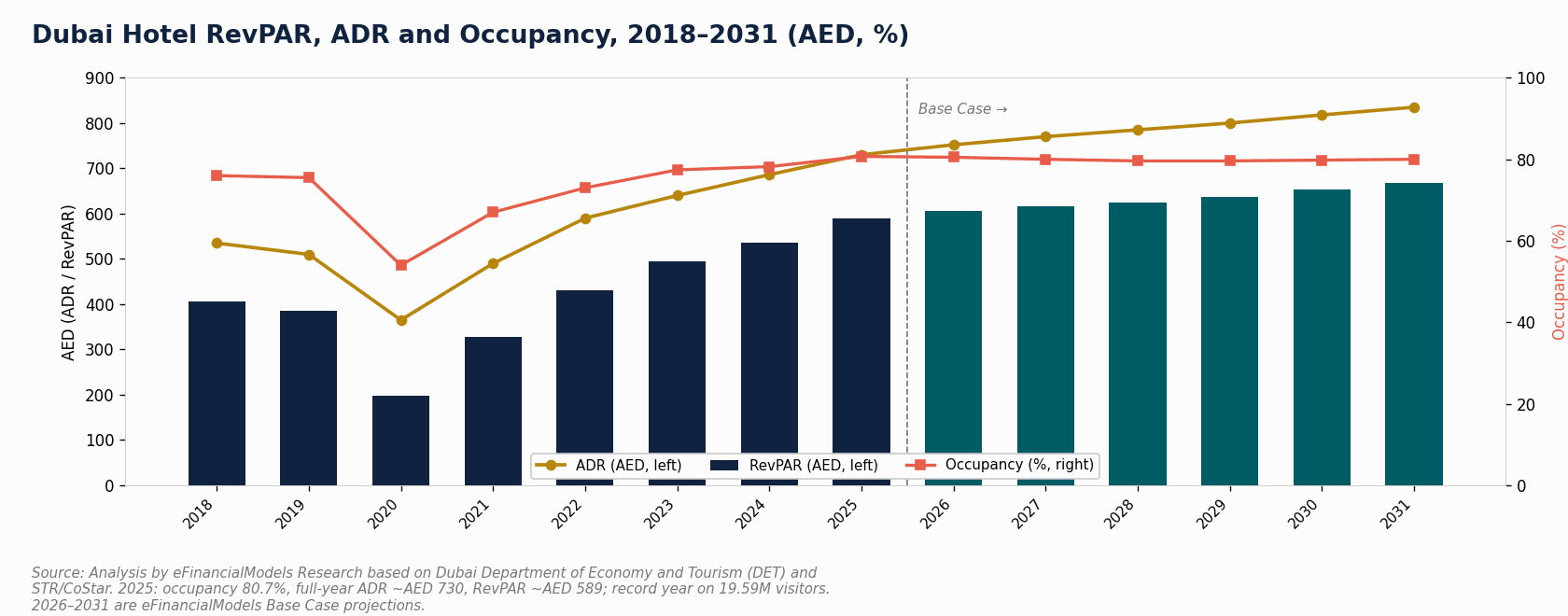
- Dubai’s full-year 2025 hotel occupancy reached approximately 80.7%, with average daily rate (ADR) near AED 730 (about US$199) and RevPAR near AED 589 (about US$160), all at or above prior peaks.
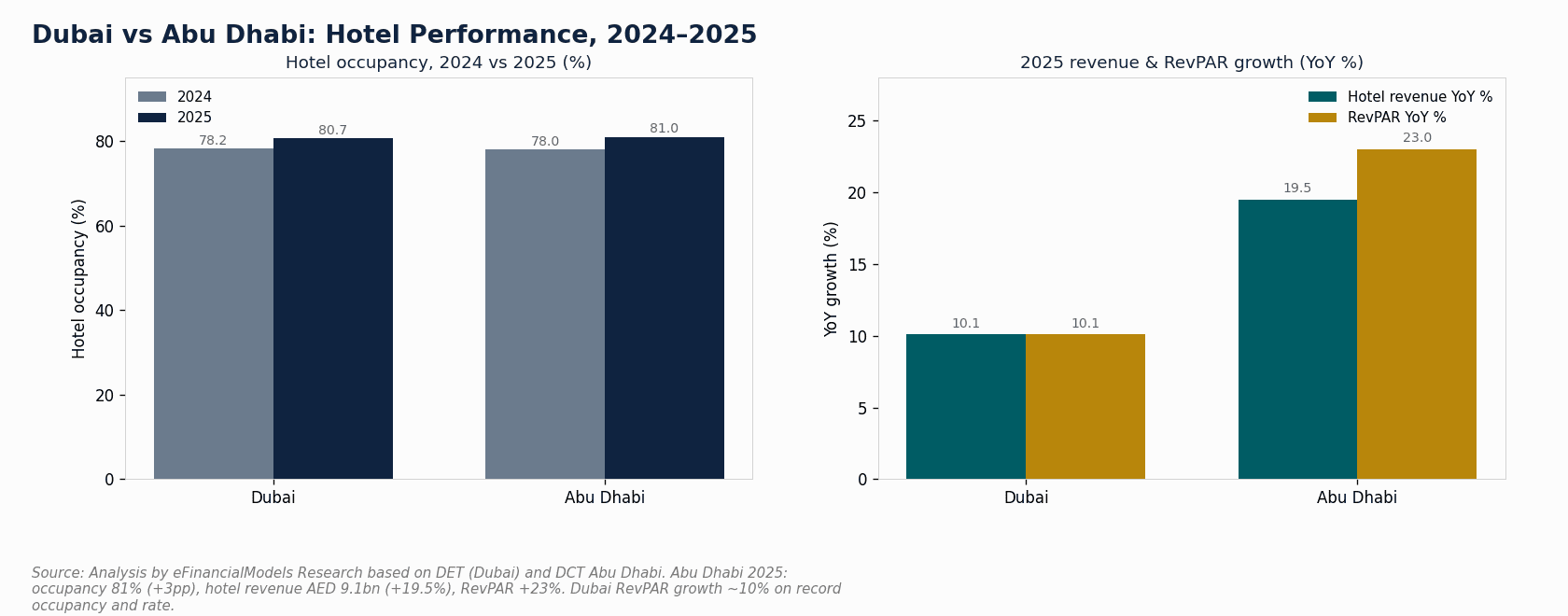
- Abu Dhabi posted hotel revenue up 19.5% to roughly AED 9.1 billion in 2025, with RevPAR rising approximately 23% year over year.
- More than 26,000 new hotel rooms are due across the UAE through 2026, with luxury and upper-upscale tiers accounting for roughly 75% of rooms under construction.
- Dubai is now the world’s largest branded-residential market, with approximately 48,474 completed units and 30,374 more under construction across about 90 projects, commanding a price premium of roughly 40% over comparable non-branded homes.
- The Wynn Al Marjan Island integrated resort in Ras Al Khaimah — a US$3.9–5.1 billion project with approximately 1,542 rooms and the UAE’s first commercial gaming license — opens in 2027 and creates an entirely new demand pool.
- The EFM Base Case projects a RevPAR CAGR of approximately 2.5% through 2031; the Bull Case reaches 4.5% and the Bear Case is flat, with occupancy ranging from 74% to 84% depending on scenario.
- The 9% federal corporate tax, effective for financial years from June 2023, must now sit explicitly in every UAE hospitality pro forma.
The UAE Hospitality Market Today: Record Performance as the Baseline
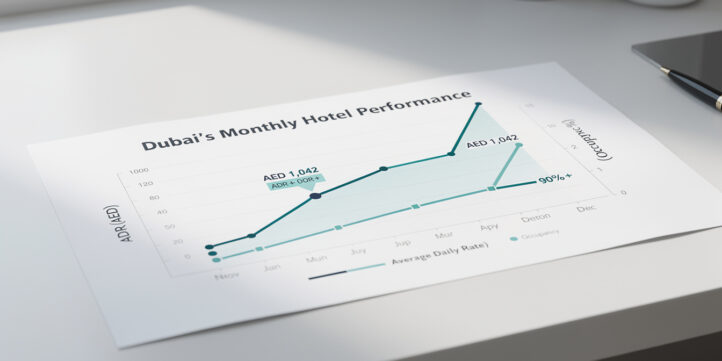
The UAE enters the 2026–2031 forecast window from a position of record strength, not recovery. Dubai welcomed 19.59 million international overnight visitors in 2025, up approximately 5% on 2024, according to the Dubai Department of Economy and Tourism. That figure represents the city’s third consecutive record year. Full-year hotel occupancy of approximately 80.7% places Dubai among the highest-occupancy major cities globally, and December 2025 ADR reached approximately AED 1,042 with New Year’s Eve occupancy hitting 94%.
Abu Dhabi matched that momentum. Hotel revenue rose 19.5% to approximately AED 9.1 billion and RevPAR climbed roughly 23%, according to the Department of Culture and Tourism Abu Dhabi. Both emirates are rate-led: occupancy is already near its practical ceiling, so future RevPAR growth depends on defending and growing ADR against a rising supply tide.
For modelers and investors, the critical implication is that an annual-average RevPAR assumption materially understates winter pricing power and overstates summer performance. Resort and luxury assets must be underwritten month by month, not on a single blended figure.
Supply Pipeline: 26,000 Rooms and a Top-Heavy Mix
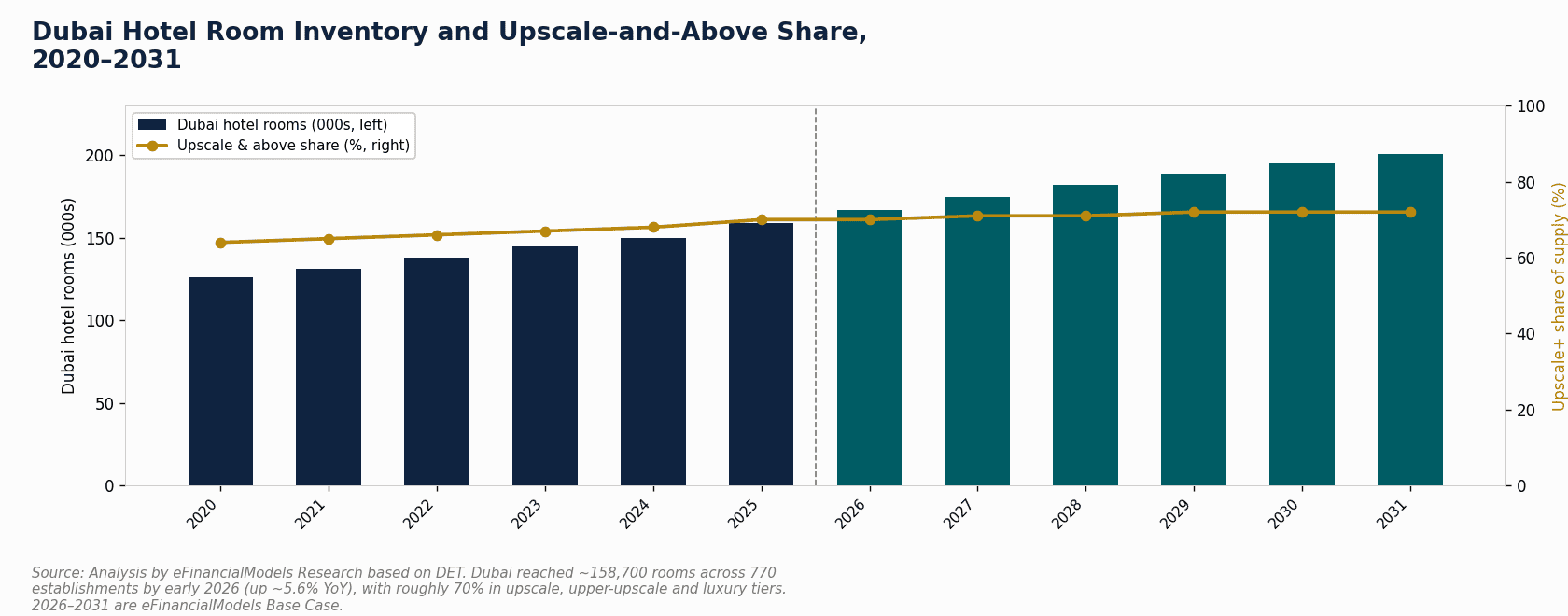
Supply, not demand, is the variable that will define UAE hospitality returns through 2031. Dubai’s room inventory reached approximately 158,700 keys across 770 establishments by early 2026, up about 5.6% year over year, according to analysis by eFinancialModels Research based on data from the Dubai Department of Economy and Tourism and Arabian Business. Roughly 70% of that existing stock sits in the upscale, upper-upscale, and luxury tiers — and the pipeline skews even further toward the top.
Across the UAE, more than 26,000 rooms are due through 2026 across 100-plus projects. Of the rooms currently under construction, approximately 5,503 are luxury keys and 3,013 are upper-upscale, meaning luxury and upper-upscale together account for roughly three-quarters of the pipeline. The pace of luxury deliveries between 2026 and 2028 is the single supply variable most likely to test rate discipline.
Marquee openings in this window include Six Senses on Palm Jumeirah, Nobu Hotel on Saadiyat Island (approximately 165 keys), and the Hilton Marjan Island Beach Resort in Ras Al Khaimah (approximately 350 keys). These are demand-creating assets, not just incremental room counts, and they should be modeled as submarket catalysts.
Wynn Al Marjan Island: A Category-Defining Event
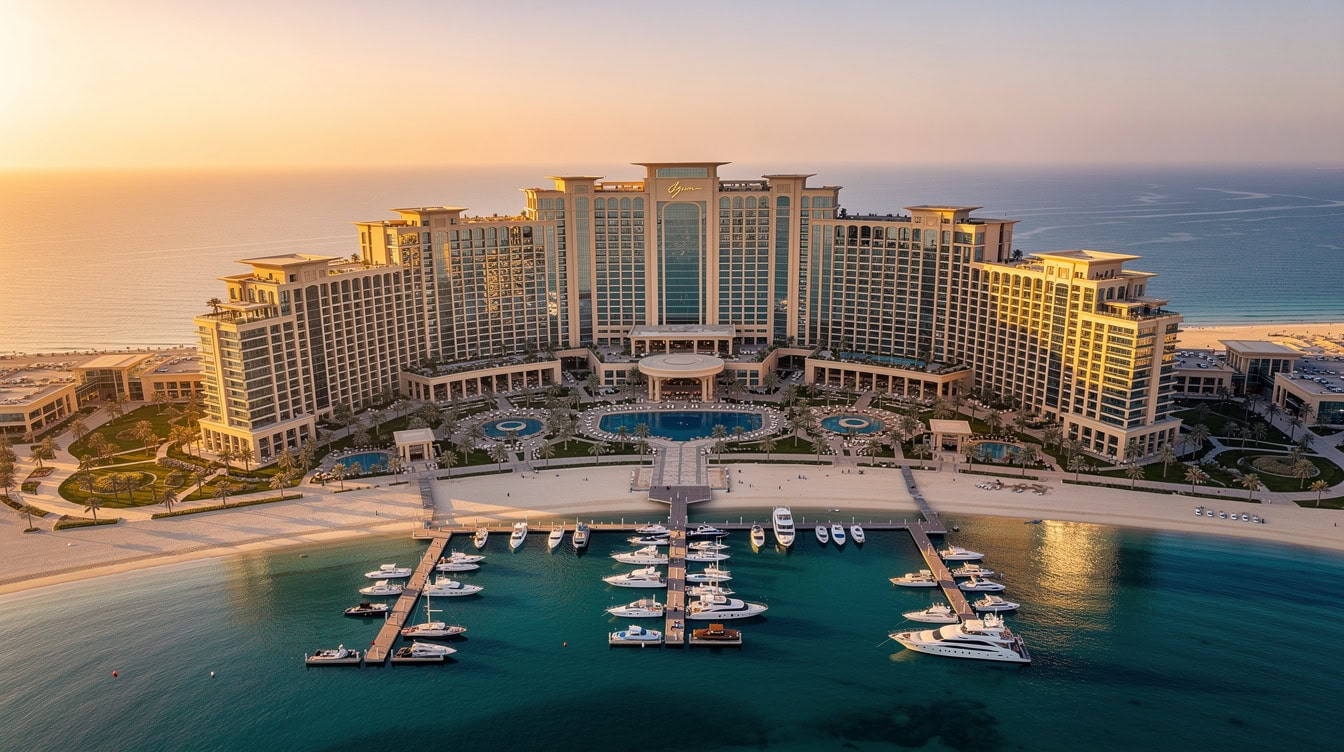
The single most consequential supply event of the period is the Wynn Al Marjan Island integrated resort in Ras Al Khaimah. The project carries a capital cost of approximately US$3.9–5.1 billion, will hold about 1,542 hotel rooms and 22 villas, and holds the first commercial gaming license issued in the UAE, according to the General Commercial Gaming Regulatory Authority (GCGRA). It is scheduled to open in 2027.
For Ras Al Khaimah, Wynn is a step-change in positioning. For the wider UAE market, it introduces a gaming-and-leisure demand pool that did not previously exist. The GCGRA estimates that commercial gaming could contribute AED 10–15 billion per year to the UAE economy by 2030. Modelers underwriting RAK assets — or Dubai assets that may benefit from spillover — should treat the 2027 opening as a datable demand event with an explicit ramp, not a vague long-run tailwind.
Branded Residential: Dubai Leads the World
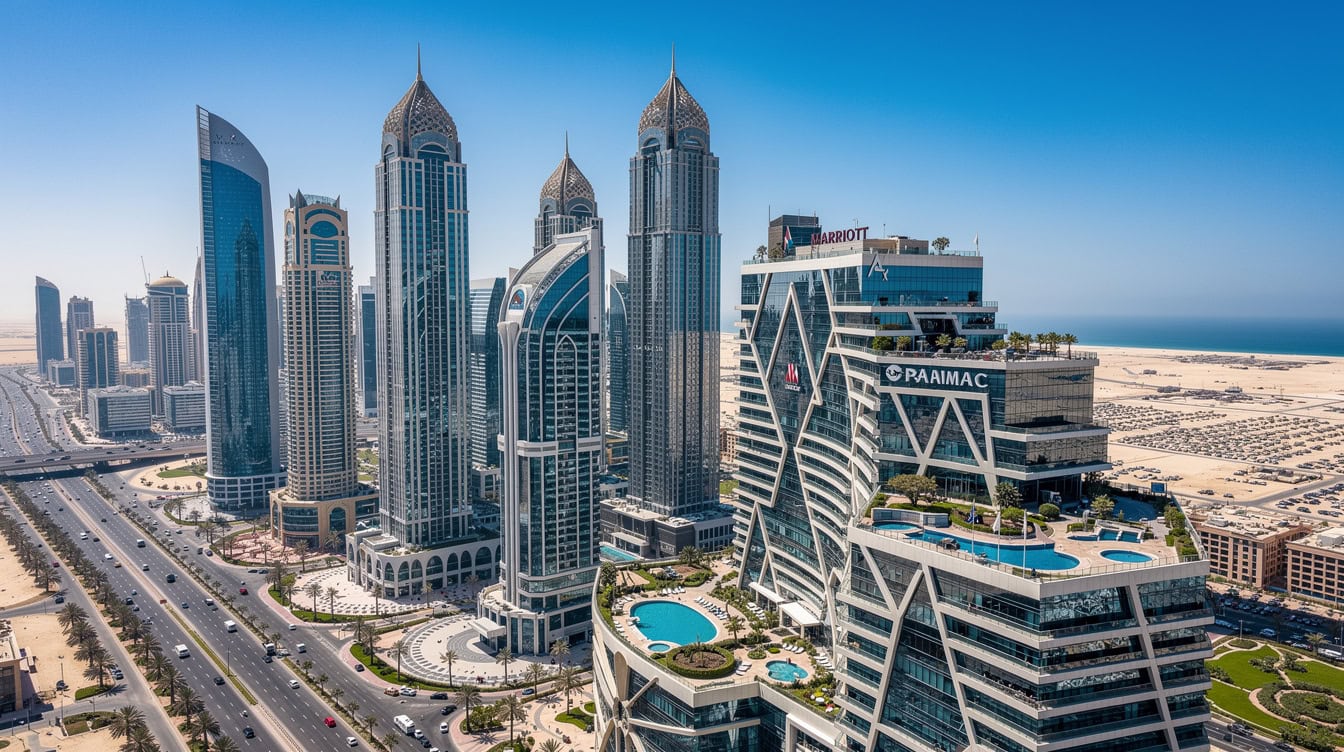
Branded residential — for-sale homes that carry a hotel or lifestyle brand, either managed by a hotel operator or licensed under a lifestyle brand — has moved from a Dubai novelty to the world’s dominant market. Dubai now holds approximately 48,474 completed branded-residential units, with roughly 30,374 more under construction across about 90 projects, according to Knight Frank and CBRE research cited in the UAE Hospitality Market Study 2026–2031. The city is on track to surpass 140 branded schemes by 2031, ahead of South Florida, which previously led the global format.
In the first nine months of 2025, Dubai branded-residential transaction volumes rose approximately 26% and value rose approximately 51% year over year, according to Knight Frank. The segment reached roughly 13% of total residential sales value, and approximately 79% of branded sales were off-plan (meaning sold before construction completes, funded through construction-linked escrow payments).
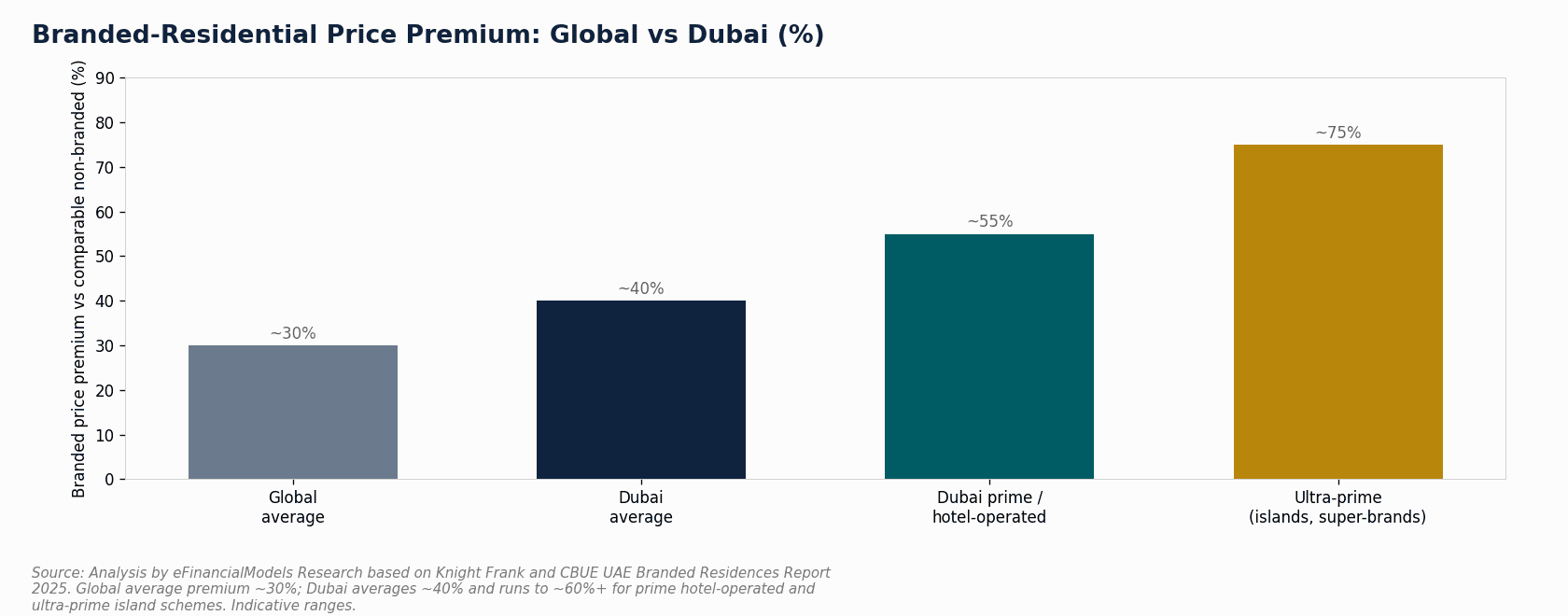
The economics explain the format’s dominance. Branded homes carry a price premium of roughly 40% over comparable non-branded product in Dubai on average, rising to 60% or more for prime, hotel-operated, and island schemes, against a global average premium nearer 30% according to Knight Frank. That premium funds two things simultaneously: a higher developer margin and the cost of the brand.
Two Brand Models, Two Pro Forma Architectures
There are two distinct structures a developer can use, and they carry very different economics:
- Lifestyle-license model: The brand lends its name for a one-time or sales-linked license fee, typically in the low single digits as a percentage of gross development value (GDV), with no ongoing hotel operation. Most of the 40% premium accrues directly to the developer’s sell-down margin.
- Hotel-operator model: A hotel brand manages the residences under a management agreement, charging a management fee and key money. The premium is higher (often 60%-plus for prime product), but so is the cost and the operational obligation.
For the modeler, branded residential is a sell-down, not a hold. Revenue is the off-plan sales price per square foot multiplied by saleable area, recognized against an absorption curve and collected through escrow on a construction-linked payment plan. The return is a development margin and an equity IRR over a three-to-five-year build-and-sell horizon, not a stabilized yield over a multi-decade operating life.
Worked Example: Branded-Residential Development Margin
Here’s the math for a simplified branded-residential scheme using the study’s base-case assumptions:
Inputs:
- Saleable area: 50,000 sq ft
- Non-branded comparable price: AED 3,000 per sq ft
- Branded premium: 40%
- Branded sales price: AED 3,000 × 1.40 = AED 4,200 per sq ft
- Gross development value (GDV): 50,000 × AED 4,200 = AED 210,000,000
- Land and construction cost: AED 140,000,000 (67% of GDV)
- Brand license fee: 4% of GDV = AED 8,400,000
- Total cost: AED 148,400,000
Development margin: AED 210,000,000 − AED 148,400,000 = AED 61,600,000
Margin as % of GDV: 61,600,000 / 210,000,000 = 29.3%
If the brand model switches to a hotel-operator structure with a 10% GDV fee and a 60% premium:
- Branded sales price: AED 3,000 × 1.60 = AED 4,800 per sq ft
- GDV: AED 240,000,000
- Brand cost: 10% × AED 240,000,000 = AED 24,000,000
- Total cost: AED 164,000,000
- Development margin: AED 76,000,000 (31.7% of GDV)
The hotel-operator model delivers a higher absolute margin but requires managing ongoing brand-standard obligations. The license model is simpler and faster to execute. Both must also account for the 9% federal corporate tax on profits.
Pricing, Yields, and Capital Markets
UAE hospitality capital markets operate on different logic than Western hotel markets. Hotel investors target cap rates (net operating income divided by asset value) of approximately 8.5% market-wide, according to JLL data cited by eFinancialModels Research. But prime resort assets on the Palm Jumeirah trade near 4–5% because buyers underwrite capital appreciation and scarcity rather than running yield. Emerging locations and Ras Al Khaimah price wider at 6–8%.
The market is funded largely by sovereign, regional, and private equity rather than leveraged debt structures. This insulates the UAE from the refinancing stress that defines US and European hotel markets. The binding risks here are regional geopolitics, premium oversupply, and the durability of the rate premium — not a debt maturity wall.
The golden-visa regime, the absence of personal income tax, and safe-haven demand continue to channel high-net-worth individual (HNWI) inflows into branded purchases and long-stay luxury demand. The National Tourism Strategy 2031 targets 40 million annual hotel guests and AED 450 billion of tourism GDP nationally, according to the UAE government’s WE THE UAE 2031 program. The UAE corporate tax rate stands at 9% (UAE Ministry of Finance) for financial years beginning on or after June 1, 2023, a structural shift that every hospitality pro forma must now reflect explicitly.
Three Scenarios to 2031
The table below summarizes the three scenarios from the EFM study. RevPAR (revenue per available room) is the standard hotel performance metric: ADR multiplied by occupancy rate.
| Scenario | Probability | RevPAR CAGR | Dubai Occupancy | Dubai ADR (AED) | Prime Cap Rate |
|---|---|---|---|---|---|
| Bear Case | 25% | ~0.0%/yr | ~74% | ~700 | ~6.0% |
| Base Case | 50% | ~2.5%/yr | ~80% | ~835 | ~4.5–5% |
| Bull Case | 25% | ~4.5%/yr | ~84% | ~920 | ~4.0% |
Source: Analysis by eFinancialModels Research. Scenario probabilities reflect senior-analyst judgment.
The Bear Case assumes a regional geopolitical shock combined with premium oversupply pushing occupancy toward 74% and compressing the branded-residential premium. The Bull Case assumes the National Tourism Strategy 2031 and the gaming catalyst both overdeliver, with HNWI migration accelerating. The Base Case — assigned 50% probability — projects orderly absorption of the luxury pipeline with Dubai occupancy holding near 80% and ADR growing from approximately AED 752 in 2026 to AED 835 by 2031.
Operator Competitive Landscape
The UAE branded hotel market is dominated by five international operators and anchored by several home-grown luxury brands. The table below shows approximate market positions based on analysis by eFinancialModels Research using Mordor Intelligence operator share data (single source, treat as indicative), company disclosures, and STR.
| Operator | UAE Share | Key Brands | 2026–2031 Move |
|---|---|---|---|
| Accor | ~25% | Raffles, Fairmont, Sofitel | Luxury and lifestyle expansion |
| Marriott | ~23% | Ritz-Carlton, St. Regis, EDITION | Resort growth |
| Hilton | ~21% | Waldorf Astoria, Conrad | Marjan Island resort |
| IHG | ~14% | InterContinental, Six Senses, Regent | Six Senses Palm entry |
| Rotana | ~12% | Regional upper-upscale | UAE resort roll-out |
| Jumeirah | Home-grown | Burj Al Arab, Madinat | Global brand extension |
| Kerzner | Home-grown | One&Only, Atlantis | Atlantis The Royal; One&Only growth |
| Wynn Resorts | Entering 2027 | Integrated gaming resort | Al Marjan Island, first UAE license |
Beneath the hotel operators sit the master developers who drive both branded-residential supply and resort development: Emaar (Address, Armani residences), DAMAC (fashion-house licenses including Versace and Cavalli), Nakheel (Palm Jumeirah, Palm Jebel Ali), Meraas (Bvlgari, Bluewaters), and Aldar (Saadiyat, Yas in Abu Dhabi).
Common Modeling Mistakes and How to Fix Them
Five specific errors appear repeatedly in UAE upper-tier hospitality models:
- Using annual-average RevPAR for resort assets. December ADR in Dubai reached approximately AED 1,042 in 2025 while summer months compress sharply. An annual average understates winter cash flow and overstates summer. Fix: build a monthly seasonal curve for November through March peak and June through August trough.
- Treating branded residential as a hotel hold. Branded residential is a sell-down with a three-to-five-year development horizon. Applying a cap-rate valuation to a branded-residential scheme produces a meaningless number. Fix: model it as a development cash flow with an absorption schedule, escrow-linked collections, and an explicit brand-fee line.
- Omitting the 9% federal corporate tax. The UAE introduced a 9% federal corporate tax for financial years beginning on or after June 2023. Many legacy models pre-date this change. Fix: include the corporate tax explicitly in every after-tax owner and developer pro forma.
- Tracking supply at the emirate level rather than the submarket level. The Palm Jumeirah, Downtown Dubai, Saadiyat Island, and Al Marjan Island each have distinct supply dynamics. Emirate-level occupancy masks submarket oversupply. Fix: track pipeline by named cluster.
- Treating the 2027 Wynn opening as a vague tailwind. The gaming opening is a datable event with a demand ramp and timing risk (the project has already experienced a modest delay). Fix: model it as a specific event in 2027 with a 12-to-24-month ramp and a timing stress scenario.
Key Risks to the Outlook
The risks to this market are weighted toward geopolitics and premium oversupply rather than demand collapse or refinancing stress. Regional geopolitical disruption is the critical risk: the UAE has demonstrated safe-haven resilience, but the international, leisure-led nature of upper-tier demand means a serious regional escalation would hit occupancy and rate quickly. The modest delay to the Wynn opening, attributed in part to regional logistics, is a concrete example of how geopolitical friction translates into project timing.
Premium oversupply is the high-severity supply-side risk. A concentrated wave of luxury keys and branded units in the same prime clusters between 2026 and 2028 could outpace absorption and compress both hotel rate and the residential premium in the most heavily built submarkets. The natural hedge is differentiation: a distinctive, well-located, well-branded asset will defend its premium where an undifferentiated one will not.
Branded-residential premium compression is the third high-severity risk. When every developer steers the same prime clusters toward branded product, the 40% premium that justifies the model could compress later in the forecast period. Phasing off-plan releases to match absorption protects both price and sales velocity.
FAQ: UAE Hospitality Investment 2026–2031
What is RevPAR and why does it matter for UAE hotel investment?
RevPAR stands for revenue per available room and equals ADR (average daily rate) multiplied by occupancy rate. It is the single most widely used metric for comparing hotel performance across properties and markets. In the UAE context, RevPAR matters because the market is rate-led: occupancy is already near 80–81% in Dubai and Abu Dhabi, so future RevPAR growth depends almost entirely on defending and growing ADR. The EFM Base Case projects a RevPAR CAGR of approximately 2.5% through 2031, implying Dubai ADR grows from roughly AED 752 in 2026 to approximately AED 835 by 2031. For a resort asset, the practical implication is that a monthly seasonal RevPAR curve — not an annual average — is the only accurate way to underwrite the asset, because December ADR of approximately AED 1,042 and summer trough ADR can differ by 40% or more.
How does the branded-residential price premium work in Dubai?
Branded residential carries a price premium of roughly 40% over comparable non-branded homes in Dubai on average, rising to 60% or more for prime, hotel-operated, and island product, according to Knight Frank and CBRE. The global average premium is nearer 30%, making Dubai an outlier. The premium funds two things: a higher developer margin and the cost of the brand. In the lifestyle-license model, the brand cost is typically around 4% of gross development value, so most of the 40% premium flows to the developer. In the hotel-operator model, the brand cost is closer to 10% of GDV but the achievable premium is higher. A developer building 50,000 sq ft of branded units at AED 4,200 per sq ft (40% above a AED 3,000 non-branded comparable) generates a GDV of AED 210 million. After a 4% license fee of AED 8.4 million and construction costs, the development margin can reach approximately 29% of GDV.
What cap rates should investors use for UAE resort assets?
Cap rate (net operating income divided by asset value) varies significantly by location and asset type in the UAE. Hotel investors target approximately 8.5% market-wide, according to JLL data. Prime resort assets on the Palm Jumeirah trade near 4–5% because buyers underwrite capital appreciation and scarcity rather than running yield. Emerging locations and Ras Al Khaimah price wider at 6–8%, reflecting higher risk and lower liquidity. The practical implication is that a prime Palm resort should not be valued on a running-yield basis alone: the appreciation component is a material part of the total return, and a model that ignores it will systematically undervalue the asset. Investors should also note that the UAE market is largely equity-funded, so the refinancing risk that drives cap-rate expansion in US and European markets is far less relevant here.
How should modelers treat the Wynn Al Marjan Island opening?
Wynn Al Marjan Island is a roughly US$3.9–5.1 billion integrated resort with approximately 1,542 rooms, 22 villas, and the UAE’s first commercial gaming license, scheduled to open in 2027. The GCGRA estimates commercial gaming could contribute AED 10–15 billion per year to the UAE economy by 2030. Modelers should treat the opening as a datable demand event with an explicit 12-to-24-month ramp, not as a vague long-run tailwind. The project has already experienced a modest delay attributed to regional logistics, so timing stress scenarios are essential. For RAK assets, the Wynn opening is transformational: it pulls luxury leisure and gaming demand into a market that was previously a secondary resort destination. For Dubai and Abu Dhabi assets, the effect is complementary rather than cannibalistic, adding a differentiated leisure draw to the wider UAE offer.
What does the 9% UAE corporate tax mean for hospitality pro formas?
The UAE introduced a 9% federal corporate tax for financial years beginning on or after June 1, 2023. This is a structural change that reshapes after-tax returns for both hotel owners and branded-residential developers. A luxury resort generating AED 50 million in net operating income before tax now faces a AED 4.5 million annual tax liability that did not exist in models built before 2023. For a branded-residential developer with a AED 61.6 million development margin on a AED 210 million GDV scheme, the 9% corporate tax reduces the after-tax margin to approximately AED 56.1 million (a reduction of about 9%). Every UAE hospitality and real-estate development pro forma built or updated from 2024 onward must include this line explicitly. Free-zone entities may qualify for different treatment, but the default assumption should be the 9% rate until specific relief is confirmed.
What is the difference between the lifestyle-license and hotel-operator branded-residential models?
The lifestyle-license model involves a brand (often a fashion house or lifestyle label) licensing its name to a developer for a one-time or sales-linked fee, typically around 4% of GDV, with no ongoing hotel operation or service obligation. The developer captures most of the 40% price premium as margin. The hotel-operator model involves a hotel brand managing the residences under a management agreement, charging a management fee and key money totaling closer to 10% of GDV, but delivering a higher premium (often 60%-plus for prime product) and ongoing brand-standard services. The choice between models depends on the developer’s operational capability, the target buyer profile, and the specific brand’s market positioning. DAMAC uses fashion-house licenses (Versace, Cavalli) while Emaar uses its own hotel brands (Address, Armani), and Meraas uses hotel-operator brands (Bvlgari). Both models require an explicit brand-fee line in the pro forma and an absorption schedule tied to off-plan sales velocity.
How seasonal is UAE resort demand, and how should modelers handle the summer trough?
UAE resort demand is highly seasonal, with the peak running from November through March and the trough from June through August. December 2025 ADR in Dubai reached approximately AED 1,042 and New Year’s Eve occupancy hit 94%, according to eFinancialModels Research based on DET data. Summer months see sharp compression in both rate and occupancy as temperatures peak. The practical modeling implication is significant: an asset underwritten on an annual-average RevPAR will misprice both the winter cash flow that drives the return and the summer trough that drives the working-capital and staffing model. The correct approach is to build a monthly seasonal curve, flex staffing and cost to that curve, and use group, MICE (meetings, incentives, conferences, and exhibitions), and events demand — such as the Abu Dhabi Formula 1 and Dubai exhibitions — to partially offset shoulder-season softness.
Conclusion
The UAE luxury, resort, and branded-residential market enters 2026–2031 from a position of genuine strength: record occupancy, rate-led RevPAR growth, the world’s largest branded-residential market, and a gaming catalyst that creates an entirely new demand pool. The risks are real — a top-heavy luxury supply pipeline, geopolitical uncertainty, and the potential for branded-residential premium compression in over-built clusters — but they are manageable with disciplined, submarket-level underwriting.
The single highest-value action a modeler or investor can take is to combine a seasonal hotel underwriting with a brand-led residential sell-down on an integrated parcel, priced on appreciation and scarcity rather than running yield, with the 9% corporate tax and the 2027 gaming opening both modeled explicitly.
I recommend starting with the UAE Hospitality Market Study 2026–2031 for the full demand, supply, and capital-markets analysis, paired with the Hospitality Financial Model Bundle to translate those assumptions into property-level cash flows, sell-down mechanics, and investor returns.