
0 ITEMS

Snack Bar Financial Model Excel Template
The Snack Bar Financial Model helps entrepreneurs and planners turn a food service concept into a structured financial forecast. Instead of starting with a blank spreadsheet, users can work from a ready-to-use model built around the realities of a snack bar, coffee truck, kiosk, or small quick service food concept. The template supports financial planning by organizing revenue assumptions, customer traffic, average order values, startup costs, operating expenses, payroll, cash flow, profitability, and funding needs into one editable framework. This template is designed for founders, business owners, consultants, analysts, and anyone preparing a business plan, loan application, investor presentation, or internal budget. It gives users a practical way to estimate how many customers the snack bar may serve, how much each customer may spend, what menu categories may drive sales, and how operating costs will affect margins over time. By connecting sales volume, cost of goods sold, staffing, fixed expenses, and capital needs, the model helps users understand whether the business can reach sustainable profitability. The Snack Bar Financial Model is especially useful for decision-making before launch or expansion. Users can adjust assumptions, test different revenue cases, review projected financial statements, and examine cash flow requirements before committing capital. It helps identify how much startup investment may be required, when the business may break even, how payroll and supplier costs affect results, and whether projected sales are strong enough to support the operating structure. This makes it valuable for evaluating pricing, menu mix, staffing levels, and funding strategy. Built with editable assumptions, investor-ready formatting, and five-year projections, the template gives users a clearer view of both opportunity and risk. It can be used in Microsoft Excel or Google Sheets, making it practical for individual founders and collaborative planning teams. Whether you are opening a new snack bar, refining an existing food service operation, or preparing financial documents for lenders or investors, this model helps replace guesswork with a more organized, data-driven planning process.
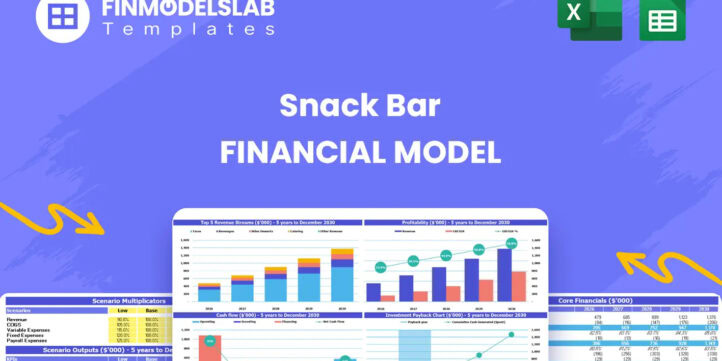


Financial Model Overview
The Snack Bar Financial Model is a ready-to-use financial model template designed to help entrepreneurs, business owners, consultants, and analysts plan the economics of a snack bar, coffee truck, kiosk, or small quick service food concept. It brings the core assumptions of the business into one organized structure, including customer traffic, average order value, product mix, cost of goods sold, operating expenses, payroll, capital investment, cash flow, and profitability. For a snack bar, small changes in daily covers, weekend demand, supplier costs, staffing schedules, and menu pricing can materially affect results, so having a connected forecast is essential for smarter planning. This template helps users estimate startup funding needs, prepare five-year projections, review lender-friendly reports, and understand whether the business can generate enough gross profit and cash flow to support growth. It is fully editable, compatible with Excel and Google Sheets, and structured to support business plans, loan applications, investor discussions, budgeting, monthly reviews, and internal decision-making.
All-in-One Dashboard
The all-in-one dashboard gives users a central place to review the most important inputs and outputs of the Snack Bar Financial Model without moving through every individual worksheet. This component typically brings together assumptions such as daily customer volume, average order value, sales mix, startup investment, payroll structure, cost of goods sold, operating expenses, and financing assumptions, then translates them into key outputs such as revenue, gross profit, EBITDA, net income, cash balance, and return metrics. For a snack bar operator, this is valuable because the business depends on fast operational decisions, such as whether to adjust prices, add a weekend promotion, change staffing levels, or increase inventory for peak periods. The dashboard helps users see the relationship between commercial assumptions and financial outcomes in one view, making it easier to review the model with partners, lenders, investors, or internal team members. Instead of relying on disconnected spreadsheets, the dashboard provides a practical control center for financial planning and helps make the model easier to use for both financial and non-financial users.
Low Base High Scenario Analysis
The low, base, and high scenario analysis component helps users test how the snack bar may perform under different business conditions. The base case can represent the expected plan, while the low case may reflect weaker customer traffic, lower average order value, higher ingredient costs, or slower growth, and the high case may reflect stronger demand, successful marketing, improved pricing, or better operating efficiency. The section may use adjustable assumptions for daily covers, weekday and weekend sales patterns, sales mix, cost of goods sold, labor cost, fixed expenses, and capital requirements to show how each scenario affects revenue, profitability, cash flow, and funding needs. This is useful for planning because food service businesses are sensitive to demand fluctuations, seasonality, weather, local competition, and customer habits. With scenario analysis, users can stress-test the business before launching, prepare contingency plans, and present a more credible financial case to investors or lenders. It also supports better decision-making by showing the gap between best-case potential and downside risk, helping founders understand what must happen for the snack bar to remain financially stable.
Professional Charts
The professional charts component converts the model’s financial outputs into clear visual reports that can be used for presentations, business plans, investor decks, lender meetings, and internal reviews. These charts may show revenue growth, cost trends, gross margin, EBITDA, cash balance, profit trajectory, break-even timing, revenue stream contribution, or changes in key performance indicators over time. For a snack bar business, visual reporting is particularly helpful because operators need to understand how customer traffic, menu mix, and expense control translate into financial performance. Charts make it easier to identify whether sales are growing fast enough, whether costs are rising too quickly, whether cash reserves are adequate, and whether profitability improves as the business scales. They also make the financial model easier to communicate to stakeholders who may not want to review every worksheet in detail. By presenting the forecast visually, this component helps users turn spreadsheet calculations into a more polished, decision-ready narrative that supports funding, planning, and performance tracking.
ROE Components and DuPont Analysis
The ROE components and DuPont analysis section helps users understand what drives return on equity rather than looking only at final profit figures. This component breaks return on equity into underlying drivers such as profitability, asset efficiency, and financial leverage, allowing users to see how margins, revenue generation, investment levels, and financing structure influence overall returns. For a snack bar, this can be useful when comparing different launch strategies, such as purchasing a customized food truck, leasing a small kiosk, investing in premium equipment, or expanding into multiple locations. Inputs may include net income, total assets, equity investment, liabilities, sales, and margin assumptions, while outputs may include return on equity, asset turnover, and leverage-related indicators. The value of this section is that it helps users evaluate whether the business is simply profitable or actually generating an attractive return relative to the capital invested. For founders and investors, this supports better decisions about ownership funding, debt use, reinvestment, and expansion timing, especially when the snack bar requires meaningful upfront investment in equipment, inventory, and setup.
Revenue Inputs
The revenue inputs section is where users define the commercial engine of the snack bar forecast. It may include assumptions for daily customers, weekday and weekend traffic patterns, average order value, operating days, pricing, sales growth, product categories, seasonal demand, and changes in customer behavior over time. For a snack bar, revenue is often driven by simple but powerful variables, such as how many people buy during morning rush, lunch periods, evenings, or weekends, and how much each guest spends on beverages, food items, and specials. This section allows users to replace generic estimates with their own business-specific assumptions, whether they are planning an espresso-focused cart, a snack kiosk, a mobile coffee truck, or a compact quick service concept. The outputs from this section feed directly into monthly and annual revenue forecasts, supporting the income statement, cash flow forecast, and profitability analysis. It is useful because it helps users understand the sales volume required to support rent, payroll, supplies, debt service, and owner returns, while also making it easier to test the impact of pricing changes, promotions, or new menu offerings.
Bank-Ready Reports
The bank-ready reports component organizes the model’s financial outputs into a format that is easier for lenders, investors, and professional stakeholders to review. This may include projected profit and loss statements, cash flow forecasts, balance sheet outputs, funding requirements, debt service assumptions, repayment capacity, and summary financial metrics. For a snack bar seeking startup funding, equipment financing, a working capital loan, or expansion capital, lenders typically want to see a clear connection between assumptions and results. This section helps present that connection in a structured way by showing expected revenue, expenses, profit, cash generation, and the ability to meet financial obligations. Inputs may include loan amount, interest rate, repayment term, capital expenditures, startup costs, and operating assumptions, while outputs may show monthly cash flow, annual profit, and financing needs. The benefit is that users can prepare more professional financial documents without building statements from scratch. It also helps founders anticipate lender questions, identify potential weaknesses in the plan, and demonstrate that the snack bar has been evaluated from a disciplined financial perspective.
Revenue Breakdown
The revenue breakdown component provides a more detailed view of how different product categories or sales streams contribute to total sales. For a snack bar, this may include espresso drinks, brewed coffee, packaged snacks, food items, seasonal specials, combo offers, catering, event sales, or other revenue categories relevant to the concept. Instead of treating all revenue as one line, this section helps users understand which products drive volume, which categories have higher average ticket values, and where margin improvement opportunities may exist. Inputs may include category share, price per item, units sold, growth rates, and customer purchasing behavior, while outputs may include revenue by category, category contribution, and changes in sales mix over time. This is useful for planning because snack bar profitability often depends on selling a balanced mix of high-volume and high-margin items. If one category has strong revenue but weak margins, the model can help users evaluate pricing, supplier costs, or menu strategy. A detailed revenue breakdown also supports better inventory planning, marketing decisions, and investor discussions by showing how the business expects to make money in practical operational terms.
KPI Dashboard
The KPI dashboard focuses on performance metrics and benchmarks that help users evaluate whether the snack bar is operating efficiently and competitively. It may track key indicators such as average order value, daily covers, revenue per operating day, gross margin, cost of goods sold percentage, labor cost percentage, EBITDA margin, net profit margin, cash balance, payback period, and other operational or financial ratios. For a snack bar business, these metrics are essential because the model’s success depends not only on total revenue but also on how efficiently the business converts sales into profit and cash. Inputs from the revenue, cost, payroll, and financial statement sections feed into the KPI dashboard, creating a concise performance view that can be reviewed monthly, quarterly, or annually. This component is useful for benchmarking assumptions against food service norms, setting targets, identifying cost issues, and communicating performance to partners or stakeholders. It helps users move beyond top-line sales forecasts and focus on the metrics that determine whether the business is healthy, scalable, and financially sustainable.
Startup Cost and Capital Planning
The startup cost and capital planning component helps users estimate the total investment needed before the snack bar begins operating. This section may include equipment purchases, food truck or kiosk setup, espresso machine and appliances, refrigeration, initial inventory, licenses, permits, branding, signage, point-of-sale systems, deposits, pre-opening marketing, professional fees, and working capital reserves. For a snack bar, underestimating launch costs can create cash pressure very quickly, especially when the business needs to purchase equipment and stock inventory before revenue begins. This component allows users to itemize each cost, separate one-time capital expenditures from recurring expenses, and understand the amount of owner equity, loan funding, or outside investment that may be required. The outputs may include total startup budget, funding gap, capital expenditure schedule, and opening cash requirement. This is valuable for business planning and funding preparation because it gives founders a clearer view of what must be financed and when the money will be needed. It also helps users make practical decisions, such as whether to buy or lease equipment, reduce initial scope, delay certain purchases, or maintain a larger operating reserve.
Break-Even Analysis
The break-even analysis component helps users identify when the snack bar may become profitable and what level of sales is required to cover fixed and variable costs. This section may use assumptions for gross margin, cost of goods sold, payroll, rent, insurance, utilities, software, marketing, loan payments, and other operating expenses to calculate the revenue or customer volume needed to reach break-even. For a snack bar, this is a critical planning tool because the business often has a mix of variable costs tied to food and beverage sales and fixed costs that must be paid regardless of customer traffic. Outputs may include break-even sales, break-even units or customer counts, monthly break-even timing, and the relationship between sales growth and operating leverage. This is useful for decision-making because it shows whether the planned pricing, menu mix, and customer assumptions are sufficient to support the cost structure. It can also guide launch strategy by helping users set realistic daily sales targets, evaluate promotional needs, manage staffing, and determine how much cash reserve is required before the business reaches stable profitability.
File types:
Excel – Single-User: .xlsx
Excel – Multi-User: .xlsx
Similar ProductsOther customers were also interested in...


 HenrySheykin
Cigar Lounge Financial Model Excel Template
The Cigar Lounge Financial Model helps entrepreneurs, business owners, consultants, analysts, and fo... Read more
Juice Bar Financial Model Excel Template
The Juice Bar Financial Model helps entrepreneurs, founders, consultants, analysts, and business own... Read more

Wine Bar Financial Model Excel Template
The Wine Bar Financial Model helps entrepreneurs, founders, consultants, analysts, and hospitality b... Read more

Tapas Bar Financial Model Excel Template
The Tapas Bar Financial Model helps entrepreneurs, restaurant founders, business owners, consultants... Read more

Beer Bar Financial Model Excel Template
The Craft Beer Bar Financial Model helps entrepreneurs, founders, bar owners, consultants, and analy... Read more

Sports Bar Financial Model Excel Template
The Sports Bar Financial Model Financial Model Template helps entrepreneurs, founders, business owne... Read more

Sandwich Bar Financial Model Excel Template
The Sandwich Shop Financial Model is a ready-to-use financial model template designed to help entrep... Read more
Karaoke Bar Business Plan Financial Model Excel Te...
The Karaoke Bar Financial Model helps entrepreneurs, business owners, consultants, founders, and ana... Read more
All Day Bar & Restaurant Financial Model Excel...
The All-Day Restaurant Financial Model helps users turn a food and beverage concept into a structure... Read more
 Giorgos
All-day Restaurant and Bar – 5 Year Financial Mo...
Financial Model providing advanced financial planning & analysis for an All-day Restaurant &... Read more
You must log in to submit a review.