
0 ITEMS

Paintball Financial Model Excel Template
The Paintball Financial Model helps entrepreneurs, founders, consultants, analysts, and business owners turn a paintball facility concept into a structured financial forecast. Instead of starting with a blank spreadsheet, users can work from a ready-to-use financial model template built around the economics of a paintball business, including ticket packages, group events, premium play, ancillary sales, equipment needs, staffing, operating expenses, and capital investment. It gives users a practical way to estimate startup costs, forecast revenue, evaluate cash flow, and understand profitability before launching, expanding, or presenting the opportunity to stakeholders. This template is designed for business planning, funding preparation, internal budgeting, and investor or lender discussions. Users can customize the assumptions to reflect their local market, pricing strategy, expected visitor volume, field capacity, payroll structure, supplier costs, rent or land expenses, marketing plans, and growth expectations. By connecting revenue assumptions with cost of goods sold, payroll, operating expenses, capital expenditures, and cash flow, the model helps users see how each decision affects financial performance. It is especially useful for preparing a business plan, validating a launch budget, reviewing funding needs, or comparing different strategic options before committing capital. The Paintball Financial Model supports up to five years of projections and includes tools for reviewing income, expenses, profit, cash flow, investor returns, and key performance indicators. It helps users evaluate whether the business can cover fixed and variable costs, how quickly it may reach break-even, and what level of sales volume may be required to sustain operations. The template also helps identify the drivers that matter most, such as admissions volume, average ticket price, group booking demand, ancillary revenue per customer, staffing efficiency, paintball supply costs, and equipment investment. Built to be editable and presentation-ready, the model can support both early-stage planning and ongoing decision-making. Entrepreneurs can use it to estimate feasibility, operators can use it to adjust budgets and targets, and advisors can use it to create a professional financial case for clients. With organized inputs, automated calculations, visual outputs, scenario planning, and bank-ready reporting, the Paintball Financial Model makes it easier to replace guesswork with clear financial planning and more confident business decisions.


Financial Model Overview
The Paintball Financial Model is a ready-to-use financial model template created for planning, launching, funding, or expanding a paintball facility. It gives entrepreneurs, business owners, consultants, analysts, and founders a structured way to evaluate the financial potential of a paintball business using editable assumptions and automated outputs. A paintball operation depends on several connected revenue and cost drivers, including standard game packages, group and corporate events, premium player experiences, paintball and equipment sales, concessions, rental gear, staffing, field development, utilities, marketing, insurance, and ongoing maintenance. This template brings those drivers into one organized model so users can forecast revenue, estimate startup costs, plan operating expenses, review cash flow, assess profitability, and prepare investor-ready financial reports. Instead of building complex spreadsheets from scratch, users can start with a professional framework that can be customized for a local market, indoor or outdoor facility, startup launch, acquisition, or expansion plan.
All-in-One Dashboard
The all-in-one dashboard brings the core inputs and core outputs of the Paintball Financial Model into a central planning view. This component is useful because a paintball facility has many moving parts, and the dashboard helps users quickly understand how major assumptions translate into projected financial performance. Inputs may include visitor volume, pricing, group booking demand, premium package rates, ancillary sales, payroll levels, startup investment, operating costs, and financing assumptions. Outputs may include revenue, gross profit, EBITDA, net profit, ending cash balance, payback period, and key operating metrics. By consolidating these figures in one place, the dashboard helps owners and advisors review the business at a glance, identify whether assumptions are realistic, and decide where deeper analysis is needed. It is especially valuable during planning meetings, investor conversations, bank discussions, and internal reviews because it turns detailed spreadsheet calculations into an accessible summary of the business case.
Low, Base, and High Scenario Analysis
The low, base, and high scenario analysis section helps users test how the paintball business may perform under different operating conditions. A paintball facility can be affected by seasonality, local competition, weather, marketing performance, group booking demand, pricing power, and customer retention, so a single forecast is often not enough for responsible planning. This component allows users to compare conservative, expected, and optimistic cases by adjusting assumptions such as customer visits, average spend per player, group event volume, ancillary revenue, staffing costs, supply costs, and growth rates. The outputs show how changes in these assumptions affect revenue, margins, cash flow, profitability, and funding requirements. This is useful for risk management because it helps users understand downside exposure, set realistic targets, and prepare contingency plans. It also supports investor and lender discussions by showing that the business has been evaluated under more than one possible outcome rather than relying only on an ideal forecast.
Professional Charts
The professional charts component converts financial projections into clean visual summaries that are easier to interpret and present. Paintball business planning often requires explaining complex information to partners, lenders, investors, landlords, or internal team members who may not want to review every detail in a spreadsheet. This section can display trends such as revenue growth, expense movement, gross margin, EBITDA, net income, cash balance, customer volume, break-even progress, and return metrics. The inputs come from the underlying financial model, while the outputs are visual charts and graphs that make performance patterns easier to understand. This is useful for presentations because it helps users communicate the story behind the numbers, highlight key drivers, and support decisions with evidence. Instead of presenting only rows of financial data, users can show how the paintball facility is expected to scale, when profitability improves, and where the business may need operational attention.
ROE Components and DuPont Analysis
The ROE components and DuPont analysis section helps users examine the drivers behind return on equity rather than looking only at a single investor return figure. For a paintball business, return on equity may be influenced by profitability, asset efficiency, capital structure, equipment investment, facility development costs, debt financing, and operating margins. This component breaks return performance into more meaningful parts, allowing users to evaluate whether returns are being driven by strong margins, efficient use of assets, or the use of leverage. Inputs may include net income, revenue, assets, equity, debt, depreciation, and financing assumptions. Outputs may include return on equity, profit margin, asset turnover, equity multiplier, and related performance indicators. This is valuable for investors and owners because it helps explain why returns change over time and what actions may improve them. For example, the model can help users assess whether better pricing, higher group booking utilization, improved ancillary sales, or more efficient equipment deployment could strengthen investor outcomes.
Revenue Inputs
The revenue inputs section is where users define the commercial engine of the paintball facility. This component is designed around the main ways a paintball business can generate income, including standard ticket packages, group and corporate events, premium play packages, extra paintballs, equipment rentals, concessions, merchandise, memberships, and other ancillary sales. Users can adjust assumptions such as annual visits, ticket prices, attendance growth, average spend per customer, group event frequency, premium customer share, and revenue per ancillary transaction. The model uses these assumptions to calculate projected sales across the forecast period and connect revenue performance to profitability, cash flow, and funding needs. This section is useful because revenue quality depends not only on total visitors but also on customer mix and spending behavior. By editing the inputs, users can test pricing strategies, estimate the value of corporate events, evaluate upsell opportunities, and understand how much volume is needed to support the facility’s operating cost structure.
Bank-Ready Reports
The bank-ready reports component organizes the financial forecast into lender-friendly and stakeholder-ready outputs. A paintball facility often requires meaningful upfront investment for land or leasehold improvements, field development, rental equipment, protective gear, utilities, inventory, insurance, and working capital, so users may need professional reports to support loan applications or funding discussions. This section typically summarizes the income statement, cash flow statement, balance sheet, debt service ability, profitability, and key assumptions in a format that is easier for banks, investors, and advisors to review. Inputs are drawn from the revenue forecast, expense planning, startup cost schedule, financing assumptions, and operating projections. Outputs help demonstrate whether the business can generate enough cash to cover expenses, repay debt, and maintain a healthy cash reserve. This is useful because lenders and investors expect organized financial statements, clear assumptions, and a credible view of repayment capacity before making decisions.
Revenue Breakdown
The revenue breakdown component gives users a detailed view of how each revenue stream contributes to total sales. For a paintball business, this level of detail matters because different revenue streams can have different margins, seasonality, operational requirements, and growth potential. Standard ticket packages may drive steady customer flow, group and corporate events may provide larger bookings, premium packages may increase average transaction value, and ancillary sales such as paintballs, concessions, and merchandise may improve margins. This section uses inputs such as volume by customer type, pricing by package, sales mix, ancillary spend, and growth assumptions to generate a detailed revenue stream forecast. The outputs help users see which parts of the business are most important to total income and which may deserve more marketing or operational focus. It is useful for planning because it supports better pricing decisions, sales targets, staffing plans, inventory management, and promotional strategy.
KPI Dashboard
The KPI dashboard focuses on the performance metrics that help users monitor the health and efficiency of the paintball business. While financial statements show overall results, key performance indicators make it easier to understand what is driving those results. This component may track metrics such as total visits, average revenue per player, revenue per event, gross margin, EBITDA margin, payroll as a percentage of revenue, ancillary revenue share, cash balance, customer growth, return on equity, payback period, and benchmark comparisons. Inputs come from both the operating assumptions and the model’s calculated outputs, while the dashboard converts them into a concise performance view. This is useful for owners and managers because it helps them move from broad financial results to actionable operating insights. If revenue is below target, the KPI dashboard can help identify whether the issue is attendance, pricing, event bookings, or add-on sales. If profit margins are weak, it can point attention toward staffing, supply costs, or overhead.
Startup Cost Breakdown
The startup cost breakdown section organizes the initial investment required to launch or prepare the paintball facility for operations. A paintball business typically requires upfront spending before revenue begins, and the model helps users estimate these needs in a clear and structured way. Inputs may include land acquisition or lease deposits, field development, obstacles and game structures, safety netting, rental markers, masks, protective gear, air systems, compressors, pro shop setup, concessions equipment, initial inventory, signage, technology, licensing, insurance deposits, pre-opening payroll, marketing, utilities setup, and working capital reserves. Outputs may include total startup funding required, capital expenditure categories, opening cash needs, and the timing of initial outflows. This section is useful for budgeting and funding because it reduces the risk of overlooking major launch costs. It also helps users determine whether personal funds, investor capital, bank financing, or equipment financing may be needed to get the facility open and operating with sufficient liquidity.
Break-Even Analysis
The break-even analysis section helps users understand when the paintball business may begin covering its costs and generating profit. This component connects revenue assumptions, fixed operating expenses, variable costs, payroll, cost of goods sold, and gross margin to estimate the level of sales or customer volume needed to reach profitability. Inputs may include average ticket price, average ancillary revenue per player, variable cost per customer, monthly rent or facility costs, payroll, insurance, utilities, marketing, maintenance, debt payments, and other overhead. Outputs may include break-even revenue, break-even customer volume, projected break-even month, margin of safety, and the gap between current assumptions and required performance. This is useful for decision-making because it shows whether the business plan is financially realistic and what actions could accelerate profitability. Users can evaluate the impact of higher pricing, stronger group event sales, lower staffing costs, better supplier terms, or improved ancillary sales on the timeline to break-even.
File types:
Excel – Single-User: .xlsx
Excel – Multi-User: .xlsx
Similar ProductsOther customers were also interested in...



 Giorgos
Golf & Entertainment Center – 5 Year Financi...
Financial Model providing an advanced 5-year financial plan for a startup or operating Golf & En... Read more

 Jair
Indoor Golf Business Model
This template is a detailed and user-friendly financial model that takes into account the specifics ... Read more

 HenrySheykin
Golf Course Financial Model Excel Template
The Golf Course Financial Model Financial Model Template helps entrepreneurs, owners, consultants, a... Read more
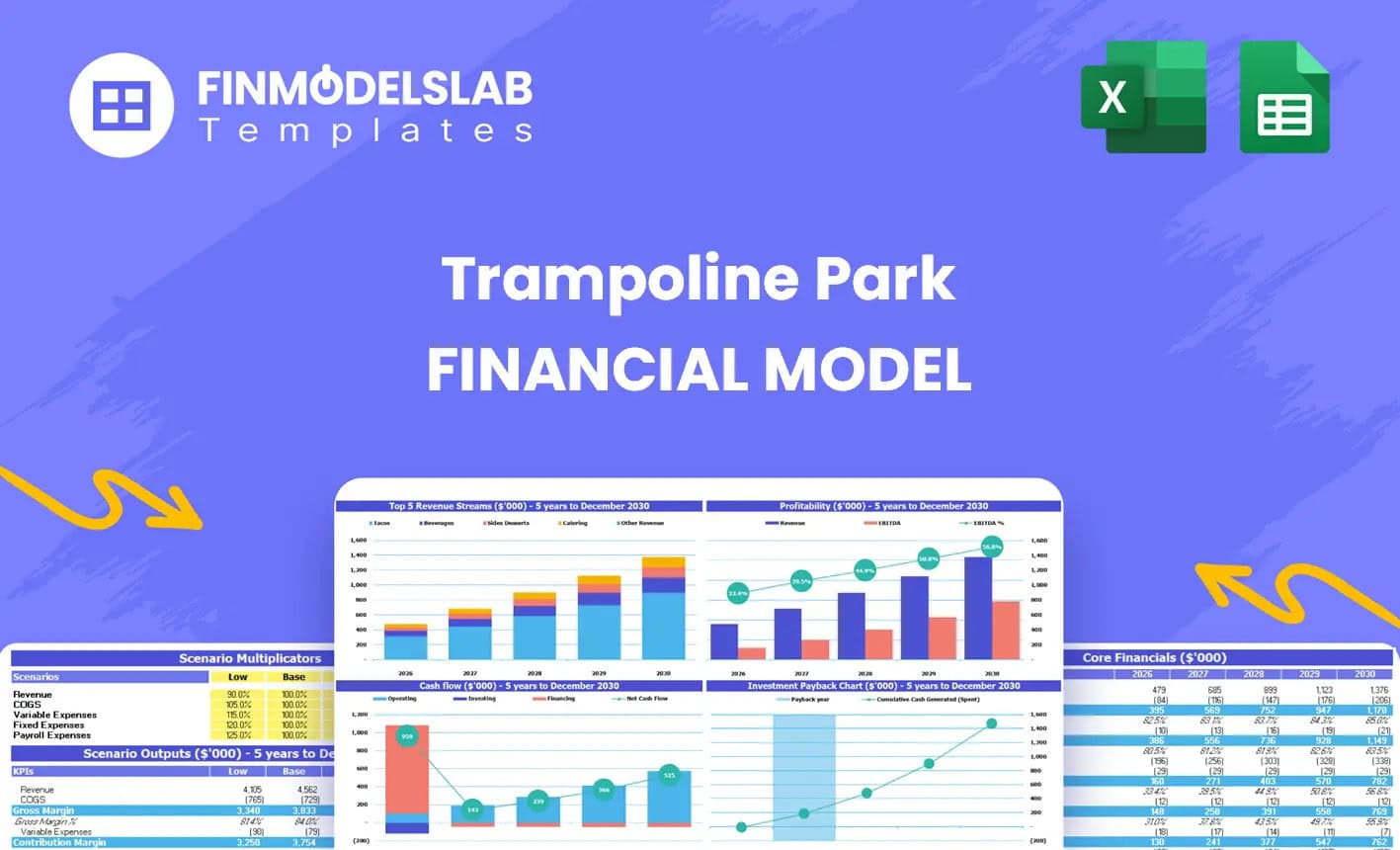
Trampoline Park Business Financial Model Excel Tem...
The Trampoline Park Financial Model helps entrepreneurs, founders, consultants, analysts, and busine... Read more

Multi Sport Complex Business Plan Financial Model ...
The Multi-Sport Complex Financial Model helps entrepreneurs, founders, operators, consultants, and a... Read more

Scuba Diving Center – 5 Year Financial Model
Scuba diving affords an unparalleled experience with the underwater world. However, safe diving requ... Read more

Sky Diving Center – 5 Year Financial Model
Skydiving is the sport of jumping from an aircraft and performing acrobatic maneuvers in the air dur... Read more

 City Finance
Indoor Golf Centre Finance Model
A comprehensive editable, MS Excel spreadsheet for tracking Indoor Golf Centre finances, integrates ... Read more

Indoor Rock Climbing Gym Finance Model
A comprehensive editable, MS Excel spreadsheet for tracking Indoor Rock Climbing Gym finances, Incom... Read more

Casino Hotel Financial Model Excel Template
The Casino Hotel Financial Model helps users build a structured five-year forecast for an integrated... Read more
You must log in to submit a review.