
0 ITEMS

Free Discounted Cash Flow (DCF) Valuation Model Template
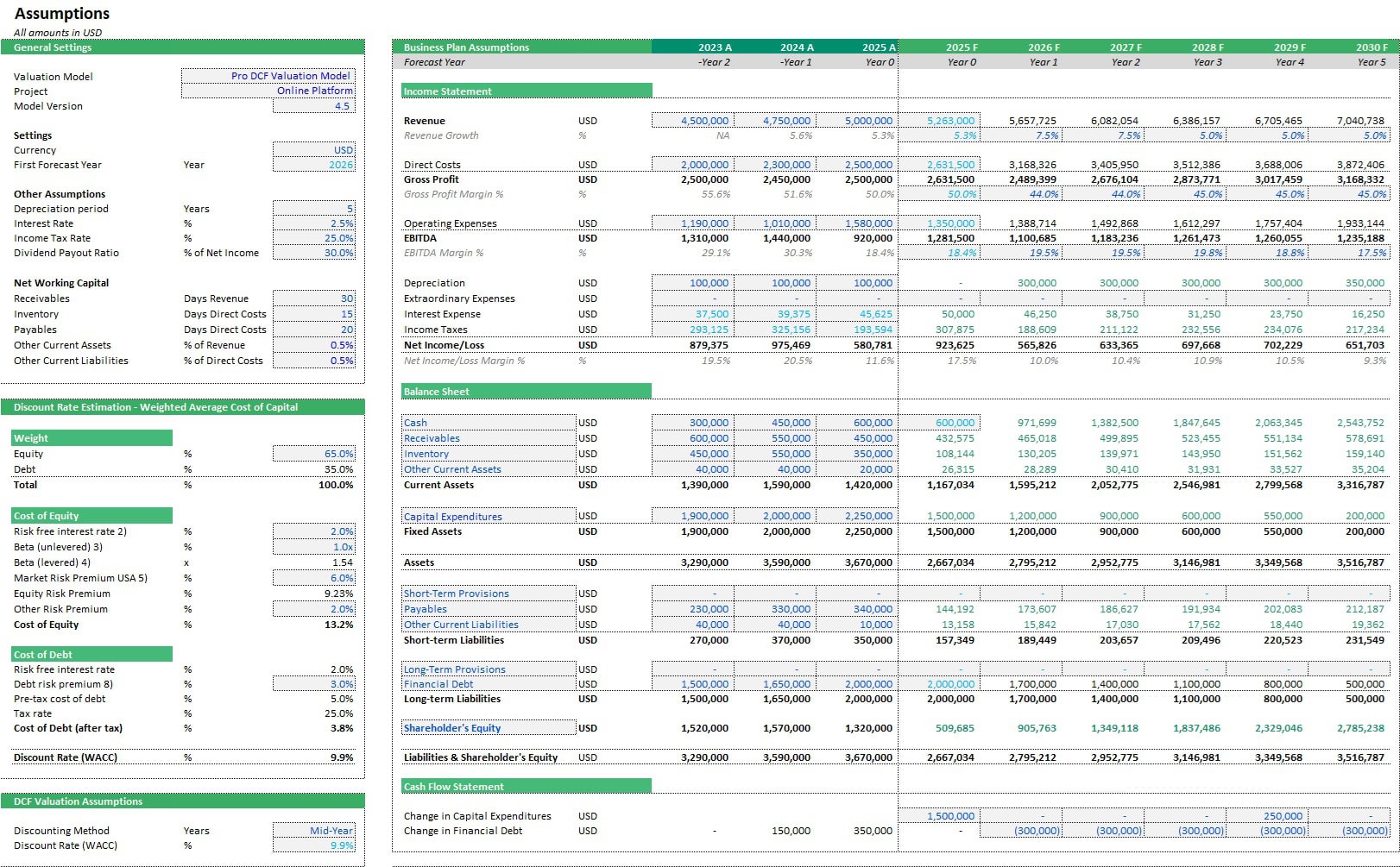
This Discounted Cash Flow (DCF) valuation calculator template projects a three-statement model that allows users to value a company based on the net present value derived from the discounted free cash flows to the firm and terminal value. The DCF model enables users to select and further understand the appropriate terminal value calculation by analyzing and comparing the results of the ten terminal value methods.




Understand the Core of Intrinsic Valuation
The Discounted Cash Flow (DCF) valuation method is a widely accepted intrinsic valuation approach under the income method. Unlike valuation techniques based on accounting profits or market multiples, DCF focuses on the cash a business can generate. It estimates a company’s value by projecting free cash flows and discounting them back to their present value using a rate that reflects risk and the time value of money.
This model emphasizes cash flows before debt or equity financing—known as Free Cash Flow to Firm (FCFF)—and captures the core drivers of valuation: EBIT, WACC, growth rate, and ROIC. Because of its foundation in economic fundamentals, DCF is considered one of the most theoretically sound and widely used valuation techniques.
How to Calculate Discounted Cash Flow in Excel?
This free Excel template helps users learn how to calculate a company’s Enterprise Value by discounting the forecasted Free Cash Flows to the Firm (FCFF) using a discount rate (WACC).
In understanding the company’s value, the users are suggested to follow the steps below:
Step 1 – Input Historical Financial Data:
Input at least three historical financial years (Income Statement, Balance Sheet, Cash Flow Statement) to build a foundation for the DCF model Excel template forecast.
Step 2 – Forecast Key Assumptions:
Enter key assumptions, including the first forecast year, revenue growth, margins, depreciation period, capital expenditures, and net working capital, to project the three-statement model.
Step 3 – Calculate Free Cash Flows to the Firm (FCFF):
Once the projected three-statement model is complete, Free Cash Flows to Firm for the next five years are automatically calculated and are used as a basis for the discounted cash flow model calculation. To arrive at the Free Cash Flows to the firm, the following are added or deducted from EBIT:
- Adjusted Taxes (the applicable income tax rate applied to EBIT)
- Add back Depreciation and Amortization, as these are non-cash expenses
- Net Change in Net Working Capital needs to account for any changes in the working capital required to run a company
- Deduct CAPEX, one of the major cash outflows
- Terminal Value
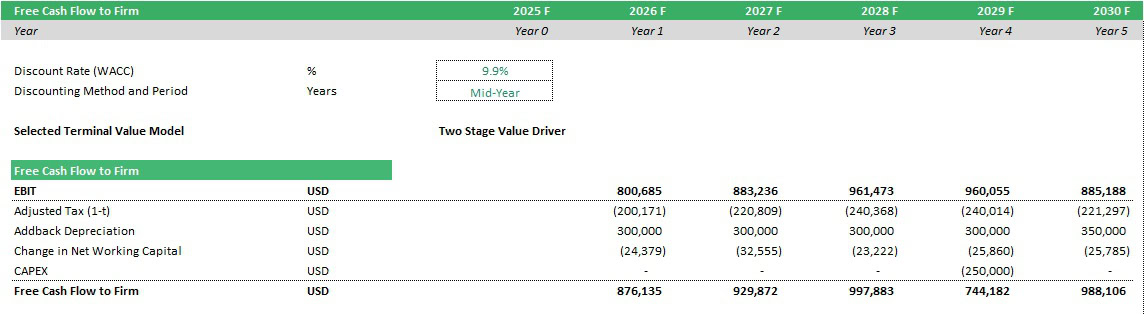
*Note: This model uses FCFF, which reflects the cash available to all capital providers. This differs from Free Cash Flow to Equity (FCFE), which accounts for debt service and is used for equity-only valuation.
Step 4 – Determine the Discount Rate (WACC):
The discount rate reflects the riskiness of the expected cash flows. This model helps users estimate it using the Weighted Average Cost of Capital (WACC), combining the cost of equity and debt proportionate to the company’s capital structure.

Step 5 – Estimate Terminal Value Using 10 Methods:
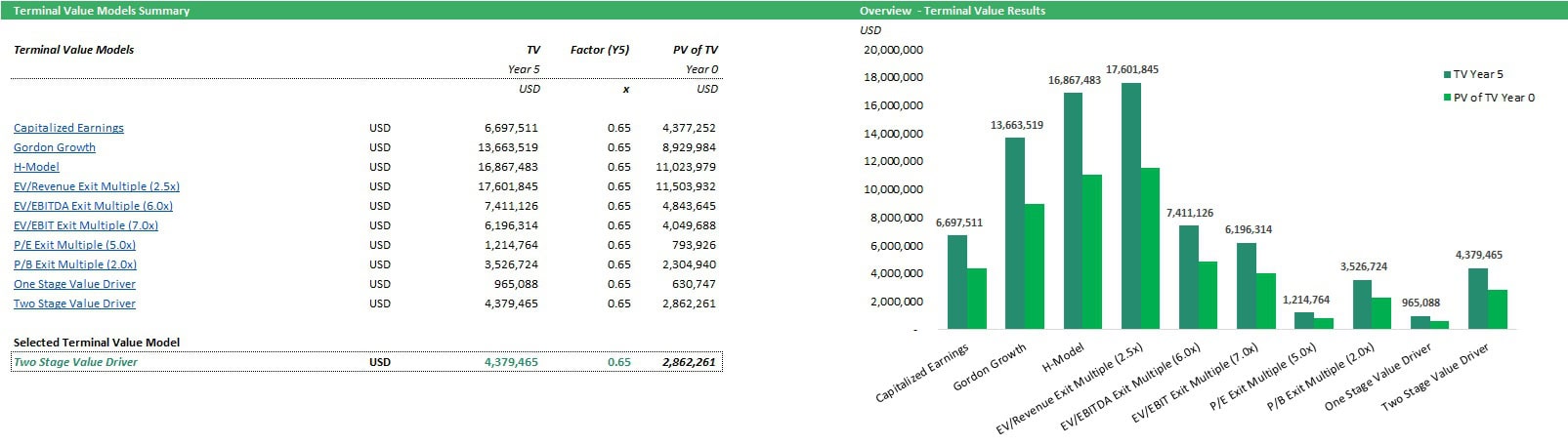
This DCF Excel template estimates the Terminal Value using ten different methods to value the business beyond the forecast period. Terminal Value represents the value generated from all expected cash flows beyond the forecasted period on a going-concern basis.
Users can input and adjust rates, periods, and exit multiple assumptions to see how different scenarios impact the Terminal Value across these methods:
- Capitalized Earnings – Capitalization of EBIT less taxes at the company’s discount rate.
- Gordon Growth – Capitalized free cash flows assuming perpetual growth.
- H-Model – Two-stage growth model accounting for a transition from high to stable growth.
- EV/Revenue Exit Multiple – Terminal value based on a revenue multiple at exit.
- EV/EBITDA Exit Multiple – Terminal value based on a multiple of EBITDA.
- EV/EBIT Exit Multiple – Terminal value based on a multiple of EBIT.
- P/E Exit Multiple – Terminal value derived from a price-to-earnings ratio.
- P/B Exit Multiple – Terminal value calculated using a price-to-book multiple.
- One Stage Value Driver – Models excess return into the future using a single-stage formula.
- Two-Stage Value Driver – Estimates terminal value as a function of ROIC (Return on Invested Capital) and growth in two distinct phases.
Step 6 – Discount Free Cash Flows and Terminal Value:
Here, using the discount rate, you discount each year’s free cash flow and the terminal value back to today. This shows what future cash is worth now. Use Excel’s formula:
=FCF / (1 + discount rate)^year
Do the same for the terminal value. Add all results to get the total present value. This step turns future estimates into a clear, current value.
Step 7 – Calculate Enterprise and Equity Value:
The discounted cash flow valuation model discounts all forecasted Free Cash Flows to the Firm (FCFF), including the estimated Terminal Value, to their present value using a discount factor.

The total net present value of these cash flows represents the Enterprise Value. The model adds the company’s Cash & Cash Equivalents to calculate the Equity Value and deducts Financial Debt. The resulting Equity Value is the final output of the discounted cash flow valuation model.

*Valuation Date: The DCF valuation is performed as of a specific date, which users can define. This date serves as the anchor point for discounting future cash flows.
What makes this DCF Excel Model Stand Out?
In calculating the companies’ Enterprise Value, it is essential to calculate the Terminal Value as realistically as possible, as this helps estimate the value of a business beyond the explicit forecast period. Capitalized Earnings, Gordon Growth, and Exit Multiples are the most common terminal value methods. These methods are helpful and valuable to users who wish to quickly evaluate their company using the DCF model discount rate (WACC), one steady growth rate, and competitors’ readily available exit multiples. However, these methods do not reflect reality as they do not consider drivers such as changes in the discount rate, competitive advantage period, and the effect of ROIC (Return on Invested Capital).
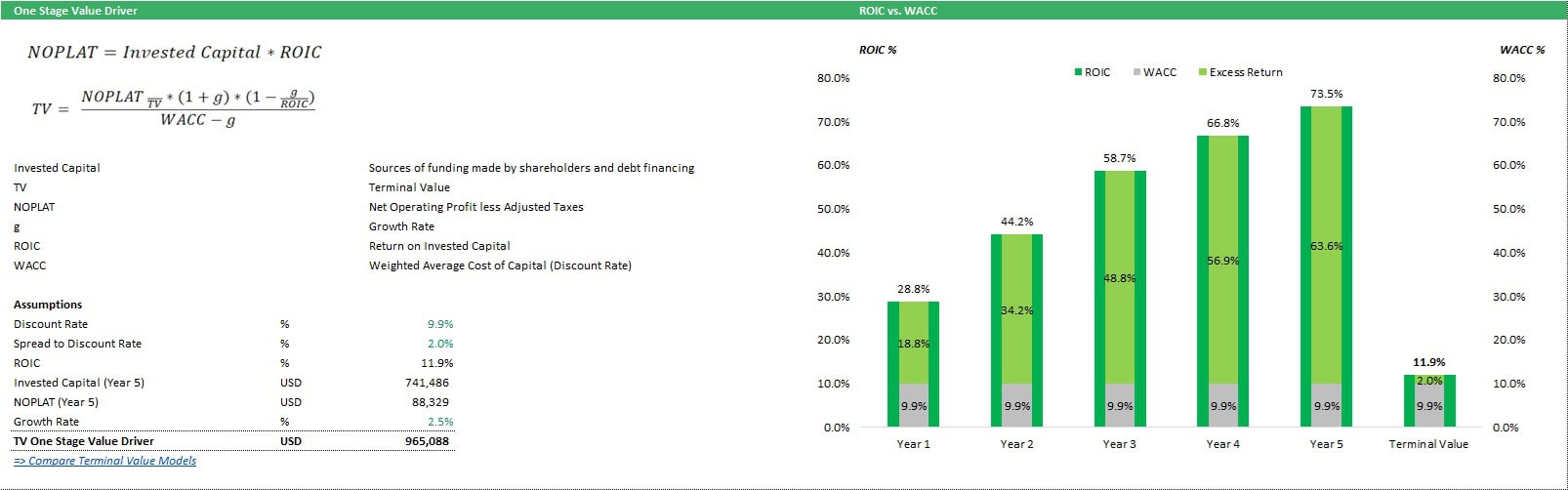
This Discounted Cash Flow calculator offers three other terminal values that consider those drivers:
1. H-Model has a high growth in discount rate for a period, and then decreases to a lower rate

2. One-Stage Value Driver considers the changes in Capital Employed and Growth rate:
3. Two-Stage Value Driver reflects the changes in competitive advantage and ROIC:

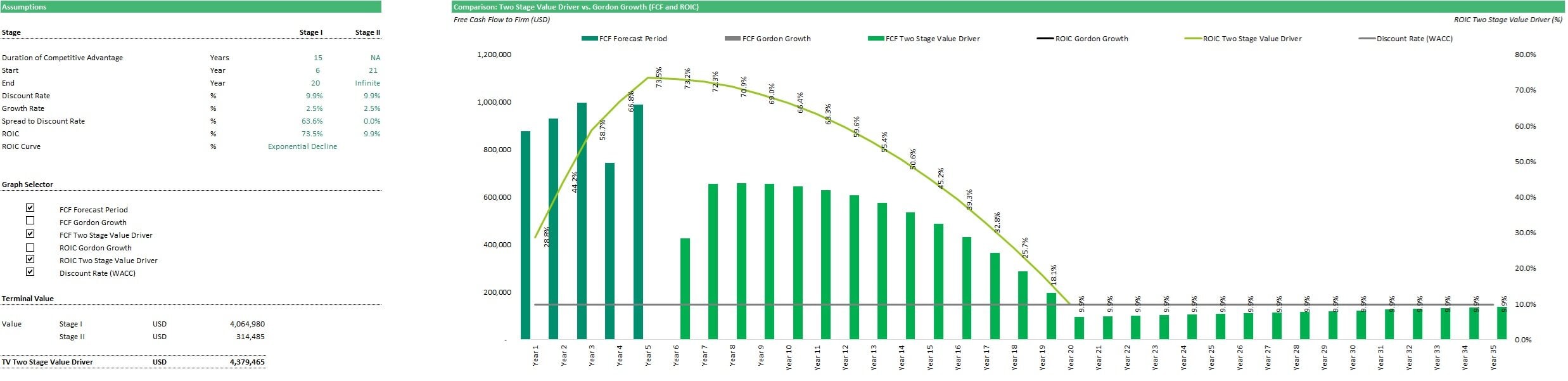
For a deeper understanding of how terminal value is calculated, check out Ten Ways to Estimate Terminal Value in DCF.
Master the Fundamentals of Valuation with This Free DCF Template
This free Discounted Cash Flow (DCF) Valuation Model in Excel is designed to help users understand and apply core valuation principles at any level. With both a Pro and Basic version included, this toolkit allows you to project cash flows, apply different terminal value methods, and confidently analyze intrinsic value. Whether exploring valuation for the first time or refining your understanding of terminal value techniques, this model provides a solid foundation for learning and experimentation.
Easily tailor the pre-filled forecast by modifying the light blue and blue input cells to reflect your specific business case and assumptions.
The fully editable Excel file is available for immediate download and comes with two versions:
- Pro Version – Includes ten terminal value methods: Capitalized Earnings, Gordon Growth, H-Model, Exit Multiples (EV/Revenue, EV/EBITDA, EV/EBIT, P/E, P/B), One-Stage Value Driver, and Two-Stage Value Driver.
- Basic Version – Offers Gordon Growth and Exit Multiple (EV/EBITDA) methods for quick and simple valuation analysis.
- Cup of Coffee – Acknowledge the work of the author by paying the author a voluntary cup of coffee, and you also get both model versions in one go.
.xlsx (MS Excel)
Ready for More In-Depth Valuation? Try the Advanced DCF Model!
Once you’ve mastered the basics using this free template, upgrade to the Advanced Discounted Cash Flow (DCF) Valuation Model Template in Excel for a more powerful, professional-grade solution. It includes a 10-year monthly forecast, ten terminal value methods, a robust WACC calculator, detailed scenario and sensitivity analysis, and pitchbook-ready outputs.
With industry-tailored assumptions and monthly granularity, it helps capture long-term value, model business cycles, and support strategic decision-making. Download now to perform accurate, insightful valuations with confidence.


Similar ProductsOther customers were also interested in...



Waterfall Profit Distribution Model (up to 4 Tiers...
We are introducing our 4-Tier Waterfall Profit Distribution Model. The waterfall profit distribution... Read more

Budget Template in Excel – Analysis in 4 Ste...
The Purpose of the 4 Step Budget Analysis Spreadsheet Template is to offer a user-friendly solution ... Read more

 Anuj
Anuj
Private Equity Fund Model (Investor Cashflows)
The Private Equity Fund Cashflows Model helps LPs and GPs analyze fund cash flows, returns, and dist... Read more

 Giorgos
Advanced Financial Model with DCF and Valuation
Dynamic 10-Year Financial Model, suitable for any type of business, supporting strategic planning, i... Read more

 Jason Varner
All My Financial Models, Spreadsheets, Templates, ...
Lifetime access to all future templates as well! Here is a set of spreadsheets that have some of the... Read more

 Pushkar
3 Statement Financial Modeling with DCF & Rel...
Financial Modeling Tutorial guides user via step by step approach on how to build financial models w... Read more

Startup Company Financial Model – 5 Year Fin...
Highly-sophisticated and user-friendly financial model for Startup Companies providing a 5-Year adva... Read more
 Pierre-AlexandreHeur...
Due Diligence P&L – Exhaustive Revenue a...
Model for in depth understanding of high level profit and loss and revenue analysis. Big-4 like chec... Read more

Franchisor Licensing: Financial Model with Cap Tab...
Build up to a 10 year financial forecast with assumptions directly related to the startup and operat... Read more

 ECF Consultancy
Corporate Finance Toolkit – 30 Financial Mod...
The toolkit is an essential resource for any organization, providing a comprehensive collection of t... Read more
Reviews
 CEO of OEDC
Hi Heros,
As CEO of offshore Energy Development Company I should confess that you considered every aspect of needs of a model at that DCF model I love that
it couldn’t be better than you built,
thanks and thanks and more thanks
15 of 37 people found this review helpful.
Help other customers find the most helpful reviews
Did you find this review helpful?
-

Dear Kam,
Thank you so much for this wonderful feedback! We’re thrilled to hear you liked our DCF model. Knowing that it serves your valuation requirements so comprehensively truly makes our work worthwhile. We’re here if you ever need any assistance!
The eFinancialModels Team
8 of 20 people found this review helpful.
Help other customers find the most helpful reviews
Did you find this review helpful?

 Excellent Template
It’s designed in such a way that all the readers can understand the depth of analysis of the DCF and PV.
Recommend for you.
361 of 688 people found this review helpful.
Help other customers find the most helpful reviews
Did you find this review helpful?
 Amazing Templetes DCF
 DCF
DCF
Super nice DCF valuation spreadsheet, very practical and easy to use!
Thank you so much for sharing
361 of 734 people found this review helpful.
Help other customers find the most helpful reviews
Did you find this review helpful?
 This Will Help Students
As a student like me, it’s really hard to find good and reliable templates. However, this site really gives me the best easy-to-understand models, that’s why I like the site. Thank you for the free template!
394 of 911 people found this review helpful.
Help other customers find the most helpful reviews
Did you find this review helpful?
 DCF Valuation odel is great!
An excellent introduction to the genre. Highly recommended. I this is just the free version, I cannot wait to see the purchased one.
383 of 720 people found this review helpful.
Help other customers find the most helpful reviews
Did you find this review helpful?
 CFO
CFO
 DFC Model
Really well laid out easy to use template/model. Was very helpful.
709 of 1292 people found this review helpful.
Help other customers find the most helpful reviews
Did you find this review helpful?
 Deduct a company’s financial debt
if company’s financial debt tenor spread for 15 years , how can we deduct the same from the DCF while valuation?
596 of 1193 people found this review helpful.
Help other customers find the most helpful reviews
Did you find this review helpful?
 Finance Manager
Excellent Template. It covers all the aspects of the company on which the valuation is carried out for. I really appreciate the efforts spent in making this template. It is easy to understand and easy to comprehend the results based on the information that is used in the DCF calculation.
I would appreciate It if another option was also included in addition to Multiples of EBITDA, the Growth to perpetuity percentage for the terminal valuation.
743 of 1411 people found this review helpful.
Help other customers find the most helpful reviews
Did you find this review helpful?
-
Good news! We have updated the model and it now has 10 methods to calculate the terminal value.
439 of 888 people found this review helpful.
Help other customers find the most helpful reviews
Did you find this review helpful?
 DCF Template
Excellent templates..
628 of 1211 people found this review helpful.
Help other customers find the most helpful reviews
Did you find this review helpful?
You must log in to submit a review.