0 ITEMS

How Much Does a Financial Model Cost? Build, Buy or Hire

A financial model costs anywhere from the price of a template, which varies by listing, to tens of thousands of dollars at a large firm, and the price depends on who builds it and what it must prove. For a first-time founder, a freelancer or a boutique usually sits in the middle, while a template edited by the founder costs the least.
Key Takeaways
- The price of a model depends on who builds it, how many scenarios it carries and how much structure it needs.
- Freelancers, boutique firms and large firms publish very different prices, so compare the total project cost, not the hourly rate.
- A template edited by the founder is the cheapest route when the business fits a standard structure.
- Building alone costs no fee, but the founder’s hours are the real price and errors can go unnoticed.
- A written brief with scope, forecast years and scenarios lowers the cost of every route.
What does it cost to hire someone to build a financial model?
Hiring a freelancer on Upwork for a three-statement startup model typically costs between $1,500 and $3,500 per project, and the price rises with the complexity of the model type. The freelance marketplace Upwork lists typical project prices on its financial modelers page, which carries no date and was read in November 2026, and the table below repeats them by model type.
| Model type | What it covers (this article’s description) | Typical Upwork price per project (USD) |
|---|---|---|
| Cash flow projection and burn rate analysis | Monthly cash in and out, and how long the money lasts | $500 to $1,500 |
| Three-statement model for startups | A profit and loss statement, balance sheet and cash flow statement forecast over 3 to 5 years | $1,500 to $3,500 |
| Fundraising and valuation model | A discounted cash flow (DCF) valuation, which values a business by discounting its forecast cash flows to today, plus sensitivity tables and a cap table with funding scenarios, where the cap table lists who owns which share of the company | $3,000 to $6,000 |
| Transaction model for a merger, acquisition or leveraged buyout (LBO) | A leveraged buyout is a purchase financed mostly with borrowed money, and the model tests whether the debt can be repaid | $5,000 to $10,000+ |
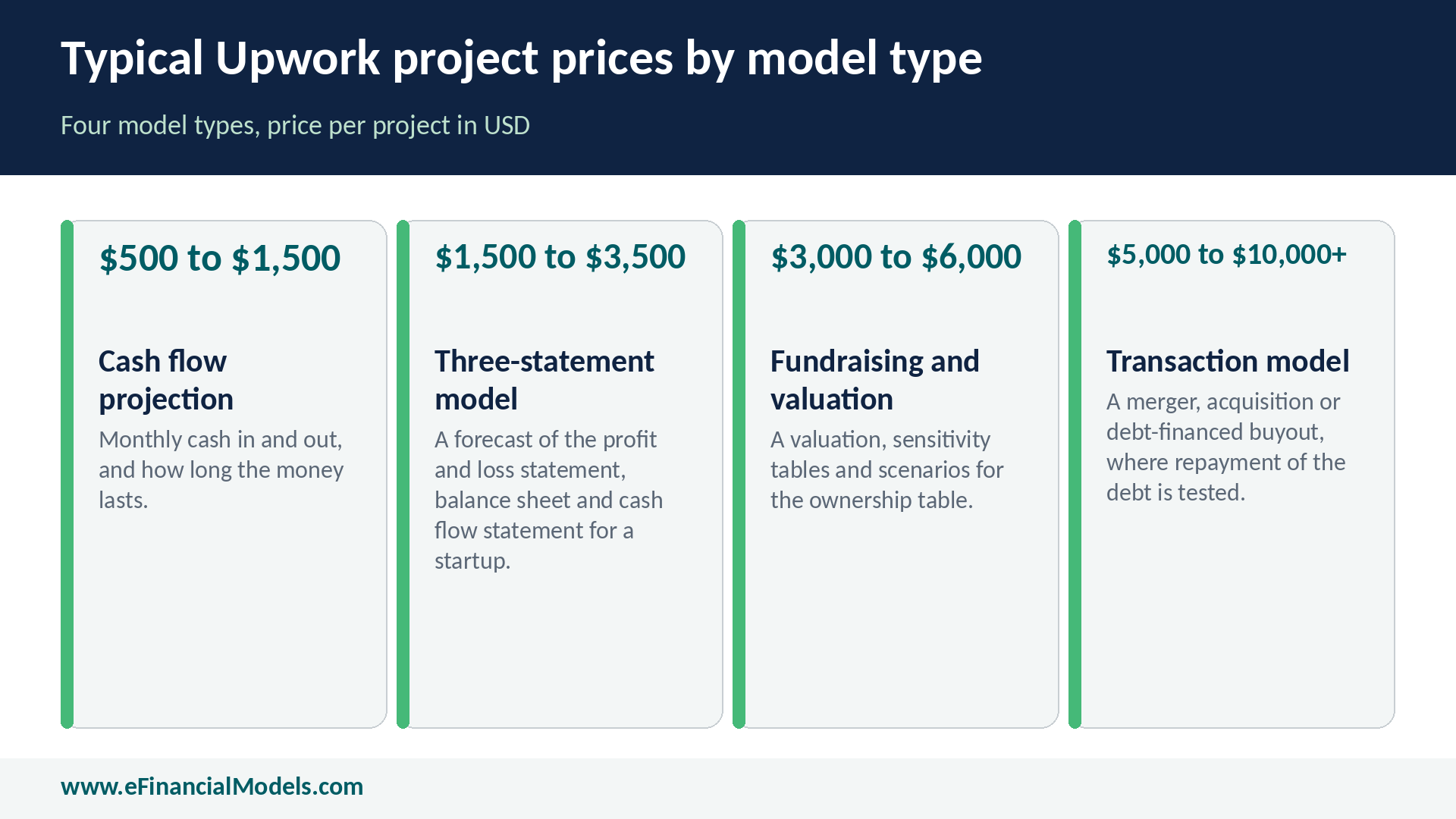
Four cards that restate the Upwork project price ranges for each model type, taken from the marketplace’s financial modelers page.
The same page says freelance financial modeling consultants on Upwork typically charge $25 to $65 per hour, although the exact cost depends on scope. The builder tier matters as much as the model type. A 2026 blog post by the modeling agency Fiscallion compares its own agency with freelancers and reports the agency and large-firm prices below for investor-ready models, so those figures are a vendor’s view. The freelancer row uses the Upwork hourly rate, and the boutique row uses the fixed packages of the Business Plan Firm described in the next section:
| Builder tier | Published price (USD) | Source note |
|---|---|---|
| Freelancer on Upwork | $25 to $65 per hour | An hourly rate, not a project price |
| Boutique firm (Business Plan Firm) | $750, $1,250 or $1,950 for a fixed-price package | Three packages listed on the firm’s own page |
| Agency (Fiscallion’s own service) | From $9,000 over 6 to 10 weeks | Described by Fiscallion for its own model builds |
| Big 4 or investment-bank-adjacent firm | $10,000 to $50,000+ | Reported on the Fiscallion page, which links the Excel Business Resource site |
The agency and large-firm prices come from the Fiscallion freelancer versus agency comparison, last updated on 21 October 2026. The Big 4 are the four largest accounting and advisory firms. The large-firm range is reported on that page, which links the Excel Business Resource site, so it is a vendor’s summary and not a rate card. The agency line is Fiscallion’s own price.
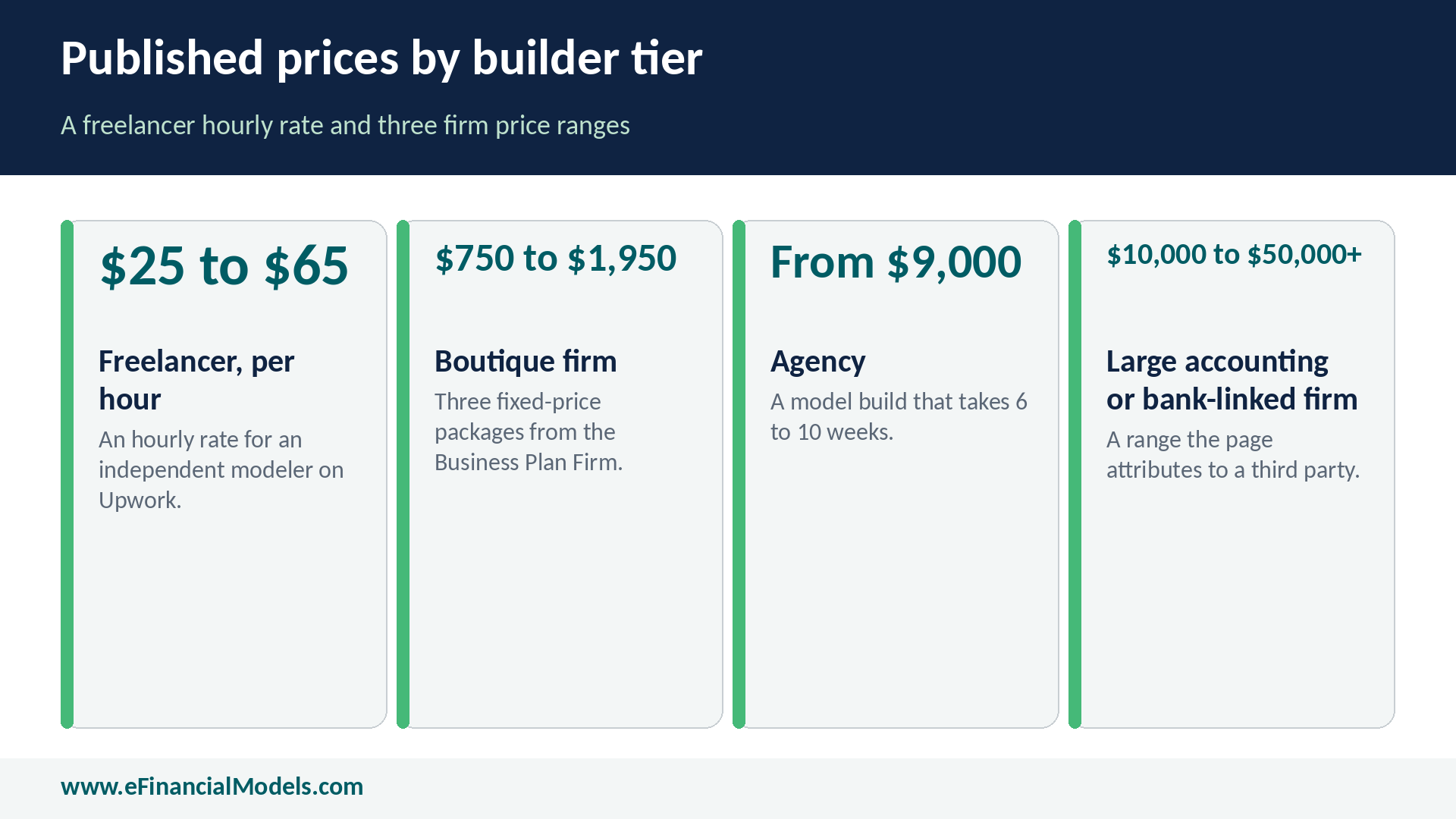
A side-by-side view of four builder tiers: the Upwork hourly rate for freelancers, the Business Plan Firm packages for boutiques and the Fiscallion prices for agencies and large firms.
What do fixed-price boutiques and contract rates look like?
Fixed prices make the comparison easier, because the scope is written next to the fee. The boutique Business Plan Firm lists Essential at $750, Standard at $1,250 and Premium at $1,950, each delivered in 3 to 7 days, on its financial models page, last updated on 30 October 2026. Essential is a five-year profit and loss, cash flow and balance sheet model with one revision round. Standard adds scenarios and a view of how the funding will be spent. Premium adds multiple locations or products, a cap table or a debt schedule.
Contractors are priced by the day. The UK job-trend site ITJobsWatch reports in 2026 that the median Financial Modeller daily rate in the UK is £625, based on contract vacancies, according to its finance modeller contract page. That is a day rate for a contract role, not a project price, so it suits a long engagement more than a first startup model.
What does it cost to buy a template or build the model alone?
A template shifts the cost from a fee to the founder’s own hours, and the price of the file is usually small. The eFinancialModels custom financial modeling services page lists service offers that each carry a starting price, and a starting price is the entry level of an offer, so the final fee depends on scope. The startup financial model collection lists ready-made templates for founders who want to fill in their own numbers.
Building alone has no fee, but time is not free. The worked example below uses assumed numbers, not quotes. It values the founder’s time at an assumed $40 an hour and uses assumed fixed project fees. The freelancer fee and the boutique fee sit inside the published project price ranges above, and the template fee is a pure assumption.
| Route | Assumed hours of the founder’s time | Time cost (hours times $40) | Assumed fee | Total cost |
|---|---|---|---|---|
| Build from scratch | 60 | $2,400 (60 × $40) | $0 (no fee) | $2,400 |
| Template and own editing | 15 | $600 (15 × $40) | $100 | $700 ($600 + $100) |
| Freelancer plus 4 hours of review | 4 | $160 (4 × $40) | $2,500 | $2,660 ($160 + $2,500) |
| Boutique plus 4 hours of review | 4 | $160 (4 × $40) | $1,950 | $2,110 ($160 + $1,950) |
The assumed $2,500 freelancer fee is a fixed project price inside the $1,500 to $3,500 range for a startup three-statement model. The template route wins here only because it removes most of the building hours, and it stops being cheapest when the business needs structure that no template offers, such as phased funding or several debt tranches.
Which route fits a first-time founder?
The route should follow the decision the model supports. A model for a private go or no-go decision can be a template with light editing. A model shown to a lender or investor deserves a second pair of eyes, because the reader will test the structure.
Outside money is common for small firms. The Federal Reserve Banks report that 60% of firms applied for financing in the 12 months before the 2025 survey, according to the 2026 Report on Employer Firms, which covers small employer firms in the United States. The survey does not measure model costs, but it shows how many small firms face a financing reader in a single year, and the reader expects a forecast that holds up. For a private decision a template is enough, and for a lender or an investor a freelancer, a boutique or a template with a professional review fits better.
What makes a model cost more or less?
Within any model type, scope drives the price. Each extra forecast year, scenario, revenue line, loan or investor class adds building and testing hours. Delivery time follows scope: the Business Plan Firm’s small packages arrive in 3 to 7 days, while Fiscallion’s agency builds take 6 to 10 weeks. Revision rounds, support after delivery and the ownership of the file belong in the quote.
A short written brief reduces the price on every route. It names the business, the forecast years, the revenue lines, the financing terms and the three scenarios wanted, and it says who will read the result.
How can a founder compare quotes fairly?
Quotes are fair to compare only when they list the same deliverables. A founder can ask each candidate for the number of forecast years, the number of scenarios, the revision rounds, the delivery time and whether the Excel file keeps live formulas. A live formula recalculates when an input changes, while a pasted value does not, so only live formulas let the founder update the model later.
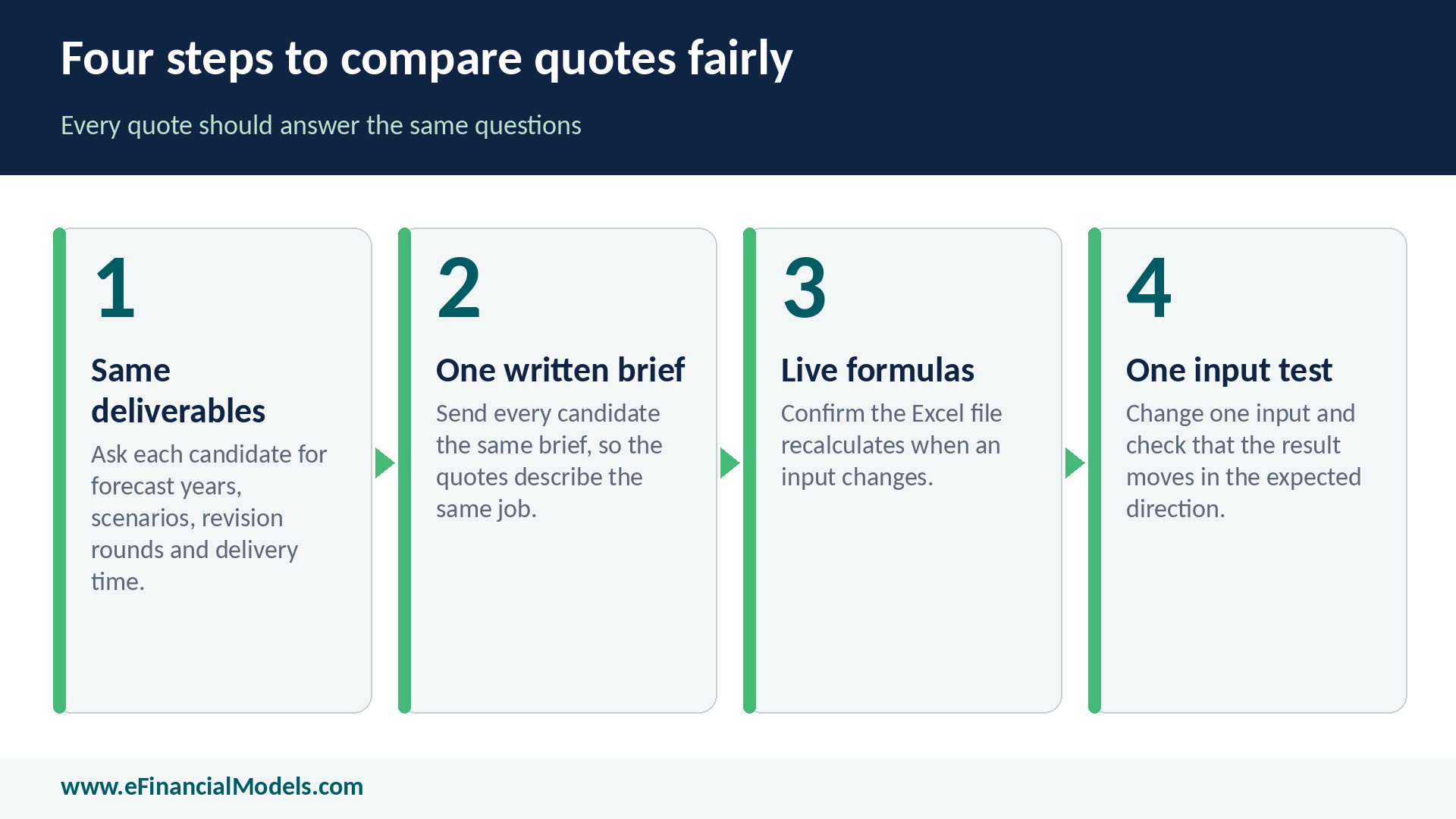
A four-step routine that makes quotes from different builders comparable before any money is paid.
Conclusion
A standard startup model costs a founder from under $1,000 to a few thousand dollars from a freelancer or a boutique, more from a large firm, and mainly time when built alone, so the cheapest route in the worked example is a template edited by the founder, ideally checked by a second person before a lender or investor sees it. The next step for a founder with a standard business is to open the Simple Fundraising Model from eFinancialModels, an Excel template that holds three-statement projections for 5 years, a sources and uses of funds schedule and a DCF valuation, and to request custom help only for the parts that the template cannot cover.
Frequently Asked Questions
Is a financial model for a bank loan priced differently from one for investors?
A lender mainly wants to see that the business can repay the loan, so the model needs a clear debt schedule and a cash forecast, while an investor wants growth scenarios, a valuation and a cap table. The second set of requirements takes longer to build and to check, which usually means more building and checking hours. Asking the reader first which tables they expect prevents paying for pages that nobody opens.
How long does it take to have a model built?
Delivery time depends on the scope and on how quickly the founder answers questions. A small fixed-price package can arrive within about a week, while a custom engagement with several rounds of review can take 6 to 10 weeks, according to Fiscallion’s agency timeline. Waiting for the founder’s inputs often causes more delay than the building itself, so gathering prices, headcount plans and the funding amount before the first call shortens any schedule and keeps the fee closer to the first quote.
Who owns the model after the builder delivers it?
Ownership should be written into the agreement before work begins. The founder needs the unlocked Excel file, a list of the assumptions used and a short note on how the sheets connect. Without them, even a small change such as a new hire or a different loan rate means paying the original builder again. A request for the file with live formulas, instead of a locked copy or screenshots, settles the question in advance.
Is it worth paying for updates after the first version?
Updates are worth paying for when the model feeds a recurring decision, such as a monthly budget review or an investor report. According to the Fiscallion comparison, ongoing forecasting and reporting starts from $3,500 a month at that agency. A founder who can update the inputs alone does not need a retainer, so the choice depends on the hours the founder can spare each month.
Should a founder pay for a model before the business has revenue?
A business without sales rests on assumptions, so a large fee buys precision that does not exist yet. A modest first model that shows the main cost lines, the funding need and a cautious scenario usually serves a pre-revenue founder well. After the first months of real sales data, the assumptions can be replaced with actual results, and that is the moment when a deeper build or a professional review becomes easier to justify.