0 ITEMS

Real Estate Financial Modeling Services: Costs & Options Compared

Yes, someone else can build a real estate or project model, and the price varies with scope and experience: marketplace freelancers publish hourly rates, consulting firms quote by scope, and eFinancialModels prices templates and custom offers per item. First-time founders should choose the route by what the model must carry, such as a loan application, an investor meeting or a private go or no-go decision.
Key Takeaways
- A freelancer, a consulting firm, a template seller or the founder can build a real estate or project model, each at a different price and risk.
- Freelancers publish hourly rates, firms quote by scope, and eFinancialModels prices templates and custom offers per item, so compare total project cost, not rates.
- Real estate models need property-type structure, such as development phases or rent roll lines, so specialization matters more than the lowest rate.
- A short written brief covering scope, years and scenarios lowers the cost and the risk of every route.
- Whoever builds the model, a second review with changed inputs catches the errors that spreadsheet audits find so often.
Can someone else build my real estate or project model?
Yes, four routes exist: a freelancer hired on a marketplace, a consulting firm, a ready-made template adapted with custom help, or a build by the founder. A real estate model, often called a pro forma, is a forecast of a property’s income, costs, financing and returns, and every route produces some version of it.
The reason to take the choice seriously is cash. The Federal Reserve Banks’ “2025 Report on Employer Firms: Findings from the 2024 Small Business Credit Survey” states that more than half of firms cited paying operating expenses (56%) or uneven cash flows (51%) as challenges, according to the 2025 report on employer firms. The survey covers small employer firms in all industries, not only real estate, but it shows why a cash forecast matters.
What do the main options cost?
The routes are priced in different units, so the table describes how each is priced and ranks the tiers by judgement, not by a single published rate. No published benchmark for the cost of building a real estate model was found, so the figures after the table are price signals for related modeling work.
| Route | How it is priced | Relative tier | Best fit | Main risk |
|---|---|---|---|---|
| Marketplace freelancer, such as Upwork or Fiverr | Hourly rate or fixed gig price, depending on the platform | Low to mid, depending on the seller | Small, well-defined tasks | Real estate skill varies by seller |
| eFinancialModels templates and custom offers | Price per template, and “starting at” prices for custom work | Mid | Standard property types needing adaptation | Template may not match the deal |
| Specialist consulting firm | Quoted by scope, no published rate found | High | Complex financing or investor reporting | Cost is out of range for early projects |
| Founder builds alone | Time only | Time only | Learning the model structure | Errors go unnoticed without review |
On the freelance side, the platform goLance reports in an October 2026 rate guide that freelance financial analysts charge $35 to $300 an hour worldwide, depending on experience, according to its financial analyst rate guide. That spread is wide, and these are general analyst rates, not real estate rates.
Fixed-price gig sites such as Fiverr work differently, because a seller lists an entry package at a starting price and sells larger scopes as higher packages. Fiverr price figures could not be verified for this article, so none are given.
At the top of the range sit consulting firms. No verifiable published rate for a consulting firm was available, and firm quotes for a real estate model depend on scope, so the table places firms in the high tier by judgement.
In the middle by effort sit the eFinancialModels custom service offers, which offer more tailoring than a template alone and less than a full firm engagement, and which are priced per offer rather than per hour. Its custom financial modeling services page lists offers that are each priced “starting at” an amount from $44 to $195, and a “starting at” price is the entry level of an offer, so the final fee depends on scope. Founders who prefer a ready-made file can browse the real estate category of templates.
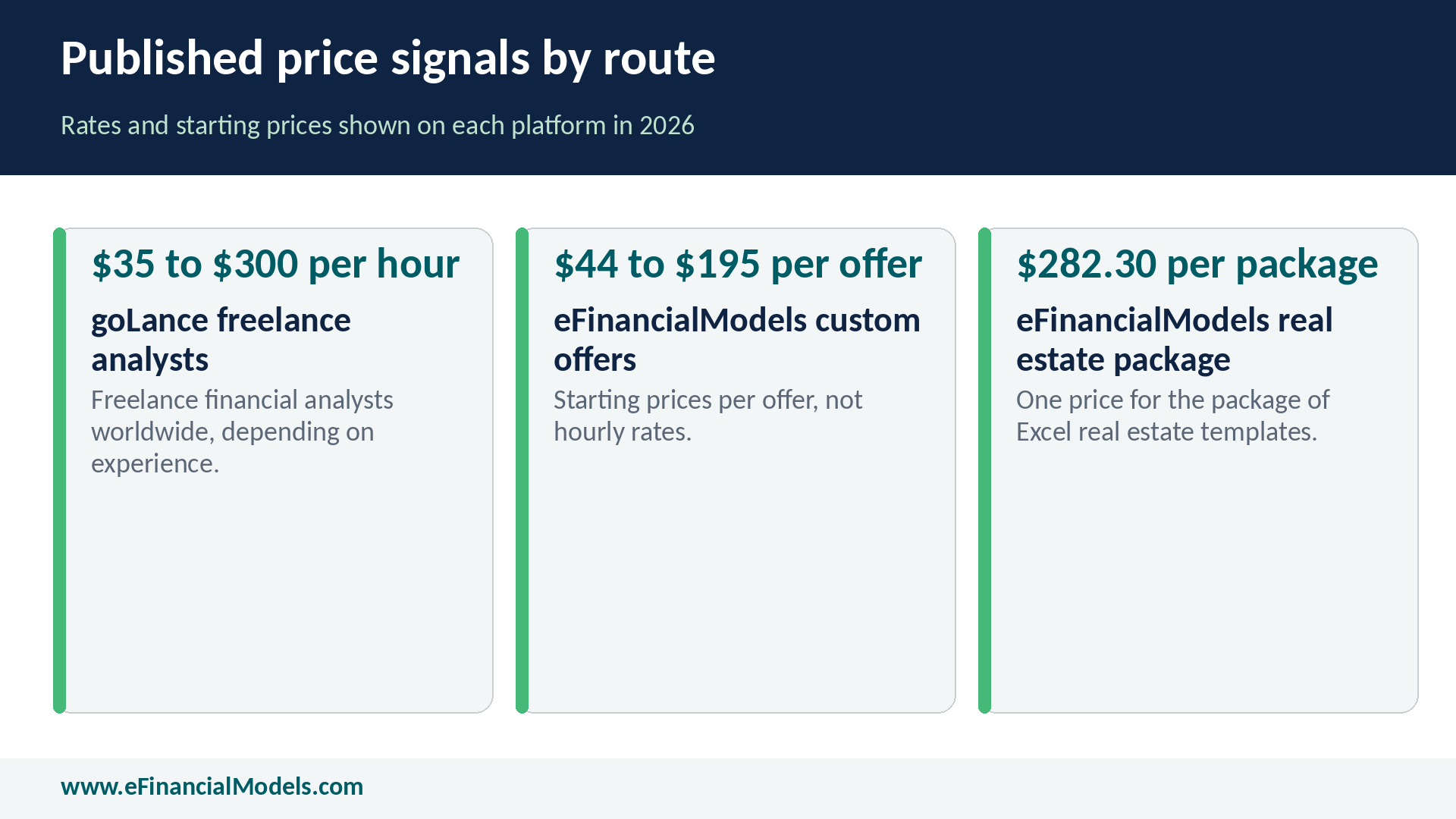
Published price signals for freelance analysts and eFinancialModels offers, taken from the platform pages in 2026.
What does a worked cost comparison look like?
A simple hours-times-rate example shows how the routes compare for one project. Assume a first-time founder needs 20 hours of modeling work for a small development project, and assume three illustrative hourly rates of $50, $150 and $300, all between the $35 and $300 ends of the goLance range above.
- Freelancer at an assumed $50 an hour: 20 × $50 = $1,000.
- Experienced analyst at an assumed $150 an hour: 20 × $150 = $3,000.
- Senior analyst at an assumed $300 an hour, the top of the goLance range: 20 × $300 = $6,000.
Now assume instead that the founder buys the real estate template package and pays a freelancer to review and adapt it for 4 hours at the same assumed $50 an hour. The review adds 4 × $50 = $200 to the $282.30 package price, for a total of $482.30, on the assumption that the 4 review hours replace most of the 20 build hours. The template route is cheaper here only because the template removes most of the build hours, which is why the routes are best compared on total project cost and not on rates.
These are assumptions for comparison, not quotes.
How does vertical specialization change the choice?
A model for a rental property needs different logic than a model for a development, so a builder who has done the same property type before saves time and avoids structural mistakes. A development model tracks land, construction phases and sale or lease-up dates, while a rental model tracks rent lines, vacancy, operating costs and loan payments. Lenders often test the latter with the debt service coverage ratio (DSCR), which compares a property’s yearly net operating income with its yearly loan payments.
Templates make that specialization visible before any money is spent. The eFinancialModels Real Estate Financial Model Templates Package lists 12 financial model templates in Excel and is currently offered at $282.30, with titles such as a residual land value calculation, a mini storage business plan, a serviced office model and a rental property model. Founders working on a build-and-sell project can also browse the real estate development category of templates.
Returns metrics follow the same pattern. A development model usually reports the internal rate of return (IRR), the annual rate at which a project’s future cash inflows, reduced to today’s value, equal its outflows, alongside total profit, and a builder who knows the property type knows which of these a lender expects to see.
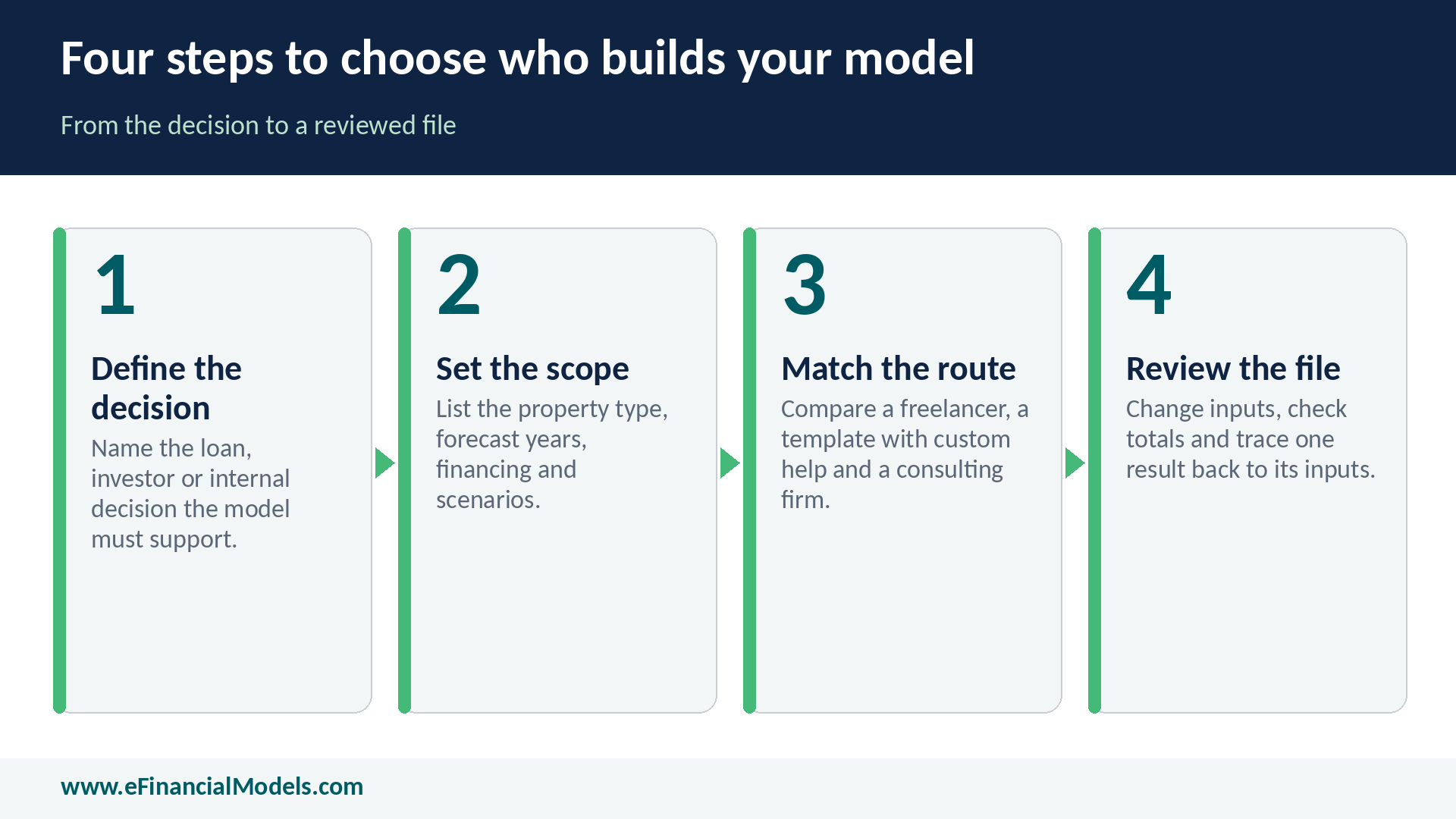
A four-step path from the decision the model supports to a reviewed file.
What should a founder check before hiring anyone?
A founder should check scope, ownership and review before the first invoice, because mistakes in these three areas are expensive to fix later. Scope means a written brief that lists the property type, the forecast years, the financing assumptions and the scenarios wanted. Ownership means the delivered file keeps live formulas rather than pasted values, so the founder can change inputs later. Review means someone other than the builder changes inputs and watches the outputs move.
The review step matters because spreadsheet errors are common. Raymond Panko wrote in a 2000 paper that field audits found errors in 24% of the 367 spreadsheets audited, and that the most recent audits found errors in at least 86% of the spreadsheets audited, according to his paper Spreadsheet Errors: What We Know. The data are older than most sources here, so they support a general caution rather than a precise error rate for any one builder.
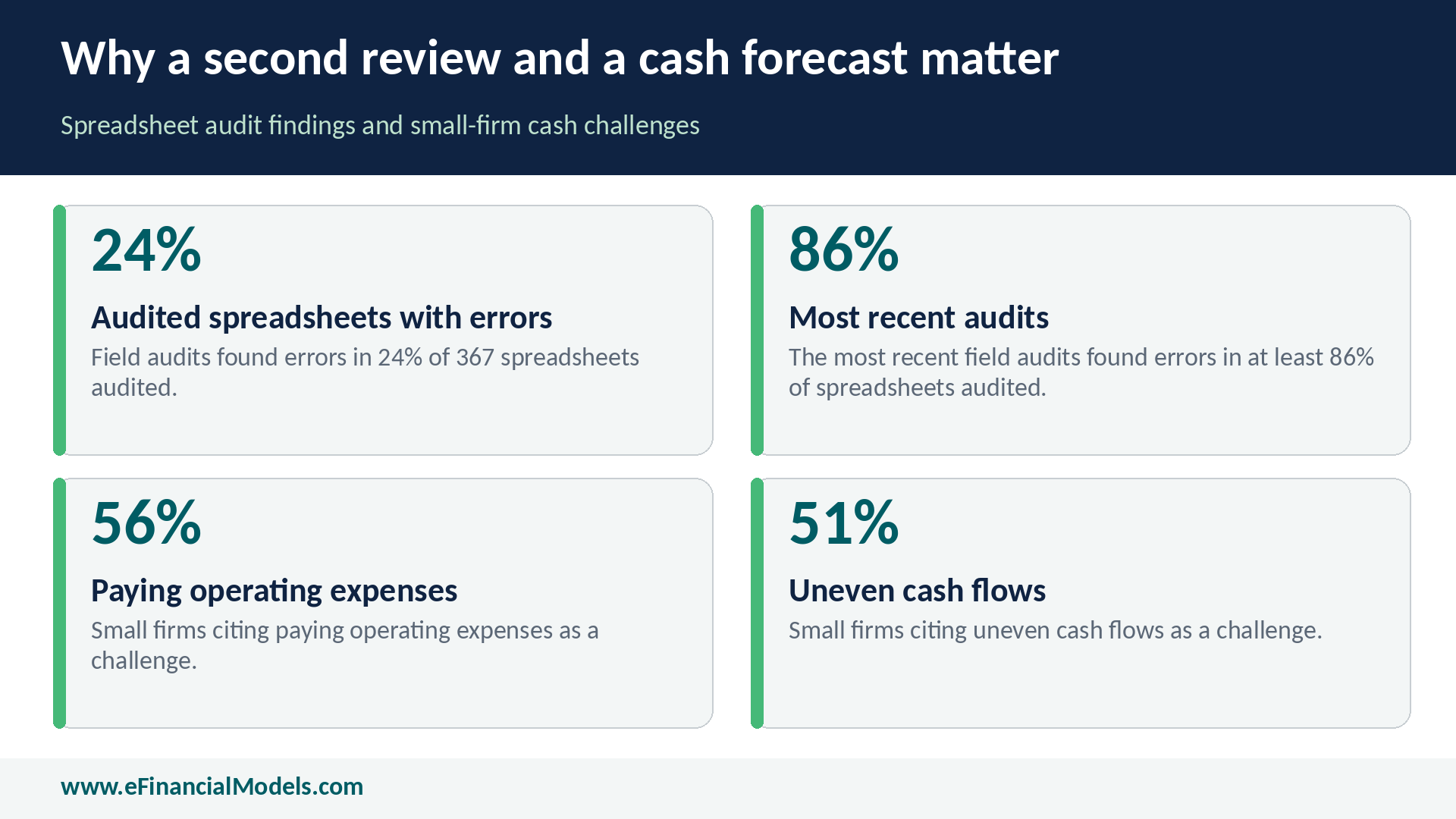
Spreadsheet error findings and small-firm cash challenges that explain why a second review and a cash forecast matter.
Conclusion
By the tiers in the table, which are a judgement rather than published rates, a freelancer is usually the lowest-priced hourly route and a consulting firm the highest, and a specialized template with custom help can be a practical middle option for founders with a standard property type. The next step for a founder with a standard property type is to open the Real Estate Financial Model Templates Package from eFinancialModels, check which of its 12 templates matches the project, and then hire help only for the parts that template cannot cover.
Frequently Asked Questions
Should a first-time founder hire a freelancer or a specialist firm?
Most early projects suit a freelancer with real estate experience, because the work is bounded and the budget is small. A specialist firm earns its fee when lenders or investors will examine the structure, when several entities share the cash, or when a deal has unusual financing. Asking each candidate for one finished sample on the same property type reveals more than any hourly rate does.
What should a written brief for a modeler include?
A good brief names the property type, the purchase or construction budget, the forecast horizon, the financing terms and the three scenarios wanted: cautious, expected and optimistic. It also says who will read the result, since a lender needs different tables than a partner does. Adding the inputs already known, such as the asking price or the rent per unit, saves paid hours that would otherwise go to questions.
Who owns the model and its formulas after delivery?
Ownership should be written into the agreement before work begins. The founder needs the unlocked Excel file, a short list of assumptions and a note explaining how each sheet connects. Without those, a later change of tenant mix or loan terms means paying the original builder again. A request for the file with live formulas, rather than a locked copy or a set of screenshots, settles the question.
Can a template replace a consultant for a simple rental property?
For one building with a handful of units, a template often covers the whole job, because rent, vacancy, operating costs and loan payments follow a standard pattern. The founder fills in the lease and loan terms, then tests a lower rent and a higher interest rate to see whether the project still works. Help is only worth buying if the template cannot represent the deal, such as phased construction or a joint venture split.
How can a founder check a delivered model without being an expert?
Three quick checks work without advanced skills. First, change one input, such as the rent, and confirm that the result moves in the expected direction. Second, confirm that the totals on each sheet match the summary page. Third, ask the builder to explain one number from the output back to its inputs in plain words. A builder who cannot trace a result has probably built a fragile file.